

Multilingualism and History
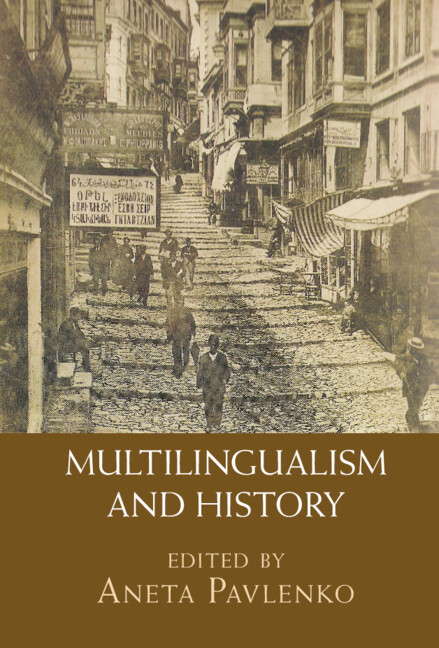
Multilingualism and History
Looking for an examination copy?
If you are interested in the title for your course we can consider offering an examination copy. To register your interest please contact collegesales@cambridge.org providing details of the course you are teaching.
We often hear that our world 'is more multilingual than ever before', but is it true? This book shatters that cliché. It is the first volume to shine light on the millennia-long history of multilingualism as a social, institutional and demographic phenomenon. Its fifteen chapters, written in clear, accessible language by prominent historians, classicists, and sociolinguists, span the period from the third century BC to the present day, and range from ancient Rome and Egypt to medieval London and Jerusalem, from Russian, Ottoman and Austro-Hungarian empires to modern Norway, Ukraine, and Spain. Going against the grain of traditional language histories, these thought-provoking case studies challenge stereotypical beliefs, foreground historic normativity of institutional multilingualism and language mixing, examine the transformation of polyglot societies into monolingual ones, and bring out the cognitive and affective dissonance in present-day orientations to multilingualism, where 'celebrations of linguistic diversity' coexist uneasily with creation of 'language police'.
- Provides the first comprehensive introduction to the history of multilingual societies, from Ptolemaic Egypt to the present day
- Introduces an integrated and novel view of multilingualism as a historic phenomenon, with its own distinct theories and timelines of development
- Highlights the similarities and differences between multilingual polities across time and proposes new questions for future research
Reviews & endorsements
‘The book decisively puts to rest any idea that the present is more multilingual than the past, while encouraging historians and linguists to reckon with the methodologies, challenges, and tools of each other’s disciplines. Pavlenko has produced a volume that is instructive for historians, demonstrating how sociolinguistic approaches to historic sources can offer new insights into past societies, especially in accessing the lived realities of non-elite communities. At the same time, the book will surely be of interest to linguists, as the collected chapters definitively prove how rewarding the study of written sources can be in sociolinguistic analysis.’ Alison John, Language in Society
Product details
- Published: April 2023
- Format: Hardback
- ISBN: 9781009236256
- Length: 312 pages
- Dimensions: 235 × 158 × 21 mm
- Weight: 0.6kg
- Availability: Available


Table of Contents
- 1. Multilingualism and historic amnesia: an introduction Aneta Pavlenko
- 2. Greek meets Egyptian at the temple gate: bilingual papyri from Hellenistic and Roman Egypt (third century BCE – fourth century CE) Anastasia Maravela
- 3. Language shift, attitudes, and management in the Roman West Alex Mullen
- 4. Languages at war: military interpreters in antiquity and the modern world Rachel Mairs
- 5. How multilingualism came to be ignored in the history of Standard English Laura Wright
- 6. Multilingualism and the attitude toward French in the Latin Kingdom of Jerusalem Jonathan Rubin
- 7. Why colonial Dutch failed to become a global lingua franca Roland Willemyns
- 8. How unique was Russia's multilingual elite? Gesine Argent
- 9. Language ideology and observation: nineteenth-century scholars in northwestern Siberia Susan Gal
- 10 Studying historical multilingualism in everyday life: the case of the Habsburg Monarchy in the nineteenth century Jan Fellerer
- 11 Multilingualism and the end of the Ottoman Empire: language, script, and the quest for the 'modern' Benjamin Fortna
- 12. 'Multilingualism is now a must': discourses on languages and international cooperation at the Council of Europe Zorana Sokolovska
- 13. The presence of the past in language revitalization Pia Lane
- 14. Historic reenactments in contemporary Spain: fiestas de moros y cristianos Yasmine Beale-Rivaya
- 15. Multilingual ghost signs: dissonant languages in the landscape of memory Aneta Pavlenko.
- Show more



