

Can Construction Grammar Be Proven Wrong?
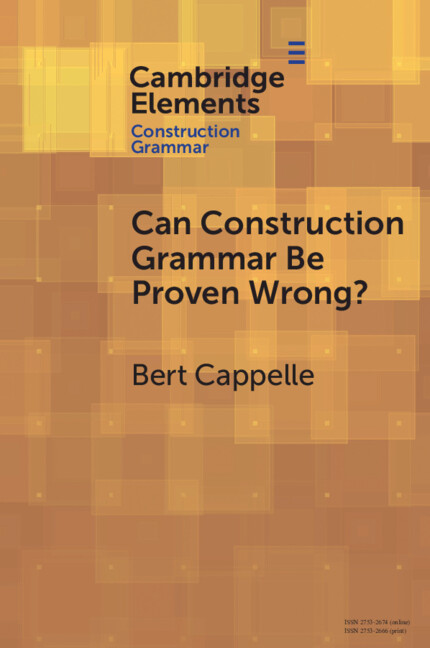
Can Construction Grammar Be Proven Wrong?
Looking for an examination copy?
If you are interested in the title for your course we can consider offering an examination copy. To register your interest please contact collegesales@cambridge.org providing details of the course you are teaching.
Construction Grammar has gained prominence in linguistics, owing its popularity to its inclusive approach that considers language units of varying sizes and generality as potential constructions – mentally stored form-function units. This Element serves as a cautionary note against complacency and dogmatism. It emphasizes the enduring importance of falsifiability as a criterion for scientific hypotheses and theories. Can every postulated construction, in principle, be empirically demonstrated not to exist? As a case study, the author examines the schematic English transitive verb-particle construction, which defies experimental verification. He argues that we can still reject its non-existence using sound linguistic reasoning. But beyond individual constructions, what could be a crucial test for Construction Grammar itself, one that would falsify it as a theory? In making a proposal for such a test, designed to prove that speakers also exhibit pure-form knowledge, this Element contributes to ongoing discussions about Construction Grammar's theoretical foundations.
Reviews & endorsements
‘Bert Cappelle engages critically and sometimes ruthlessly with foundational aspects of CxG, arguing for a rigorous scientific approach that emphasizes falsifiability, empirical testing and openness to alternative perspectives. While he acknowledges the successes and contributions of CxG, he also highlights the importance of addressing its limitations and fostering collaborative discussions with diverse linguistic frameworks. The book serves as a call to action, if not a wake-up call, for Construction Grammarians, encouraging them to scrutinize and refine their theoretical commitments while embracing the complexities of language. In doing so, it stands as a thoughtful and thought-provoking contribution to ongoing discussions within the field of CxG. It is an honest, constructive and optimistic critique, offering guidelines for how the theory can further mature and enhance its standing within the overall scientific framework.’ Jakob Horsch, English Language & Linguistics
Product details
- Published: February 2024
- Format: Paperback
- ISBN: 9781009343206
- Length: 82 pages
- Dimensions: 230 × 150 × 5 mm
- Weight: 0.15kg
- Availability: Available

Table of Contents
- 1. Introduction: The Stakes
- 2. Can't Touch This: Does CxG Have an Attitude Problem?
- 3. Falsificationism: A Still-Influential Approach to Scientific Inquiry
- 4. The Particular but Generalizable Problem Posed by Particle Verbs
- 5. How CxG could Play the Science Game Fairly
- 6. Keep Calm and Constructi-con.
- Show more
