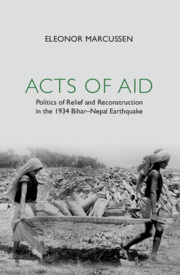

This socio-political history on the aftermath of the 1934 Bihar–Nepal earthquake explores disaster aid, relief, and reconstruction and the questions they give rise to about class, communities and inequality. The book traces disaster responses across the twentieth century in order to demonstrate how they were embedded in political processes transcending the event of the earthquake. Aid, relief and reconstruction mirrored political agendas and ideas that articulated both changes and continuities by the colonial state, civil society and international organisations. The impact of the earthquake and aid in its wake varied widely according to social groups, ethnicity and gender in the aftermath. By studying the effects of the earthquake on communities directly affected and society, the author argues that we can come closer to an understanding of the role political, social and cultural factors held in shaping resilience to natural disasters. This title is also available as Open Access on Cambridge Core.
‘The book stands as a ground-breaking work. It not only illuminates a critical historical event but also underscores the significance of disaster history to inform future policies and strategies for disaster preparedness and response. With its extensive utilisation of archival sources, reports and newspapers, the book brings a breath of fresh air to the field, both conceptually and methodologically.’
Vipul Singh Source: Environment and History
Loading metrics...
* Views captured on Cambridge Core between #date#. This data will be updated every 24 hours.
Usage data cannot currently be displayed.
This section outlines the accessibility features of this content - including support for screen readers, full keyboard navigation and high-contrast display options. This may not be relevant for you.
Accessibility compliance for the PDF of this book is currently unknown and may be updated in the future.