
Skip to main content Accessibility help
×
  • Cited by 4
    • Show more authors
    • You may already have access via personal or institutional login
    • Select format
    • Publisher:
      Cambridge University Press
      Publication date:
      15 September 2022
      22 September 2022
      ISBN:
      9781009075909
      9781316513712
      9781009074681
      Dimensions:
      (229 x 152 mm)
      Weight & Pages:
      0.52kg, 256 Pages
      Dimensions:
      (229 x 152 mm)
      Weight & Pages:
      0.375kg, 256 Pages
    You may already have access via personal or institutional login
  • Selected: Digital
    Add to cart View cart Buy from Cambridge.org

    Book description

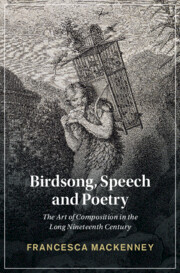
    In the long nineteenth century, scientists discovered striking similarities between how birds learn to sing and how children learn to speak. Tracing the 'science of birdsong' as it developed from the 'ingenious' experiments of Daines Barrington to the evolutionary arguments of Charles Darwin, Francesca Mackenney reveals a legacy of thought which informs, and consequently affords fresh insights into, a canonical group of poems about birdsong in the Romantic and Victorian periods. With a particular focus on the writings of Samuel Taylor Coleridge, the Wordsworth siblings, John Clare and Thomas Hardy, her book explores how poets responded to an analogy which challenged definitions of language and therefore of what it means to be human. Drawing together responses to birdsong in science, music and poetry, her distinctive interdisciplinary approach challenges many of the long-standing cultural assumptions which have shaped (and continue to shape) how we respond to other creatures in the Anthropocene.

    Reviews

    ‘… this carefully argued, sensitively written book adds substantially to the growing body of interdisciplinary work that examines literature in the context of questioning Anthropocene assumptions about what it is to be human, and the cultural history of our responses to the more-than-human world.’

    Sara Lodge Source: Times Literary Supplement

    ‘Mackenney’s wide-ranging knowledge of the nineteenth-century science offers compelling readings of canonical and non-canonical works to raise burgeoning questions about race, gender and class in literature of the long nineteenth century.’

    Hee Eun Helen Lee Source: www.review19.org

    ‘Can one think without words? This book offers a fascinating discussion of literary, scientific, and philosophical engagements with this question. … it makes an important contribution to studies of the non-human in Romantic and Victorian literature; in particular, it reminds readers that descriptions of beautiful, singing birds are neither merely figurative nor ethically neutral.’

    Shannon Draucker Source: Victorian Studies

    Refine List

    Actions for selected content:

    Select all | Deselect all
    • View selected items
    • Export citations
    • Download PDF (zip)
    • Save to Kindle
    • Save to Dropbox
    • Save to Google Drive

    Save Search

    You can save your searches here and later view and run them again in "My saved searches".

    Please provide a title, maximum of 40 characters.
    ×

    Contents

    Metrics

    Altmetric attention score

    Full text views

    Total number of HTML views: 0
    Total number of PDF views: 0 *
    Loading metrics...

    Book summary page views

    Total views: 0 *
    Loading metrics...

    * Views captured on Cambridge Core between #date#. This data will be updated every 24 hours.

    Usage data cannot currently be displayed.

    Accessibility standard: Unknown

    Why this information is here

    This section outlines the accessibility features of this content - including support for screen readers, full keyboard navigation and high-contrast display options. This may not be relevant for you.

    Accessibility Information

    Accessibility compliance for the PDF of this book is currently unknown and may be updated in the future.