Skip to main content Accessibility help
×
  • Cited by 3
    • Show more authors
    • You may already have access via personal or institutional login
    • Select format
    • Publisher:
      Cambridge University Press
      Publication date:
      23 May 2024
      13 June 2024
      ISBN:
      9781009464864
      9781009464840
      Dimensions:
      Weight & Pages:
      Dimensions:
      (178 x 127 mm)
      Weight & Pages:
      0.11kg, 102 Pages
    You may already have access via personal or institutional login
  • Selected: Digital
    Add to cart View cart Buy from Cambridge.org

    Book description

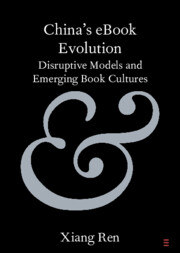
    This Element explores the changing landscape of eBook businesses and cultures in China in the past two decades and examines how disruptive innovation and the platform economy have transformed one of the world's largest book markets. Through an evolutionary perspective, this Element documents and analyses the emergence, growth, and refinement of disruptive models in three areas of trade publishing, including free eBook developments, digital self-publishing, and platformed social reading. It offers a critical account of the complex interplay between emerging technologies, business innovations, and book cultures and conceptualises China's eBook evolution as both a part of global digital publishing transformation in the platform age and an embodiment of local dynamics in a transitional society. This Element is essential for scholars, students, publishers, and the interested publics to understand China's digital publishing innovations and their global implications.

    References

    Alter, A. & Harris, E. A. (2023). ‘Franzen, Grisham and Other Prominent Authors Sue OpenAI’, The New York Times, 20 September, www.nytimes.com/2023/09/20/books/authors-openai-lawsuit-chatgpt-copyright.html. Accessed 20 October 2023.
    Anantrasirichai, N. & Bull, D. (2022). ‘Artificial Intelligence in the Creative Industries: A Review’, Artificial Intelligence Review, 55(1), pp. 589656. https://doi.org/10.1007/s10462-021-10039-7.
    Anderson, P. (2020). ‘US Publishers, Authors, Booksellers Call Out Amazon’s “Concentrated Power”’, Publishing Perspectives, 17 August, https://publishingperspectives.com/2020/08/us-publishers-authors-booksellers-call-out-amazons-concentrated-power-in-the-book-market/. Accessed 5 June 2021.
    Araman, V. F. & Popescu, I. (2010). ‘Media Revenue Management with Audience Uncertainty: Balancing Upfront and Spot Market Sales’, Manufacturing & Service Operations Management, 12(2), pp. 190212. https://doi.org/10.1287/msom.1090.0262.
    Bai, R. (2019). ‘Refashioning Chinese Television through Digital Fun’, in Shimpach, S. (ed.) The Routledge Companion to Global Television. Oxfordshire: Routledge, pp. 359370.
    Banet-Weiser, S. (2011). ‘Branding the Post-feminist Self: Girls’ Video Production and YouTube’, in Kearney, CK (ed.) Mediated Girlhoods: New Explorations of Girls’ Media Culture. New York: Peter Lang Publishing, pp. 277294.
    Barnett, T. (2015). ‘Platforms for Social Reading: The Material Book’s Return’, Scholarly and Research Communication, 6(4), pp. 1–23. https://doi.org/10.22230/src.2015v6n4a211.
    Bartholomeusz, S. (2022). ‘“Barbaric Growth”: China Tightens Grip on Engine that Powers Its Economy’, The Sydney Morning Herald, 9 February, www.smh.com.au/business/the-economy/barbaric-growth-china-looks-to-tighten-grip-on-engine-that-powers-its-economy-20220209-p59uxw.html. Accessed 3 October 2023.
    Benkler, Y., Faris, R., & Roberts, H. (2018). Network Propaganda: Manipulation, Disinformation, and Radicalization in American Politics. Oxford: Oxford University Press.
    Bhaskar, M. (2016). Curation: The Power of Selection in a World of Excess. London: Little, Brown Book Group.
    Bhaskar, M. (2020). ‘AI and Publishing: What Next?’, Logos, 31(3), pp. 1319. https://doi.org/10.1163/18784712-03103003.
    Bilibili, (2023). Bilibili Inc. Announces Second Quarter 2023 Financial Results, 17 August, https://tools.eurolandir.com/tools/PressReleases/GetPressRelease/?ID=4367425&lang=en-GB&companycode=services. Accessed 3 October 2023.
    Bronwyn, R. (2022). ‘Social Reading Cultures on BookTube, Bookstagram, and BookTok’, Synergy, 20(1). https://slav.vic.edu.au/index.php/Synergy/article/view/597/592.
    Caas Data (2021). Who Is No. 1 in Book Livestreaming E-Commerce? 26 September, https://36kr.com/p/1415359050651273. Accessed 25 October 2023.
    CADPA (2021). 2020 Annual Report of Digital Reading in China. Beijing: China Audio-video and Digital.
    Chen, A. (2020). ‘Authors Strike to Protest Alleged IP Abuse by Tencent-Backed China Literature’, PingWest, 11 May, https://en.pingwest.com/a/6633. Accessed 11 September 2023.
    Chen, J. (2017). Internet Giants Lay Out Plans for the Mass Reading Market, 19 June, http://tech.china.com.cn/internet/20170609/301474.shtml. Accessed 8 September 2023.
    Chen, M. (2022). In-Depth Report on Yuewen Group (0772. HK) – The Path of Advancement for the Super IP Factory. Beijing: Sealand Securities, p. 85.
    Chen, X. (2011). ‘2010: The Turning Point for Chinese Book Publishing Industry’, Publishing Research Quarterly, 27(1), pp. 7682. https://doi.org/10.1007/s12109-011-9203-x.
    Chen, X. (2022). ‘When Books Meet Live Streaming’, Guang Ming Daily, 5 July. http://cul.china.com.cn/2022-07/05/content_42025271.htm. Accessed 30 October 2023.
    Cheng, C. (2020). Song Yu|Full-Time Mom on Douyin, Sharing a Unique Parenting Approach, 14 October, www.dsb.cn/129275.html. Accessed 25 October 2023.
    Chi, H. (2013). ‘The Largest E-Book Piracy Case in the Country Has Been Busted’, China News, 27 July, www.chinanews.com.cn/cul/2013/07-27/5091954.shtml. Accessed 18 August 2023.
    China Literature (2018). China Literature Limited 2017 Annual Report. https://ir-1253177085.cos.ap-hongkong.myqcloud.com/investment/20200220/5e4e01fb1780c.pdf. Accessed 8 September 2023.
    China Literature (2022). China Literature Limited 2021 Annual Report. Hong Kong: China Literature. https://ir-1253177085.cos.ap-hongkong.myqcloud.com/investment/20220419/625e4587b8e1d.pdf. Accessed 6 September 2023.
    China Literature (2023). China Literature Limited 2022 Annual Report. Hong Kong: China Literature. https://ir-1253177085.cos.ap-hongkong.myqcloud.com/investment/20230418/643e7c5325696.pdf. Accessed 6 September 2023.
    China Publishers (2023a). 2022 Book Industry WeChat Official Account Annual List|Is the Era of Graphics and Texts Coming to an End? 28 January, www.sohu.com/a/635029538_121123863. Accessed 13 August 2023.
    China Publishers (2023b). Dialogue with Fang Xi: CITIC Publishing Must Be Profitable with Self-Broadcasting, while Long Videos Lay the Path for the Future, 13 March, www.sohu.com/a/653609965_121123863. Accessed 2 October 2023.
    Chinese Academy of Social Sciences (2022). 2021 Report on the Development of Chinese Online Literature. Beijing: Chinese Academy of Social Sciences.
    Chinese Academy of Social Sciences (2023). 2022 Report on the Development of Chinese Online Literature. Beijing: Chinese Academy of Social Sciences.
    Christensen, C., McDonald, R., Altman, E., & Palmer, J. (2018). ‘Disruptive Innovation: An Intellectual History and Directions for Future Research’, Journal of Management Studies, 55(7), pp. 10431078. https://doi.org/10.1111/joms.12349.
    Clark, C., Picton, I., & Galway, M. (2023). Children and Young People’s Reading Trends in 2023. London: National Literacy Trust. https://nlt.cdn.ngo/media/documents/Reading_trends_2023.pdf. Accessed 15 October 2023.
    Clark, P. (1984). Popular Chinese Literature and Performing Arts in the People’s Republic of China, 1949–1979. Oakland: University of California Press.
    Cloudary Corporation (2012). Amendment No.8 to Form F-1, 7 May, www.sec.gov/Archives/edgar/data/1518239/000119312512214147/d208939df1a.htm. Accessed 6 September 2023.
    CNNIC (2019). The 44th China Statistical Report on Internet Development. Beijing: CNNIC.
    Creamer, E. (2023). ‘Self-Publishers Must Declare if Content Sold on Amazon’s Site Is AI-Generated’, The Guardian, 11 September, www.theguardian.com/books/2023/sep/11/self-publishers-must-declare-if-content-sold-on-amazons-site-is-ai-generated. Accessed 20 October 2023.
    Cui, H. (2022). Annual Report on Digital Publishing Industry in China: 2021–2022. Beijing: China Book Press.
    Deng, W. (2019). ‘Media Industry: Detailed Comparison of Midu, Lianshang, and Feidu to Understand the Characteristics and Future of the Free Reading Model’, Sina Finance, 3 April, http://stock.finance.sina.com.cn/stock/go.php/Report_Show/kind/search/rptid/607627708471/index.phtml. Accessed 20 August 2023.
    Dezuanni, M., Reddan, B., Rutherford, L., & Schoonens, A. (2022). ‘Selfies and Shelfies on #bookstagram and #booktok – Social Media and the Mediation of Australian Teen Reading’, Learning, Media and Technology, 47(3), pp. 355372. https://doi.org/10.1080/17439884.2022.2068575.
    Ding, T. (2021). Online Reading APP, WeChat Reading and Tomato Novels Are Undercurrents, 11 June, www.jiemian.com/article/6223345.html. Accessed 13 August 2023.
    Domon, K., Melcarne, A., & Ramello, G. B. (2019). Digital Piracy in Asian Countries. Journal of Industrial and Business Economics, 46(1), pp. 117135. https://doi.org/10.1007/s40812-019-00111-3.
    DoNews (2020). ‘Can ByteDance Realise the Dream of Pan-Entertainment?’, Huxiu, 5 August, www.huxiu.com/article/373609.html. Accessed 13 August 2023.
    Dong, S. & Wu, S. (2017). Sprawling and Low-Quality Content, Fragmented Reading, Rampant Plagiarism: Three Hidden Concerns Amplified by Digital Reading, 11 May, www.xinhuanet.com/politics/2017-05/11/c_1120952308.htm. Accessed 5 October 2023.
    Douyin (2023). 2023 Report on the Ecosystem of Douyin Book Reading. Beijing: Douyin Group.
    Douyin e-Commerce (2022). Report on the Development of the Book Industry in Douyin E-Commerce. Beijing: Douyin Group.
    Driscoll, B., Fletcher, L., Wilkins, K., & Carter, D. (2018). ‘The Publishing Ecosystems of Contemporary Australian Genre Fiction’, Creative Industries Journal, 11(2), pp. 203221. https://doi.org/10.1080/17510694.2018.1480851.
    Einarsson, K., Taylor, J., Mendoza-Sepulveda, N., & Salama, M. (2023). ‘The International Publishers Association Freedom to Publish Committee – Challenges and Accomplishments’, Publishing Research Quarterly, 39(1), pp. 3446. https://doi.org/10.1007/s12109-022-09931-z.
    Feng, J. (2013). Romancing the Internet: Producing and Consuming Chinese Web Romance. Leiden: Brill.
    Filloux, F. (2012). ‘eBooks: The Giant Disruption’, The Guardian, 27 February, www.theguardian.com/technology/2012/feb/27/ebooks-giant-disruption-publishing. Accessed 29 May 2021.
    Flew, T. (2021). Regulating Platforms. Cambridge, UK: Polity Press.
    Flew, X., Ren, X., & Wang, Y. (2019). ‘Creative Industries in China: The Digital Turn’, in Cunningham, S. & Flew, T. (eds.) A Research Agenda for Creative Industries. Cheltenham, UK: Edward Elgar, pp. 164178.
    Flood, A. (2021). ‘The Rise of BookTok: Meet the Teen Influencers Pushing Books Up the Charts’, The Guardian, 25 June. www.theguardian.com/books/2021/jun/25/the-rise-of-booktok-meet-the-teen-influencers-pushing-books-up-the-charts. Accessed 24 October 2023.
    Frater, P. (2018). ‘Inside Alibaba and Tencent’s Plans for World Media Domination’, Variety, 3 May. https://variety.com/2018/biz/asia/alibaba-tencent-china-1202795583/. Accessed 17 October 2023.
    Gao, H. & Duan, J. (2021). ‘Livestream Marketing of Chinese Publishing Enterprises: Current Status, Issues, and Countermeasures – Empirical Analysis Based on Taobao Livestreaming’, China Editor, (5). www.sohu.com/a/471047365_121123682. Accessed 2 October 2023.
    Gilbert, R. J. (2015). ‘E-Books: A Tale of Digital Disruption’, Journal of Economic Perspectives, 29(3), pp. 165184. https://doi.org/10.1257/jep.29.3.165.
    Global Times (2020). ‘Controversial Contract of China’s Online Literature Platform Causes a Stir’, Global Times, 4 May, www.globaltimes.cn/content/1187375.shtml. Accessed 11 September 2023.
    Goh, B. (2022). Amazon to Pull Kindle Out of China, Other Businesses to Remain, 2 June, https://money.usnews.com/investing/news/articles/2022-06-02/amazon-says-will-shut-kindle-bookstore-in-china-next-year. Accessed 3 October 2023.
    Graziani, T. (2018). ‘Chinese Mobile eBook Market Is Booming’, WalktheChat, 27 October. https://walkthechat.com/chinese-mobile-ebook-market-is-booming/. Accessed 19 August 2023.
    Gudinavičius, A. & Grigas, V. (2022). ‘Two Decades of E-Book Publishing in a Small Language Market: Publishers Lag Behind Pirates’, Publishing Research Quarterly, 38(3), pp. 490502. https://doi.org/10.1007/s12109-022-09894-1.
    Han, R. & Huang, S. (2019). ‘The De-politicization of Internet Literature in China’, Australian Journal of Basic and Applied Sciences [Preprint]. https://doi.org/10.22587/ajbas.2019.13.8.16.
    Hao, Z., Wei, Y., & Xu, S. (2008). ‘Latest Trends of Reading in China’, Publishing Research Quarterly, 24(1), pp. 48. https://doi.org/10.1007/s12109-008-9065-z.
    He, H. (2020). Optimising during Adjustment, Moving towards Mainstream Development, 20 January, https://m.aapplewood.com/n1/2020/0120/c404027-31556551.html. Accessed 11 September 2023.
    He, H. (2022). ‘Passionately Depicting the New Era Is the Mission to Which Web Literature Is Bound’, CCTV, 16 April, https://news.cctv.com/2022/04/16/ARTIwgRfUMa6uXsM2KaT45z8220416.shtml. Accessed 30 August 2023.
    He, P. (2020). ‘Why Are Big Factories Doing Book Reading Business?’, JMedia Official Account, 24 October, www.jiemian.com/article/5163237.html. Accessed 13 August 2023.
    He, W., Lin, L., & Fung, A. (2022). ‘Online Fiction Writers, Labor, and Cultural Economy’, Global Media and China, 7(2), pp. 169182. https://doi.org/10.1177/20594364221105643.
    Hepp, A., Schmitz, A., & Schneider, N. (2023). ‘Afterlives of the Californian Ideology| Afterlives of the Californian Ideology: Tech Movements, Pioneer Communities, and Imaginaries of Digital Futures – Introduction’, International Journal of Communication, 17(0), p. 19.
    Hepu (n.d.). ‘Free Reading App, I Only Keep These Two’, Zhihu Column. https://zhuanlan.zhihu.com/p/53727366. Accessed 12 August 2023.
    Hernández, J. C. & Zhang, A. (2018). ‘Writer of Erotic Novels in China Is Jailed for Producing Gay Pornography’, The New York Times, 19 November. www.nytimes.com/2018/11/19/world/asia/tianyi-china-erotic-novels-prison.html. Accessed 11 September 2023.
    Heyman, S. (2015). ‘Taxes on Digital Books Are Called Unfair’, The New York Times, 29 July. www.nytimes.com/2015/07/30/arts/international/taxes-on-digital-books-are-called-unfair.html. Accessed 3 October 2023.
    Hockx, M. (2015). Internet Literature in China. New York: Columbia University Press.
    Hu, H. (2020). ‘The Way of Survival: Labour Differentiation and Subjective Practices among Online Literature Authors’, China Youth Research, (12). www.sohu.com/a/436149534_690232. Accessed 9 September 2023.
    Hu, Y. (2023). Yuewen Will Change CEOs after Three Years: What Will Cheng Wu Leave Behind? What Will Hou Xiaonan Bring? 9 May, https://m.jiemian.com/article/9372062.html. Accessed 13 August 2023.
    Hua, Z. (2019). The ‘IP Awakening Plan’ Is Here! Want to Date a Web Novel Male Lead? Choose From 100 Novels’ Male Leads!, 25 September, www.sohu.com/a/343361055_120046696#google_vignette. Accessed 15 October 2023.
    Huang, H. (2021). Setting Aside Emotions, How Should the Publishing Industry Rationally Perceive This Phenomenon of Live Broadcasts Exceeding One Hundred Million in Book Sales? 2 October, https://m.thepaper.cn/newsDetail_forward_14743146. Accessed 2 October 2023.
    Huang, X. & Hao, T. (2014). ‘System of Digital Publishing Policies and Regulations in China’, Library Hi Tech, 32(3), pp. 397408. https://doi.org/10.1108/LHT-06-2013-0082.
    Hutchinson, J. (2023). Digital Intermediation: Unseen Infrastructure for Cultural Production. London: Routledge.
    Hviid, M., Izquierdo-Sanchez, S., & Jacques, S. (2019). ‘From Publishers to Self-Publishing: Disruptive Effects in the Book Industry’, International Journal of the Economics of Business, 26(3), pp. 355381. https://doi.org/10.1080/13571516.2019.1611198.
    iFeng, (2010). ‘China Mobile’s Mobile Reading Goes Public, Plans Not to Make a Profit for Three Years’, Tech iFeng, 6 May, https://tech.ifeng.com/telecom/special/cmdzs/. Accessed 19 August 2023.
    Institute for Chinese Press and Publication (2023). ‘The 20th National Reading Survey Report Is Hot Off the press’, China Publishing Today, 25 April. www.cptoday.cn/news/detail/15353. Accessed 15 October 2023.iReader Tech (2022). 2021 Annual Report of iReader Tech Ltd. Shanghai. http://static.sse.com.cn/disclosure/listedinfo/announcement/c/new/2022-04-23/603533_20220423_25_ZuIvXLsx.pdf.
    iReader Tech (2023). 2022 Annual Performance Forecast. Beijing: iReader Technology Corporation Limited.
    iResearch (2018). Report on Chinese Online Literature Authors. Beijing: iResearch.
    Jenkins, H., Ford, S., & Green, J. (2013). Spreadable Media: Creating Value and Meaning in a Networked Culture. New York: NYU Press.
    Ji, O. (2023). ‘The “Model Dilemma and Inevitability” Behind the Collapse of Yuewen’s Performance’, China Economics, 23 March, http://finance.ce.cn/stock/gsgdbd/202303/23/t20230323_38458933.shtml. Accessed 8 September 2023.
    Jia, L., Nieborg, D. B., & Poell, T. (2022). ‘On Super Apps and App Stores: Digital Media Logics in China’s App Economy’, Media, Culture & Society, 44(8), pp. 14371453. https://doi.org/10.1177/01634437221128937.
    Jiang, S. (2019). In Collaboration with Over 300 Publishing Institutions, The Content Introduction of Yuewen Has Been Comprehensively Upgraded, 27 December, www.iprchn.com/cipnews/news_content.aspx?newsId=120414. Accessed 23 September 2023.
    Jiang, Z. (2018). Notification on the Cleanup and Rectification of Undesirable Trends in Network Novels, such as Subcultures in Officialdom, by Various Literary Websites, 27 November, www.thepaper.cn/newsDetail_forward_2677088. Accessed 11 September 2023.
    Johnson, M. J. (2021). Books and Social Media: How the Digital Age Is Shaping the Printed Word. London: Routledge.
    Kenney, M. & Zysman, J. (2020). ‘The Platform Economy: Restructuring the Space of Capitalist Accumulation’, Cambridge Journal of Regions, Economy and Society, 13(1), pp. 5576. https://doi.org/10.1093/cjres/rsaa001.
    Khalid, A. (2023). ‘Spotify Gets Serious about Audiobooks’, The Verge. 3 October, www.theverge.com/2023/10/3/23902039/spotify-audiobooks-subscription-podcast-audible-amazon-pushkin. Accessed 20 October 2023.
    Konoval, S. J. (2015). ‘Amazon, or the Modern Prometheus: How the Kindle Is Firing Up a Reading Revolution, and Why the Status Quo Is Resisting’, Journal of Law and Commerce, 33(1), pp. 118141. https://doi.org/10.5195/JLC.2014.76.
    Connection, KrASIA (2023). ‘Tencent’s China Literature Unveils Industry’s First Large Language Model for Writers’, KrASIA, 21 August, https://kr-asia.com/tencents-china-literature-unveils-industrys-first-large-language-model-for-writers. Accessed 19 September 2023.
    Kreutzmann-Gallasch, A. & Schroff, S. (2022). ‘A Case for Openness – Book Publishing and the Role of Amazon’, IIC – International Review of Intellectual Property and Competition Law, 53(2), pp. 194218. https://doi.org/10.1007/s40319-022-01159-w.
    Kutzner, K., Petzold, K., & Knackstedt, R. (2019). Characterising Social Reading Platforms: A Taxonomy-Based Approach to Structure the Field. Wirtschaftsinformatik 2019 Proceedings. https://aisel.aisnet.org/wi2019/track06/papers/10.
    Lei, Y. (2013). ‘Amazon’s Day One in China: The Role of Amazon’s Kindle in China’, Publishing Research Quarterly, 29(4), pp. 365370. https://doi.org/10.1007/s12109-013-9334-3.
    Li, M. (2017). ‘With the Popularity of Apps, Mobile Reading Apps Have Become a Major Hotspot for E-Book Piracy’, Xinhua Net, 12 April, www.xinhuanet.com/zgjx/2017-04/12/c_136202085.htm. Accessed 18 August 2023.
    Li, Q. (2021). ‘BTT Battles in Online Literature’, The Paper, 21 March, www.thepaper.cn/newsDetail_forward_11801941. Accessed 25 August 2023.
    Li, X. (2023). ‘Farewell, E-Books!’, Zhihu Column, 28 February, https://zhuanlan.zhihu.com/p/610092303. Accessed 13 August 2023.
    Li, Y. (2017). ‘China’s Tencent Has an Entertainment Reach Hollywood Would Envy’, Wall Street Journal, 1 June. www.wsj.com/articles/chinas-inescapable-tencent-adds-hollywood-movies-to-its-vast-walled-garden-1496312147. Accessed 13 August 2023.
    Li, Y. (2021). ‘Free Theory of Network Literature and the Symptoms of Digital Capitalism’, Academic Journal of Zhongzhou, (296), pp. 153159.
    Liang, K. (2019). ‘Agreement Reached in Long-Running Novel Character Dispute’, China Daily, 10 October, www.chinadaily.com.cn/cndy/2019-10/10/content_37514604.htm. Accessed 11 September 2023.
    Liu, B. (2008). ‘Use of Digitization to Modernize China’s Publishing Industry’, Publishing Research Quarterly, 24(1), pp. 4047. https://doi.org/10.1007/s12109-008-9064-0.
    Liu, F. (2013). ‘Dangdang’s Zero-Yuan Promotion Provokes Anger from Publishers, Sparking Controversy Over the Sales Model of E-Book Copyrights’. Sohu, 5 July, https://business.sohu.com/20130705/n380746285.shtml. Accessed 21 January 2024.
    Liu, J., & Yan, S. (2020, October 3). Chinese Online Literature Rankings Released, Integrating Stories and Characters into the Zeitgeist. http://cul.china.com.cn/2020-10/03/content_41317284.htm.
    Liu, Y. (2020). ‘What Is Going on with WeChat Reading?’, Shenzhen Business News, 21 May, http://szsb.sznews.com/MB/content/202005/21/content_861880.html. Accessed 23 September 2023.
    Liu, Y. (2021). Dialogue with Cheng Wu, Vice President of Tencent: Creativity Cannot Be Industrialised, but It Can Be Ecologicalized, 20 June, www.jiemian.com/article/6253680.html. Accessed 12 August 2023.
    Loewenstein, A. (2014). ‘Kindle v Glass, Apps v Text: The Complicated Future of Books, The Guardian, 26 March, www.theguardian.com/commentisfree/2014/mar/26/kindle-v-glass-apps-v-text-the-complicated-future-of-books. Accessed 24 January 2023.
    Luo, Y. (2022). ‘Illusions of Techno-nationalism’, Journal of International Business Studies, 53(3), pp. 550567. https://doi.org/10.1057/s41267-021-00468-5.
    Luo, Z. & Li, M. (2022). ‘Participatory Censorship: How Online Fandom Community Facilitates Authoritarian Rule’, New Media & Society, https://doi.org/10.1177/14614448221113923.
    Ma, J. (2013). ‘Online Book Giveaways Raise Industry Concerns’, China Daily, 19 April, www.chinadaily.com.cn/life/2013-04/19/content_16422245.htm. Accessed 14 August 2023.
    Mansell, R. & Steinmueller, W. E. (2020). Advanced Introduction to Platform Economics. Cheltenham, UK: Edward Elgar.
    Mei, Y. (2023). Publication of the ‘2022 Annual Report on Digital Reading in China: Examining the 225.89 Billion Yuan Subscription Revenue in the Digital Reading Market, 24 April, www.sohu.com/a/669895152_121123872. Accessed 6 October 2023.
    Meng, L. (2019). ‘Qidian and Jinjiang Have Successively Suspended Update Sections, Causing a Sharp Drop in Stock Prices for Webnovel Industry Leader’, Yuewen Group, 27 May, https://m.sohu.com/a/316865479_465270/m.sohu.com/a/316865479_465270. Accessed 11 September 2023.
    Meng, Q. (2022). ‘Why Kindle Has Become a Product that Cannot Keep Up with the Times?’, China News Weekly, 9 February, https://new.qq.com/rain/a/20220209A05QZE00. Accessed 13 August 2023.
    Meng, S. (2012). ‘China’s Book Publishing Industry: A Review of 2011’, Publishing Research Quarterly, 28(2), pp. 124129. https://doi.org/10.1007/s12109-012-9267-2.
    Milliot, J. (2022). ‘RELX Remains World’s Biggest Book Publisher’, Publishers Weekly, 7 October, www.publishersweekly.com/pw/by-topic/industry-news/publisher-news/article/90549-global-50-the-world-ranking-of-the-publishing-industry-2021.html. Accessed 3 October 2023.
    Montgomery, L., & Priest, E. (2016). Copyright in China’s Digital Cultural Industries, in Keane, M. (ed.) Handbook of Cultural and Creative Industries in China. Cheltenham, UK: Edward Elgar Publishing, pp. 339359. https://doi.org/10.4337/9781782549864.00036.
    Murray, S. (2012). The Adaptation Industry: The Cultural Economy of Contemporary Literary Adaptation. London: Routledge.
    Mydrivers (2023). The Tencent QQ Reading Subscription Rules Have Been Changed! They Will No Longer Synchronize with Qidian Subscription Data, 6 April, https://finance.sina.com.cn/tech/discovery/2023-04-06/doc-imypmcvi2121657.shtml. Accessed 26 September 2023.
    Myrberg, C. (2017). ‘Why Doesn’t Everyone Love Reading E-Books?’, Insights: The UKSG Journal, 30(3), 115125. https://doi.org/10.1629/uksg.386.
    NetEase Cloud Reading (2016). 2016 Survival Report for Original Online Literature Authors.www.sohu.com/a/76562265_334205. Accessed 9 September 2023.
    Nielsen, R. K. & Sarah, A. G. (2022). The Power of Platforms. Oxford, UK: Oxford University Press.
    O’Neill, P. H. (2015). ‘The Chilling Effect Chinese Censorship Has on Internet-Fiction Authors’, The Daily Dot, 19 April, www.dailydot.com/debug/chinese-online-fiction-censorship/. Accessed 11 September 2023.
    Ong, A. (2006). Neoliberalism as Exception: Mutations in Citizenship and Sovereignty. Durham, US: Duke University Press.
    Open Book (2023). The 2022 Annual Report on the Book Retail Market. Beijing: Open Book.
    Ouyang, Y. (2023). ‘ChatGPT Is Not the Technical Nemesis of Online Literature Creation’, Arts and Literature Paper, 24 August, www.zgwypl.com/content/details24_440981.html. Accessed 15 October 2023.
    Peng, X. (2023). ‘Short Video E-Commerce Emerged as a Highlight in Last Year’s Book Retail Market, with the Largest Increase in Book Purchases among Those Born after 2000’, Yi Cai, 8 January, www.yicai.com/news/101644194.html. Accessed 2 October 2023.
    Phillips, A. & Kovač, M. (2022). Is This a Book? 1st ed. Cambridge: Cambridge University Press. https://doi.org/10.1017/9781108938389.
    Poell, T. & Nieborg, D. & van Dijck, J. (2019). Platformisation. Internet Policy Review, 8(4). https://doi.org/10.14763/2019.4.1425.
    Potts, J., Hartley, J. D., Montgomery, L., Neylon, C., & Rennie, E. (2017). ‘A journal Is a Club: A New Economic Model for Scholarly Publishing’, Prometheus, 35, pp. 7592. https://doi.org/10.1080/08109028.2017.1386949.
    Qin, A. (2016). ‘Craving a Hot TV Show in China? Start Scouring the Web’, The New York Times, 28 October, www.nytimes.com/2016/10/29/arts/television/craving-a-hot-tv-show-in-china-start-scouring-the-web.html. Accessed 29 August 2023.
    Qin, S. (2022). ‘Kindle Has Been in China for Nine Years and Has Turned from Prosperity to Decline. Should It Be Said That It Is Useless?’, The Paper, 24 January, www.thepaper.cn/newsDetail_forward_16417982. Accessed 13 August 2023.
    Qin, W. (2010). The Awkwardness behind the Prosperity of the E-Book Market, 29 September, http://business.sohu.com/20100929/n275348017.shtml. Accessed 18 August 2023.
    Qu, T. & Deng, I. (2023). ‘A Popular Bookseller Showed Tencent How to Take On ByteDance in Live-Streaming’, South China Morning Post, 17 June, www.scmp.com/tech/big-tech/article/3224369/chinas-booming-one-man-bookstore-wechat-shows-how-tencent-taking-bytedance-live-streaming-e-commerce. Accessed 1 October 2023.
    QuestMobile (2022). 2022 China Mobile Internet Semi-Annual Report. Beijing: QuestMobile.
    Qutoutiao Inc. (2019). ‘Qutoutiao Inc. 2018 Annual Report’. Shanghai: Shanghai Qtech.
    Ramdarshan Bold, M. (2018). ‘The Return of the Social Author: Negotiating Authority and Influence on Wattpad’, Convergence, 24(2), pp. 117136. https://doi.org/10.1177/1354856516654459.
    Rashidian, N., Tsiveriotis, G., & Brown, P. (2019). Platforms and Publishers: The End of an Era. www.cjr.org/tow_center_reports/platforms-and-publishers-end-of-an-era.php.
    Ren, X. (2016). ‘Between Sustaining and Disruptive Innovation: China’s Digital Publishing Industry in the Age of Mobile Internet’, in Keane, M. (ed.) Handbook of Cultural and Creative Industries in China. Cheltenham: Edward Elgar, pp. 377395.
    Ren, X. (2019). ‘Publishing and Innovation: Disruption in the Chinese Ebook Industry’, in Baker, D. J. & Brien, D. L. (eds.) Publishing and Culture. Cambridge, UK: Cambridge Scholars, pp. 199219.
    Ren, X. (2020). ‘Chinese Teen Digital Entertainment: Rethinking Censorship and Commercialisation in Short Video and Online Fiction’, in Green, L., Holloway, D., Stevenson, K., Leaver, T. & Haddon, L. (eds.) The Routledge Companion to Digital Media and Children. London: Routledge, pp. 539548.
    Ren, X. (2022). ‘Understanding the Digital Publishing Economy: From eBook Disruption to Platform Ecosystem’, in Flew, T., Holt, J., & Thomas, J. (eds.) The SAGE Handbook of the Digital Media Economy. London: SAGE, pp. 301324. https://doi.org/10.4135/9781529757170.
    Ren, X. (2023). ‘Mapping Globalised Chinese Webnovels: Genre Blending, Cultural Hybridity, and the Complexity of Transcultural Storytelling’, International Journal of Cultural Studies. https://doi.org/10.1177/13678779231211918.
    Ren, X. & Montgomery, L. (2012). ‘Chinese Online Literature: Creative Consumers and Evolving Business Models’, Arts Marketing: An International Journal, 2(2), pp. 118130. https://doi.org/10.1108/20442081211274002.
    Richter, F. (2022). ‘Infographic: E-Books Still No Match for Printed Books’, Statista Daily Data, 21 April, www.statista.com/chart/24709/e-book-and-printed-book-penetration. Accessed 5 October 2023.
    Rose, J. B. (2022). ‘Digital Innovation in Indian Language Publishing’, Logos, 33(2–3), pp. 8693. https://doi.org/10.1163/18784712-03104044.
    Ross, M. N. (2016). Dealing with Disruption: Lessons from the Publishing Industry. London: Routledge.
    Ryder, P. M. (2011). Rhetorics for Community Action: Public Writing and Writing Publics. Lanham: Lexington Books.
    Scholz, T. (2012). Digital Labor: The Internet as Playground and Factory. London: Routledge.
    Shao, L. & Ieong, M. U. (2022). ‘Public Attitudes towards Experts in China’, Journal of Asian Public Policy, 0(0), pp. 124. https://doi.org/10.1080/17516234.2022.2123699.
    Shao, Y. (2023). ‘Producing Chinese Web-Based Literature: The “Qidian Model”’, in Ensslin, A., Round, J., & Thomas, B. (eds.) The Routledge Companion to Literary Media. London: Routledge, pp. 285298.
    Shen, X., Williams, R., Zheng, S., et al. (2019). ‘Online Literature in China’, Zenodo, https://zenodo.org/record/2590572. Accessed 22 October 2022.
    Shirky, C. (2010). Cognitive Surplus: Creativity and Generosity in a Connected Age. New York: Penguin eBooks.
    Skains, R. L. (2019). Digital Authorship: Publishing in the Attention Economy. 1st ed. Cambridge: Cambridge University Press.
    Sohu (2020). Yuewen Group Holds Discussion Meeting, Promises to Amend Old Contracts, and Authors Can Choose Whether to Offer Free Content. www.sohu.com/a/393545729_100179065.
    Sohu (2021). ‘The Magical Power of Copyrighted Content Is Substantial, with Strong Collaborations Online in Chinese between Tencent, Bytedance, Yuewen (China Literature), and Baidu’, 28 January, www.sohu.com/a/447265165_120907753. Accessed 2 October 2023.
    Sohu (2023). ‘The First AI Reading Service Digital Personality Is Born, with Over 20 Publishing Units Already Starting’, 4 May, www.sohu.com/a/672788413_121418230. Accessed 12 October 2023.
    Spangler, T. (2022). Why Netflix, Disney Plus Are Launching Ad-Supported Streaming Plans, 19 October, https://variety.com/2022/digital/news/netflix-disney-plus-ad-plans-analysis-1235408143/. Accessed 20 October 2023.
    Statista (2021). Digital Publishing in China. Statista, www.statista.com/study/54579/digital-publishing-in-china/. Accessed 18 August 2023.
    Statista (2023). China: Online Literature Market Size 2022, Statista, www.statista.com/statistics/895925/china-online-literature-market-revenue/. Accessed 28 May 2023.
    Statista, . (n.d.). ePublishing – China vs the United States, Statista, www.statista.com/outlook/dmo/digital-media/epublishing/custom. Accessed 19 October 2023.
    Srnicek, N. (2016). Platform Capitalism. Cambridge: Polity.
    Strumpf, D. (2022). ‘Amazon to Close Kindle Bookstore in China’, Wall Street Journal, 2 June, www.wsj.com/articles/amazon-to-close-kindle-bookstore-in-china-11654168818. Accessed 3 October 2023.
    Su, C. (2023). Douyin, TikTok and China’s Online Screen Industry: The Rise of Short-Video Platforms. London: Routledge.
    Su, X. (2022). ‘I Spent a Day Watching Short Videos to Collect Red Envelopes, and I Earned 1.2 Yuan’, Sina Finance, 10 October, http://finance.sina.com.cn/tech/csj/2022-10-10/doc-imqmmthc0328136.shtml. Accessed 25 August 2023.
    Tang, M. C., Jung, Y. E., & Li, Y. (2022). ‘Exploring the Sociotechnical System of Chinese Internet Literature Online Forums: A Social Network Analytical Approach’, Online Information Review, 47(3), pp. 505521. https://doi.org/10.1108/OIR-11-2021-0596.
    Tang, Q. (2019). Research on the ‘IP Hot’ Phenomenon in Online Literature, 12 November, www.reileurope.com/wx/wx_wlwhywx/201911/t20191115_5037156.shtml. Accessed 17 October 2023.
    The General Administration of Press and Publication (2010). Opinions from the General Administration of Press and Publication on Accelerating the Development of China’s Digital Publishing Industry. www.gov.cn/gongbao/content/2011/content_1778072.htm. Accessed 3 October 2023.
    The Paper (2020). Physical Bookstores during the Pandemic: Self-Rescue through Douyin Live Streaming and Online Community Sales, 13 February, https://m.thepaper.cn/kuaibao_detail.jsp?contid=5955183&from=kuaibao. Accessed 2 October 2023.
    Thompson, J. B. (2021). Book Wars: The Digital Revolution in Publishing. Cambridge: Polity.
    Tian, X. & Martin, B. (2013). ‘Reading the Signs: What Is Really Happening with Digital Publishing in China?’, Publishing Research Quarterly, 29(3), pp. 252270. https://doi.org/10.1007/s12109-013-9324-5.
    Tomato Novel (2023). 1598 Original Authors on Tomato Novel Network Earned Over 10,000 RMB in April, 26 May, https://fanqienovel.com/writer/zone/article/7237373390368014396. Accessed 25 August 2023.
    Van Dijck, J., de Winkel, T., & Schäfer, M. T. (2023). ‘Deplatformization and the Governance of the Platform Ecosystem’, New Media & Society, 25(12), pp. 34383454. https://doi.org/10.1177/14614448211045662.
    Varnelis, K. (2012). Networked Publics. Cambridge, US: MIT Press.
    Wang, B., Mao, W., & Li, G. (2019). ‘China’s Digital Publishing Moving towards In-Depth Integrated Development’, Publishing Research Quarterly, 35(4), pp. 648669. https://doi.org/10.1007/s12109-019-09697-x.
    Wang, R. (2022). ‘Community-Building on Bilibili: The Social Impact of Danmu Comments’, Media and Communication, 10(2), pp. 5465. https://doi.org/10.17645/mac.v10i2.4996.
    Wang, S. (2014). How Does Electronic Publishing Revolutionise Digital Reading in China? New York Times Chinese, 29 January, https://cn.nytimes.com/books/20140122/tc22epublishing/. Accessed 27 August 2023.
    Wang, S. (2021). ‘Platformization, Panentertainment and Piracy: What the Fast-Changing Chinese Mediasphere Tells Us about Technology, Policy and the State’, Journal of Digital Media & Policy, https://doi.org/10.1386/jdmp_00043_1.
    Weel, A. van der (2014). ‘From an Ownership to an Access Economy of Publishing’, Logos, 25(2), pp. 3946, https://doi.org/10.1163/1878-4712-11112043.
    Wright, K. (2013). ‘Publishers Round On Dangdang over Free E-Books’, The Bookseller, 10 May, www.thebookseller.com/news/publishers-round-dangdang-over-free-e-books. Accessed 14 August 2023.
    Wu, C. & Zhang, Y. (2012). ‘China Mobile Reading’s Information Fee Revenue Reached 1.5 Billion Yuan Last Year’, China Publishing Group, 10 April, www.cnpubg.com/news/2012/0410/698.shtml. Accessed 19 August 2023.
    Wu, Y. (2022). ‘China Tech Crackdown – Government Signals Easing of Regulations’, China Briefing News, 23 May, www.china-briefing.com/news/china-tech-crackdown-recent-developments-signal-easing-regulations/. Accessed 3 October 2023.
    Xiao, D., Zhou, H., Wang, D., & Yu, C. (2023). ‘Analysis of the Marketing Value and Path of Popular Science Books by Knowledge Internet Celebrities’, Science Technology and Publication, 42(5), p. 124. https://doi.org/10.16510/j.cnki.kjycb.20230523.005.
    Xie, Y. (2015). The Release of Findings from the 12th National Survey on Chinese National Reading Habits, 21 April, www.xinhuanet.com/politics/2015-04/21/c_127712128.htm. Accessed 6 October 2023.
    Xu, A., Li, W., Chen, Z., et al. (2021). ‘A Study of Young Chinese Intentions to Purchase “Online Paid Knowledge”: An Extended Technological Acceptance Model’, Frontiers in Psychology, 12. https://doi.org/10.3389/fpsyg.2021.695600.
    Xu, C. (2013). ‘Exclusive Interview with Duokan Reading’s Wang Yi: Mobile Reading Experience Takes Precedence’, 51CTO, 21 October, www.51cto.com/article/413553.html. Accessed 27 August 2023.
    Xu, M. (2021). ‘The Birth of Online Literature: The Power of Data and Breakthroughs’, Exploration and Free Views, 2021 (10), pp. 169176.
    Xu, X. (2021). ‘As for Online Writers Engaged in Special Labour, Who Is Concerned about Their Health?’, The Paper, 23 December, https://m.thepaper.cn/newsDetail_forward_15972989?from=. Accessed 8 September 2023.
    Yan, L. (2020). On Kuaishou and Douyin, Binge-Watching Dramas Has Become a New Trend for Short Video Content, 17 January, www.sohu.com/a/367407531_100165449. Accessed 27 October 2023.
    Yang, X., Zhang, Z., & He, S. (2019). Yuewen Group (0772. HK) 18 Reading Data: WeChat Reading on the Rise, QQ Read/Qidian Growth Slowing Down, Beijing: Great Wall Securities.
    Yang, Y. & Ha, L. (2021). ‘Why People Use TikTok (Douyin) and How Their Purchase Intentions Are Affected by Social Media Influencers in China: A Uses and Gratifications and Parasocial Relationship Perspective’, Journal of Interactive Advertising, 21(3), pp. 297305. https://doi.org/10.1080/15252019.2021.1995544.
    Yi, M. (2023). Founder Electronics Has Released Its Media Large Model and Intelligent Content Creator, Heralding an AI-Driven Transformation in Content Production Methods, 15 September, www.cbbr.com.cn/contents/520/88895.html. Accessed 12 October 2023.
    Yu, D. (2020). ‘ByteDance to Invest $165m in Chinese E-Book Reader Zhangyue’, Tech in Asia, 5 November, www.techinasia.com/bytedance-invest-165m-chinese-ebook-reader-zhangyue. Accessed 2 October 2023.
    Yu, P. K. (2021). ‘Third Amendment to the Chinese Copyright Law’, SSRN, https://papers.ssrn.com/abstract=3867389. Accessed 7 November 2022.
    Yu, Z. (2017). Dialogue: Internet Literature, Capital and People’s Nature, 2 November, www.jiemian.com/article/1678849.html. Accessed 13 August 2023.
    Yuan, L. & Hu, C. (2022). From Kindle Monopoly to a Blossoming of Domestic Brands: The Promising Future of the Digital Reading Market, 17 January, www.xinhuanet.com/2022-01/17/c_1128268538.htm. Accessed 6 October 2023.
    Zhang, J. (2018). Tencent QQ Expands Young Content Ecosystem, Enabling Content and Social Interactions to Empower Each Other, 3 November, www.app.dawuhanapp.com/p/55664.html. Accessed 26 September 2023.
    Zhang, L. & Fung, A. Y. (2014). ‘Working as Playing? Consumer Labor, Guild and the Secondary Industry of Online Gaming in China’, New Media & Society, 16(1), pp. 3854. https://doi.org/10.1177/1461444813477077.
    Zhang, L., Wu, S., & Zhou, D. (2021). ‘A Review and Analysis of the Concept of the Digital Content Industry in China’, Publishing Research Quarterly, 37(2), pp. 307316. https://doi.org/10.1007/s12109-021-09808-7.
    Zhang, Y. (2020). China Literature Rewrites Contracts after Authors Complain of Exploitation, 7 May, www.yicaiglobal.com/news/china-literature-rewrites-contracts-after-authors-complain-of-exploitation. Accessed 11 September 2023.
    Zhang, Y. (2022). ‘WeChat Reading Is No Longer “Free,” and Tencent’s “Experimental Field’ Is Abolished?’, 36Kr, 13 July, https://36kr.com/p/1825880375166728. Accessed 10 August 2023.
    Zhang, Z. (2014). ‘Review of the 2013 Publishing Industry: Reading Interests Start to Diversify’, People Net, 14 February, http://culture.people.com.cn/n/2014/0214/c22219-24359691.html. Accessed 25 August 2023.
    Zhejiang Mobile (2011). Exploring China Mobile Reading Base: From a 3 Yuan Monthly Subscription to Earning Hundreds of Millions Monthly, 17 October, www.zj.10086.cn/easyown/ppdt/100000143029.html. Accessed 19 August 2023.
    Zukin, M. (2022). BookTok’s Busy Year: Plagiarism, Period Drama, and More, 21 December, www.vulture.com/2022/12/booktoks-busy-year-plagiarism-period-drama-and-more.html. Accessed 2 October 2023.

    Metrics

    Altmetric attention score

    Full text views

    Total number of HTML views: 0
    Total number of PDF views: 0 *
    Loading metrics...

    Book summary page views

    Total views: 0 *
    Loading metrics...

    * Views captured on Cambridge Core between #date#. This data will be updated every 24 hours.

    Usage data cannot currently be displayed.

    Accessibility standard: Unknown

    Why this information is here

    This section outlines the accessibility features of this content - including support for screen readers, full keyboard navigation and high-contrast display options. This may not be relevant for you.

    Accessibility Information

    Accessibility compliance for the PDF of this book is currently unknown and may be updated in the future.