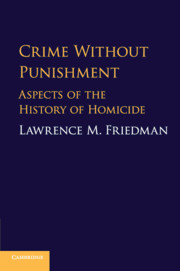

In this compelling book, Lawrence M. Friedman looks at situations where killing is condemned by law but not by social norms and, therefore, is rarely punished. He shows how penal codes categorize homicides by degree of intent, which are in turn based on society's sense of moral outrage. Despite being officially defined as murder, many homicides have historically gone unpunished. Friedman looks at early vigilante justice, crimes of passion, murder of necessity, mercy killings, and assisted suicides. In his explorations of these unpunished homicides, Friedman probes what these circumstances tell us about conflicts in social and cultural norms, and the interaction of law and society.
Loading metrics...
* Views captured on Cambridge Core between #date#. This data will be updated every 24 hours.
Usage data cannot currently be displayed.
This section outlines the accessibility features of this content - including support for screen readers, full keyboard navigation and high-contrast display options. This may not be relevant for you.
Accessibility compliance for the PDF of this book is currently unknown and may be updated in the future.