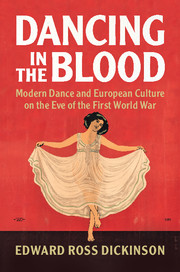

This is a remarkable account of the revolutionary impact of modern dance on European cultural life in the early twentieth century. Edward Ross Dickinson uncovers modern dance's place in the emerging 'mass' culture of the modern metropolis, sufficiently ubiquitous and high-profile to spark media storms, parliamentary debates, and exasperated denunciations even from progressive art critics. He shows how modern dance spoke in multiple registers - as religious and as scientific; as redemptively chaste and scandalously sensual; as elitist and popular. He reveals the connections between modern dance and changing gender relations and family dynamics, imperialism, racism, and cultural exchanges with the wider non-European world, and new conceptions of selfhood. Ultimately the book finds in these complex and often contradictory connections a new way of understanding the power of modernism and modernity and their capacity to revolutionize and transform the modern world in the momentous, creative, violent middle decades of the twentieth century.
'Edward Ross Dickinson brilliantly demonstrates that aesthetic modernism danced a neat double-two-step in the early decades of the twentieth century, combining the tense oppositions of global modernity into a harmonious new language. With its nimble prose and adroit research, Dancing in the Blood is itself a delightfully artful and informative cultural history.'
Michael Saler - University of California, Davis
'Dancing in the Blood makes a major new contribution to the scholarship of early twentieth-century dance. Edward Ross Dickinson brings a fresh historical perspective to dance and asks us to reconsider the formative early years of modern dance with new readings of modernism and modernity. An exhilarating read.'
Michael Huxley - De Montfort University
'Dancing in the Blood is extremely readable and packed full of solid historical detail, offering a brilliant resource every scholar working in the field should turn to.'
Lucia Ruprecht Source: The Journal of Modern History
'I thoroughly enjoyed this tremendous book, and I expect all historians of the early twentieth century will, too.'
Robert M. Brain Source: The American Historical Review
Loading metrics...
* Views captured on Cambridge Core between #date#. This data will be updated every 24 hours.
Usage data cannot currently be displayed.
This section outlines the accessibility features of this content - including support for screen readers, full keyboard navigation and high-contrast display options. This may not be relevant for you.
Accessibility compliance for the PDF of this book is currently unknown and may be updated in the future.