
Skip to main content Accessibility help
×
  • Cited by 11
    • Show more authors
    • You may already have access via personal or institutional login
    • Select format
    • Publisher:
      Cambridge University Press
      Publication date:
      05 November 2012
      18 October 2012
      ISBN:
      9781139175838
      9781107024601
      9781107690912
      Dimensions:
      (228 x 152 mm)
      Weight & Pages:
      0.53kg, 258 Pages
      Dimensions:
      (228 x 152 mm)
      Weight & Pages:
      0.42kg, 255 Pages
    You may already have access via personal or institutional login
  • Selected: Digital
    Add to cart View cart Buy from Cambridge.org

    Book description

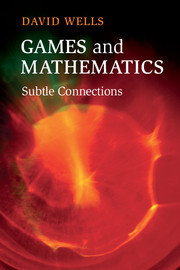
    The appeal of games and puzzles is timeless and universal. In this unique book, David Wells explores the fascinating connections between games and mathematics, proving that mathematics is not just about tedious calculation but imagination, insight and intuition. The first part of the book introduces games, puzzles and mathematical recreations, including knight tours on a chessboard. The second part explains how thinking about playing games can mirror the thinking of a mathematician, using scientific investigation, tactics and strategy, and sharp observation. Finally the author considers game-like features found in a wide range of human behaviours, illuminating the role of mathematics and helping to explain why it exists at all. This thought-provoking book is perfect for anyone with a thirst for mathematics and its hidden beauty; a good high school grounding in mathematics is all the background that is required, and the puzzles and games will suit pupils from 14 years.

    Reviews

    'One of the wellsprings out of which the discipline of mathematics has developed is human delight in intellectual play, manifest in the ubiquity of abstract games across millennia and cultures. The author of this fascinating book is expert in both domains, and in the art of clearly explaining significant aspects of mathematics in ways both accessible to non-experts and illuminating to experts. Through a delightfully rich variety of historical and multicultural examples, he unveils the intimate relationship between abstract games and mathematics as the study of structures, and, in so doing, illuminates much more about mathematical behaviour and cognition. At a time when too much of mathematics education in school seems designed to squeeze out every last drop of playfulness, we are reminded that mathematics can, and should, be an intellectual playground.'

    Brian Greer - Portland State University

    ‘This is a very approachable yet erudite book. Wells' game is to turn Plato's theory of forms on its head: instead of starting with physical examples and imagining their ideal forms, we should take our cue from the abstract laws and intuitions of games. Chess pieces are defined by their powers rather than their physical forms, and so are many situations in mathematics … The book illustrates this thesis with fascinating context: from Ulam's 'lucky' numbers … to the symmetry of the theorem discovered by Emperor Napoleon and the mathematics which arises in Go, Hex and chess … Games and Mathematics makes an important advance in communicating the nature of mathematics. It contains a profound message for philosophers of mathematics, but all mathematically-inclined readers will find [it] as compelling as Wells' excellent 'Curious and Interesting' books.'

    Paul Brown - author of Proof: Interesting Activities in Conjecture and Mathematical Proof

    'This is no ordinary compilation of recreational problems in mathematics … the text reads well and is something of a page-turner … this is not a mere compilation of problems, but a guided tour, and one would hope that it would reach a wider audience, so the authors' expressed intention, of showing that mathematics is not merely computation, but actually foremost an imaginative play, should become effective … All in all this could be a delightful volume in every aspect and I find myself recommending the work … with warmth and enthusiasm and with no qualms.'

    Ulf Persson - Chalmers University of Technology, Gothenburg

    'Complete with a consistent argument and a wealth of supportive references, this is a fun work for both game players and mathematicians to explore. Highly recommended.'

    J. Johnson Source: Choice

    Refine List

    Actions for selected content:

    Select all | Deselect all
    • View selected items
    • Export citations
    • Download PDF (zip)
    • Save to Kindle
    • Save to Dropbox
    • Save to Google Drive

    Save Search

    You can save your searches here and later view and run them again in "My saved searches".

    Please provide a title, maximum of 40 characters.
    ×

    Contents

    References
    Alavi, Y. 1985 Graph Theory with ApplicationsWiley
    Alcuin of York 1992 Propositions to Sharpen the Young 76 102
    d’Alembert, J. le R. 1963
    Andrews, G. E. 1976 The Theory of PartitionsAddison-Wesley
    Andrews, G. E. 1990 Euler's “Exemplum memorabile inducionis fallacisJournal of the American Mathematical Society 3 653
    Apollonius 1896 Apollonius of Perga: Treatise on Conic SectionsHeath, T. L.Cambridge University Press
    Archimedes 1952
    Ascher, M. 1990 A river-crossing problem in cross-cultural perspectiveMathematics Magazine 63–1 26
    Asimov, I.Shulman, J. A. 1988 Asimov's Book of Science and Nature QuotationsBlue Cliff
    Atiyah, M. 2003
    Avedon, E. M.Sutton-Smith, B. 1971 The Study of GamesWiley
    Averkieva, J.Sherman, M. A. 1992 Kwakiutl String FiguresUniversity of Washington Press
    Bailey, D. H.Borwein, J. M. 2000 Experimental Mathematics: Recent Developments and Future OutlookEngquist & Schmid
    Ball, W. W. Rouse 1892 Mathematical Recreations and Problems of Past and Present TimesMacmillan
    Barbeau, E. J.Leah, P. J. 1976 Euler's 1760 paper on divergent seriesHistoria Mathematica 3(2) 141
    Barbeau, E. J. 1979 Euler subdues a very obstreperous seriesAmerican Mathematical Monthly 86–5 356
    Berge, C. 1971 Principles of CombinatoricsAcademic Press
    Berlekamp, E. R.Conway, J. H.Guy, R. K. 1982 Winning Ways for your Mathematical PlaysAcademic Press/A K Peters
    Berlekamp, E.Wolfe, D. 1994 Mathematical Go: Chilling Gets the Last PointA K Peters
    Berne, E. 1960
    Birbrager, I. 1975 Chess: Serious; for FunChess Ltd
    Bishop, E. A. 1985 Schizophrenia in contemporary mathematicsContemporary Mathematics 39 1
    Boorman, S. A. 1969 The Protracted Game: A Wei-ch'i Interpretation of Maoist Revolutionary StrategyOxford University Press
    Borwein, J. M.Bailey, D. H. 2004 Experimental Mathematics: Plausible Reasoning in the 21st CenturyA K Peters
    Borwein, J. M.Borwein, P. B. 1992 Strange series and high precision fraudAmerican Mathematical Monthly 99–7 622
    Borwein, J.Borwein, P.Girgensohn, R.Parnes, S. 2009 http://oldweb.cecm.sfu
    Boyer, B. C. 1945 Fermat's integration of National Mathematics Magazine 20–1 29
    Boyer, C. B. 1956 History of Analytic GeometryScripta Mathematica
    Boyer, C. B. 1991 A History of MathematicsWiley
    Brams, S. J.Taylor, A. D. 1996 Fair DivisionCambridge University Press
    Bromwich, T. J. l’A. 1931 An Introduction to the Theory of Infinite SeriesMacmillan
    Browder, F. 1983 Mathematical Developments arising from Hilbert ProblemsAmerican Mathematical Society
    Brown, B. H. 1925 110
    Browne, C. 2000 Hex Strategy: Making the Right ConnectionsA K Peters
    Browne, C. 2005 Connection GamesA K Peters
    Castelvecchi, D. 2006 Out of the voidNew Scientist 2006
    Conway, J. H. 1976 On Numbers And GamesAcademic Press
    Coolidge, J. L 1949 The Mathematics of Great AmateursClarendon Press
    Culin, S. 1896 Mankala, the National Game of AfricaUS National Museum Annual ReportWashington595
    Culin, S. 1975 Games of the North American IndiansDover1902
    Dalpé, D. 1998 Schwarz's Surface and the Theory of Minimal SurfacesConcordia UniversityCanadawww.collectionscanada.ca
    Davis, P. J. 1995 The rise, fall, and possible transfiguration of triangle geometryAmerican Mathematical Monthly 102–3 204
    Descartes, R. 1996 Oeuvres de DescartesAdam, C.Tannery, P.Vrin, Paris
    Dickson, L. E. 1971 History of the Theory of NumbersChelsea Publishing Company
    Dudeney, H. E. 1907 The Canterbury Tales and other Curious ProblemsThomas Nelson
    Dyson, F. J. 1983 5
    Einstein, A. 1921
    Einstein, A. 1983 Sidelights on RelativityDover
    Engquist, B.Schmid, W. 2000 Mathematics Unlimited, 2001 and BeyondSpringer
    Epstein, D.Levy, S. 1995 Experimentation and proof in mathematicsNotices of the American Mathematical Society 42–6 670
    Euler, L. 1760 De seriebus divergentibusOpera Omnia585
    Euler, L. 1760 Opera Omnia 15 50
    Evelyn, C. J. A.Money-Coutts, G. B.Tyrrell, J. A. 1974
    Felix, L. 1960 The Modern Aspect of MathematicsBasic Books
    Fennema, E.Leder, G. C. 1990 Mathematics and GenderTeachers College Press
    Fine, R.Fine, B. 1977
    Fink, T.Mao, Y. 2001 The 85 Ways to Tie a Tie: the Science and Aesthetics of Tie KnotsFourth Estate
    Finkel, I. 2006 Ancient Boardgames in PerspectiveBritish Museum Press
    Foley, M. 1990 Laws, Men and Machines: Modern American Government and the Appeal of Newtonian MechanicsRoutledge
    Frame, M. L.Mandelbrot, B. B. 2002 Fractals, Graphics, & Mathematics EducationMathematical Association of America
    Frege, G. 1884
    Gautschi, W. 1994 Mathematics of Computation 1943–1993: A Half-Century of Computational MathematicsAmerican Mathematical Society
    Golomb, S. 1965 PolyominoesPolyominoes: Puzzles, Patterns, Problems, and PackingsPrinceton University Press 1996
    Goodstein, R. L. 1938 Geometry in modern dressThe Mathematical Gazette XXII
    Goodstein, R. L.Primrose, E. J. F. 1953 Axiomatic Projective GeometryUniversity CollegeLeicester
    Goodstein, R. L. 1957 Recursive Number TheoryNorth-Holland
    Goodstein, R. L. 1965 Essays on the Philosophy of MathematicsLeicester University Press
    Griffiths, P. A. 2000 Mathematics at the turn of the millenniumThe American Mathematical Monthly 107–1 1
    Hadamard, J. 1945 The Psychology of Invention in the Mathematical FieldPrinceton University Press
    Hadfield, O. D.Maddux, C.-D. 1988 Cognitive style and mathematics anxiety among high school studentsPsychology in the Schools 25–1 75
    Haimo, D. T. 1995 Experimentation and conjecture are not enoughThe American Mathematical Monthly 102–2 102
    Halmos, P. R. 1987 9
    Hamming, R. W. 1998 Mathematics on a distant planetThe AMM 105–7 640
    Hanna, G. 1996 The ongoing value of proofPME Conference XXValenciaSpain
    Hannak, J. 1959 Emanuel Lasker, The Life of a Chess MasterAndre DeutschDover
    Hardy, G. H. 1908 letter, Mendelian proportions in a mixed populationScience 28 49
    Hardy, G. H. 1915
    Hardy, G. H. 1920
    Hardy, G. H. 1934 letter, The -type and the -type among mathematiciansNature 7 134
    Hardy, G. H. 1940 Ramanujan, 12 Lectures on his Life and WorkCambridge University Press
    Hardy, G. H. 1941 A Mathematician's ApologyCambridge University Press
    Hardy, G. H. 1946 Review of HadamardThe Psychology of Invention in the Mathematical Field, The Mathematical Gazette 30 111
    Hardy, G. H. 1949 Divergent SeriesClarendon Press
    Hardy, G. H. 1967 Collected papers of G.H. HardyClarendon Press
    Hardy, G. H.Littlewood, J. E. 1923 Some problems of “partitio numerorum”: III: On the expression of a number as the sum of primesActa Mathematica 1 1
    Harris, M. 1997
    Heath, T. L. 1908 The Thirteen Books of Euclid's ElementsCambridge University Press
    Heath, T. L. 1910 Diophantus, of Alexandria, a Study in the History of Greek AlgebraCambridge University Press
    Heath, T. L. 1921 A History of Greek MathematicsClarendon Press
    Hearn, R. A.Demaine, E. D. 2009 Games, Puzzles and ComputationA K Peters
    Henle, J. 1996
    Hilbert, D. 1900
    Hilbert, D.Cohn-Vossen, S. 1952 Geometry and the ImaginationChelsea
    Hobson, E. W. 1910
    Hofstadter, D. 1979 Gödel, Escher, Bach: An Eternal Golden BraidBasic Books
    Hutchins, 1952 Euclid, Archimedes, Apollonius of Perga, NichomachusGreat Books of the Western WorldEncyclopaedia Britannica
    Jeffreys, H.Jeffreys, B. S. 1946 Methods of Mathematical PhysicsCambridge University Press
    Jesseph, D. M. 2007 Descartes, Pascal, and the epistemology of mathematics: the case of the cycloidPerspectives in Science15MIT
    Keene, R. 2006
    Kepler, J. 1611
    Kline, M. 1980 Mathematics: The Loss of CertaintyOxford University Press
    Kline, M. 1983 Euler and infinite seriesMathematics Magazine 56–5 307
    Knopp, K. 1928 Theory and Application of Infinite SeriesBlackie
    Krull, W. 1987 9
    Lakatos, I. 1976 Proofs and Refutations: The Logic of Mathematical DiscoveryWorral, J.Zahar, E. V.Cambridge University Press
    Lasker, E. 1911
    Lasker, E. 1925
    Lasker, E. 1907 StruggleLasker's Publishing Company
    Lasker, E. 1940 The Community of the FutureM. J. Bernin
    Leibniz, G. W. 1865
    Lemon, D. 1890 Everybody's Illustrated Book of PuzzlesSaxon & Co
    Lionnais, F. Le 2004 Great Currents of Mathematical ThoughtDover
    Littlewood, J. E. 1963 Littlewood's MiscellanyBollobas, B.Cambridge University Press
    Loomis, E. S. 1940 The Pythagorean PropositionNational Council of TeachersWashington
    Lucas, É. 1882 Récréations MathématiquesGauthier-Villars
    Mackay, A. L. 1994 Dictionary of Scientific QuotationsAdam Hilger
    MacLane, S. 1983 The health of mathematicsThe Mathematical Intelligencer 5–4
    Madhava, www-history.mcs.st-andrews.ac.uk/~history
    Mandelbrot, B. 2006 www.misbehaviorofmarkets.com/intro.htm+frame+
    McLean, T. 1983 The English at Play in the Middle AgesThe Kensal Press
    Manin, J. I. 1979 How convincing is a proofThe Mathematical Intelligencer 2–1 17
    Mathias, A. R. D. 1992 The ignorance of Bourbaki, 1987, revised versionThe Mathematical Intelligencer 14–3 4
    Maupertuis, de, P. L. N. 1746 Le lois de mouvement et du repos, déduites d'un principe de métaphysiqueMém. Ac.
    Mead, M.Wolfenstein, M. 1955 Childhood in Contemporary CulturesUniversity of Chicago Press
    Midonik, H. 1968 The Treasury of MathematicsPenguin
    Mikami, Y. 1961 The Development of Mathematics in China and JapanChelsea
    Morley, F. 1933 Inversive GeometryG. Bell and Sons
    Mumford, D. 2002 Indra's Pearls: The Vision of Felix KleinCambridge University Press
    Murray, H. J. R. 1913 A History of Board-games other than ChessClarendon Press
    Nagahara, Y. 1972 Strategic ConceptsIshi Press
    Nahin, P. J. 1988 Oliver Heavyside: the Life, Work, and Times of an Electrical Genius of the Victorian AgeJohns Hopkins University Press
    Nayakama, S. 1975 Japanese scientific thought: MathematicsDictionary of Scientific BiographyScribner
    Neumann, von, J. 1947
    Newman, J. R. 1956 The World of MathematicsGeorge Allen & Unwin
    Newton, I. 1676
    Newton, I. 1687
    Novcic, S. D. 1986 Sah i MatematikaZavod za Udzbenike i Nastavna Sredstva
    O’Connor, J. J.Robertson, E. F. 2006 MacTutor History of Mathematicswww-history.mcs.st-andrews.ac.uk/~history
    Papert, S. A. 1988 The mathematical unconsciousWechsler, J.On Aesthetics in ScienceBirkhäuserBoston, MA
    Penrose, R. 1974 The role of aesthetics in pure and applied mathematical researchBulletin of the Institute of Mathematics and its Applications 10
    Piaggio, H. T. T. 1943 217
    Pinn, K. 1998 http://arxiv.org/abs.chao-dyn/9803012
    Poincarè, H. 1956 Mathematical creationNewman, James R.The World of MathematicsSimon and Schuster2041
    Poincaré, H. 1914 Science and MethodDover
    Polster, B. 2006 The Shoelace Book: A Mathematical Guide to the Best (and Worst) Ways to Lace Your ShoesAmerican Mathematical Society
    Polya, G. 1954 Induction and Analogy in MathematicsPrinceton University Press
    Potts, R. 1865 Euclid's Elements of Geometry, together with a Selection of Geometrical Exercises from the Senate-House and College Examination PapersLongman, Green, LongmanRoberts & Green
    Powell, A. B.Frankenstein, M. 1997 Ethnomathematics: Challenging Eurocentrism in Mathematics EducationState University of New York Press
    Pritchard, C. 2003 The Changing Shape of GeometryCambridge University Press
    Probert, M. 1999
    Pullan, J. M. 1968 The History of the AbacusHutchinson
    Rahner, H. 1972 Man at PlayHerder and Herder
    Ravina, M. 1993 Wasan and the physics that wasn't: Mathematics in the Tokugawa periodMonumenta Nipponica 48–2 205www.jstor.org/stable/2385528
    Reed, N. B. 1998 More than just a Game: the Military Nature of Greek Athletic ContestsAres Publishers
    Restivo, S. P. 1992 Mathematics in Culture and Society: Sociological InquiriesKluwer
    Rigaud, S. R. 1841
    Robertson, J.Webb, W. 1998 Cake-Cutting AlgorithmsA K Peters
    Rota, G.-C. 1993 The lost caféContention 2–2 41
    Rota, G.-C. 2006
    Rothman, T. 1998
    Rotholer, B. 1999 Mehen, god of the boardgamesBoard Games StudiesLeiden
    Rothschild, de, P. 1968 The Irrational JourneyHamish Hamilton
    Rouse Ball, W. W. 1892 Mathematical Recreations and Problems of Past and Present TimesMacmillan
    Russell, B. 1903 Principles of MathematicsCambridge University Press
    Russell, B. 1913 The philosophical importance of mathematical logicThe Monist 23 481
    Russell, B. 1956 Logic and KnowledgeGeorge Allen & Unwin
    Saunderson, N. 1740
    Schilpp, P. A. 1951
    Schneider, W. 2001
    Schroeder, M. 1991 Fractals, Chaos, Power LawsW. H. Freeman
    Segoe, K. 1960 Go Proverbs IllustratedNihon KiinTokyo
    Sloane,
    Stevenson, G. 1961 Mathematical Methods for Science StudentsLongman
    Stewart, I. 1985 1475
    Stillwell, J. 1998 105
    Struik, D. J. 1990 A Source Book in MathematicsPrinceton University Press
    Sylvester, J. J. 1869 The Collected Papers of James Joseph SylvesterCambridge University Press
    Tani, Y. 1964 The Magic Calculator: the Way of the AbacusJapan Publications Trading Company
    Tartakower, S. G. 1956 My Best Games of Chess 1931–1954Golombek, H.G. Bell & Sons
    Thurston, W. 1994 Proof and progress in mathematicsBulletin of the American Mathematical Society 30–7 161
    Turkle, S.Papert, S. 1990 Epistemological pluralism: styles and voices within the computer cultureSigns 16–1 128
    Turner, J. C.van de Griend, P. 1996 History and Science of KnotsWorld Scientific
    Tylor, E. B. 1879 The history of gamesThe Fortnightly Review 25 735
    Van Binsberge, W.
    Villegas, F. R. 2007 Experimental Number TheoryOxford University Press
    Voltaire 1764 A Philosophical DictionaryThe probability of a tie in three candidate racehttp://frank.mtsu.edu/-dwalsh/3votetie.gif
    Weisstein, E. W. 2006
    Wells, D. G. 1976 GuerillaboardgameAriel, UK
    Wells, D. G. 1979 Checkpoint: DangerRavensburger in Germany
    Wells, D. G. 1979 Recreations in LogicDover
    Wells, D. G. 1980 The Problem Solver
    Wells, D. G. 1982 Can You Solve These?Tarquin Publications
    Wells, D. G. 1986
    Wells, D. G. 1987 Mathematics through Problem SolvingBlackwell
    Wells, D. G. 1988 Hidden Connections, Double MeaningsCambridge University Press
    Wells, D. G. 1988 Which is the most beautiful?The Mathematical Intelligencer 10–4 30
    Wells, D. G. 1990 Are these the most beautiful?The Mathematical Intelligencer 12–3 37
    Wells, D. G. 1991 The Penguin Dictionary of Curious and Interesting GeometryPenguin
    Wells, D. G. 1991
    Wells, D. G. 1992 Penguin Book of Curious and Interesting PuzzlesPenguinDover
    Wells, D. G. 1993
    Wells, D. G. 1993 Bulletin of the Institute of Mathematics and its Applications 29 24
    Wells, D. G. 1995 You are a Mathematician: a Wise and Witty Introduction to the Joy of NumbersPenguin
    Wells, D. G. 1997 The Penguin Book of Curious and Interesting MathematicsPenguin
    Wells, D. G. 2003 The End of Civilisation: Science, Ideology and IrrationalityRain Press
    Wells, D. G. 2005 Prime NumbersWiley
    Wells, D. G. 2008
    Wells, D. G. 2010 Philosophy and Abstract GamesRain Press
    Wells, D. G.Clarke, S. 1988 What's the point of games in the mathematics classroom?Investigator 12
    Wells, D. G.Schultz, D 2008 A surprise with parallel Lines: an exploration that went wrong, then rightThe Mathematical Gazette 92 162
    Weyl, H. 1995 Topology and abstract algebra as two roads of mathematical comprehensionAmerican Mathematical Monthly 102–5 177
    Wigner, E. P. 1960 13--1
    Williams, H. C. 1998 Éduard Lucas and Primality TestingJohn Wiley
    Williams, H. C.Shallit, J. O. 1994
    Wilson, R. J. 1985
    Wolfenstein, M. 1958 86
    Yan, L.Shiran, D. 1987 Chinese Mathematics: a Concise HistoryClarendon Press
    Young, W. H. 1928 The mathematical method and its limitationsAtti del Congresso Internazionale Dei MatematiciBologna
    Zeilberger, D. 1993 Theorems for a price: Tomorrow's semi-rigorous mathematical cultureNotices of the American Mathematical Society 40–8 978

    Metrics

    Altmetric attention score

    Full text views

    Total number of HTML views: 0
    Total number of PDF views: 0 *
    Loading metrics...

    Book summary page views

    Total views: 0 *
    Loading metrics...

    * Views captured on Cambridge Core between #date#. This data will be updated every 24 hours.

    Usage data cannot currently be displayed.

    Accessibility standard: Unknown

    Why this information is here

    This section outlines the accessibility features of this content - including support for screen readers, full keyboard navigation and high-contrast display options. This may not be relevant for you.

    Accessibility Information

    Accessibility compliance for the PDF of this book is currently unknown and may be updated in the future.