
Skip to main content Accessibility help
×
  • Cited by 14
    • Show more authors
    • You may already have access via personal or institutional login
    • Select format
    • Publisher:
      Cambridge University Press
      Publication date:
      21 June 2019
      04 July 2019
      ISBN:
      9781316471708
      9781107135505
      9781316501306
      Dimensions:
      (228 x 152 mm)
      Weight & Pages:
      0.63kg, 294 Pages
      Dimensions:
      (229 x 152 mm)
      Weight & Pages:
      0.45kg, 308 Pages
    You may already have access via personal or institutional login
  • Selected: Digital
    Add to cart View cart Buy from Cambridge.org

    Book description

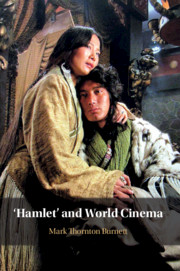
    'Hamlet' and World Cinema reveals a rich history of cinematic production extending across the globe. Making a case for Hamlet as the world's most frequently filmed text, and using specially commissioned interviews with cast, directors and screenwriters, it discusses films from Africa, Asia, Europe, Latin America and the Middle East. The book argues that the play has been taken up by filmmakers world-wide to allegorise the energies, instabilities, traumas and expectations that have defined the twentieth and twenty-first centuries. In so doing, it rejects the Anglophone focus which has dominated criticism up to now and explores instead the multiple constituencies that have claimed Shakespeare's most celebrated work as their own. 'Hamlet' and World Cinema uncovers a vital part of the adaptation story. This book facilitates a fresh understanding of Shakespeare's cinematic significance and newly highlights Hamlet's political and aesthetic instrumentality in a vast range of local and global contexts.

    Reviews

    ‘'Hamlet' and World Cinema is a remarkable book. In fact, there's nothing quite like it in the literature of Shakespeare on film. Burnett provides detailed cultural readings of thirty Hamlet films, each revealing something rich and strange about the country of origin and the moment of creation. His scholarship is astonishing as his analyses incorporate knowledge of each culture's history, politics, myths, film and stage traditions, language, as well as its appropriation of Shakespeare. He has a profound understanding of the myriad purposes Hamlet serves in these films as aesthetic object, political critique, cultural icon, or colonial intruder. The volume is not just a homage to Shakespeare's enduring impact on world cultures, but to the art of film itself.'

    Samuel Crowl - Ohio University

    '(A) virtuosic study.'

    Sir Stanley Wells Source: Times Literary Supplement

    'Graced with numerous stills and engaging writing, this book demands attention.'

    W. W. Dixon Source: Choice

    ‘We are privileged to join the author on this journey.’

    Michael P. Jensen Source: The Shakespeare Newsletter

    ‘The book ‘makes a case for Hamlet as the world’s most frequently filmed text’ and shows how transpositions of the play to Brazilian book review 185 favelas, a compound in northern Ghana, and Tang Dynasty China (to name justthree) have illuminated the politics of race, gender, and class in these settings … ‘Hamlet’ and World Cinema privilege specific plays, allowing them to display the multiplicity these works have come to represent …’

    Sally Barnden Source: Shakespeare Bulletin

    Refine List

    Actions for selected content:

    Select all | Deselect all
    • View selected items
    • Export citations
    • Download PDF (zip)
    • Save to Kindle
    • Save to Dropbox
    • Save to Google Drive

    Save Search

    You can save your searches here and later view and run them again in "My saved searches".

    Please provide a title, maximum of 40 characters.
    ×

    Contents

    Metrics

    Altmetric attention score

    Full text views

    Total number of HTML views: 0
    Total number of PDF views: 0 *
    Loading metrics...

    Book summary page views

    Total views: 0 *
    Loading metrics...

    * Views captured on Cambridge Core between #date#. This data will be updated every 24 hours.

    Usage data cannot currently be displayed.

    Accessibility standard: Unknown

    Why this information is here

    This section outlines the accessibility features of this content - including support for screen readers, full keyboard navigation and high-contrast display options. This may not be relevant for you.

    Accessibility Information

    Accessibility compliance for the PDF of this book is currently unknown and may be updated in the future.