
Skip to main content Accessibility help
×
  • Cited by 18
    • Show more authors
    • Open Access
      You have digital access to this book
    • Select format
    • Publisher:
      Cambridge University Press
      Publication date:
      12 July 2023
      10 August 2023
      ISBN:
      9781108685481
      9781009440646
      9781108716062
      Creative Commons:
      Creative Common License - CC Creative Common License - BY Creative Common License - NC
      This content is Open Access and distributed under the terms of the Creative Commons Attribution licence CC-BY-NC 4.0.
      https://creativecommons.org/creativelicenses
      Dimensions:
      (229 x 152 mm)
      Weight & Pages:
      0.247kg, 66 Pages
      Dimensions:
      (229 x 152 mm)
      Weight & Pages:
      0.11kg, 66 Pages
    Open Access
    You have digital access to this book
    Selected: Digital
    View content
    Add to cart View cart Buy from Cambridge.org

    Book description

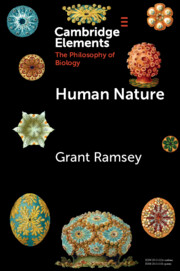
    Human nature is frequently evoked to characterize our species and describe how it differs from others. But how should we understand this concept? What is the nature of a species? Some take our nature to be an essence and argue that because humans lack an essence, they also lack a nature. Others argue for non-essentialist ways of understanding human nature, which usually aim to provide criteria for sorting human traits into one of two bins, the one belonging to our nature and the other outside our nature. This Element argues that both the essentialist and trait bin approaches are misguided. Instead, the author develops a trait cluster account of human nature, which holds that human nature is based on the distribution of our traits over our (actual and possible) life histories. One benefit of this account is that it aligns human nature with the human sciences, rendering the central concern of the human sciences to be the study of human nature. This title is also available as Open Access on Cambridge Core.

    Reviews

    ‘Ramsey provides a clear and helpful survey of the current state of thinking about human nature and a defence of a particular position on the issue … I think this book (or element) does a very good job of achieving what I take to be the aim of its genre. It well describes the state of play on the topic, and compellingly explains why almost nobody still thinks that humans have a nature in the traditional, essentialist sense.’

    John Dupré Source: Metascience

    ‘The author advocates for a more ambitious concept of human nature he calls the life-history trait cluster (LTC) account … Ramsey argues that the LTC version of human nature can serve as a unifying basic principle for the human sciences.’

    Peter Richerson Source: The Quarterly Review of Biology

    ‘I think this book (or element) does a very good job of achieving what I take to be the aim of its genre. It well describes the state of play on the topic, and compellingly explains why almost nobody still thinks that humans have a nature in the traditional, essentialist sense.’

    John Dupré Source: Metascience

    References

    Almécija, S., Hammond, A. S., Thompson, N. E. et al. (2021). Fossil apes and human evolution. Science, 372(6542), eabb4363. https://doi.org/10.1126/science.abb4363.
    Bisbey, T. M., Reyes, D. L., Traylor, A. M., and Salas, E. (2019). Teams of psychologists helping teams: The evolution of the science of team training. American Psychologist, 74(3), 278–89. https://doi.org/10.1037/amp0000419.
    Blake, P. R., McAuliffe, K., and Warneken, F. (2014). The developmental origins of fairness: The knowledge–behavior gap. Trends in Cognitive Sciences, 18(11), 559–61. https://doi.org/10.1016/j.tics.2014.08.003.
    Blake, P. R., McAuliffe, K., Corbit, J. et al. (2015). The ontogeny of fairness in seven societies. Nature, 528, 258–61. https://doi.org/10.1038/nature15703.
    Bouchard, T. J. (2013). The Wilson effect: The increase in heritability of IQ with age. Twin Research and Human Genetics, 16(5), 923–30. https://doi.org/10.1017/thg.2013.54.
    Brosnan, S. F., and de Waal, F. B. M. (2003). Monkeys reject unequal pay. Nature, 425, 297–9. https://doi.org/10.1038/nature01963.
    Buller, D. J. (2005). Adapting Minds: Evolutionary Psychology and the Persistent Quest for Human Nature. Cambridge, MA: MIT Press.
    Cashdan, E. (2013). What is a human universal? Human behavioral ecology and human nature. In Downes, S. and Machery, E., eds., Arguing about Human Nature: Contemporary Debates. New York: Routledge Press, pp. 7180.
    Darwin, C. (1859). On the Origin of Species by Means of Natural Selection. London: Murray.
    De Waal, F. B. M. (2005). Our Inner Ape: A Leading Primatologist Explains Why We Are Who We Are. New York: Riverhead Books.
    Doris, J. M. (2002). Lack of Character: Personality and Moral Behavior. Cambridge: Cambridge University Press.
    Dubreuil, D., Gentile, M. S., and Visalberghi, E. (2006). Are capuchin monkeys (Cebus apella) inequity averse? Proceedings of the Royal Society B: Biological Sciences, 273, 1223–8. https://doi.org/10.1098/rspb.2005.3433.
    Dupré, J. (2018). Human nature: A process perspective. In Hannon, E. and Lewens, T., eds., Why We Disagree about Human Nature. Oxford: Oxford University Press, pp. 92107.
    Eiberg, H., Troelsen, J., Nielsen, M. et al. (2008). Blue eye color in humans may be caused by a perfectly associated founder mutation in a regulatory element located within the HERC2 gene inhibiting OCA2 expression. Human Genetics, 123, 177–87. https://doi.org/10.1007/s00439-007-0460-x.
    Ellis, S., Franks, D. W., Nattrass, S. et al. (2018). Analyses of ovarian activity reveal repeated evolution of post-reproductive lifespans in toothed whales. Scientific Reports, 8(1), 110. https://doi.org/10.1038/s41598-018-31047-8.
    Evershed, R. P., Payne, S., Sherratt, A. G. et al. (2008). Earliest date for milk use in the near East and Southeastern Europe linked to cattle herding. Nature, 455, 528–31. https://doi.org/10.1038/nature07180.
    Evershed, R. P., Davey Smith, G., Roffet-Salque, M. et al. (2022). Dairying, diseases and the evolution of lactase persistence in Europe. Nature, 608(7922), 336–45.
    Freud, S. (1962). Civilization and Its Discontents. New York: W. W. Norton.
    Geraci, A., and Surian, L. (2011). The developmental roots of fairness: Infants’ reactions to equal and unequal distributions of resources. Developmental Science, 14(5), 1012–20. https://doi.org/10.1111/j.1467-7687.2011.01048.x.
    Ghiselin, M. T. (1974). The Economy of Nature and the Evolution of Sex. Berkeley: University of California Press.
    Ghiselin, M. T. (1997). Metaphysics and the Origins of Species. Albany: SUNY Press.
    Glazko, G. V., and Masatoshi, N. (2003). Estimation of divergence times for major lineages of primate species. Molecular Biology and Evolution, 20, 424–34. https://doi.org/10.1093/molbev/msg050.
    Greene, R. (2018). The Laws of Human Nature. New York: Viking.
    Griffiths, P. (1999). Squaring the circle: Natural kinds with historical essences. In Wilson, R. A., ed., Species: New Interdisciplinary Essays. Cambridge, MA: MIT Press, pp. 209–28.
    Griffiths, P. (2009). Reconstructing Human Nature. Arts: The Journal of the Sydney University Arts Association, 31, 3057.
    Griffiths, P. (2011). Our plastic nature. In Gissis, S. B. and Jablonka, E., eds., Transformations of Lamarckism: From Subtle Fluids to Molecular Biology. Cambridge, MA: MIT Press, pp. 319–30.
    Griffiths, P., Machery, E., and Linquist, S. (2009). The vernacular concept of innateness. Mind & Language, 24(5), 605–30. https://doi.org/10.1111/j.1468-0017.2009.01376.x.
    Gupta, A. P., and Lewontin, R. C. (1982). A study of reaction norms in natural populations of Drosophila pseudoobscura. Evolution, 36(5), 934–48. https://doi.org/10.2307/2408073.
    Hacker, P. M. S. (2021). The Moral Powers: A Study of Human Nature. New York: John Wiley.
    Hannon, E., and Lewens, T. (2008). Why We Disagree about Human Nature. Oxford: Oxford University Press.
    Hartmann, W. E., Wendt, D. C., Burrage, R. L., Pomerville, A., and Gone, J. P. (2019). American Indian historical trauma: Anticolonial prescriptions for healing, resilience, and survivance. American Psychologist, 74(1), 619. https://doi.org/10.1037/amp0000326.
    Hoffman, L., and Oppenheim, L. (2019). Three identical strangers and the twinning reaction – clarifying history and lessons for today from Peter Neubauer’s twins study. JAMA, 322, 1012. https://doi.org/10.1001/jama.2019.8152.
    Hull, D. L. (1986). On human nature. PSA: Proceedings of the Biennial Meeting of the Philosophy of Science Association, 2, 313. https://doi.org/10.1086/psaprocbienmeetp.1986.2.192787.
    Hume, D. (1731). A Treatise of Human Nature. Oxford: Clarendon Press.
    Hyde, J. S., Bigler, R. S., Joel, D., Tate, C. C., and van Anders, S. M. (2019). The future of sex and gender in psychology: Five challenges to the gender binary. American Psychologist, 74(2), 171–9. https://doi.org/10.1037/amp0000307.
    Ingold, T. (2019). Review of Why We Disagree about Human Nature. Notre Dame Philosophical Reviews. https://ndpr.nd.edu/news/why-we-disagree-about-human-nature/.
    Ingram, C. J., Mulcare, C. A., Itan, Y., Thomas, M. G., and Swallow, D. M. (2009). Lactose digestion and the evolutionary genetics of lactase persistence. Human Genetics, 124, 579–91. https://doi.org/10.1007/s00439-008-0593-6.
    Kellogg, W. N., and Kellogg, L. A. (1933). The Ape and the Child: A Study of Environmental Influence upon Early Behavior. New York: Whittlesey House.
    Kierkegaard, S. (2006). Kierkegaard: Fear and Trembling. Edited by Evans, C. S. and Walsh, S.. Cambridge: Cambridge University Press.
    Kippenhahn, R., Weigert, A., and Weiss, A. (1990). Stellar Structure and Evolution. Berlin: Springer-Verlag.
    Kronfeldner, M. (2018). What’s Left of Human Nature? A Post-essentialist, Pluralist, and Interactive Account of a Contested Concept. Cambridge, MA: MIT press.
    Kuhn, T. S. (1962). The Structure of Scientific Revolutions. Chicago: University of Chicago Press.
    LaPorte, J. (2004). Natural Kinds and Conceptual Change. Cambridge: Cambridge University Press.
    Leonardi, M., Gerbault, P., Thomas, M. G., and Burger, J. (2012). The evolution of lactase persistence in Europe: A synthesis of archaeological and genetic evidence. International Dairy Journal, 22(2), 8897. https://doi.org/10.1016/j.idairyj.2011.10.010.
    Lipkis, E. (2017). Blame human nature, not guns. New York Times, November 9.
    Machery, E. (2008). A plea for human nature. Philosophical Psychology, 21(3), 321–9. https://doi.org/10.1080/09515080802170119.
    Machery, E. (2016). Human nature. In Smith, D. L., ed., How Biology Shapes Philosophy: New Foundations for Naturalism. Cambridge: Cambridge University Press, pp. 204–26.
    Manjoo, F. (2018). The problem with fixing WhatsApp? Human nature might get in the way. New York Times, October 24.
    McAuliffe, K., Chang, L. W., Leimgruber, K. L. et al. (2015). Capuchin monkeys, Cebus apella, show no evidence for inequity aversion in a costly choice task. Animal Behaviour, 103, 6574. https://doi.org/10.1016/j.anbehav.2015.02.014.
    McAuliffe, K., Blake, P. R., and Warneken, F. (2017). Do kids have a fundamental sense of fairness? Experiments show that this quality often emerges by the age of 12 months. Scientific America blog, August 23. https://blogs.scientificamerican.com/observations/do-kids-have-a-fundamental-sense-of-fairness/?print=true.
    McCormack, W. (2018). Records from controversial twin study sealed at Yale until 2065. Yale Daily News, October 1. https://yaledailynews.com/blog/2018/10/01/records-from-controversial-twin-study-sealed-at-yale-until-2065/.
    Mischel, W., Shoda, Y., and Mendoza-Denton, R. (2002). Situation-behavior profiles as a locus of consistency in personality. Current Directions in Psychological Science, 11(2), 50–4. https://doi.org/10.1111/1467-8721.00166.
    Owen, R. (1843). Lectures on the Comparative Anatomy and Physiology of the Invertebrate Animals: Delivered at the Royal College of Surgeons, in 1843. London: Longman.
    Pedroso, M. (2012). Essentialism, history, and biological taxa. Studies in History and Philosophy of Science Part C: Studies in History and Philosophy of Biological and Biomedical Sciences, 43(1), 182–90. https://doi.org/10.1016/j.shpsc.2011.10.019.
    Peirson, B. R. E. (2012). Richard Woltereck’s concept of Reaktionsnorm. Embryo Project Encyclopedia (2012-09-06). ISSN: 1940-5030. http://embryo.asu.edu/handle/10776/3940.
    Pinker, S. (2002). The Blank Slate: The Modern Denial of Human Nature. New York: Viking.
    Quain, J. R. (2016). Makers of Self-Driving Cars Ask What to Do with Human Nature. New York Times, July 7.
    Ramsey, G. (2012). How human nature can inform human enhancement: A commentary on Tim Lewens’s “Human nature: The very idea.” Philosophy and Technology, 25, 479–83. https://doi.org/10.1007/s13347-012-0087-2.
    Ramsey, G. (2013). Human nature in a post-essentialist world. Philosophy of Science, 80, 983–93. https://doi.org/10.1086/673902.
    Ramsey, G. (2017). What is human nature for? In Fuentes, A. and Visala, A., eds., Verbs, Bones, and Brains: Interdisciplinary Perspectives on Human Nature. Notre Dame: University of Notre Dame Press, pp. 217–30.
    Ramsey, G. (2018). Trait bin and trait cluster accounts of human nature. In Hannon, E. and Lewens, T., eds., Why We Disagree about Human Nature. Oxford: Oxford University Press, pp. 4057.
    Ramsey, G., and Peterson, A. S. (2012). Sameness in biology. Philosophy of Science, 79(2), 255–75. https://doi.org/10.1086/664744.
    Rochat, P., Dias, M. D., Liping, G. et al. (2009). Fairness in distributive justice by 3- and 5-year-olds across seven cultures. Journal of Cross-Cultural Psychology, 40(3), 416–42. https://doi.org/10.1177/0022022109332844.
    Shoda, Y., LeeTiernan, S., and Mischel, W. (2002). Personality as a dynamical system: Emergence of stability and distinctiveness from intra- and interpersonal interactions. Personality and Social Psychology Review, 6(4), 316–25. https://doi.org/10.1207/S15327957PSPR0604_06.
    Sloane, S., Baillargeon, R., and Premack, D. (2012). Do infants have a sense of fairness? Psychological Science, 23(2), 196204. https://doi.org/10.1177/0956797611422072.
    Sommerville, J. A., Schmidt, M. F. H., Yun, J. E., and Burns, M. (2013). The development of fairness expectations and prosocial behavior in the second year of life. Infancy, 18, 4066. https://doi.org/10.1111/j.1532-7078.2012.00129.x.
    Sterelny, K. (2018). Skeptical reflections on human nature. In Hannon, E. and Lewens, T., eds., Why We Disagree about Human Nature. Oxford: Oxford University Press, pp. 108–26.
    Stevenson, L. F., Haberman, D. L., Wright, P. M., and Witt, C. (2017). Thirteen Theories of Human Nature. Oxford: Oxford University Press.
    Stotz, K., and Griffiths, P. (2018). A developmental systems account of human nature. In Hannon, E. and Lewens, T., eds., Why We Disagree about Human Nature. Oxford: Oxford University Press, pp. 5875.
    Swallow, D. M. (2003). Genetics of lactase persistence and lactose intolerance. Annual Review of Genetics, 37(1), 197219. https://doi.org/10.1146/annurev.genet.37.110801.143820.

    Metrics

    Altmetric attention score

    Full text views

    Total number of HTML views: 0
    Total number of PDF views: 0 *
    Loading metrics...

    Book summary page views

    Total views: 0 *
    Loading metrics...

    * Views captured on Cambridge Core between #date#. This data will be updated every 24 hours.

    Usage data cannot currently be displayed.

    Accessibility standard: Unknown

    Why this information is here

    This section outlines the accessibility features of this content - including support for screen readers, full keyboard navigation and high-contrast display options. This may not be relevant for you.

    Accessibility Information

    Accessibility compliance for the PDF of this book is currently unknown and may be updated in the future.