
Skip to main content Accessibility help
×
  • Cited by 24
    • Show more authors
    • You may already have access via personal or institutional login
    • Select format
    • Publisher:
      Cambridge University Press
      Publication date:
      05 December 2013
      05 December 2013
      ISBN:
      9781139794800
      9781107037717
      9781108740081
      Dimensions:
      (228 x 152 mm)
      Weight & Pages:
      0.66kg, 270 Pages
      Dimensions:
      (244 x 170 mm)
      Weight & Pages:
      0.5kg, 274 Pages
    You may already have access via personal or institutional login
  • Selected: Digital
    Add to cart View cart Buy from Cambridge.org

    Book description

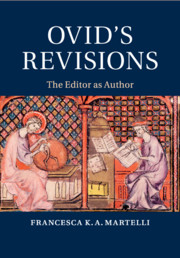
    A striking feature of Ovid's literary career derives from the processes of revision to which he subjects the works and collections that make up his oeuvre. From the epigram prefacing the Amores, to the editorial notices built into the book-frames of the Epistulae Ex Ponto, Ovid repeatedly invites us to consider the transformative horizons that these editorial interventions open up for his individual works, and which also affect the shape of his career and authorial identity. Francesca K. A. Martelli plots the vicissitudes of Ovid's distinctive career-long habit, considering how it transforms the relationship between text, oeuvre and authorial voice, and how it relates to the revisory practices at work in the wider cultural and political matrix of Ovid's day. This fascinating study will be of great interest to students and scholars of classical literature, and to any literary critic interested in revision as a mode of authorial self-fashioning.

    Refine List

    Actions for selected content:

    Select all | Deselect all
    • View selected items
    • Export citations
    • Download PDF (zip)
    • Save to Kindle
    • Save to Dropbox
    • Save to Google Drive

    Save Search

    You can save your searches here and later view and run them again in "My saved searches".

    Please provide a title, maximum of 40 characters.
    ×

    Contents

    Bibliography

    Adams, J. N. (1982) The Latin Sexual Vocabulary, London
    Alföldy, G. (1991) ‘Augustus und die Inschriften: Tradition und Innovation. Die Geburt der imperialen Epigraphik’, Gymnasium 98: 289–324
    Altheim, F. (1938) A History of Roman Religion (trans. Harold Mattingly), London
    Altman, J. G. 1982 Epistolarity: Approaches to a Form, Columbus
    Argentieri, L. (2007) ‘Meleager and Philip as Epigram Collectors’, in P. Bing and J. S. Bruss (eds.) Brill’s Companion to Hellenistic Epigram, Leiden and Boston, 147–64
    Armstrong, R. (2005) Ovid and his Love Poetry, London
    Auerbach, E. (1957) Mimesis: The Representation of Reality in Western Literature, Michigan
    Austin, C., and Olson, S. D. (2004) ‘On the Date and Plot of AristophanesThesmophoriazusae II’, LICS 3: 1–11
    Austin, J. (1962) How to do Things with Words, Oxford
    Austin, R. G. (1968) ‘Ille ego qui quondam…’, CQ 18: 107–15
    Austin, R. G.(1977) P. Vergili Maronis Aeneidos Liber Sextus, Oxford
    Barchiesi, A. (1988) [1997] ‘Ovid the Censor’, AJAH 13: 96–105
    Barchiesi, A.(1991) ‘Discordant Muses’, PCPhS 37: 1–21
    Barchiesi, A.(1993) ‘Future Reflexive: Two Modes of Allusion and Ovid’sHeroides’, HSCP 95: 333–65
    Barchiesi, A.(1994) review of Booth (1992), Gnomon 66: 588–92
    Barchiesi, A.(1997a) The Poet and the Prince, Berkeley and Los Angeles
    Barchiesi, A.(1997b) ‘End Games: Ovid’s Metamorphoses 15 and Fasti 6’, in D. H. Roberts, F. M. Dunn and D. Fowler (eds.)(1997), Classical Closure: Reading the End in Greek and Latin Literature, Princeton, 181–208
    Barchiesi, A.(2005) ‘The Search for the Perfect Book: A PS to the New Posidippus’, in K. Gutzwiller (ed.), The New Posidippus: A Hellenistic Poetry Book, Oxford, 320–42
    Beard, M. (1987) ‘A Complex of Times: No more Sheep on Romulus’ Birthday’, PCPhS 33: 1–15
    Beard, M.(2004) ‘The Triumph of Ovid’, in A. Barchiesi, J. Rüpke and S. Stephens (eds.), Rituals in Ink, Stuttgart, 115–26
    Beard, M., North, J., and Price, S. (1998) Religions of Rome (2 vols.), Cambridge
    Benedetto, G. (1993) Il sogno e l’invettiva, Florence
    Bömer, F. (1957–8) P. Ovidius Naso, Die Fasten (2 vols.), Heidelberg
    Booth, J. (1992) Ovid: The Second Book of Amores, Warminster
    Bowers, F. (1964) ‘Some Principles for Scholarly Editions of Nineteenth-Century American Authors’, Studies in Bibliography 17: 223–8
    Bowman, F. P. (1990) ‘Genetic Criticism’, Poetics Today 11: 627–46
    Boyle, A. J. (1997) ‘Postscripts from the Edge: Exilic Fasti and Imperialised Rome’, Ramus 26: 7–28
    Brooks, P. (1992) Reading for the Plot, Cambridge, Mass.
    Brooks, P.(1993) Body Work, Cambridge, Mass.
    Burke, P. F. (1979) ‘Roman Rites for the Dead andAeneid 6’, CJ 74: 220–8
    Butrica, J. (2001) ‘The LostThesmophoriazusae of Aristophanes’, Phoenix 55: 44–76
    Butrica, J.(2004) ‘The Date of Aristophanes’ Lost Thesmophoriazusae: A Response to Austin and Olson’, LICS 3.07: 1–5
    Cameron, A. (1968) ‘The First Edition of Ovid’sAmores’, CQ 18: 320–33
    Cameron, A.(1995) Callimachus and his Critics, Princeton
    Cerquiglini, B. (1989) Eloge de la variante: Histoire critique de la philologie, Paris
    Chaplin, J. D. (2000) Livy’s Exemplary History, Oxford
    Citroni, M. (1986) ‘Le raccomandazioni del poeta: apostrofe al libro e contatto col destinatario’, Maia 38: 111–46
    Clarke, K. (1999) Between Geography and History: Hellenistic Constructions of the Roman World, Oxford
    Clarke, K.(2008) Making Time for the Past: Local History and the Polis, Oxford
    Conte, G. B. (1980) Il genere e i suoi confini, Turin
    Conte, G. B.(1982) ‘Istituti letterari e stili di ricerca: una discussione’, MD 8: 123–39
    Conte, G. B.(1983) ‘Una discussione impossibile’, MD 9: 153–4
    Conte, G. B.(1992) ‘Proems in the Middle’, YCS 29: 147–59
    D’Elia, S. (1958) ‘Il problema cronologico degli Amores’, in N. Herescu (ed.), Ovidiana: Recherches sur Ovide, Paris, 210–223
    Derrida, J. (1977a) ‘Signature Event Context’, Glyph 1: 172–97
    Derrida, J.(1977b) ‘LIMITED INC a b c …’, Glyph 2: 162–254
    Derrida, J.(1981) Dissemination (trans. B. Johnson), London
    Derrida, J.(1987) The Post Card From Socrates to Freud and Beyond (trans. A. Bass), Chicago and London
    Deufert, M. (1996) Pseudo-Lukrezisches im Lukrez: Die unechten Verse in Lukrezens ‘De Rerum Natura’, Berlin and New York
    Domenicucci, P. (1996) Astra Caesarum: Astronomia, astrologia, e catasterismo da Cesare a Domiziano, Pisa
    Dover, K. J. (1968) Aristophanes: Clouds, Oxford
    Downing, E. (1990) ‘Anti-Pygmalion: the praeceptor in Ars Amatoria, Book 3’, Helios 17: 237–49 (= idem in J. I. Porter (ed.) (1999), Constructions of the Classical Body, Michigan, 235–51)
    Dumézil, G. (1970) Archaic Roman Religion (2 vols.), Chicago and London
    Durante, M. (1957) ‘Il nome di Omero’, Rendiconti dell’Accademia Nazionale dei Lincei, Classe di scienze morali, storiche e filologiche 12: 94–111
    Edwards, C. (2003) ‘Incorporating the Alien: The Art of Conquest’, in C. Edwards and G. Woolf (eds.), Rome the Cosmopolis, Cambridge, 44–70
    Eichgrün, E. (1961) Kallimachos und Apollonios Rhodios, Berlin
    Emonds, H. (1941) Zweite Auflage im Altertum, Leipzig
    Evans, H. B. (1983) Publica Carmina: Ovid’s Books from Exile, Lincoln and London
    Fairweather, J. (1987) ‘Ovid’s Autobiographical Poem, Tristia 4.10’, CQ 37: 181–96
    Fantham, R. E. (1985) ‘Ovid, Germanicus and the Composition of the Fasti’, Papers of the Liverpool Latin Seminar 5: 243–81
    Fantham, R. E.(1988) ‘Varietas and Satietas: De Oratore 3.96–103 and the Limits of Ornatus’, Rhetorica 6: 257–90
    Fantham, R. E.(1992) ‘The Role of Evander in Ovid’sFasti’, Arethusa 25: 155–72
    Fantham, R. E.(1998) Ovid’s Fasti IV, Cambridge
    Farrell, J. (1992) ‘Dialogue of Genres in Ovid’s “Lovesong of Polyphemus” (Met. 13.719–897)’, AJP 113: 235–68
    Farrell, J.(1999) ‘The Ovidian Corpus: Poetic Body and Poetic Text’, in Hardie, Barchiesi, and Hinds (eds.) (1999), 127–41
    Fear, T. (2000) ‘The Poet as Pimp: Elegiac Seduction in the Time of Augustus’, Arethusa 33: 127–240
    Feeney, D. C. (1991) The Gods in Epic, Oxford
    Feeney, D. C.(1992) ‘Si licet et fas est: Ovid’s Fasti and the Problem of Free Speech under the Principate’, in Powell (ed.) (1992), 1–25
    Feeney, D. C.(2007) Caesar’s Calendar: Ancient Time and the Beginnings of History, California
    Ferri, R. (1993) I dispiaceri di un epicureo: Uno studio sulla poetica oraziana delle Epistole (con un capitolo su Persio), Pisa
    Fishwick, D. (1987) The Imperial Cult in the Latin West: Studies in the Ruler Cult of the Western Provinces (vol. 1), Leiden
    Fishwick, D.(1991) The Imperial Cult in the Latin West: Studies in the Ruler Cult of the Western Provinces (vol. 2.1), Leiden
    Fitzgerald, W. (2007) ‘The Letter’s the Thing (in Pliny Book 7)’, in R. Morello and A. Morrison (eds.) (2007), 191–210
    Ford, A. (1992) Homer and the Poetry of the Past, Ithaca and London
    Foucault, M. (1979) ‘What is an Author?’, in J. Harari (ed.), Textual Strategies: Perspectives in Post-Structuralist Criticism, Ithaca, 141–60
    Fowler, D. (2000) Roman Constructions: Readings in Postmodern Latin, Oxford
    Fowler, D.(forthcoming) Unrolling the Text
    Fox, M. (2004) ‘Stars in the Fasti: Ideler (1825) and Ovid’s Astronomy Revisited’, AJP 125: 91–125
    Fraenkel, H. (1945) Ovid. A Poet between Two Worlds, Berkeley, Los Angeles, London
    Fraser, P. M. (1972) Ptolemaic Alexandria (2 vols.), Oxford
    Frazer, J. G. (1929) The Fasti of Ovid (4 vols.), London
    Freud, S. (2001) The Standard Edition of the complete Psychological Works of Sigmund Freud, vol. 11 (1910): Five lectures on psychoanalysis, Leonardo da Vinci and other Works (trans. J. Strachey), London, 63–137
    Gaertner, J. F. (2005) Ovid Epistulae ex Ponto, Book 1, Oxford
    Galasso, L. (1995) P. Ovidii Nasonis Epistularum ex Ponto liber II, Florence
    Gale, M. R. (1994) ‘Lucretius 4.1–25 and the Proems of theDe Rerum Natura’, PCPhS 40: 1–17
    Galinsky, G. K. (1975) Ovid’s Metamorphoses: An Introduction to the Basic Aspects, Berkeley and Los Angeles
    Gaskell, P. (1972) A New Introduction to Bibliography, Oxford
    Gee, E. R. (2000) Ovid, Aratus, and Augustus: Astronomy in Ovid’s Fasti, Cambridge
    Genette, G. (1997a) Paratexts: Thresholds of Interpretation, Cambridge
    Genette, G.(1997b) Palimpsests: Literature in the Second Degree (trans. C. Newman and C. Doubinsky), Lincoln, Nebr. and London
    Gibson, R. K. (2000) ‘Book endings in Greek poetry andArs Amatoria 2 and 3’, Mnemosyne 53: 588–91
    Gibson, R. K.(2003) Ovid: Ars Amatoria Book 3, Cambridge
    Gibson, R. K., Green, S. J., and Sharrock, A. (eds.) (2006) The Art of Love: Bimillennial Essays on Ovid’s Ars Amatoria and Remedia Amoris, Oxford
    Gildenhard, I. (2003) ‘The “Annalist” before the Annalists: Ennius and his Annales’, in U. Eigler, U. Gotter, N. Luraghi, and U. Walter (eds.), Formen römischer Geschichtsschreibung von den Anfängen bis Livius: Gattungen, Autoren, Kontexte, Darmstadt, 93–114
    Giomini, R. (1959) ‘Ricerche sulle due edizioni degli Amores’, in H. Paratore (ed.), Atti del Convegno Internazionale (2 vols.), Rome (vol. 1), 125–42
    Goldhill, S. (1993) ‘Authority and Citation’, in M. Biriotti and N. Miller (eds.), What is an Author?, Manchester
    Gradel, I. (2004) Emperor Worship and Roman Religion, Oxford
    Green, P. (1982) ‘Carmen et Error: πρόφασις and αἰτία in the Matter of Ovid’s Exile’, ClAnt 1: 202–20
    Green, S. J. (2001) ‘Docens Poeta: Development of the Interviewer’s Skills in Ovid’sFasti’, Latomus 60: 603–12
    Green, S. J.(2004) Ovid, Fasti I: A Commentary, Leiden
    Green, S. J.(2008) ‘The Expert, the Novice and the Exile: A Narrative Tale of Three Ovids inFasti’, in G. Lively and P. Sulzman-Mitchell (eds.), Latin Elegy and Narratology: Fragments of a Story, Columbus, 180–95
    Greg, W. W. (1950) ‘The Rationale of Copy-Text’, Studies in Bibliography 3: 19–36
    Grisart, A. (1959) ‘La publication des Métamorphoses: une source du récit d’Ovide’, in H. Paratore (ed.), Atti del Convegno Internazionale Ovidiano (2 vols.), Rome (vol. 2), 125–56
    Gurd, S. (2006) ‘Cicero and Editorial Revision’, in ClAnt 26: 48–80
    Gurd, S.(2012) Work in Progress, New York
    Gutzwiller, K. (1997) ‘The Poetics of Editing in Meleager’s Garland’, TAPA 127: 169–200
    Habermas, J. (1989) The Structural Transformation of the Public Sphere (trans. T. Burger), Cambridge
    Habinek, T. (1998) The Politics of Latin Literature, Princeton
    Habinek, T.(2009) ‘Presence and Meaning in Roman Culture’, unpublished paper, Oxford
    Hardie, P. R. (1986) Virgil’s Aeneid: Cosmos and Imperium, Oxford
    Hardie, P. R.(1991) ‘The Janus Episode in Ovid’sFasti’, MD 26: 47–64
    Hardie, P. R.(1993) ‘Ut pictura poesis?Horace and the Visual Arts’, in N. Rudd (ed.), Horace 2000: A Celebration, London
    Hardie, P. R.(2002a) Ovid’s Poetics of Illusion, Cambridge
    Hardie, P. R.(ed.)(2002b) The Cambridge Companion to Ovid, Cambridge
    Hardie, P. R.(2004) ‘Ovidian Middles’, in S. Kyriakidis and F. de Martino (eds.), Middles in Latin Poetry, Bari, 151–82
    Hardie, P. R.(2006) ‘Lethaeus Amor: The Art of Forgetting’, in Gibson, Green and Sharrock (eds.) (2006), 166–92
    Hardie, P., Barchiesi, A., and Hinds, S. (eds.) (1999) Ovidian Transformations. Essays on Ovid’s Metamorphoses and its Reception, PCPhS Suppl. 23, Cambridge
    Hardie, P., and Moore, H. (eds.) (2010) Classical Literary Careers and their Reception, Cambridge
    Harries, B. (1989) ‘Causation and the Authority of the Poet in Ovid’sFasti’, CQ 38: 164–85
    Harrison, S. J. (1988) ‘Deflating the Odes: Horace Epistles 1.20’, CQ 38: 473–6
    Hay, L. (1979) Essais de critique génétique, Paris
    Hay, L.(1988) ‘Does “Text” Exist?’, Studies in Bibliography 41: 64–76
    Helgerson, R. (1983) Self-crowned Laureates: Spenser, Jonson, Milton and the Literary System, Berkeley
    Henderson, A. A. R. (1979) P. Ovidi Nasonis Remedia Amoris, Edinburgh
    Henderson, J. (1986) ‘Becoming a Heroine (1st): Penelope’s Ovid…’, LCM 11: 7–10
    Henderson, J.(1997a) Figuring out Roman Nobility: Juvenal’s Eighth ‘Satire’, Exeter
    Henderson, J.(1997b) ‘Not Wavering but Frowning: Ovid as Isopleth (Tristia 1 through 10)’, Ramus 26: 138–71
    Henderson, J.(2006) ‘In Ovid with Bed (Ars 2 and 3)’, in R. Gibson, S. Green and A. Sharrock (eds.) (2006), 77–95
    Henderson, J.(2007) ‘“… when who should walk into the room but…”: Epistoliterarity in Cicero ad Qfr. 3.1’, in R. Morello and A. Morrison (eds.), Ancient Letters: Classical and Late Antique Epistolography, Oxford, 37–86
    Henderson, J.(2011) Review of Lowrie (2009), in CR 61: 118–21
    Herbert-Brown, G. (1994) Ovid and the Fasti: An Historical Study, Oxford
    Herter, H. (1973) ‘Kallimachos aus Kyrene’, RE (Suppl.) 13: 184–266
    Hinds, S. E. (1985) ‘Booking the Return Trip: Ovid and Tristia 1’, PCPhS 31: 13–32
    Hinds, S. E.(1987) ‘Generalising about Ovid’, Ramus 16: 4–31
    Hinds, S. E.(1993) ‘Medea in Ovid: Scenes from the Life of an Intertextual Heroine’, MD 30: 9–47
    Hinds, S. E.(1998) Allusion and Intertext: Dynamics of Appropriation in Roman Poetry, Cambridge
    Hinds, S. E.(1999a) ‘After Exile: Time and Teleology from Metamorphoses to Ibis’, in Hardie, Barchiesi and Hinds (eds.) (1999), 48–67
    Hinds, S. E.(1999b) ‘First among Women: Ovid, Tristia 1.6 and the Traditions of ‘Exemplary’ Catalogue’, PCPhS Suppl. 22, 123–42, Cambridge
    Hintermeier, C. (1993) Die Briefpaare in Ovids Heroides: Tradition und Innovation, Stuttgart
    Hölkeskamp, K.-J. (1996) ‘Exempla und mos maiorum: Überlegungen zum kollektiven Gedächtnis der Nobilität’, in H.-J. Gehrke and A. Möller (eds.), Vergangenheit und Lebenswelt: Soziale Kommunikation, Traditionsbildung und historisches Bewusstsein, Tübingen, 301–38
    Hollis, A. S. (1977) Ovid Ars Amatoria Book 1, Oxford
    Holzberg, N. (2002) Ovid: The Poet and his Work (trans. G. M. Goshgarian), Ithaca and London
    Holzberg, N.(2005) Die Appendix Vergiliana: Pseudepigraphen im literarischen Kontext, Tübingen
    Hubbard, T. K. (1986) ‘Parabatic Self-Criticism and the Two Versions of Aristophanes’ Clouds’, ClAnt 5: 182–97
    Hubbard, T. K.(1991) The Mask of Comedy: Aristophanes and the Intertextual Parabasis, Ithaca and London
    Hunter, R. L. (1989) Apollonius of Rhodes, Argonautica 3, Cambridge
    Hutchinson, G. O. (2002) ‘The publication and individuality of Horace’s Odes Books 1–3’, CQ 52: 517–37
    Ideler, C. L. (1822–3) ‘Über den astronomischen Theil der Fasti des Ovid’, Abhandlungen der Königlichen Akademie der Wissenschaften zu Berlin, 137–69
    Jacobson, H. (1974) Ovid’s Heroides, Princeton
    Jaeger, M. (1998) Livy’s Written Rome, Michigan
    Janka, M. (1997) Ovid Ars Amatoria Buch 2: Kommentar, Heidelberg
    Jansen, L. (2012) ‘Ovidian Paratexts: Editorial Postscript and Readers in ex Ponto 3.9’, in MD 68: 81–110
    Keith, A. (1992) ‘Amores 1.1: Propertius and the Ovidian Programme’, in C. Deroux (ed.), Studies in Latin literature and history 6, Brussels, 341–2
    Keith, A.(1994) ‘Corpus eroticum: Elegiac Poetics and Elegiac puellae in Ovid’sAmores’, CW 88: 27–40
    Kennedy, D. F. (1984) ‘The Epistolary Mode and the First of Ovid’sHeroides’, CQ 34: 413–22
    Kennedy, D. F.(1993) The Arts of Love, Cambridge
    Kennedy, D. F.(2008) ‘Elegy and the Erotics of Narratology’, in G. Lively and P. Salzman-Mitchell (eds.), Latin Elegy and Narratology: Fragments of Story, Columbus, Ohio, 19–33
    Kenney, E. J. (1995) ‘“Dear Helen…”: the pithanotate prophasis?’, Proceedings of the Leeds International Latin Seminar 8: 187–208
    Kenney, E. J.(1996) Ovid Heroides XVI–XXI, Cambridge
    Kerkhecker, A. (1999) Callimachus’ Book of Iambi, Oxford
    Knox, P. E. (1985) ‘The Epilogue to the Aetia’, GRBS 26: 59–65
    Knox, P. E.(1986) ‘Ovid’s Medea and the Authenticity of Heroides 12’, HSCP 85: 133–53
    Knox, P. E.(1993) ‘The Epilogue to the Aetia: An Epilogue’, ZPE 96: 175–8
    Knox, P. E.(1995) Ovid Heroides: Select Epistles, Cambridge
    Knox, P. E.(2005) ‘Getting it Right: Ovid on Alluding from Exile’, unpublished paper delivered at Corpus Christi seminar, Oxford
    Kovacs, D. (1987) ‘Ovid, Metamorphoses 1.2’, CQ 37: 458–65
    Kranz, W. (1961) ‘Sphragis’, RhM 104: 3–46, 97–124
    Kraus, C. (1994) Livy: Ab urbe condita. Book VI, Cambridge
    Krevans, N. (1984) ‘The Poet as Editor: Callimachus, Virgil, Horace, Propertius and the Development of the Poetic Book’, unpublished dissertation, Princeton University
    Kyriakidis, S. (1998) Narrative Structure and Poetics in the Aeneid: The Frame of Book 6, Bari
    Labate, M. (1987) ‘Elegia triste ed elegia liete: Un caso di riconversione letteraria’, MD 19: 91–129
    Lachmann, K. (1876) Kleinere Schriften II, Berlin
    Langlands, R. (2008) ‘“Reading for the Moral” in Valerius Maximus: The Case ofseveritas’, CCJ 54: 160–187
    La Penna, A. (1981) ‘I proemi del “come” e i proemi del “che cosa” ovvero i futili giochi della filologia strutturalistica’, Maia 33: 217–23
    La Penna, A.(1983) ‘A proposito di proemi poetici e di vaniloqui metodologici’, Maia 35: 115–21
    Latte, K. (1960) Römische Religionsgeschichte, Munich
    Lernout, G. (1995) ‘The Finnegan’s Wake Notebooks and Radical Philology’, in D. Hayman and S. Slote (eds.) Probes: Genetic Studies in Joyce, Amsterdam, 19–48
    Lernout, G.(1996) ‘Anglo-American Textual Criticism and the Case of Hans Walter Gabler’s Edition of Ulysses’, Genesis 9: 45–65
    Lernout, G.(2006) ‘Controversial Editions: Hans Walter Gabler’sUlysses’, Text 16: 229–41
    Lipking, L. (1981) Life of the Poet: Beginning and Ending Poetic Careers, Chicago
    Litchfield, H. W. (1914) ‘NationalExempla Virtutis in Roman Literature’, HSCP 25: 1–17
    Littlewood, J. (2006) A Commentary on Ovid’s Fasti, Book 6, Oxford
    Lowrie, M. (2009) Writing, Performance, and Authority in Augustan Rome, Oxford
    Luck, G. (1961) Die römische Liebeselegie, Heidelberg
    Luck, G.(1969) The Roman Love Elegy, Edinburgh
    Maas, P. (1928) ‘The Oxyrhynchus Papyri. Part XVII’, DLZ 49: 128–31
    McGann, J. (1983a) A Critique of Modern Textual Criticism, Chicago
    McGann, J.(1983b) The Romantic Ideology: A Critical Investigation, Chicago
    Mackenzie, D. (1999) Bibliography and the Sociology of Texts, Cambridge
    McKeown, J. (1987) Ovid: Amores, Volume I. Text and Prolegomena, Liverpool
    McKeown, J.(1989) Ovid: Amores, Volume II. A Commentary on Book One, Leeds
    McKeown, J.(1998) Ovid: Amores, Volume III. A Commentary on Book Two, Leeds
    Martelli, F. (2010) ‘Signatures Events Contexts: Copyright at the End of the First Principate’, Ramus 39: 130–59
    Massimilla, G. (1996) Aitia: Libri Primo e Secondo. Introduzione, testo critico, traduzione e commento, Pisa
    Mayer, R. (2001) Tacitus: Dialogus de oratoribus, Cambridge
    Meyer, E. (1990) ‘Explaining the Epigraphic Habit in the Roman Empire: the Evidence of Epitaphs’, JRS 80: 74–96
    Michelini, A. N. (1987) Euripides and the Tragic Tradition, Madison
    Michels, A. K. (1967) The Calendar of the Roman Republic, Princeton
    Millar, F. (1993) ‘Ovid and the Domus Augusta: Rome seen from Tomoi’, JRS 83: 1–17
    Miller, J. (2002) ‘The Fasti: Style, Structure and Time’, in B. Boyd (ed.), Brill’s Companion to Ovid, Leiden, 167–96
    Moles, J. (1993) ‘Livy’s Preface’, PCPhS 39: 141–68
    Montrose, L. (1996) ‘Spenser’s domestic domain: poetry, property and the Early Modern subject’, in M. de Grazia, M. Quilligan and P. Stallybrass (eds.), Subject and Object in Renaissance Culture, Cambridge, 83–130
    Murgia, C. E. (1985) ‘Imitation and Authenticity in Ovid’sMetamorphoses 1.477 and Heroides 15’, AJP 106: 456–74
    Murgia, C. E.(1986a) ‘The Date of Ovid’sArs Amatoria 3’, AJP 107: 74–94
    Murgia, C. E.(1986b) ‘Influence of Ovid’sRemedia Amoris on Ars Amatoria 3 and Amores 3’, CP 81: 203–20
    Myerowitz, M. (1985) Ovid’s Games of Love, Detroit
    Mynors, R. A. B. (ed.) (1990) Virgil: Georgics, Oxford
    Nagle, B. (1980) The Poetics of Exile: Program and Polemic in the Tristia and Epistulae ex Ponto of Ovid, Brussels
    Nagy, G. (1979) The Best of the Achaeans: Concepts of the Hero in Archaic Greek Poetry, Baltimore
    Nagy, G.(1996) Poetry as Performance: Homer and Beyond, Cambridge
    Nelis-Clèment, J., and Nelis, D. (forthcoming) ‘Furor Epigraphicus: Augustus, the Poets, and the Inscriptions’, in P. Liddel and P. Low (eds.), Inscriptions and their Uses in Greek and Latin Literature, Oxford
    Newlands, C. (1995) Playing with Time: Ovid and the Fasti, Ithaca and London
    Newlands, C.(1997) ‘The Role of the Book in Tristia 3.1’, Ramus 26: 57–79
    Nisbet, R. G. M. and Hubbard, M. (1978) A Commentary on Horace: Odes Book II, Oxford
    Nisbet, R. G. M. and Rudd, N. (2004) A Commentary on Horace: Odes Book III, Oxford
    Ogilvie, R. M. (1965) A Commentary on Livy: Books 1–5, Oxford
    Oliensis, E. (1997) ‘Return to Sender: The Rhetoric ofnomina in Ovid’s Tristia’, Ramus 26: 172–93
    Oliver, R. P. (1945) ‘The First Edition of the Amores’, TAPA 76: 191–215
    Palmer, A. (ed.) [completed by L. C. Purser (ed.)](1898) P. Ovidi Nasonis Heroides, Oxford
    Panciera, S. (2007) ‘L’epigrafia latina nel Passaggio della republica all’impero’, in M. Mayer, G. Baratta and A. Guzmán Almagro (eds.), Acta XII Congressus internationalis epigraphiae graecae et latinae: Provinciae Imperii Romani inscriptionibus descriptae, Barcelona, 1093–1106
    Paratore, H. (1959) ‘L’Evoluzione della ‘sphragis’ in Ovidio’, in H. Paratore (ed.), Atti del Convegno Internazionale Ovidiano (2 vols.), Rome
    Parsons, P. J. (1977) ‘Callimachus: Victoria Berenices’, ZPE 25: 1–50
    Pasco-Pranger, M. (2006) Founding the Year: Ovid’s Fasti and the Poetics of the Roman Calendar, Leiden
    Peeters, F. (1939) Les Fastes d’Ovide: Histoire du Texte, Brussels
    Peirano, I. (2012) The Rhetoric of the Roman Fake, Cambridge
    Pfeiffer, R. (1928) ‘Ein neues Altersgedicht des Kallimachos’, Hermes 63: 302–41
    Philips, C. R. (1992) ‘Roman Religion and Literary Studies of Ovid’sFasti’, Arethusa 25: 55–80
    Pieri, M. (1895) Quaestiones ad P. Ovidi Nasonis Epistulas heroidum pertinentes, Massilia
    Platt, V. (2011) Facing the Fods: Epiphany and Representation in Graeco-Roman Art, Oxford
    Pohlenz, M. (1913) De Ovidi carminibus amatoriis, Göttingen
    Porte, D. (1985) L’Etiologie religieuse dans les Fastes d’Ovide, Paris
    Powell, A. (ed.) (1992) Roman Poetry and Propaganda in the Age of Augustus, Bristol
    Price, S. (1984) Rituals and Power: The Roman imperial cult in Asia Minor, Cambridge
    Pucci, P. (1979) ‘The Song of the Sirens’, Arethusa 12: 121–32
    Pucci, P.(1987) Odysseus Polutropos: Intertextual Readings in the Odyssey and Iliad, Ithaca and London
    Quint, D. (1993) Epic and Empire: Politics and Generic Form from Vergil to Milton, Princeton
    Rambaux, C. (1986) ‘Remarques sur la composition de l’Art d’Aimer et des Remèdes à l’Amour d’Ovide’, REL 64: 150–71
    Reitzenstein, E. (1935) ‘Das neue Kunstwollen in den Amores Ovids’, RhM 84: 62–88
    Rimell, V. (2006) Ovid’s Lovers: Desire, Difference and the Poetic Imagination, Cambridge
    Robinson, M. (2011) A Commentary on Ovid’s Fasti, Book Two, Oxford
    Roller, M. (2004) ‘Exemplarity in Roman Culture: The Cases of Horatius Cocles and Cloelia’, CP 99: 1–56
    Rosati, G. (2006) ‘The Art of Remedia Amoris: Unlearning to Love?’, in Gibson, Green and Sharrock (2006), 143–65
    Rüpke, J. (1995) Kalender und Öffentlichkeit: Die Geschichte der Repräsentation und religiösen Qualifikation von Zeit in Rome, Berlin
    Schiesaro, A. (1994) ‘The Palingenesis ofDe rerum natura’, PCPhS 40: 81–107
    Scodel, R. (1982) ‘The Achaean Wall and the Myth of Destruction’, HSCP 82: 33–50
    Scodel, R.(1992) ‘Inscription, Absence and Memory: Epic and Early Epitaph’, Studi Italiani di Filologia Classica 85: 57–77
    Scullard, H. H. (1981) Festivals and Ceremonies of the Roman Republic, London
    Searle, J. (1969) Speech Acts, Cambridge
    Searle, J.(1977) ‘Reiterating the Differences: A Reply to Derrida’, Glyph 1: 198–208
    Searle, J.(1979) Expression and Meaning: Studies in the Theory of Speech Acts, Cambridge
    Searle, J.(1983) Intentionality: An Essay in the Theory of Mind, Cambridge
    Segal, C. (1969) ‘Myth and Philosophy in the Metamorphoses: Ovid’s Augustanism and the Augustan Conclusion of Book XV’, AJP 90: 257–92
    Sharrock, A. (1994) Seduction and Repetition in Ovid’s Ars Amatoria II, Oxford
    Sharrock, A.(2006) ‘Love in Parentheses: Digression and Narrative Hierarchy in Ovid’s Erotodidactic Poems’, in R. Gibson, S. Green and A. Sharrock (eds.) (2006), 23–39
    Skard, E. (1965) ‘Die Heldenschau in Vergils Aeneis’, SO 40: 53–65
    Skütsch, O. (1985) The Annals of Ennius, Oxford
    Stillinger, J. (1994) Coleridge and Textual Instability, Oxford
    Suerbaum, W. (1968) Untersuchungen zur Selbstdarstellung älterer römischer Dichter: Livius Andronicus, Naevius, Ennius, Hildesheim
    Syme, R. (1958) ‘Imperator Caesar: A Study in Nomenclature’, Historia 7: 172–88
    Syme, R.(1978) History in Ovid, Oxford
    Tabeling, E. (1932) Mater larum: Zum wesen der Larenreligion, Frankfurt
    Tarrant, R. J. (1981) ‘The Authenticity of the Letter from Sappho to Phaon (Heroides XV)’, HSCP 85: 133–53
    Tarrant, R. J.(1983) ‘Ovid: Fasti’, in L. Reynolds (ed.), Texts and Transmission, Oxford, 266–8
    Tarrant, R. J.(2002) ‘Ovid and Ancient Literary History’, in Hardie (2002b), 13–33
    Thomas, R. (ed.) (1988) Georgics (2 vols.), Cambridge
    Thorpe, J. (1972) Principles of Textual Criticism, San Marino, Calif.
    Todorov, T. (1971) ‘Les Transformations narratives’, in Poétique de la Prose, Paris, 225–40
    Várhelyi, Z., and Habinek, T. (conveners) (2010) ‘Personae, Individuals and Selves: What are we talking about when we discuss Ancient Individuals?’ Roundtable, Annual Meeting of the American Philological Association, Anaheim, Calif., 2010
    Vogliano, A. (1928) ‘Il nuovo Proemio di Callimaco’, BFC 34: 201–11
    Volk, K. (2002) The Poetics of Latin Didactic, Oxford
    Wallace-Hadrill, A. (1982) ‘The Golden Age and Sin in Augustan Ideology’, Past and Present 95: 19–36
    Wallace-Hadrill, A.(1987) ‘Time for Augustus: Ovid, Augustus and the Fasti’, in M. Whitby, P. Hardie and M. Whitby (eds.), Homo Viator: Classical Essays for John Bramble, Bristol, 221–30
    Watson, P. (1982) ‘Ovid and cultus: Ars Amatoria 3.113–28’, TAPA 112: 237–44
    Wellmann-Bretzigheimer, G. (1981) ‘OvidsArs Amatoria’, in H. G. Rotzer and H. Walz (eds.), Europaische Lehrdichtung: Festschrift für Walter Naumann, Darmstadt, 1–32
    West, D. (1994) The Imagery and Poetry of Lucretius, Bristol
    West, M. (1974) Studies in Greek Elegy and Iambus, Berlin
    Wheeler, S. (2000) Narrative Dynamics in Ovid’s Metamorphoses, Tübingen
    Wildberger, J. (1998) Ovids Schule der ‘elegischen’ Liebe: Erotodidaxe und Psychagogie in der Ars Amatoria, Frankfurt
    Williams, G. D. (1992) ‘Representations of the Book-roll in Latin Poetry: Tr. 1.1.3–14 and Related Texts’, Mnemosyne 45: 178–89
    Williams, G. D.(1994) Banished Voices: Readings in Ovid’s Exile Poetry, Cambridge
    Williams, G. D.(1996) The Curse of Exile: A Study of Ovid’s Ibis, PCPhS Suppl. 19, Cambridge
    Wiseman, T. P. (1995) Remus: A Roman Myth, Cambridge
    Woodman, A. (1974) ‘Exegi Monumentum: Horace, Odes 3.30’, in A. Woodman and D. West (eds.), Quality and Pleasure in Latin Poetry, Cambridge, 115–28
    Woolf, G. (1996) ‘Monumental Writing and the Expansion of Roman Society in the Early Empire’, JRS 86: 22–39
    Wyke, M. (1994) ‘Woman in the Mirror: The Rhetoric of Adornment in the Roman World’, in L. J. Archer, S. Fischer and M. Wyke (eds.), Women in Ancient Societies: ‘An Illusion of the Night’, Basingstoke and London, 134–51
    York, M. (1986) The Roman Festival Calendar of Numa Pompilius, New York
    Zeller, H. (1975) ‘A New Approach to the Critical Constitution of Literary Texts’, Studies in Bibliography 28: 231–64
    Zetzel, J. E. G. (1981) ‘On the Opening of Callimachus, Aetia II’, ZPE 42: 31–3
    Zetzel, J. E. G.(1996) ‘Poetic Baldness and its Cure’, MD 36: 73–100
    Zissos, A., and Gildenhard, I. (1999) ‘Problems of Time in Metamorphoses 2’, in Hardie, Barchiesi and Hinds (eds.) (1999), 31–47
    Zumthor, P. (1972) Essai de poétique médiévale, Paris

    Metrics

    Altmetric attention score

    Full text views

    Total number of HTML views: 0
    Total number of PDF views: 0 *
    Loading metrics...

    Book summary page views

    Total views: 0 *
    Loading metrics...

    * Views captured on Cambridge Core between #date#. This data will be updated every 24 hours.

    Usage data cannot currently be displayed.

    Accessibility standard: Unknown

    Why this information is here

    This section outlines the accessibility features of this content - including support for screen readers, full keyboard navigation and high-contrast display options. This may not be relevant for you.

    Accessibility Information

    Accessibility compliance for the PDF of this book is currently unknown and may be updated in the future.