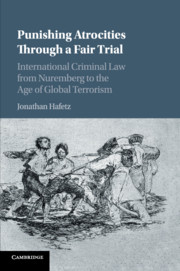

Over the past decades, international criminal law has evolved to become the operative norm for addressing the worst atrocities. Tribunals have conducted hundreds of trials addressing mass violence in the former Yugoslavia, Rwanda, Sierra Leone, Cambodia, and other countries to bring to justice perpetrators of genocide, war crimes, and crimes against humanity. But international courts have struggled to hold perpetrators accountable for these offenses while still protecting the fair trial rights of defendants. Punishing Atrocities through a Fair Trial explores this tension, from criticism of the Nuremberg Trials as 'victor's justice' to the accusations of political motivations clouding prosecutions today by the International Criminal Court. It explains why international criminal law must adhere to transparent principles of legality and due process to ensure its future as a legitimate and viable legal regime.
'Jonathan Hafetz has produced a deeply impressive analysis of the likely irreducible tension between fairness and accountability that characterizes trials for international crimes. At once historical, theoretical, critical - and above all deeply learned - the book should prove to be standard reading for years to come.'
Kevin Jon Heller - University of Amsterdam
'This text offers a lucid evaluation of the system of international criminal justice today - from its philosophical underpinnings to its enduring challenges - in an accessible and engaging way. Hafetz tackles some of the core debates in the field with expertise, including the problem of selectivity in prosecutions, techniques for translating collective criminality into individual criminal responsibility, finding the appropriate balance between the drive for accountability for the worst crimes known to humankind and the imperative of procedural fairness, and the challenge of integrating terrorism into the international criminal law canon. This book will be essential reading for the young scholar or practitioner interested in understanding the field as well as the seasoned adherent.'
Beth Van Schaack - Center for Advanced Study in the Behavioral Sciences (CASBS), Stanford University, California
'… I would suggest it as essential reading for judges, prosecutors, defense lawyers, and any judicial staff … Punishing Atrocities is a useful, practical, rewarding read that informs as much as it provokes.'
Michael G. Karnavas Source: International Criminal Law Blog (www.michaelgkarnavas.net/blog)
Loading metrics...
* Views captured on Cambridge Core between #date#. This data will be updated every 24 hours.
Usage data cannot currently be displayed.
This section outlines the accessibility features of this content - including support for screen readers, full keyboard navigation and high-contrast display options. This may not be relevant for you.
Accessibility compliance for the PDF of this book is currently unknown and may be updated in the future.