
Skip to main content Accessibility help
×
  • Cited by 321
    • Show more authors
    • You may already have access via personal or institutional login
    • Select format
    • Publisher:
      Cambridge University Press
      Publication date:
      18 December 2009
      03 January 2005
      ISBN:
      9780511614071
      9780521842655
      9780521603614
      Dimensions:
      (247 x 174 mm)
      Weight & Pages:
      0.71kg, 290 Pages
      Dimensions:
      (247 x 174 mm)
      Weight & Pages:
      0.575kg, 290 Pages
    You may already have access via personal or institutional login
  • Selected: Digital
    Add to cart View cart Buy from Cambridge.org

    Book description

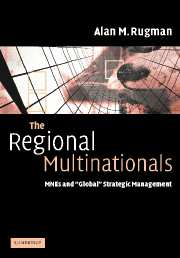
    Although many firms label themselves 'global', very few can back this up with truly global sales and operations. In The Regional Multinationals Alan Rugman examines first-hand data from multinationals and finds that most multinationals are strongly regional, with international operations in their home regions of North America, the US or Asia. Only a tiny proportion of the world's top 500 companies actually sell the same product and deliver the same services around the world. Rugman exposes the facts behind the popular myths of doing business globally, explores a variety of regional models and offers an authoritative agenda for future business strategy. The Regional Multinationals is the essential resource for all academics and students in International Business, Organization and Strategic Management, as well as those with an interest in finding out how multinationals really work in practice and how future strategy must respond.

    Reviews

    "Alan Rugman has unequivocably shown that most multinational enterprises operate at a regional rather than global level. Less hype and more accuracy regarding globalization can't be a bad thing." Paul W. Beamish, Director, Asian Management Institute, Ivey Business School, University of Western Ontario

    "a must-read for MNE executives, scolars of international management, and graduate students with their sights set on international business careers." Michael A. Hitt, Distinguished Professor, Texas A&M University

    "required reading for anyone interested in the evolving structure of the international economy or the strategy and organizational structure of international firms. Rugman's arguments and conclusions have novel and important implications for the strategic management of multinational firms, international business theory, economic governance and international business research." Stephen J. Kobrin, William Wurster Professor of Multinational Management, The Wharton School, University of Pennsylvania

    "As usual, Alan Rugman provides comprehensive data and thorough analysis to support a strong argument against conventional wisdom." Professor George S. Yip, London Business School, and author of Total Global Strategy

    "A must-read for academics, practitioners, and public policymakers who are looking for fresh ideas on the topic of globalization and global strategy." Joseph Cheng, Professor and Director, Center for International Business Education and Research (CIBER), University of Illinois at Urbana-Champaign

    Refine List

    Actions for selected content:

    Select all | Deselect all
    • View selected items
    • Export citations
    • Download PDF (zip)
    • Save to Kindle
    • Save to Dropbox
    • Save to Google Drive

    Save Search

    You can save your searches here and later view and run them again in "My saved searches".

    Please provide a title, maximum of 40 characters.
    ×

    Contents

    Case references
    Academic references
    Agarwal, J, Malhotra, N., and Wu, T. 2002. “Does NAFTA Influence Mexico's Product Image? A Theoretical Framework and an Empirical Investigation in Two Countries,” Management International Review 42(4): 441–71
    Barkema, H., Bell, J., and Pennings, J. 1996. “Foreign Entry, Cultural Barriers and Learning,” Strategic Management Journal 17(2): 151–66
    Bartlett, C. 1986. “Building and Managing the Transnational: The New Organizational Challenges” in Porter, M. E. (ed.) Competition in Global Industries, Boston, MA: Harvard Business School Press, pp. 367–406
    Bartlett, C. and Ghoshal, S. 1989. Managing Across Borders: The Transnational Solution, Cambridge, MA: Harvard Business School Press
    Bartlett, C. and Ghoshal, S. 1998. Managing Across Borders: The Transnational Solution (Second Edition), Boston, MA: Harvard Business School Press
    Bartlett, C. and Ghoshal, S. 2000. Text, Cases and Readings in Cross-Border Management, New York: Irwin/McGraw-Hill
    Bartlett, C. and Ghoshal, S. 2002. “The Transnational and Beyond: Reflections and Perspectives at the Millennium” in M. A. Hitt and J. C. Cheng (eds.) Managing Transnational Firms: Resources, Market Entry and Strategic Alliances, Oxford: Elsevier, pp. 3–36
    Bartlett, C., Ghoshal S., and Birkinshaw, J. 2003. Transnational Management: Text and Cases, Boston, MA: McGraw Hill
    Belis-Bergouignan, M. C., Bordenave, G., and Lung, Y. 2000. “Global Strategies in the Automobile Industry,” Regional Studies 34(1): 41–54
    Bhagwati, J. 2002. Free Trade Today, Princeton, NJ: Princeton University Press
    Birkinshaw, J. 2000. Entrepreneurship in the Global Firm, London: Sage
    Braintrust Research Group 2003. The Regional Nature of Global Multinational Activity, Toronto: Braintrust Research Group
    Buckley, P. 2002. “Is the International Business Research Agenda Running Out of Steam?Journal of International Business Studies 33(2): 365–73
    Buckley, P. and Casson, M. 1976. The Future of the Multinational Enterprise, London: Macmillan
    Buckley, P. and Casson, M. 1981. “The Optimal Timing of a Foreign Direct Investment,” Economic Journal, 91(361): 75–87
    Buckley, P., Dunning, J., and Pearce, R. 1977. “The Influence of Firm Size, Sector, Nationality, and Degree of Multinationality in the Growth and Profitability of the World's Largest Firms,” Weltwirtschaftliches Archiv ⅭXIV, pp. 243–57
    Buckley, P., Dunning, J., and Pearce, R. 1984. “An Analysis of the Growth and Profitability of the World's Largest Firms 1972 to 1977,” Kyklos 37(1): 3–27
    Campbell, A. and Verbeke, A. 1994. “The Globalization of Service Multinationals,” Long Range Planning 27(2): 95–102
    Campbell, A. and Verbeke, A. 2001. “The Multinational Management of Multiple External Network”, in Van den Bulcke, D. and Verbeke, A. (eds.) Globalisation and the Small Open Economy, Cheltenham: Elgar, pp. 193–209
    Cartwright, W. R. 1993. “Multiple Linked Diamonds and the International Competitiveness of Export-Dependent Industries: The New Zealand Experience,” Management International Review 33(2): 55–70
    Cohen, W. and Levinthal, D. 1990. “Absorptive Capacity: A New Perspective on Learning and Innovation,” Administrative Science Quarterly 35: 128–52
    D'Cruz, J. 1986. “Strategic Management of Subsidiaries” in H. Etemad and L. S. Dulude (eds.) Managing the Multinational Subsidiary, London: Croom Helm, pp. 75–80
    Daniels, J. 1987. “Bridging National and Global Marketing Strategies Through Regional Operations,” International Marketing Review 4(3): 29–44
    Dunning, J. H. 1981. International Production and the Multinational Enterprise, London: George Allen and Unwin
    Dunning, J. H. 1993. The Globalization of Business, London: Routledge
    Dunning, J. H. 1996. “The Geographic Sources of Competitiveness of Firms: Some Results of a New Survey,” Transnational Corporations 5(3): 1–30
    Dunning, J. H. 2001. Global Capitalism at Bay? London: Routledge
    Dunning, J. and Mucchielli, J. 2002. Multinational Firms: The Global-Local Dilemma, London: Routledge
    Dunning, J. and Norman, G. 1987. “The Location Choice of Offices of International Companies,” Environmental Planning A 19: 613–31
    Dunning, J. and Rugman, A. M. 1985. “The Influence of Hymer's Dissertation on the Theory of Foreign Direct Investment,” American Economic Review, Papers and Proceedings 75 (2): 228–32
    Egelhoff, W. 1982. “Strategy and Structure in Multinational Corporations: An Information-processing Approach,” Administrative Science Quarterly, 27: 435–58
    Enright, M. 2000. “The Globalization of Competition and the Localization of Competitive Advantage: Policies Towards Regional Clustering” in N. Hood and S. Young (eds.) Globalization of Economic Activity and Economic Development, Macmillan, Basingstoke, UK, pp. 303–31
    European Commission, 2002. Report on United States Barriers to Trade and Investment, 2000, Brussels: European Commission, July
    Fina, E. and Rugman, A. 1996. “A Test of Internalization Theory and Internationalization Theory: The Upjohn Company,” Management International Review 36 (3): 199–213
    Frankel, J., Stein, E., and Wei, S. J. 1995. “Trading Blocs and the Americas: The Natural, the Unnatural and the Super-natural,” Journal of Development Economics 47: 61–95
    Freeland, R. F. 1996. “The Myth of the M-Form? Governance, Consent, and Organizational Change,” American Journal of Sociology 102: 2 (September): 483–526
    Geringer, J. M., Beamish, P., and Costa, R. C. 1989. “Diversification Strategy and Internationalization: Implications for MNE Performance,” Strategic Management Journal 10(2): 109–19
    Gestrin, M. 2000. “The Globalization of Retail: On Your Marks …” European Retail Digest, 26: 6–8
    Gestrin, M., Knight, R., and Rugman, A. 2000. The Templeton Global Performance Index 2000, Templeton College, University of Oxford
    Ghemawat, P. 2001. “Distance Still Matters: The Hard Reality of Global Expansion,” Harvard Business Review 79 (8) (September): 137–47
    Ghemawat, P. 2003. “Semiglobalization and International Business Strategy,” Journal of International Business Studies 34(2): 138–52
    Govindarajan, V. and Gupta, A. 2001. The Quest for Global Dominance, San Francisco: Josey-Bass/Wiley
    Grosse, R. 1981. “Regional Offices of MNCs,” Management International Review 21(1): 48–55
    Hamel, G., Doz, Y., and Prahalad, C. 1989. “Collaborate With Your Competitors and Win,” Harvard Business Review 67 (1): 133–9
    Heenan, D. A. 1979. “The Regional Headquarters Division: A Comparative Analysis,” Academy of Management Journal 22 (2): 410–15
    Henderson, Fritz, 2003. “Capitalizing on Global Growth,” presentation at 2003 Tokyo Analyst Conference, October 20
    Hitt, M. A., Hoskisson, R. E., and Kim, H. 1997. “International Diversification: Effects on Innovation and Firm Performance in Product-diversified Firms,” Academy of Management Journal 40: 767–98
    Hymer, S. 1976. The International Operations of National Firms, Cambridge: MIT Press
    Jeannet, J. 2000. Managing with a Global Mindset, London: Financial Times / Prentice Hall, Pearson
    Johansson, J. and Vahlne, J. E. 1977. “The Internationalization Process of the Firm: A Model of Knowledge Development and Increasing Foreign Market Commitments,” Journal of International Business Studies 8 (1): 23–32
    Johansson, J. and Vahlne, J. E. 1990. “The Mechanism of Internationalization,” International Marketing Review 7(4): 1–24
    Kobrin, Stephen 1998. “The MAI and the Clash of Globalization,” Foreign Policy (112): 97–109
    Kogut, B. 1983. “Foreign Direct Investment as a Sequential Process” in C. P. Kindleberger and D. B. Audretsch (eds.) The Multinational Corporation in the 1980s. Cambridge, Mass.: MIT Press, pp. 38–56
    Kogut, B. and Kulatilaka, N. 1994. “Operating Flexibility, Global Manufacturing, and the Option Value of a Multinational Network,” Management Science 40 (1): 123–39
    Kogut, B. and Zander, U. 1993. “Knowledge of the Firm and the Evolutionary Theory of the Multinational Enterprise,” Journal of International Business Studies 24 (4): 625–45
    Koza, M. P. and Lewin, A. Y. 1998. “The Co-Evolution of Strategic Alliances,” Organization Science 9 (3): 255–64
    Krugman, P. 1993. “Regionalism Versus Multilateralism: Analytical Note” in J. de Melo and A. Panagarily (eds.) New Dimensions in Regional Integration, New York: Cambridge University Press, pp. 58–79
    Lasserre, P. 1996. “Regional Headquarters: The Spearhead for Asia Pacific Markets,” Long Range Planning 29: 30–37
    Levitt, T. 1983. “The Globalization of Markets,” Harvard Business Review, (May–June): 92–102
    Milner, H. V. 1988. Resisting Protectionism: Global Industries and the Policies of International Trade, Princeton, NJ: Princeton University Press
    Moon, C., Rugman, A., and Verbeke, A. 1998. “A Generalized Double Diamond Approach to the Global Competitiveness of Korea and Singapore,” International Business Review 7(2): 135–50
    Morck, R. and Yeung, B. 1991. “Why Investors Value Multinationality,” Journal of Business, 64(2): 165–87
    Morris, R. W. 2000. “Motor Vehicles 2000,” Survey of Current Business, (February 2001)
    Morrison, A. and Roth, K. 1991. The Regional Solution: An Alternative to Globalization, Transnational Corporations 1(2): 37–55
    Morrison, A., Ricks, D., and Roth, K. 1991. “Globalization Versus Regionalization: Which Way for the Multinational?Organizational Dynamics, 19(3): 17–29
    Nelson, R. and Winter, S. 1982. An Evolutionary Theory of Economic Change, Cambridge, Mass: Belknapp Press
    Ohmae, K. 1985. Triad Power: The Coming Shape of Global Competition, New York: The Free Press
    Ollinger, M. 1994. “The Limits of Growth of the Multidivisional Firm: A Case Study of the US Oil Industry from 1930–90,” Strategic Management Journal 15(7): 503–520
    Perlmutter, H. 1969. “The Tortuous Evolution of the Multinational Enterprise”, The Columbia Journal of World Business 4(1): 9–18
    Pomfret, R. 2001. The Economics of Regional Trading Arrangements, University of Oxford: Oxford University Press
    Poon, J. 1997. “The Cosmopolitanization of Trade Regions: Global Trends and Implications,” Economic Geography 73: 390–404
    Porter, M. 1986. (ed.) Competition in Global Industries, Boston, MA: Harvard Business School Press
    Porter, M. 1990. The Competitive Advantage of Nations, New York: Free Press-Macmillan
    Ronan, S. and Shenkar, O. 1985. “Clustering Countries on Attitudinal Dimensions: A Review and Syntheses,” Academy of Management Review 10: 435–54
    Rugman, A. 1976. “Risk Reduction by International Diversification,” Journal of International Business Studies 7(2): 85–90
    Rugman, A. 1981. Inside the Multinationals: The Economics of Internal Markets, New York: Columbia University Press
    Rugman, A. 1990. Multinationals and Canada US Free Trade, Columbia, SC: University of South Carolina Press
    Rugman, A. (ed.) 1994. Foreign Investment and NAFTA, Columbia, SC: University of South Carolina Press
    Rugman, A. 1996. The Theory of Multinational Enterprises, Cheltenham: Elgar
    Rugman, A. 2000. The End of Globalization, London: Random House and New York: Amacom-McGraw Hill
    Rugman, A. 2003. “Regional Strategy and the Demise of Globalization,” Journal of International Management 9 (4): 409–17
    Rugman, A. and Brain, C. 2003.“Multinationals are Regional, not Global,” Multinational Business Review 11 (1) Spring 2003: 3–12
    Rugman, A. and D'Cruz, J. R. 1993. “Developing International Competitiveness: The Five Partners Model,” Business Quarterly 58(2): 60–70
    Rugman, A. and D'Cruz, J. R. 2000. Multinationals as Flagship Firms: Regional Business Networks, Oxford: Oxford University Press
    Rugman, A. and Girod, S. 2003. “Retail Multinationals and Globalization: The Evidence is Regional,” European Management Review 21 (1): 24–37
    Rugman, A. and Hodgetts, R. 2003. “The End of Global Strategy,” European Management Journal 19(4): 333–43
    Rugman, A., Kirton, J., and Soloway, J. 1999. Environmental Regulations and Corporate Strategy, Oxford: Oxford University Press
    Rugman, A. and Kudina, A. 2002. “Britain, Europe and North America” in M. Fratianni et al. (eds.), Governing Global Finance, Aldershot, UK: Ashgate, pp. 185–95
    Rugman, A., Van den Broeck, J. and Verbeke, A. 1995 (eds.) Research in Global Strategic Management (5) Beyond the Diamond. Greenwich, Conn: JAI Press
    Rugman, A. and Verbeke, A. 1990a. Global Corporate Strategy and Trade Policy, London and New York: Routledge
    Rugman, A. and Verbeke, A. 1990b. “Strategic Planning, Adjustment and Trade Liberalisation” in A. Rugman, Multinationals and Canada-United States Free Canada, Columbia, SC: University of South Carolina Press, pp. 146–78
    Rugman, A. and Verbeke, A. 1991. “Environmental Change and Global Competitive Strategy in Europe” in A. Rugman and A. Verbeke (eds.), Research in Global Strategic Management, (2): Global Competition and the European Community, Conn.: JAI Press, pp. 3–28
    Rugman, A. and Verbeke, A. 1992. “A Note on the Transnational Solution and the Transaction Cost Theory of Multinational Strategic Management,” Journal of International Business Studies 23(4): 761–71
    Rugman, A. and Verbeke, A. 1993a. “Foreign Subsidiaries and Multinational Strategic Management: An Extension of Porter's Single Diamond Framework,” Management International Review 33(2): 71–84
    Rugman, A. and Verbeke, A. 1993b (eds.) Global Competition: Beyond the Three Generics. Research in Global Strategic Management (4), Greenwich, Connecticut/London, England: JAI Press Inc
    Rugman, A. and Verbeke, A. 1998a. “Multinational Enterprises and Public Policy,” Journal of International Business Studies 29(1): 115–36
    Rugman, A. and Verbeke, A. 1998b. “Corporate Strategies and Environmental Regulations: An Organizing Framework,” Strategic Management Journal 19(3): 363–75
    Rugman, A. and Verbeke, A. 2000. “Six Cases of Corporate Strategic Response to Environmental Regulation,” European Management Journal 18(4): 377–85
    Rugman, A. and Verbeke, A. 2001a. “Subsidiary-Specific Advantages in Multinational Enterprises,” Strategic Management Journal 22(8): 237–50
    Rugman, A. and Verbeke, A. 2001b. “Location, Competitiveness and the Multinational Enterprise,” in A. Rugman and T. Brewer, (eds.), The Oxford Handbook of International Business, Oxford: Oxford University Press, pp. 150–80
    Rugman, A. and Verbeke, A. 2002. “Edith Penrose's Contribution to the Resource-based View of Strategic Management,” Strategic Management Journal 23 (8): 769–80
    Rugman, A. and Verbeke, A. 2003a. “The World Trade Organization, Multinational Enterprises, and the Civil Society” in John Kirton (ed.) Sustaining Global Growth and Development, Aldershot, UK: Ashgate, 81–97
    Rugman, A. and Verbeke, A. 2003b. “Multinational Enterprises and Clusters: An Organizing Framework, Management International Review 43: Special Issue 3: 151–69
    Rugman, A. and Verbeke, A. 2003c. “Extending the Theory of the Multinational Enterprise: Internalization and Strategic Management Perspectives,” Journal of International Business Studies 34(2): 125–37
    Rugman, A. and Verbeke, A. 2003d. “Regional Multinationals and Triad Strategy” in A. Rugman (ed.) Leadership in International Business Education and Research. Oxford: Elsevier, pp. 253–68
    Rugman, A. and Verbeke, A. 2004. “A Perspective on Regional and Global Strategies of Multinational Enterprises,” Journal of International Business Studies 35 (1): 3–18
    Rugman, A., Verbeke, A. and Luxmore, S. 1990. “Corporate Strategy and the Free Trade Agreement: Adjustment by Canadian Multinational Enterprises,” Canadian Journal of Regional Science 13 (2/3): 307–30
    Ruigrok, W. and Wagner, H. 2003. “Internationalization and Performance: An Organizational Learning Perspective,” Management International Review 43(1): 63–83
    Salorio, E. 1993. “Strategic Use of Import Protection: Seeking Shelter for Competitive Advantage” in A. Rugman and A. Verbeke (eds.), Beyond the Three Generics, Greenwich, Conn.: JAI Press, pp. 101–24
    Schlie, E. and Yip, G. 2000. “Regional Follows Global: Strategy Mixes in the World Automotive Industry,” European Management Journal 18: 343–56
    Stopford, J. and Strange, S. 1991. Rival States, Rival Firms, Cambridge: Cambridge University Press
    Stopford, J. M. and Wells, L. T. 1972. Managing the Multinational Enterprise: Organization of the Firm and Ownership of the Subsidiaries, New York: Basic Books
    Tallman, S. B. and Yip, G. S. 2001. “Strategy and the Multinational Enterprise” in A. Rugman and T. Brewer (eds.) The Oxford Handbook of International Business, Oxford: Oxford University Press, pp. 317–48
    United Nations 2001. World Investment Report 2001, New York and Geneva: United Nations Conference on Trade and Development
    United Nations 2002. World Investment Report 2002, New York and Geneva: United Nations Conference on Trade and Development
    Van Den Bulcke, D. and Verbeke, A. 2001. Globalization and the Small Open Economy, Cheltenham and Northampton: Elgar
    Vermeulen, F. and Barkema, H. 2002. “Pace, Rhythm, and Scope: Process Dependence in Building a Profitable Multinational Corporation,” Strategic Management Journal 23: 637–53
    Vernon, R. 1966. “International Investment and International Trade in the Product Cycle,” Quarterly Journal of Economics 80: 190–207
    Vernon, R. 1971. Sovereignty at Bay, New York: Basic Books
    Viner, J. 1950. The Customs Union Issue, New York: Carnegie Endowment for International Peace
    Wan, W. P. and Hoskisson, R. E. 2003. “Home Country Environments, Corporate Diversification Strategies and Firm Performance,” Academy of Management Journal 46(1): 27–45
    Westney, E. and Zaheer S. 2001. “The Multinational Enterprise as an Organization” in Rugman A. M. and Verbeke, A. (eds.) The Oxford Handbook of International Business, Oxford: Oxford University Press, 2001, pp. 349–79
    Williamson, O. E. 1975. Markets and Hierarchies: Analysis and Antitrust Implications, New York: Free Press
    Wolf, J. and Egelhoff, W. G. 2002. “A Reexamination and Extension of International Strategy-Structure Theory,” Strategic Management Journal 23: 181–89
    Yeung, H., Wai-chung, P., Martin, J. and Martin, P. 2001. “Towards a Regional Strategy: The Role of Regional Headquarters of Foreign Firms in Singapore,” Urban Studies 38(1): 157–83
    Yip, G. 2002. Total Global Strategy II, Upper Saddle River, NJ: Prentice Hall
    Zaheer, S. 1995. “Overcoming the Liability of Foreignness,” Academy of Management Journal 38(2): 341–63
    Zaheer, S. and Mosakowski, E. 1997. “The Dynamics of the Liability of Foreignness: A Global Study of Survival in Financial Services,” Strategic Management Journal 18(6): 439–64

    Metrics

    Altmetric attention score

    Full text views

    Total number of HTML views: 0
    Total number of PDF views: 0 *
    Loading metrics...

    Book summary page views

    Total views: 0 *
    Loading metrics...

    * Views captured on Cambridge Core between #date#. This data will be updated every 24 hours.

    Usage data cannot currently be displayed.

    Accessibility standard: Unknown

    Why this information is here

    This section outlines the accessibility features of this content - including support for screen readers, full keyboard navigation and high-contrast display options. This may not be relevant for you.

    Accessibility Information

    Accessibility compliance for the HTML of this book is currently unknown and may be updated in the future.