
Skip to main content Accessibility help
×
  • Cited by 11
    • Show more authors
    • You may already have access via personal or institutional login
    • Select format
    • Publisher:
      Cambridge University Press
      Publication date:
      08 October 2018
      04 October 2018
      ISBN:
      9781108591478
      9781108426138
      9781108444590
      Dimensions:
      (228 x 152 mm)
      Weight & Pages:
      0.52kg, 240 Pages
      Dimensions:
      (229 x 152 mm)
      Weight & Pages:
      0.4kg, 244 Pages
    You may already have access via personal or institutional login
  • Selected: Digital
    Add to cart View cart Buy from Cambridge.org

    Book description

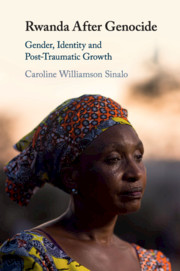
    In the 1994 Rwanda genocide, around 1 million people were brutally murdered in just thirteen weeks. This book offers an in-depth study of posttraumatic growth in the testimonies of the men and women who survived, highlighting the ways in which they were able to build a new, and often enhanced, way of life. In so doing, Caroline Williamson Sinalo advocates a new reading of trauma: one that recognises not just the negative, but also the positive responses to traumatic experiences. Through an analysis of testimonies recorded in Kinyarwanda by the Genocide Archive of Rwanda, the book focuses particularly on the relationship between posttraumatic growth and gender and examines it within the wider frames of colonialism and traditional cultural practices. Offering a striking alternative to dominant paradigms on trauma, the book reveals that, notwithstanding the countless tales of horror, pain, and loss in Rwanda, there are also stories of strength, recovery, and growth.

    Reviews

    'Rwanda after Genocide is an important and unique book. In a model of gender-inclusive research, Caroline Williamson Sinalo brings a deep humanity and critical vigour to her study of masculinities and femininities during and after the 1994 genocide. Drawing on revelatory and sometimes wrenching survivor testimonies, she has gleaned vital insights into the daunting challenge of 'post-traumatic growth' in Rwanda.'

    Adam Jones - author of Genocide: A Comprehensive Introduction

    'Based on extensive interviews of genocide survivors, Williamson Sinalo provocatively reconsiders how we ought to approach trauma in post-genocide Rwanda. While acknowledging the pain, suffering and loss many endured, her focus on post-traumatic growth offers a salutary complement to Western trauma theories which, too often, fail to recognize survivors’ ability to reshape their lives in ways they see as more meaningful than before the genocide.'

    Alexandre E. Dauge-Roth - Bates College, Maine

    ‘[T]his wise and luminous book about post-traumatic growth in Rwandan genocide survivor testimonies is essential reading for anyone interested in studying the legacies of violence in post-conflict situations.’

    Stef Craps - Ghent University

    ‘Navigating both the dark and bright days seen in Rwanda, and using the 1994 genocide as the central point of analysis, Caroline Williamson Sinalo offers a sensitive look at the pain experienced since.’

    Ernest Mutwarasibo - University of Rwanda

    'Caroline Williamson Sinalo's nuanced and complex account skewers two clichés about post-genocide Rwanda: everyday citizens lack agency and voice; and the consequences of the genocide for survivors have been exclusively negative. Analysing archival testimonies assembled by Rwandan researchers, Williamson Sinalo shows the limitations of Western theories of trauma when applied to the Rwandan context and highlights the salience of the provocative concept of 'posttraumatic growth'. This book is a must-read for anyone wanting to go beyond the black-and-white accounts of present day Rwanda and the narrow theoretical understandings of 'trauma' that currently dominate the literature.'

    Phil Clark - School of Oriental and African Studies, University of London

    Refine List

    Actions for selected content:

    Select all | Deselect all
    • View selected items
    • Export citations
    • Download PDF (zip)
    • Save to Kindle
    • Save to Dropbox
    • Save to Google Drive

    Save Search

    You can save your searches here and later view and run them again in "My saved searches".

    Please provide a title, maximum of 40 characters.
    ×

    Contents

    Metrics

    Altmetric attention score

    Full text views

    Total number of HTML views: 0
    Total number of PDF views: 0 *
    Loading metrics...

    Book summary page views

    Total views: 0 *
    Loading metrics...

    * Views captured on Cambridge Core between #date#. This data will be updated every 24 hours.

    Usage data cannot currently be displayed.

    Accessibility standard: Unknown

    Why this information is here

    This section outlines the accessibility features of this content - including support for screen readers, full keyboard navigation and high-contrast display options. This may not be relevant for you.

    Accessibility Information

    Accessibility compliance for the PDF of this book is currently unknown and may be updated in the future.