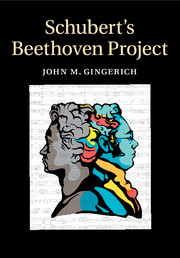

Why couldn't Schubert get his 'great' C-Major Symphony performed? Why was he the first composer to consistently write four movements for his piano sonatas? Since neither Schubert's nor Beethoven's piano sonatas were ever performed in public, who did hear them? Addressing these questions and many others, John M. Gingerich provides a new understanding of Schubert's career and his relationship to Beethoven. Placing the genres of string quartet, symphony, and piano sonata within the cultural context of the 1820s, the book examines how Schubert was building on Beethoven's legacy. Gingerich brings new understandings of how Schubert tried to shape his career to bear on new hermeneutic readings of the works from 1824 to 1828 that share musical and extra-musical pre-occupations, centering on the 'Death and the Maiden' Quartet and the Cello Quintet, as well as on analyses of the A-minor Quartet, the Octet, and of the 'great' C-Major Symphony.
'… presents intriguing evidence that Schubert followed Beethoven’s example by composing substantial works such as symphonies, piano sonatas, and string quartets for public performance and publication … Gingerich's investigation casts new light on Schubert’s late instrumental works and shows how, even though inspired by Beethoven, Schubert imbued them with his highly personal style. A thought-provoking contribution to Schubert scholarship … Essential.'
D. Arnold Source: Choice
‘… a new height and intensity in terms of the composers own musical outlook, would make such an idea an attractive one to contemplate …’
Seow-Chin Ong Source: 1650–1850
Loading metrics...
* Views captured on Cambridge Core between #date#. This data will be updated every 24 hours.
Usage data cannot currently be displayed.
This section outlines the accessibility features of this content - including support for screen readers, full keyboard navigation and high-contrast display options. This may not be relevant for you.
Accessibility compliance for the PDF of this book is currently unknown and may be updated in the future.