
Skip to main content Accessibility help
×
  • Cited by 138
    • Show more authors
    • You may already have access via personal or institutional login
    • Select format
    • Publisher:
      Cambridge University Press
      Publication date:
      15 December 2009
      12 July 2007
      ISBN:
      9780511557859
      9780521843652
      9780521604697
      Dimensions:
      (228 x 152 mm)
      Weight & Pages:
      0.508kg, 234 Pages
      Dimensions:
      (228 x 152 mm)
      Weight & Pages:
      0.394kg, 234 Pages
    You may already have access via personal or institutional login
  • Selected: Digital
    Add to cart View cart Buy from Cambridge.org

    Book description

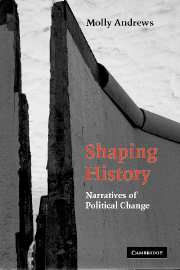
    Featuring extraordinary personal accounts, this book provides a unique window through which to examine some of the great political changes of our time, and reveals both the potential and the challenge of narrating the political world. Molly Andrews' novel analysis of the relationship between history and biography presents in-depth case studies of four different countries, offers insights into controversial issues such as the explosion of patriotism in post -9/11 USA; East Germans' ambivalent reactions to the fall of the Berlin Wall; the pressures on victims to tell certain kinds of stories while testifying before South Africa's Truth and Reconciliation Commission; and the lifelong commitment to fight for social justice in England. Each of the case studies explores the implicit political worldviews which individuals impart through the stories they tell about their lives, as well as the wider social and political context which makes some stories more 'tell-able' than others.

    Awards

    Outstanding Book Award, Narrative and Research SIG of the American Education Research Association

    Reviews

    'An absorbing reflection on the stories told by people involved in key political struggles of recent years. Molly Andrews gives a real sense of the personal and emotional commitment demanded by effective research, as well as by political activism. An essential read for those interested in political change and narrative.'

    Jenny Edkins - The University of Wales Aberystwyth

    'Molly Andrews' reflective essay on political activism draws on her studies over the past twenty years in the UK, East Germany, the United States, and South Africa. Weaving her own life story into her accounts of the developmental trajectories of her informants, she provides a complex and perceptive analysis of what led them to their views, drew them into their movements for justice and peace, and sustained them in their difficult struggles. Her fine-tuned examination of the intersection between personal histories and shifting sociopolitical processes is an important contribution to the expanding area of research on narrative and identity within historical contexts.'

    Elliot G. Mishler - Harvard Medical School

    'A stunning book that extends narrative theory and research in exciting new directions and counters the tendency to over-individualize the personal narrative. It is accessible, original and gracefully written and makes creative use of case studies with four contrasting sites of social and political change. I can't wait to assign the book in sociology courses although it also has relevance for political science and community development studies.'

    Catherine Kohler Riessman - Boston College

    'In this wonderfully accessible and engaging book Molly Andrews pushes forward our understanding of the nature and formation of political identities. Working with a treasure trove of narratives from Britain, the USA, East Germany and South Africa, collected over two decades, she unpicks the dense connections between biography and history and demonstrates their mutual relation in a most illuminating manner.'

    Margaret Wetherell - Director of the ESRC Identities and Social Action Programme, Open University

    ‘This is an inspiring book. It seamlessly weaves together theory in political science, psychology and sociology with the human stories, gathered in in-depth interviews, of people deeply engaged in important historical conditions and events. The concerns of the interviews range from identity, to commitment to causes and the moral meaning of actions. This is an important scholarly book that is a pleasure to read.’

    Ervin Staub - author of The Roots of Evil: The Origins of Genocide and Other Group Violence (Cambridge, 1992) and The Psychology of Good and Evil: Why Children, Adults, and Groups Help and Harm Others (Cambridge, 2003)

    'A very good application and extension of narrative theory, Shaping History is a wonderful addition to any qualitative methods course. Andrew's writing is personable, clear, and free of jargon.'

    Randle Hart - University of Toronto

    '[The author's] insights make this very engagingly written book essential reading for anyone interested in the relationship between individual and collective remembering. She is not afraid to ask the difficult, though, as she explains, her aim is not to come up with answers, more to expose 'layers of meaning'.'

    Source: Oral History

    Refine List

    Actions for selected content:

    Select all | Deselect all
    • View selected items
    • Export citations
    • Download PDF (zip)
    • Save to Kindle
    • Save to Dropbox
    • Save to Google Drive

    Save Search

    You can save your searches here and later view and run them again in "My saved searches".

    Please provide a title, maximum of 40 characters.
    ×

    Contents

    Bibliography
    Adam, H. and K. Adam (2000). ‘The Politics of Memory in Divided Societies’, in James, W. and Vijver, L., eds., After the TRC: Reflections on Truth and Reconciliation in South Africa. Cape Town: David Philip Publishers
    Ali, T. (2002). ‘A Political Solution is Required: September 17, 2001’, in Heuvel, K., ed., A Just Response: The Nation on Terrorism, Democracy and September 11, 2001. New York: Thunder's Mouth Press
    Allen, B. (1991). Germany East: Dissent and Opposition, rev. edn. New York: Black Rose Books
    Anderson, B. (1983). Imagined Communities: Reflections on the Origin and Spread of Nationalism. London: Verso
    Andrews, M. (1991). Lifetimes of Commitment: Aging, Politics, Psychology. Cambridge: Cambridge University Press
    Andrews, M.(1995). ‘Against Good Advice: Reflections on Conducting Research in a Country Where You Don't Speak the Language’, Oral History Review 20/1: 75–86
    Andrews, M.(1998). ‘One Hundred Miles of Lives: The Stasi Files as a People's History of East Germany’, Oral History 26/1: 24–31
    Andrews, M.(1999). ‘Truth-telling, Justice, and Forgiveness: A Study of East Germany's “Truth Commission”’, International Journal of Politics, Culture and Society 13/1: 103–120
    Andrews, M.(2000). ‘Forgiveness in Context’, Journal of Moral Education 29/1: 75–86
    Andrews, M.(2002). ‘Feminist Research with Non-feminist and Anti-feminist Women: Meeting the Challenge’, Feminism and Psychology 12/1: 55–78
    Andrews, M.(2003a). ‘Generational Consciousness, Dialogue, and Political Engagement’, in Edmunds, June and Turner, Bryan, eds., Generational Consciousness, Narrative and Politics. Boulder, CO: Rowman & Littlefield
    Andrews, M.(2003b). ‘Continuity and Discontinuity of East German Identity Following the Fall of the Berlin Wall: A Case Study’, in Gready, Paul, ed., Cultures of Political Transition: Memory, Identity and Voice. London: Pluto Press
    Andrews, M.(2004). ‘Memories of Mother: Counter-narratives of Early Maternal Influence’, in Bamberg, M. and Andrews, M., eds., Considering Counter-narratives: Narration and Resistance. Amsterdam: John Benjamins
    Andrews, M.(forthcoming). ‘Never the Last Word’, in Andrews, M., Squire, C., and Tamboukou, M., eds., Doing Narrative Research in the Social Sciences. London: Sage
    Andrews, M., S. D. Sclater, M. Rustin, C. Squire, and A. Treacher (2000). ‘Introduction’, in Andrews, M., Sclater, S. D., Squire, C., and Treacher, A., eds., Lines of Narrative: Psychosocial Perspectives. London: Routledge
    Apfelbaum, E. (2001). ‘The Dread: An Essay on Communication across Cultural Boundaries’, International Journal of Critical Psychology 4: 19–35
    Apfelbaum, E.(2002). ‘Restoring Lives Shattered by Collective Violence: The Role of Official Public Narratives in the Process of Memorialising’, Proceedings of the Conference on Narrative, Trauma and Memory: Working through the SA Armed Conflicts of the Twentieth Century. University of Cape Town, South Africa
    Arendt, H. (1958). The Human Condition. Chicago: University of Chicago Press
    Bauman, Z. (1992). Intimations of Postmodernity. London: Routledge
    Bell, D. (1960). The End of Ideology: On the Exhaustion of Political Ideas in the Fifties. Glencoe, IL: Free Press
    Bell, D.(2000). The End of Ideology: On the Exhaustion of Political Ideas in the Fifties: With ‘The Resumption of History in the New Century’. Cambridge, MA: Harvard University Press
    Berger, S. (2003). ‘Former GDR Historians in the Reunified Germany: An Alternative Historical Culture and its Attempts to Come to Terms with the GDR Past’, Journal of Contemporary History 38/1: 63–83
    Bhabha, H. K., ed., (1990). Nation and Narration. London: Routledge
    Bhavnani, K. K. (1990). ‘What's Power Got to do with it?: Empowerment and Social Research’, in Parker, I. and Shotter, J., eds., Deconstructing Social Psychology. London: Routledge
    Bodnar, J. (1996). Bonds of Affection: Americans Define their Patriotism. Princeton, NJ: Princeton University Press
    Bonner, Philip and Noor Nieftagodien (2003). ‘The Truth and Reconciliation Commission and the Pursuit of “Social Truth”. The Case of Kathorus’, in Posel, D. and Simpson, G., eds., Commissioning the Past: Understanding South Africa's Truth and Reconciliation Commission. Johannesburg: Witwatersrand University Press
    Boraine, A. (2000). A Country Unmasked: Inside South Africa's Truth and Reconciliation Commission. Oxford: Oxford University Press
    Bornat, Joanna, Chamberlayne, Prue, and Wengraf, Tom, eds., (2000). The Turn to Biographical Methods in Social Science: Comparative Issues and Examples. London: Routledge
    Borneman, J. (1991) After the Wall: East Meets West in the New Berlin. New York: Basic Books
    Braungart, M. and Braungart, R. (1986). ‘Life-course and Generational Politics’, Annual Review of Sociology 12: 205–231
    Brison, S. (2002). Aftermath: Violence and the Remaking of a Self. Princeton, NJ: Princeton University Press
    Brossat, A., Combe, S., Potel, J.-Y., and Szurek, J.-C. (1990). À l'est la mémoire retrouvée. Paris: Editions la Découverte
    Bruner, Jerome (1987). ‘Life as Narrative’, Social Research 54/1: 12–32
    Bundy, C. (2000). ‘The Beast of the Past: History and the TRC’, in James, W. and Vijver, L., eds., After the TRC: Reflections on Truth and Reconciliation in South Africa. Cape Town: David Philip Publishers
    Butler, R. N. (1963). ‘Recall and Retrospection’, Journal of the American Geriatrics Society 11, 523–529
    Camus, A. (1960). Resistance, Rebellion and Death. New York: Modern Library
    Cavell, S. (1997). ‘Comments on Veena Das's Essay “Language and Body: Transactions in the Construction of Pain” ’, in Kleinman, A., Das, V., and Lock, M., eds., Social Suffering. London: University of California Press
    Chang, N. (2002). Silencing Political Dissent: How post-September 11 Anti-terrorism Measures Threaten our Civil Liberties. New York: Seven Stories Press
    Charen, M. (1991). ‘They Can Protest but they Aren't Patriotic’, Gazette Telegraph. Colorado Springs, CO, February 6: B11
    Charles, R. (1972). ‘America, the Beautiful’, on album ‘A Message from the People’, http://www.sing365.com/music/lyric.nsf/America-The-Beautiful-lyrics-Ray-Charles/C12412B331C5297E48256C24000E44FD, accessed 12 June 2006
    Charles, R.(2006). http://www.cnn.com/2004/SHOWBIZ/Music/06/10/obit.charles, accessed 12 June 2006
    Cherry, J. (2000). ‘Historical Truth: Something to Fight for’, in Villa-Vicencio, C. and Verwoerd, W., eds., Looking Back, Reaching Forward: Reflections on the Truth and Reconciliation Commission of South Africa. London: Zed Books
    Chilton, P. A. and Schaffner, C. (2002). Politics as Text and Talk: Analytic Approaches to Political Discourse. Philadelphia: John Benjamins Publishing Co.
    Chomsky, N. (2002) ‘September 11th and the Aftermath: Where is the World Heading?: November 3, 2001’, in Heuvel, K. V., ed., A Just Response: The Nation on Terrorism, Democracy and September 11, 2001. New York: Thunder's Mouth Press
    Christie, K. (2000). The South African Truth Commission. London: Palgrave
    Cockburn, A. and J. St Clair (2001). ‘Counterpunch’, November 12, http://www.bushwatch.com/patriotism.htm, accessed 12 June 2006
    Collins, J. and Glover, R., eds., (2002). Collateral Language: A User's Guide to America's New War. New York: New York University Press
    Colvin, C. (2002). ‘Limiting Memory: The Roots and Routes of Storytelling in Post-apartheid, Post-TRC South Africa’, in Proceedings of the Conference on Narrative, Trauma and Memory: Working through the SA Armed Conflicts of the Twentieth Century. University of Cape Town, South Africa
    Connerton, P. (1989). How Societies Remember. Cambridge: Cambridge University Press
    Craige, B. J. (1996). American Patriotism in a Global Society. Albany, NY: State University of New York Press
    Das, V. (1990). ‘Our Work to Cry: Your Work to Listen’, in Das, V., ed., Mirrors of Violence: Communities, Riots and Survivors in South Asia. Oxford: Oxford University Press
    Das, V.(1997). ‘Language and the Body: Transactions in the Construction of Pain’, in Kleinman, A., Das, V., and Lock, M., eds., Social Suffering. London: University of California Press
    deGruchy, J. (2000). ‘The TRC and the Building of a Moral Culture’, in James, W. and Vijver, L., eds., (2000). After the TRC: Reflections on Truth and Reconciliation in South Africa. Cape Town: David Philip Publishers
    Denzin, N. (1989). Interpretive Biography. London: Sage
    Dienstag, J. F. (1997). ‘Dancing in Chains’: Narrative and Memory in Political Theory. Stanford, CA: Stanford University Press
    Du Toit, A. (2000). ‘Truth as Acknowledgement and Justice as Recognition’, in Rotberg, R. and Thompson, D., eds., Truth v. Justice: The Morality of Truth Commissions. Princeton, NJ: Princeton University Press
    East European Reporter (1989/90). 4/1
    Falk, R. (2002). ‘A Just Response: September 19, 2001’, in Heuvel, K. V., ed., A Just Response: The Nation on Terrorism, Democracy and September 11, 2001. New York: Thunder's Mouth Press
    Falk, R.(2003). The Great Terror War. New York: Olive Branch Press
    Flones, A. (2001). ‘Empty Patriotism: Ideologues at the Gate’, http://www.bushwatch.com/patriotism.htm accessed, accessed 12 June 2006
    Freeman, M. (2003). ‘Too Late: The Temporality of Memory and the Challenge of Moral Life’, Journal für Psychologie 11/1: 54–74
    Fukuyama, F. (1992). The End of History and the Last Man. New York: Free Press
    Garton Ash, T. (1997). The File: A Personal History. London: HarperCollins
    Gitlin, T. (2003). ‘Varieties of Patriotic Experience’, in Packer, George, ed., The Fight is for Democracy: Winning the War of Ideas in America and the World. New York: Perennial
    Gobodo-Madikizela, P. (2003). A Human Being Died that Night. Boston: Houghton Mifflin
    Greenspan, H. (1998). On Listening to Holocaust Survivors: Recounting and Life History. London: Praeger
    Hammersley, M. (1992). ‘On Feminist Methodology’, Sociology 26/2: 187–206
    Harris, S. (2004). The End of Faith. New York: W. W. Norton
    Hayner, Priscilla (2001). Unspeakable Truths: Confronting State Terror and Atrocity. London: Routledge
    Hendrix, J. (2006). http://www.popstarsplus.com/music_jimihendrix.htm, accessed 18 July 2006
    Henri, Y. (2003) ‘Reconciling Reconciliation: A Personal and Public Journey of Testifying before the South African Truth and Reconciliation Commission’, in Gready, P., ed., Political Transition: Politics and Cultures. London: Pluto Press
    Hershberg, E. and K. Moore (2002). ‘Introduction: Place, Perspective and Power – Interpreting September 11’, in Hershberg, E. and Moore, K., eds., Critical Views of September 11: Analyses from Around the World. New York: The New Press
    Heuvel, K. V., ed., (2002). A Just Response: The Nation on Terrorism, Democracy and September 11, 2001. New York: Thunder's Mouth Press
    Hofmeyr, I. (1993). ‘We Spend our Years as a Tale that is Told’: Oral Historical Narrative in a South African Chiefdom. Portsmouth, NH: Heinemann
    Horgan, J. (1997). The End of Science. Boston: Little Brown
    Hughes, L. (1938) ‘Let America Be America Again’ International Worker Order Pamphlet A New Song.
    Huntingdon, S. (2004). Who are We? America's Great Debate. London: Free Press
    Ignatieff, M. (1994). Blood and Belonging. London: Vintage
    James, W. and Vijver, L., eds., (2000). After the TRC: Reflections on Truth and Reconciliation in South Africa. Cape Town: David Philip Publishers
    Jarausch, K., H. Seeba, and D. Conradt (1997). ‘The Presence of the Past: Culture, Opinion, and Identity in Germany’, in Jarausch, Konrad, ed., After Unity: Reconfiguring German Identities. Oxford: Berghahn
    Johnson, C. (2000). Blowback: The Costs and Consequences of American Empire. New York: Henry Holt & Co.
    Kamali, M. (2001). ‘Accountability for Human Rights Violations: A Comparison of Transitional Justice in East Germany and South Africa’, Columbia Journal of Transnational Law 40/1: 89–142
    Keegan, T. (1988). Facing the Storm: Portraits of Black Lives in Rural South Africa. Cape Town: David Philip Publishers
    Kelman, H. (1997). ‘Nationalism, Patriotism, and National Identity: Social–psychological Dimensions’, in Staub, E. and Tal, D. Bar, eds., Patriotism in the Life of Individuals and Nations. Chicago: Nelson Hall
    Kenniston, K. (1968). Young Radicals. New York: Harcourt Brace
    Kingsolver, B. (2001) ‘And our Flag was still there’, http://www.bushwatch.com/patriotism.htm, accessed 12 June 2006
    Langellier, K. M. (2001). “You're Marked”: Breast Cancer, Tattoo and the Narrative Performance of Identity', in Brockmeier, J. and Carbaugh, D., eds., Narrative and Identity: Studies in Autobiography, Self, and Culture. Amsterdam and Philadelphia: John Benjamins Publishing Co.
    Lather, Patti (1988). ‘Feminist Perspectives on Empowering Research Methodologies’, Women's Studies International Forum 11: 569–581
    Laub, D. (1992). ‘Bearing Witness or the Vicissitudes of Listening’, in Felman, S. and Laub, D., eds., Testimony: Crises of Witnessing in Literature, Psychoanalysis and History. New York: Routledge
    Lieven, A. (2004). America Right or Wrong: An Anatomy of American Nationalism. London: Harper Perennial
    Maier, C. (2000). ‘Doing History, Doing Justice: The Narrative of the Historian and of the Truth Commission’, in Rotberg, R. and Thompson, D., eds., Truth v. Justice: The Morality of Truth Commissions. Princeton, NJ: Princeton University Press
    Mamdani, M. (2000). ‘A Diminished Truth’, in James, W. and Vijver, L., eds., After the TRC: Reflections on Truth and Reconciliation in South Africa. Cape Town: David Philip Publishers
    Mannheim, K. (1952) ‘The Problem of Generations’, in Kecskemet, P., ed., Essays on the Sociology of Knowledge. London: Routledge & Kegan Paul
    Massig, M. (2002). ‘October 17, 2001’, in Heuvel, K. V., ed., A Just Response: The Nation on Terrorism, Democracy and September 11, 2001. New York: Thunder's Mouth Press
    McAdams, A. J. (2001) Judging the Past in Unified Germany. Cambridge: Cambridge University Press
    McKibben, B. (2003). The End of Nature. London: Bloomsbury
    Meredith, M. (1999). Coming to Terms: South Africa's Search for Truth. New York: Public Affairs
    Miliband, R. (1979). ‘John Saville: A Presentation’, in Martin, D. E. and Rubenstein, D., eds., Ideology and the Labour Movement: Essays Presented to John Saville. London: Croom Helm
    Mills, C. W. (1959). The Sociological Imagination. New York: Grove Press
    Monteath, P. (1997). ‘Jena and the End of History’, in Alter, R. and Monteath, P., eds., Rewriting the German Past: History and Identity in the New Germany. New Jersey: Humanities Press
    Murrow, E. (1953). Ford Fiftieth Anniversary Show, CBS and NBC, June
    Myerhoff, B. (1982). ‘Life History among the Elderly: Performance, Visibility, and Re-membering’, in Ruby, J., ed., A Crack in the Mirror: Reflexive Perspectives in Anthropology. Philadelphia: University of Pennsylvania Press
    Naimark, N. (1992). ‘ “Ich will hier raus”: Emigration and the Collapse of the German Democratic Republic’, in Banac, I., ed., Eastern Europe in Revolution. Ithaca, NY: Cornell University Press
    Ndebele, N. (1998). ‘Memory, Metaphor, and the Triumph of Narrative’, in Nuttall, S. and Coetzee, C., eds., Negotiating the Past: The Making of Memory in South Africa. Cape Town: Oxford University Press
    Nuttall, S. and Coetzee, C., eds., (1998). Negotiating the Past: The Making of Memory in South Africa. Cape Town: Oxford University Press
    Nyatsumba, K. (2000). ‘Neither Dull nor Tiresome’, in James, W. and Vijver, L., eds., After the TRC: Reflections on Truth and Reconciliation in South Africa. Cape Town: David Philip Publishers
    Osiel, M. (1997). Mass Atrocity, Collective Memory and the Law. New Brunswick, NJ: Transaction Publishers
    Ostow, Robin (1993). ‘Restructuring Our Lives: National Unification and German Biographies’, Oral History Review 21/2: 1–8
    Packer, G., ed., (2003). The Fight is for Democracy: Winning the War of Ideas in America and the World. New York: Perennial
    Parker, T. (1996). Studs Terkel: A Life in Words. London: HarperCollins
    Philipsen, D. (1993). We were the People: Voices from East Germany's Revolutionary Autumn of 1989. Durham, NC: Duke University Press
    Plummer, K. (2001). Documents of Life 2: An Invitation to a Critical Humanism. London: Sage
    Polletta, F. (2002). ‘Plotting Protest: Mobilizing Stories in the 1960 Student Sit-ins’, in Davis, J., ed., Stories of Change: Narrative and Social Movements. Albany, NY: SUNY Press
    Polletta, F.(2006). It was Like a Fever: Storytelling in Protest and Politics. Chicago: University of Chicago Press
    Posel, D. (2002). ‘The TRC Report: What Kind of History? What Kind of Truth?’, in Posel, D. and Simpson, G., eds., Commissioning the Past: Understanding South Africa's Truth and Reconciliation Commission. Johannesburg: Witwatersrand University Press
    Prigogine, I. (1997). The End of Certainty. New York: Free Press
    Reich, J. (1990). ‘Reflections on Becoming an East German Dissident, on Losing the Wall and a Country’, in Prins, G., ed., Spring in Winter: The 1989 Revolutions. Manchester: Manchester University Press
    Renan, E. (1882/1990) ‘What is a Nation?’, in Bhabha, H. K., ed., Nation and Narration. London: Routledge
    Rice, J. S. (2002). ‘ “Getting our Histories Straight”: Culture, Narrative, and Identity in the Self-help Movement’, in Davis, J., ed., Stories of Change: Narrative and Social Movements. Albany, NY: SUNY Press
    Ricoeur, P. (1984, 1985, 1988). Time and Narrative, 1–3. Chicago: University of Chicago Press
    Rieder, J. (2003). ‘Into the Unknown: Unity and Conflict after September 11, 2001’, in Rieder, J. and Steinlight, S., eds., The Fractious Nation? Unity and Division in Contemporary American Life. Berkeley: University of California Press
    Rieder, J. and Steinlight, S., eds., (2003). The Fractious Nation? Unity and Division in Contemporary American Life. Berkeley: University of California Press
    Riessman, C. (2004). ‘Accidental Cases: Extending the Concept of Positioning in Narrative Studies’, in Bamberg, M. and Andrews, M., eds., Considering Counter-narratives: Narrating, Resisting, Making Sense. Amsterdam: John Benjamins Publishing Co.
    Riessman, C.(2005). ‘Exporting Ethics: A Narrative about Narrative Research in South India’, Health 9/4: 473–490
    Rokeach, M. (1960). The Open and Closed Mind. New York: Basic Books
    Rosenberg, T. (1999a). ‘Afterword’, in Meredith, M., Coming to Terms: South Africa's Search for Truth. New York: Public Affairs
    Rosenberg, T.(1999b). ‘Foreword’, in Meredith, M., Coming to Terms: South Africa's Search for Truth. New York: Public Affairs.
    Ross, F. (2003). Bearing Witness: Women and the Truth and Reconciliation Commission in South Africa. London: Pluto Press
    Rotberg, R. and Thompson, D., eds., (2000). Truth v. Justice: The Morality of Truth Commissions. Princeton, NJ: Princeton University Press
    Sachs, A. (2000). ‘His Name was Henry’, in James, W. and Vijver, L., eds., After the TRC: Reflections on Truth and Reconciliation in South Africa. Cape Town: David Philip Publishers
    Scheer, R. (2001). ‘Commentary: A True Patriot Can Pose Hard Questions’, October 23, http://www.bushwatch.com/patriotism.htm, accessed 12 June 2006
    Scheub, H. (1996). The Tongue is Fire: South African Storytellers and Apartheid. Madison, WI: University of Wisconsin Press
    Scheub, H.(1998). Story. Madison, WI: University of Wisconsin Press
    Shriver, D. (1995). An Ethic for Enemies: Forgiveness in Politics. Oxford: Oxford University Press
    Staub, E. (1997). ‘Blind versus Constructive Patriotism: Moving from Embeddedness in the Group to Critical Loyalty and Action’, in Staub, E. and Tal, D. Bar, eds., Patriotism in the Life of Individuals and Nations. Chicago: Nelson Hall
    Stoddard, E. W. and G. H. Cornwell (2002). ‘Unity’, in Collins, J. and Glover, R., eds., Collateral Language: A User's Guide to America's New War. New York: New York University Press
    Szymborska, W. (1996). ‘The Poet and the World’, Nobel Lecture, 7 December 1996, http://nobelprize.org/literature/laureates/1996/szymborska-lecture.html, accessed 13 June 2005
    Tarifa, F. and Weinstein, J. (1995/1996). ‘Overcoming the Past: De-communization and Reconstruction of Post-Communist Societies’, Studies in Comparative International Development 30/4: 63–77
    Tebbit, N. (2005). ‘ “Cricket Test could have Stopped Bombings” ’, 19 August, ePolitix.com http://www.epolitix.com/EN/News/200508/072d2cc0-3f3a-494f-8590-3e51127e853b.htm, accessed 20 July 2006
    Thompson, D. (1996). The End of Time. London: Sinclair-Stevenson
    Thompson, E. P. (1963). The Making of the English Working Class. London: Victor Gollancz
    Thompson, P. (1978). The Voice of the Past: Oral History. Oxford: Oxford University Press
    Thompson, P.(1990). ‘News from Abroad: Europe’, Oral History 18/1: 18–20
    Thornton, P. M. and T. F. Thornton (2002). ‘Blowback’, in Collins, J. and Glover, R., eds., Collateral Language: A User's Guide to America's New War. New York: New York University Press
    Tilly, C. (2002). Stories, Identities and Political Change. New York: Rowman & Littlefield
    Torpey, J. (1995). Intellectuals, Socialism and Dissent: East German Opposition and its Legacy. Minneapolis, MN: University of Minnesota Press
    Truth and Reconciliation Commission (1998). Truth and Reconciliation Commission of South Africa Report, 5. Cape Town: Truth and Reconciliation Commission
    Tutu, Desmond (1998). ‘Chairperson's Foreword’, in Truth and Reconciliation Commission of South Africa Report, 5. Cape Town: Truth and Reconciliation Commission
    Tutu, Desmond(1999). No Future without Forgiveness. London: Rider
    Villa-Vicencio, C. and Verwoerd, W., eds., (2000). Looking Back, Reaching Forward: Reflections on the Truth and Reconciliation Commission of South Africa. London: Zed Books
    Walkerdine, V. (2003). ‘Video Diaries as Data and as Television’, CNR Narrative Workshop VI: Visual Narratives, King's College Cambridge
    Walzer, M. (1987). Interpretation and Social Criticism. Cambridge, MA: Harvard University Press
    Wang, Q. and Brockmeir, J. (2002). ‘Autobiographical Remembering as Cultural Practice: Understanding the Interplay between Memory, Self and Culture’, Culture and Psychology 8/1: 45–64
    Washington Post (2006). http://www.washingtonpost.com/wp-dyn/content/article/2006/06/09/AR2006060901547_pf.html, accessed 20 June 2006
    Weschler, L. (1990). A Miracle, a Universe: Settling Accounts with Torturers. New York: Pantheon
    Whitebrook, M. (2001). Identity, Narrative and Politics. London: Routledge
    Williams, P. J. (2002). ‘Pax Americana: September 12, 2001’, in Heuvel, K. V., ed., A Just Response: The Nation on Terrorism, Democracy and September 11, 2001. New York: Thunder's Mouth Press
    Willis, E. (2002). ‘Dreaming of War: September 26, 2001’, in Heuvel, K. V., ed., A Just Response: The Nation on Terrorism, Democracy and September 11, 2001. New York: Thunder's Mouth Press
    Wilson, R. (1996). ‘The Sizwe Will not Go Away: The Truth and Reconciliation Commission, Human Rights and Nation-building in South Africa’, African Studies 55/2: 1–20
    Wolf, C. (1997). Parting from Phantoms: Selected Writings, 1990–1994. Chicago: University of Chicago Press
    Woods, R. (1986). Opposition in the GDR under Honecker 1971–85. New York: St Martin's Press
    Yevtushenko, Y. (2002) ‘Babi Yar in Manhattan: September 26, 2001’, in Heuvel, K. V., ed., A Just Response: The Nation on Terrorism, Democracy and September 11, 2001. New York: Thunder's Mouth Press
    Yoder, J. (1999). ‘Truth without Reconciliation: An Appraisal of the Enquete Commission on the SED Dictatorship in Germany’, German Politics 8/3: 59–80
    Yuval-Davis, N. (2006). ‘Belonging and the Politics of Belonging’, Patterns of Prejudice 40/3: 196–213

    Metrics

    Altmetric attention score

    Full text views

    Total number of HTML views: 0
    Total number of PDF views: 0 *
    Loading metrics...

    Book summary page views

    Total views: 0 *
    Loading metrics...

    * Views captured on Cambridge Core between #date#. This data will be updated every 24 hours.

    Usage data cannot currently be displayed.

    Accessibility standard: Unknown

    Why this information is here

    This section outlines the accessibility features of this content - including support for screen readers, full keyboard navigation and high-contrast display options. This may not be relevant for you.

    Accessibility Information

    Accessibility compliance for the PDF of this book is currently unknown and may be updated in the future.