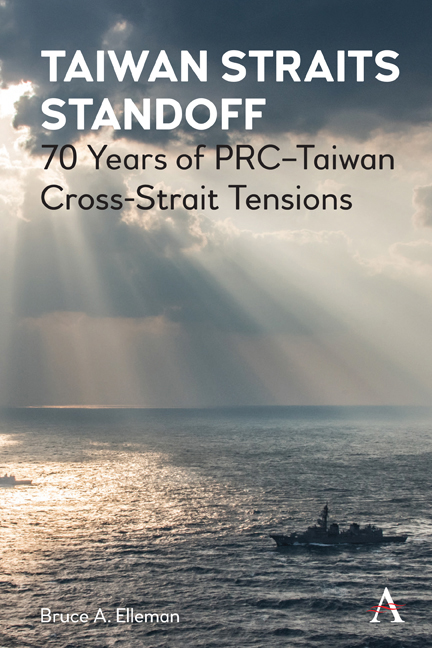
Taiwan Straits Standoff

-
The digital format of this book is no longer available to purchase from Cambridge Core. Other formats may be available.
-
Select format
-
- Publisher:
- Anthem Press
- Publication date:
- 14 December 2021
- ISBN:
- 9781839980916
- Dimensions:
- Weight & Pages:
- Dimensions:
- Weight & Pages:
- Subjects:
- East Asian History, Area Studies, Asian Studies, History
You may already have access via personal or institutional login- Subjects:
- East Asian History, Area Studies, Asian Studies, History
Show more authors 
You may already have access via personal or institutional login
Book description
Following the Nationalist defeat on the mainland in 1949, Chiang Kai-shek and his followers retreated to Taiwan, forming the Republic of China (ROC). Tensions with the People’s Republic of China (PRC) focused on control over a number of offshore islands, especially Quemoy (Jinmen) and Matsu (Mazu). Twice in the 1950s tensions peaked, during the first (1954–55) and second (1958) Taiwan Strait crises. This small body of water - often compared to the English Channel - separates the PRC and Taiwan, and has been the location for periodic military tensions, some threatening to end in war. Today, relations between the ROC and PRC depend on quelling tensions over the Taiwan Strait. This work provides a short, but highly relevant, history of the Taiwan Strait, and its significance today.
Contents
Contents
Metrics
Full text views
Full text views helpTotal number of HTML views: 0
Total number of PDF views: 0 *
 Loading metrics...
* Views captured on Cambridge Core between #date#. This data will be updated every 24 hours.
Usage data cannot currently be displayed.
Accessibility standard: Unknown
Why this information is here
This section outlines the accessibility features of this content - including support for screen readers, full keyboard navigation and high-contrast display options. This may not be relevant for you.
Accessibility Information
Accessibility compliance for the PDF of this book is currently unknown and may be updated in the future.