
Skip to main content Accessibility help
×
  • Cited by 15
    • Show more authors
    • You may already have access via personal or institutional login
    • Select format
    • Publisher:
      Cambridge University Press
      Publication date:
      04 May 2023
      25 May 2023
      ISBN:
      9781108979986
      9781108969901
      Dimensions:
      Weight & Pages:
      Dimensions:
      (178 x 127 mm)
      Weight & Pages:
      0.09kg, 86 Pages
    You may already have access via personal or institutional login
  • Selected: Digital
    Add to cart View cart Buy from Cambridge.org

    Book description

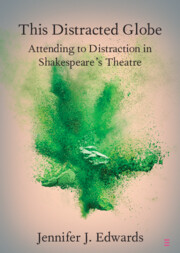
    This Element attends to attention drawn away. That the Globe is a 'distracted' space is a sentiment common to both Hamlet's original audience and attendees at the reconstructed theatre on London's Bankside. But what role does distraction play in this modern performance space? What do attitudes to 'distraction' reveal about how this theatre space asks and invites us to pay attention? Drawing on scholarly research, artist experience, and audience behaviour, This Distracted Globe considers the disruptive, affective, phenomenological, and generative potential of distraction in contemporary performance at the Globe.

    References

    Shakespeare’s Globe Theatre Archive (SGT)

    • GB 3316 SGT/DEV/EV/202 – Findings from the 1995 Globe Workshop Season Report by Pauline Kiernan, October 1995.

    • GB 3316 SGT/ED/RES/2/2 – End-of-season interviews, 2006–19.

      • [1] GB 3316 SGT/ED/RES/2/2/2010/11

      • [2] GB 3316 SGT/ED/RES/2/2/2011/1

      • [3] GB 3316 SGT/ED/RES/2/2/2018/2

      • [4] GB 3316 SGT/ED/RES/2/2/2008/3

      • [5] GB 3316 SGT/ED/RES/2/2/2009/4

      • [6] GB 3316 SGT/ED/RES/2/2/2010/6

      • [7] GB 3316 SGT/ED/RES/2/2/2008/1

      • [8] GB 3316 SGT/ED/RES/2/2/2010/9

      • [9] GB 3316 SGT/ED/RES/2/2/2010/7

      • [10] GB 3316 SGT/ED/RES/2/2/2009/6

      • [11] GB 3316 SGT/ED/RES/2/2/2009/2

      • [12] GB 3316 SGT/ED/RES/2/2/2007/1

      • [13] GB 3316 SGT/ED/RES/2/2/2010/13

      • [14] GB 3316 SGT/ED/RES/2/2/2010/5

      • [15] GB 3316 SGT/ED/RES/2/2/2015/1

      • [16] GB 3316 SGT/ED/RES/2/2/2010/12

      • [17] GB 3316 SGT/ED/RES/2/2/2019/1

      • [18] GB 3316 SGT/ED/RES/2/2/2010/8

      • [19] GB 3316 SGT/ED/RES/2/2/2010/4

      • [20] GB 3316 SGT/ED/RES/2/2/2008/2

      • [21] GB 3316 SGT/ED/RES/2/2/2009/3

      • [22] GB 3316 SGT/ED/RES/2/2/2010/2

      • [23] GB 3316 SGT/ED/RES/2/2/2010/3

      • [24] GB 3316 SGT/ED/RES/2/2/2009/5

      • [25] GB 3316 SGT/ED/RES/2/2/2014/1

      • [26] GB 3316 SGT/ED/RES/2/2/2019/2

      • Bailey, Lucy – Timon of Athens (dir.), 2008; Titus Andronicus (dir.), 2014.

      • Bertenshaw, Michael – All’s Well That Ends Well, 2011.

      • Bushell, Kirsty – Romeo and Juliet, 2017.

      • Butler, Graham – Henry V, 2012.

      • Coy, Jolyon – Antony and Cleopatra, 2014.

      • Cullen, Jonathan – Doctor Faustus, 2011.

      • Dee, Janie – All’s Well That Ends Well, 2011.

      • Doel, Imogen – The Taming of the Shrew, 2016.

      • Dromgoole, Dominic – King Lear (dir.), 2008.

      • Edwards, Charles – Much Ado About Nothing, 2011.

      • Flynn, Matthew – Henry V, 2012.

      • Garnon, James – All’s Well That Ends Well, 2011.

      • Mann, Jake – Titus Andronicus, 2014.

      • Marcell, Joseph – Much Ado About Nothing, 2011.

      • Monaghan, Jack – As You Like It, 2015.

      • Munby, Jonathan – A Midsummer Night’s Dream (dir.), 2008.

      • Nadarajah, Nadia – Globe Ensemble, 2018.

      • Needham, Matthew – Titus Andronicus, 2014.

      • Rosheuvel, Golda – Romeo and Juliet, 2017.

      • Saba, Sirine – Antony and Cleopatra, 2014.

      • Schlesinger, Helen – Globe Ensemble, 2018.

      • Shelford, Gary – As You Like It, 2015.

      • Terry, Michelle – As You Like It, 2015.

      • Wynter, Danny Lee – King Lear, 2008.

    • GB 3316 SGT/THTR/SR/2014 – Show reports for 2014 season.

    • GB 3316 SGT/THTR/SR/2021 – Show reports for 2021 season.

    • Holmes, Sean, and Prime Isaacs. ‘Meet the Director – A Midsummer Night’s Dream’, internal interview, 7 May 2021.

    • Ince, Ola, and Rachel Lemon. ‘Meet the Director – Romeo and Juliet’, internal interview, 21 June 2021.

    • O’Hea, Brendan, and Vanessa Faye-Stanley. ‘Meet the Director – Globe on Tour’, internal interview, 4 June 2021.

    • SGT/COMM/PUB/1/11/2 – ‘A Culture of Revenge’, Titus Andronicus programme interview with Lucy Bailey, 2006, pp. 14–15.

    • SGT/THTR/SM/1/2021/MND (2 boxes) – Production notes, A Midsummer Night’s Dream (2021).

    • ‘A Midsummer Night’s Dream 2021 – Covid Specific RA’, April 2020.

    • ‘Principles of Covid Safe Rehearsing/Performing’, 2 March 2020.

    Online Resources

    Royal Shakespeare Company (RSC). ‘Press Release: Shakespeare Still Has Power to Shock – RSC Titus Andronicus Audience Research Project Results’. 26 October 2017. www.rsc.org.uk/press/releases/shakespeare-still-has-power-to-shock---rsc-titus-andronicus-audience-research-project-results.
    Shakespeare’s Globe. ‘Announcing Summer 2021 at the Globe’. Blog. 24 March 2021. www.shakespearesglobe.com/discover/blogs-and-features/2021/03/24/announcing-summer-2021-at-the-globe/.
    Shakespeare’s Globe ‘Shakespeare’s Globe in Lockdown: One Year Later’. Blog. 18 March 2021. www.shakespearesglobe.com/discover/blogs-and-features/2021/03/18/shakespeares-globe-in-lockdown-one-year-later/.
    Shakespeare’s Globe ‘Press Release: Globe Announces New Digital Content, Free Films, Mark Rylance’s Shakespeare Walks, and Online Support for Students’. 30 March 2020. https://cdn.shakespearesglobe.com/uploads/2020/03/Press-Release-SGT-Digital-Content-for-Isolation-FINAL.pdf.
    Shakespeare’s Globe ‘Press Release: Shakespeare’s Globe Announces the Return of Standing Tickets’. 19 July 2021. https://cdn.shakespearesglobe.com/uploads/2021/07/Press-Release-Shakespeares-Globe-Announces-the-Return-of-Standing-Tickets.pdf.
    Shakespeare’s Globe ‘Thought of the Week: Remember Thee!’. Blog. 13 June 2020. www.shakespearesglobe.com/discover/blogs-and-features/2020/06/13/thought-of-the-week-remember-thee/.
    Shakespeare’s Globe ‘Thought of the Week: The Power of the Mind’. Blog. 17 April 2020. www.shakespearesglobe.com/discover/blogs-and-features/2020/04/17/thought-of-the-week-the-power-of-the-mind/.
    Shakespeare’s Globe ‘Thought of the Week: The Readiness Is All’. Blog. 29 May 2020. www.shakespearesglobe.com/discover/blogs-and-features/2020/05/29/thought-of-the-week-the-readiness-is-all/.
    Shakespeare’s GlobeTwelfth Night: Visual Story’. 2021. https://cdn.shakespearesglobe.com/uploads/2021/09/Visual-Story-Twelfth-Night-2021.pdf.

    Other Works

    Adorno, Theodor. ‘The Essay as Form’. New German Critique, Spring–Summer, no. 32, 1984: 151–71.
    Aebischer, Pascale. Viral Shakespeare: Performance in the Time of Pandemic. Cambridge: Cambridge University Press, 2021.
    Aebischer, Pascale, and Nicholas, Rachael. Digital Theatre Transformation: A Case Study and Digital Toolkit. Oxford: Creation Theatre, 2020.
    Ahmed, Sara. The Promise of Happiness. Durham, NC: Duke University Press, 2010.
    À Kempis, Thomas. Of the Imitation of Christ, trans. Thomas Rogers. London: printed by Henry Denham, 1580.
    Alford, Lucy. Forms of Poetic Attention. New York: Columbia University Press, 2020.
    Allred, Gemma Kate, Broadribb, Benjamin, and Sullivan, Erin, eds. Lockdown Shakespeare: New Evolutions in Performance. London: Bloomsbury Arden Shakespeare, 2022.
    Banks, Fiona, ed. Shakespeare: Actors and Audiences. London: Bloomsbury, 2018.
    Bar, Moshe. Mindwandering: How It Can Improve Your Mood and Boost Your Creativity. London: Bloomsbury, 2022.
    Barthes, Roland. The Neutral: Lecture Course at the Collège de France, 1977–1978, trans. Rosalind E. Krauss and Dennis Hollier. New York: Columbia University Press, 2005.
    Bell, Julia. Radical Attention. London: Peninsula Press, 2020.
    Bevis, Matthew. ‘In Search of Distraction’. Poetry, vol. 211, no. 2, 2017: 171–94.
    Billington, Michael. ‘To Hear or Not to Hear’. The Guardian, 15 June 2000.
    Blesser, Barry, and Salter, Linda-Ruth. Spaces Speak, Are You Listening? Experiencing Aural Architecture. Cambridge, MA: MIT Press, 2009.
    Böhme, Gernot. Atmospheric Architectures: The Aesthetics of Felt Spaces, trans. A.-Chr. Engles-Schwarzpaul. London: Bloomsbury, 2017.
    Brennan, Teresa. The Transmission of Affect. Ithaca, NY: Cornell University Press, 2004.
    Brown, Mark. ‘Shakespeare’s Globe to Reopen in May Staging Plays with No Intervals’. The Guardian, 24 March 2021.
    Burrows, Ian. Shakespeare for Snowflakes: On Slapstick and Sympathy. Winchester: Zero Books, 2020.
    Carson, Christie, and Karim-Cooper, Farah, eds. Shakespeare’s Globe: A Theatrical Experiment. Cambridge: Cambridge University Press, 2008.
    Clark, Nick. ‘Globe Theatre Takes Out 100 Audience Members with Its Gory Titus Andronicus’. The Independent, 22 July 2014.
    Conkie, Rob. ‘The Archive: Show Reporting Shakespeare’, in The Arden Research Handbook of Shakespeare and Contemporary Performance. Kirwan, Peter and Prince, Kathryn, eds. London: Bloomsbury Arden Shakespeare, 2021, pp. 2537.
    Cook, Amy. ‘Cognitive Interplay: How Blending Theory and Cognitive Science Reread Shakespeare’, in Stylistics and Shakespeare’s Language: Transdisciplinary Approaches. Culpeper, Jonathan and Ravassat, Mireille, eds. London: Bloomsbury, 2011, pp. 246–68.
    Cotterill, Anne. Digressive Voices in Early Modern English Literature. Oxford: Oxford University Press, 2004.
    Dawson, Anthony B.The Distracted Globe’, in The Culture of Playgoing in Shakespeare’s England: A Collaborative Debate. Dawson, Anthony B. and Yachnin, Paul, eds. Cambridge: Cambridge University Press, 2001, pp. 88107.
    Deleuze, Gilles. The Logic of Sense, trans. Boundas, Constantin V., Lester, Mark, and Stivale, Charles J.. London: Bloomsbury, 2015.
    Derrida, Jacques. On the Name, trans. Thomas Dutoit. Stanford, CA: Stanford University Press, 1995.
    Downame, John. A Guide to Godlynesse. London: printed by Felix Kingstone, 1622.
    Dryden, John, trans. Plutarch’s Lives. London: printed by T. Hodgkin, 1683.
    Dugan, Holly. ‘“As Dirty as Smithfield and as Stinking Every Whit”: The Smell of the Hope Theatre’, in Shakespeare’s Theatres and the Effects of Performance. Karim-Cooper, Farah and Stern, Tiffany, eds. London: Bloomsbury Arden Shakespeare, 2014, pp. 195213.
    Dustagheer, Sarah. ‘Original Practices: Old Ways and New Directions’, in The Arden Research Handbook of Shakespeare and Contemporary Performance. Kirwan, Peter and Prince, Kathryn, eds. London: Bloomsbury Arden Shakespeare, 2021, pp. 6581.
    Escolme, Bridget. Talking to the Audience: Shakespeare, Performance, Self. London: Routledge, 2005.
    Escolme, BridgetBeing Good: Actors’ Testimonies as Archive and the Cultural Construction of Success in Performance’. Shakespeare Bulletin, vol. 28, no. 1, 2010: 7791.
    Eyal, Nir. Indistractable: How to Control Your Attention and Choose Your Life. London: Bloomsbury, 2019.
    Freedman, Barbara. Staging the Gaze: Postmodernism, Psychoanalysis, and Shakespearean Comedy. Ithaca, NY: Cornell University Press, 1991.
    Gardner, Lyn. ‘Titus Andronicus Review’. The Guardian, 11 May 2014.
    Goldberg, Jonathan. The Seeds of Things: Theorizing Sexuality and Materiality in Renaissance Representation. New York: Fordham University Press, 2009.
    Granada, Luis de. Of Prayer and Meditation, trans. Richard Hopkins. Paris: printed by Thomas Brumeau, 1582.
    Greenblatt, Stephen. Shakespearean Negotiations: The Circulation of Social Energy in Renaissance England. Oxford: Clarendon Press, 1988.
    Greenblatt, Stephen The Swerve: How the World Became Modern. New York: W. W. Norton, 2011.
    Griffero, Tonino. Atmospheres: Aesthetics of Emotional Spaces, trans. Sarah de Sanctis. Farnham: Ashgate, 2014.
    Griffero, Tonino Quasi-Things: The Paradigm of Atmospheres, trans. Sarah de Sanctis. New York: State University of New York Press, 2017.
    Hari, Johann. Stolen Focus: Why You Can’t Pay Attention. London: Bloomsbury, 2022.
    Heim, Caroline. Audience as Performer: The Changing Role of Theatre Audiences in the Twenty-First Century. London: Routledge, 2015.
    Hemming, Sarah. ‘Titus Andronicus, Shakespeare’s Globe, London – Review’. Financial Times, 2 May 2014.
    Hodgdon, Barbara. ‘Shopping in the Archives: Material Memories’, in Shakespeare, Memory and Performance. Holland, Peter, ed. Cambridge: Cambridge University Press, 2006, pp. 135–67.
    Johns, Dani. ‘It’s No Joke – Since Lockdown, Live Audiences Have Forgotten How to Behave’. The Guardian, 21 April 2022.
    Johnson, Ryan J. The Deleuze-Lucretius Encounter. Edinburgh: Edinburgh University Press, 2016.
    Karim-Cooper, Farah. ‘Shakespeare’s War on Terror: Critical Review of Shakespeare’s Titus Andronicus (Directed by Lucy Bailey) at Shakespeare’s Globe, London, 2006)’. Shakespeare, vol 4, no. 1 (2008): 6371.
    Karremann, Isabel. The Drama of Memory in Shakespeare’s History Plays. Cambridge: Cambridge University Press, 2015.
    Kenny, Amy. ‘“I Hope ’Twill Make You Laugh”: Audience Laughter at the Globe Theatre’. Research International, vol. 40, no. 1, 2015: 3749.
    Kiernan, Pauline. Staging Shakespeare at the New Globe. Basingstoke: Macmillan, 1999.
    Kirwan, Peter. ‘Titus Andronicus @ Shakespeare’s Globe’. The Bardathon, 4 July 2014.
    Kirwan, Peter, and Sullivan, Erin. ‘Shakespeare in Lockdown (Review)’. Shakespeare Bulletin, vol. 38, no. 3, 2020: 489–93.
    Korducki, Kelli María. ‘I Have “Pandemic Brain”. Will I Ever Be Able to Concentrate Again?’. The Guardian, 24 June 2021.
    Langley, Eric. Shakespeare’s Contagious Sympathies: Ill Communications. Oxford: Oxford University Press, 2018.
    Langley, EricThe Path to Which Wild Error Leads: A Lucretian Comedy of Errors’. Textual Practice, vol. 28, no. 2, 2014: 161–87.
    Lennox, Gabrielle, and Mason, Hannah. ‘Virtual Dream Reality Check: A Case of Interactive Digital Theatre from the Royal Shakespeare Company’. Body, Space & Technology, vol. 22, no. 1, 2022: 19.
    Leo, John. A Geographical Historie of Africa. London: printed by George Bishop, 1600.
    Lewis, Rhodri. Hamlet and the Vision of Darkness. Princeton, NJ: Princeton University Press, 2020.
    Loftis, Sonia Freedman. Shakespeare and Disability Studies. Oxford: Oxford University Press, 2021.
    Lucretius. The Nature of Things, trans. A. E. Stallings. London: Penguin, 2007.
    Lyne, Raphael. ‘Shakespeare and the Wandering Mind’. Journal of the British Academy, vol. 8, 2020: 127.
    Mason, Robert. Reasons Academie. London: printed by Thomas Creede, 1605.
    McConachie, Bruce. Engaging Audiences: A Cognitive Approach to Spectating in the Theatre. New York: Palgrave Macmillan, 2008.
    Miller, Gemma. ‘Review of Shakespeare’s Hamlet and As You Like It (directed by Federay Holmes and Elle While for the Globe Ensembles) at Shakespeare’s Globe, London, 29 April and 30 May 2018’. Shakespeare, vol. 15, no. 1, 2019: 6972.
    Michel de, Montaigne. Essais, trans. John Florio. London: printed by Valentine Simmes, 1603.
    Neely, Carol Thomas. Distracted Subjects: Madness and Gender in Shakespeare and Early Modern Culture. Ithaca, NY: Cornell University Press, 2004.
    North, Paul. The Problem of Distraction. Stanford, CA: Stanford University Press, 2012.
    O’Malley, Evelyn. Weathering Shakespeare: Audiences and Open-Air Performance. London: Bloomsbury, 2020.
    Orman, Steve. ‘Titus Andronicus (Shakespeare’s Globe)’. Blogging Shakespeare, 31 May 2014.
    Pangallo, Matteo, and Kirwan, Peter, eds. Shakespeare’s Audiences. London: Routledge, 2021.
    Petrarch. Phisicke against Fortune, aswell Prosperous, as Aduerse Conteyned in Two Bookes, trans. Thomas Twyne. London: printed by Thomas Dawson, 1579.
    Phillips, Adam. Attention Seeking. London: Penguin, 2019.
    Purcell, Stephen. ‘Performing the Public at Shakespeare’s Globe’. Shakespeare, vol. 14, no. 1, 2018: 5163.
    Purcell, Stephen Shakespeare and Audience in Practice. Basingstoke: Palgrave Macmillan, 2013.
    Renel, William. ‘Sonic Accessibility: Increasing Social Equity through the Inclusive Design of Sound in Museums and Heritage Sites’. Curator: The Museum Journal, vol. 62, no. 3, 2019: 377402.
    Sartre, Jean-Paul. Sartre on Theatre, trans. Frank Jellinek. Contat, Michel and Rybalka, Michel, eds. New York: Pantheon, 1976.
    Sedgman, Kirsty. The Reasonable Audience: Theatre Etiquette, Behaviour Policing, and the Live Performance Experience. Basingstoke: Palgrave Macmillan, 2018.
    Serres, Michel. The Birth of Physics, trans. David Webb and William Ross. London: Rowman & Littlefield International, 2018.
    Shakespeare, William. Hamlet, rev. ed. Thompson, Ann and Taylor, Neil, eds. London: Bloomsbury Arden Shakespeare, 2016.
    Shakespeare, William The Norton Shakespeare, 3rd ed. Greenblatt, Stephen, Cohen, Walter, Gossett, Suzanne et al., eds. New York: W. W. Norton, 2017.
    Shaughnessy, Robert. ‘Connecting the Globe: Actors, Audiences and Entrainment’. Shakespeare Survey, vol. 68, 2015: 294305.
    Shirilan, Stephanie. ‘Respiratory Sympathy and Pneumatic Community in Shakespeare’, in Shakespeare’s Audiences. Pangallo, Matteo and Kirwan, Peter, eds. London: Routledge, 2021, pp. 2744.
    Smith, Bruce. The Acoustic World of Early Modern England: Attending to the O-Factor. Chicago, IL: University of Chicago Press, 1999.
    Snapes, Laura. ‘Musicians Want Us to Pay Closer Attention at Gigs. Let’s Do Them the Courtesy’. The Guardian, 21 April 2022.
    Stillman, Anne. ‘Distraction Fits’. Thinking Verse, II, 2012: 2769.
    Sullivan, Erin. ‘Live to Your Living Room: Streamed Theatre, Audience Experience, and the Globe’s A Midsummer Night’s Dream’. Participants: Journal of Audience & Reception Studies, vol. 17, no. 1, 2020: 92119.
    Sullivan, ErinImmersion in a Time of Deep Distraction’, in Lockdown Shakespeare: New Evolutions in Performance. Allred, Gemma Kate, Broadribb, Benjamin, and Sullivan, Erin, eds. London: Bloomsbury Arden Shakespeare, 2022, pp. 107–26.
    Tosh, Will. Playing Indoors: Staging Early Modern Drama in the Sam Wanamaker Playhouse. London: Bloomsbury Arden Shakespeare, 2018.
    Tribble, Evelyn B. Cognition in the Globe: Attention and Memory in Shakespeare’s Theatre. Basingstoke: Palgrave Macmillan, 2011.
    Tribble, Evelyn B.Dropping Like flies: Skilled Coordination and Front-of-House at Shakespeare’s Globe’, in Collaborative Embodied Performance: Ecologies of Skill. Bicknell, Kath and Sutton, John, eds. London: Bloomsbury Methuen Drama, 2022, pp. 2134.
    Tripney, Natasha. ‘Lucy Bailey: “It Takes a Wild Approach to Release a Play’s Energy”’. The Stage, 20 November 2015.
    Warner, Marina. ‘There’s Method in Theatre’s Blood and Gore’. The Guardian, 12 May 2014.
    Webster, John. ‘An Excellent Actor’, in Sir Thomas Overbury his Wife. London: printed by Edward Griffin, 1616, M2r-M3r.
    West, William N. Common Understandings, Poetic Confusion: Playhouses and Playgoers in Elizabethan England. Chicago, IL: University of Chicago Press, 2021.
    Widley, George. The Doctrine of the Sabbath. London: printed by Felix Kingstone, 1604.
    Williams, David. ‘Weather’. Performance Research, vol. 11, no. 3, 2006: 142–4.
    Williams, Holly. ‘Titus Andronicus, Shakespeare’s Globe, Theatre Review’. The Independent, 2 May 2014.
    Wood, Michael. ‘Distraction Theory: How to Read While Thinking of Something Else’. Michigan Quarterly Review, vol. XLVIII, no. 4, 2009: 577–88.
    Woodall, James. ‘10 Questions for Director Lucy Bailey’. The Arts Desk, 26 October 2016.
    Woods, Penelope. ‘Audiences at the Old Globe and the New’, in The Cambridge Guide to the Worlds of Shakespeare, Vol. 2 The World’s Shakespeare, 1660–Present. Smith, Bruce R. and Rowe, Katherine, eds. Cambridge: Cambridge University Press, 2016, pp. 1538–44.
    Woods, Penelope ‘Globe Audiences: Spectatorship and Reconstruction at Shakespeare’s Globe’, PhD Thesis. Queen Mary University of London and Shakespeare’s Globe, 2012.
    Worthen, W. B. Shakespeare and the Force of Modern Performance. Cambridge: Cambridge University Press, 2003.
    Worthen, W. B.Interactive, Immersive and Original Shakespeare’. Shakespeare Bulletin, vol. 35, no. 3, 2017: 407–24.
    Zhao, Sijia, Shibata, Kengo, Hellyer, Peter J. et al. ‘Rapid Vigilance and Episodic Memory Decrements in COVID-19 Survivors’. Brain Communications, vol. 4, no. 1, 2022: fcab295.

    Metrics

    Altmetric attention score

    Full text views

    Total number of HTML views: 0
    Total number of PDF views: 0 *
    Loading metrics...

    Book summary page views

    Total views: 0 *
    Loading metrics...

    * Views captured on Cambridge Core between #date#. This data will be updated every 24 hours.

    Usage data cannot currently be displayed.

    Accessibility standard: Unknown

    Why this information is here

    This section outlines the accessibility features of this content - including support for screen readers, full keyboard navigation and high-contrast display options. This may not be relevant for you.

    Accessibility Information

    Accessibility compliance for the PDF of this book is currently unknown and may be updated in the future.