
Skip to main content Accessibility help
×
  • Cited by 1
    • Show more authors
    • You may already have access via personal or institutional login
    • Select format
    • Publisher:
      Cambridge University Press
      Publication date:
      10 November 2018
      29 November 2018
      ISBN:
      9781316477168
      9781107136205
      9781316501757
      Dimensions:
      (228 x 152 mm)
      Weight & Pages:
      0.7kg, 408 Pages
      Dimensions:
      (229 x 152 mm)
      Weight & Pages:
      0.57kg, 412 Pages
    You may already have access via personal or institutional login
  • Selected: Digital
    Add to cart View cart Buy from Cambridge.org

    Book description

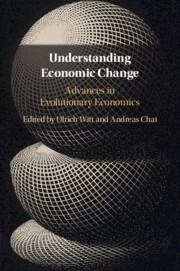
    Although the economy has always been changing, ever more innovations now seem to accelerate the transformation process. Are there any laws governing the incessant global change? Does it accord with our intentions and desires and make us happier? Do our institutions and our democracies cope with the challenges? How does economic theory explain what is going on? In this volume, experts in the field discuss the advances that evolutionary economics has made in exploring questions like these. The broad range of topics include a review of the development of the field: its conceptual and methodological characteristics are outlined; problems posed by macroeconomic evolution and the institutional challenges are highlighted; and, last but not least, the implications of the evolution of the economy for wellbeing and sustainability are addressed. Taken together, the contributions demonstrate the potential of an evolutionary paradigm for making sense of economic change and for assessing its consequences.

    Reviews

    ‘This welcome collection of essays offers a rich perspective on the history and philosophy of evolutionary economics. It delves deep into core themes such as generalized Darwinism, institutions and bounded rationality, long-run economic development and evolutionary welfare theory, while also offering original applications to land use conflicts and unsustainable consumption.'

    Jeroen van den Bergh - ICREA Research Professor, Universitat Autònoma de Barcelona

    ‘As Ulrich Witt and Andreas Chai put it in their introduction, it is time for some stocktaking concerning progress in evolutionary economics. This excellent collection of essays performs that task admirably: a number of leading authors review developments in the field with erudition and careful criticism. This is a milestone volume.'

    Geoffrey M. Hodgson - University of Hertfordshire

    ‘Evolutionary economics is in transition following a very productive and enlightening era when Nelson and Winter's ‘replicator dynamics' perspective was its reference point. The past decade has witnessed the rise of competing perspectives such as: rule based complex systems; game theoretical micro-foundations; general Darwinian theory; socio-biological models, where biology is not just used as an analogy. Although there is general agreement that economic evolution should be modelled, explicitly, as a historical process, methodological differences have become more marked. In this volume a very prominent set of contributors explain their different positions. The result is a very interesting and stimulating set of essays that are well-written and accessible to both evolutionary and mainstream economists and their students. Anyone who wishes to know what the key issues and debates are in evolutionary economics today need look no further than this excellent volume.'

    John Foster - University of Queensland

    ‘More than one century after Thorsten Veblen coined the label evolutionary economics there is still no consensus on what constitutes the core of an evolutionary approach in economics. This volume will be welcome by readers interested in learning about the current state of the field and its prospective development. The essays collected represent the principal versions of evolutionary thinking in contemporary economics, covering methodological, theoretical and normative issues. The editors' Introduction provides helpful guidance in tracing the history of the field, placing the collected essays into a broader context and pointing to prospects for theoretical convergence and integration.'

    Viktor J. Vanberg - University of Freiburg, Germany

    Refine List

    Actions for selected content:

    Select all | Deselect all
    • View selected items
    • Export citations
    • Download PDF (zip)
    • Save to Kindle
    • Save to Dropbox
    • Save to Google Drive

    Save Search

    You can save your searches here and later view and run them again in "My saved searches".

    Please provide a title, maximum of 40 characters.
    ×

    Contents

    Metrics

    Altmetric attention score

    Full text views

    Total number of HTML views: 0
    Total number of PDF views: 0 *
    Loading metrics...

    Book summary page views

    Total views: 0 *
    Loading metrics...

    * Views captured on Cambridge Core between #date#. This data will be updated every 24 hours.

    Usage data cannot currently be displayed.

    Accessibility standard: Unknown

    Why this information is here

    This section outlines the accessibility features of this content - including support for screen readers, full keyboard navigation and high-contrast display options. This may not be relevant for you.

    Accessibility Information

    Accessibility compliance for the PDF of this book is currently unknown and may be updated in the future.