
Skip to main content Accessibility help
×
  • Cited by 11
    • Show more authors
    • You may already have access via personal or institutional login
    • Select format
    • Publisher:
      Cambridge University Press
      Publication date:
      01 May 2021
      20 May 2021
      ISBN:
      9781108883993
      9781108793407
      Dimensions:
      Weight & Pages:
      Dimensions:
      (229 x 152 mm)
      Weight & Pages:
      0.19kg, 124 Pages
    • Series:
      Elements in Quantitative and Computational Methods for the Social Sciences
    You may already have access via personal or institutional login
  • Selected: Digital
    Add to cart View cart Buy from Cambridge.org
    Series:
    Elements in Quantitative and Computational Methods for the Social Sciences

    Book description

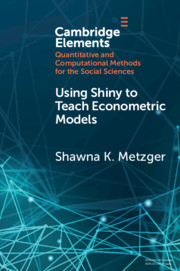
    This Element discusses how shiny, an R package, can help instructors teach quantitative methods more effectively by way of interactive web apps. The interactivity increases instructors' effectiveness by making students more active participants in the learning process, allowing them to engage with otherwise complex material in an accessible, dynamic way. The Element offers four detailed apps that cover two fundamental linear regression topics: estimation methods (least squares, maximum likelihood) and the classic linear regression assumptions. It includes a summary of what the apps can be used to demonstrate, detailed descriptions of the apps' full capabilities, vignettes from actual class use, and example activities. Two other apps pertain to a more advanced topic (LASSO), with similar supporting material. For instructors interested in modifying the apps, the Element also documents the main apps' general code structure, highlights some of the more likely modifications, and goes through what functions need to be amended.

    References

    Bahls, P. (2012). Student Writing in the Quantitative Disciplines: A Guide for College Faculty. San Francisco: Jossey-Bass Publishers.
    Beauchamp, N. (2017). Predicting and Interpolating State-Level Polls Using Twitter Textual Data. American Journal of Political Science 61(2), 490503.
    Biggs, J., and Tang, C. (2011). Teaching for Quality Learning at University (4th ed.). Maidenhead, UK: Open University Press.
    Carsey, T. M., and Harden, J. J. (2013). Monte Carlo Simulation and Resampling Methods for Social Science. Los Angeles: Sage.
    Fox, J. (2016). Applied Regression Analysis and Generalized Linear Models (3rd ed.). Los Angeles: Sage.
    Gelman, A., and Nolan, D. (2017). Teaching Statistics: A Bag of Tricks (2nd ed.). Oxford: Oxford University Press.
    Groth, R. E. (2013). Teaching Mathematics in Grades 6–12: Developing Research-Based Instructional Practices. Los Angeles: Sage.
    Hensel, P. R., Mitchell, S. M., Sowers, T. E., and Thyne, C. L. (2008). Bones of Contention: Comparing Territorial, Maritime, and River Issues. Journal of Conflict Resolution 52(1), 117143.
    Kennedy, P. (2003). A Guide to Econometrics (5th ed.). Cambridge, MA: MIT Press.
    Menary, R. (2007). Writing as Thinking. Language Sciences 29(5), 621632.
    National Council of Teachers of Mathematics (2000). Principles and Standards for School Mathematics. Reston, VA: NCTM.
    Yancey, K. B. (2009). Reflection and Electronic Portfolios: Inventing the Self and Reinventing the University. In Cambridge, D., Cambridge, B. L., and Yancey, K. B. (eds.), Electronic Portfolios 2.0: Emergent Research on Implementation and Impact, pp. 516. Sterling, VA: Stylus Publishing.

    Metrics

    Altmetric attention score

    Full text views

    Total number of HTML views: 0
    Total number of PDF views: 0 *
    Loading metrics...

    Book summary page views

    Total views: 0 *
    Loading metrics...

    * Views captured on Cambridge Core between #date#. This data will be updated every 24 hours.

    Usage data cannot currently be displayed.

    Accessibility standard: Unknown

    Why this information is here

    This section outlines the accessibility features of this content - including support for screen readers, full keyboard navigation and high-contrast display options. This may not be relevant for you.

    Accessibility Information

    Accessibility compliance for the PDF of this book is currently unknown and may be updated in the future.