
Skip to main content Accessibility help
×
  • Cited by 3
    • Show more authors
    • You may already have access via personal or institutional login
    • Select format
    • Publisher:
      Cambridge University Press
      Publication date:
      30 April 2024
      21 November 2024
      ISBN:
      9781009496896
      9781009496919
      Dimensions:
      (228 x 152 mm)
      Weight & Pages:
      0.6kg, 310 Pages
      Dimensions:
      Weight & Pages:
    You may already have access via personal or institutional login
  • Selected: Digital
    Add to cart View cart Buy from Cambridge.org

    Book description

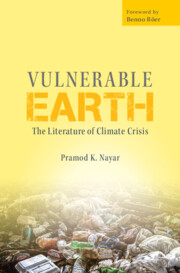
    Vulnerable Earth is a study of the literature of climate crisis. Building on the assumption that the crisis is planetary in scope even if differential and unequal in effects, it examines literary fiction, graphic novels, memoirs about toxic wastes and neo-slavery narratives, mostly from the contemporary decades, but touching upon select antecedents as well, and from all over the world. The study covers texts that fictionalize a 'hydrocrisis', those that are concerned with species extinction and experimental solutions such as rewilding, fiction and memoirs that are interested in exploring the conversations between and across species in multispecies encounters and, finally, texts that show the linkage between social justice and environmental justice.Focusing on aesthetics, narrative modes and constructions of damaged, wasted and at-risk worlds, this book shows how the literature of climate crisis foregrounds a feature that humans and nonhumans, the living and the non-living share, differentially, with the planet: vulnerability.

    Reviews

    ‘Scholars of climate fiction will appreciate the generosity with which Nayar leaves myriad openings for more focused inquiry into the literary praxes and intertextual congruities that the book’s neologisms make newly legible. As for readers new to the literatures of climate crisis, Vulnerable Earth is a valuable roadmap, one that seems especially well positioned for use in educational contexts where the environmental humanities are taught.’

    Diana Rose Newby Source: Modern Philology

    Refine List

    Actions for selected content:

    Select all | Deselect all
    • View selected items
    • Export citations
    • Download PDF (zip)
    • Save to Kindle
    • Save to Dropbox
    • Save to Google Drive

    Save Search

    You can save your searches here and later view and run them again in "My saved searches".

    Please provide a title, maximum of 40 characters.
    ×

    Contents

    Metrics

    Full text views

    Total number of HTML views: 0
    Total number of PDF views: 0 *
    Loading metrics...

    Book summary page views

    Total views: 0 *
    Loading metrics...

    * Views captured on Cambridge Core between #date#. This data will be updated every 24 hours.

    Usage data cannot currently be displayed.

    Accessibility standard: Unknown

    Why this information is here

    This section outlines the accessibility features of this content - including support for screen readers, full keyboard navigation and high-contrast display options. This may not be relevant for you.

    Accessibility Information

    Accessibility compliance for the PDF of this book is currently unknown and may be updated in the future.