

 ). 556 is the birth of Simonides, fixed by a statement of his own. The dates are probably Apollodorus’, see

 is uncertain, but not later than the fifth century, since it was known to Charon of Lampsacus (262 F 4) ap. Paus. 10. 38. 11. According to Charon it was composed by one Carcinus of Naupactus, but Pausanias claims that it was generally ascribed to a Milesian. Bergk conjectured that this was Cercops, who was also named as alternative author for the Hesiodic Aigimios; cf. the testimonia in Fragmenta Hesiodea, 151.
 , and Bowra, op. cit. 112–15.
 and the Aristophanic prelude on which the scholiast quotes the ‘Terpander’, Nub. 595 ⋯µøί µοι
  , which does not construe and can only be explained as a quotation of a stereotyped formula.) The fifth century is suggested by the metre (cf.
  showed that Homer sang? Elegiacs too were probably coloured Doric when sung, cf.
  …
…  .
.  prima facie refers to Terpander's own compositions. Cf. the notice of Xenocritus’ poems on p. 306 above.
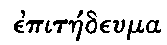 (‘fort. Aelian.’ Adler): ours? Cf.
  , are citharistic nomes designed for aulos accompaniment, Epicharmus fr. 109, Pollux 4. 65, 83, Phot. s.v. παρίαµβοι. It should be noted that for Epicharmus ἲαµβοι is a genre that may include anapaests, cf. fr. 88, with Kaibel, C.G.F., p. 87.
 (ps.-Plut. 4) is apparently alluded to at the beginning of Pindar's second dithyramb:

 , i.e. it was not conducive to distinct hearing of the words against the pipe, because the pipe was too like it. Pindar is saying that in the traditional dithyramb in the aulodic
  the s did not come out true from men's mouths, it did not live up to its promise, because of the pipe accompaniment. His new dithyramb has quite a different sound, justified by a vision of a Dionysiac rite among the gods, with drums, κρόταλα, and wild cries.
Crossref Citations

This article has been cited by the following publications. This list is generated based on data provided by Crossref.
Easterling, P. E.
and
Knox, Bernard M. W.
1985.
The Cambridge History of Classical Literature.
Janko, R.
1986.
TheShield of Heraclesand the legend of Cycnus.
The Classical Quarterly,
Vol. 36,
Issue. 1,
p.
38.
1996.
I. Introduction: Background and Problems.
New Surveys in the Classics,
Vol. 26,
Issue. ,
p.
1.
Pitotto, Elisabetta
2010.
Varianti mitologiche e riflesso del pubblico nello “Stesicoro di Lille”.
Pallas,
Vol. 83,
Issue. ,
p.
277.
Rotstein, Andrea
2012.
Mousikoi Agones and the Conceptualization of Genre in Ancient Greece.
Classical Antiquity,
Vol. 31,
Issue. 1,
p.
92.
Lawson, Colin
and
Stowell, Robin
2012.
The Cambridge History of Musical Performance.
Moore, Mary B.
2013.
Herakles Takes Aim: A Rare Attic Black-Figured Neck-Amphora Attributed to the Princeton Painter.
Metropolitan Museum Journal,
Vol. 48,
Issue. 1,
p.
37.
Phillips, Tom
2013.
EPINICIAN VARIATIONS: MUSIC AND TEXT IN PINDAR,PYTHIANS2 AND 12.
The Classical Quarterly,
Vol. 63,
Issue. 1,
p.
37.
Padilla Monge, Aurelio
2014.
Algunas notas sobre la figura de Argantonio y sus elementos míticos.
Archivo Español de Arqueología,
Vol. 87,
Issue. ,
p.
7.
2015.
The Cambridge Prehistory of the Bronze and Iron Age Mediterranean.
p.
249.
Counts, Derek B.
2015.
The Cambridge Prehistory of the Bronze and Iron Age Mediterranean.
p.
285.
Netz, Reviel
2020.
Scale, Space and Canon in Ancient Literary Culture.
Sullivan, Michael B.
2021.
Horace's Programmatic Priamel.
Journal of Roman Studies,
Vol. 111,
Issue. ,
p.
49.