


Over the past few years, the environment has received increasing attention as a major driver behind the worldwide increase in obesity(Reference Hill and Peters1, Reference Papas, Alberg and Ewing2). In fact, it has been suggested that over 86 % of the variance in intake among humans is due to factors in their immediate environment(Reference de Castro3). For example, a robust influence on people's eating behaviour is the presence and behaviour of others(Reference Herman, Roth and Polivy4). Numerous studies(Reference Clendenen, Herman and Polivy5, Reference de Castro6) have shown that people eat larger amount of foods when they eat in the presence of other people than when they eat alone. Moreover, people also adjust their intake directly to that of their eating companion; people tend to eat more in the presence of an eating companion who eats a lot of food than when in the presence of an eating companion who eats just a little(Reference Conger, Conger and Costanzo7–Reference Goldman, Herman and Polivy9). Herman & Polivy(Reference Herman and Polivy10) proposed that, in the absence of clear intake guidelines, people often use the intake of their eating companion(s) as a source of normative information about how much they may eat in a given context. The eating behaviour of others might thus suggest a quantity (or range) that is acceptable or appropriate to consume within a given context. If one's companion eats a large amount, then it is permissible to eat a large amount too, whereas it is safest to suppress one's intake when one's companion is eating nothing or only a small amount.
The intake of others, however, is not the only situational factor that may influence food intake. The environment also promotes food intake by providing more frequent occasions for the consumption of large quantities of highly palatable, energy-dense foods(Reference Hill and Peters1). The portion sizes of many foods have increased in recent years(Reference Young and Nestle11), and this trend has been observed in restaurants, supermarkets and in the home(Reference Young and Nestle11, Reference Nielsen and Popkin12). There is ample evidence that portion size directly influences the amount consumed. This so-called portion-size effect is well documented: people tend to consume more when they are served larger portions(Reference Rolls, Morris and Roe13, Reference Rolls, Roe and Meengs14). In addition, people also eat more from large packages or containers(Reference Wansink and Kim15, Reference Weijzen, Liem and Zandstra16). Herman & Polivy(Reference Herman and Polivy10) proposed that, as with the modelling effect, the portion-size effect is also a reflection of normative controls on eating. That is, people tend to assume that the portion that they have been served represents an authoritative judgement as to what one should eat. Consequently, eating beyond the initial portion may be considered inappropriate insofar as people have the expectation that the amount of food served to them by others is appropriate(Reference Rolls, Morris and Roe13).
Although both portion size and the intake of others might provide clues as to how much people may eat without eating excessively, to date the social modelling and portion-size literatures have been independent of each other. This is surprising, because both of these environmental factors could operate simultaneously. For instance, eating with another person could have a direct impact on one's food intake through social modelling processes, but intake could also be affected by the size of the portion that is served. The present study was intended to examine the potential influences of both types of situational norms during a single eating occasion. To examine the question whether both portion size and the intake of others affect food intake, an experimental–observational paradigm was used in which portion size (i.e. small or standard) and the eating companion's food intake (i.e. small, standard or large) were manipulated. First, portion size was manipulated by providing both participants with either a small or standard-size portion, after which the eating companion was instructed to eat a small, a standard or large amount of this portion, respectively. It was hypothesised that both portion size and the intake of the eating companion would operate as separate normative cues, and therefore would independently affect young women's food intake.
Experimental methods
Design
An experimental design with a three (confederate's intake: large, standard and small) by two (portion size: small, standard) between-participants design was used. Depending on condition, participants were thus offered a small- or standard-size meal, and were exposed to a same-sex confederate who had been instructed to eat a relatively small, medium or large amount from the meal offered. Participants and confederates were randomly assigned to one of the six conditions.
Participants
The sample consisted of eighty-five women (mainly first-year university students). The mean age of the women was 20·85 (sd 3·51) years. In our sample, 3·6 % of the women were underweight, 82 % had a normal weight and 13·2 % were overweight (see BMI classifications below). BMI information for one participant was missing, because she refused permission to measure her height and weight. The percentage of overweight young women in the present study is slightly lower than the current percentage of overweight women (18–25 years) in The Netherlands (19·3 %)(17). All participants were asked to refrain from eating for 3 h before their scheduled session to control for individual variations in hunger(Reference Polivy, Heatherton and Herman18).
Confederates
In the present study, five female students at the Radboud University Nijmegen, between 19 and 24 years of age (22·40 (sd 2·07) years) and with a mean BMI of 21·88 (sd 2·32) kg/m2, acted as confederates. Each confederate served in each condition several times. We specifically recruited second- or third-year students in order to reduce the possibility that participants and confederates were taking classes together, and therefore were already acquainted with each other, since it is known that eating with friends or acquaintances differs from eating with strangers(Reference Hetherington, Anderson and Norton19). Afterwards, it appeared that only one participant was acquainted with her eating companion (i.e. the confederate). Removing this session from our final analysis, however, did not affect the present results.
Procedures
The present study was conducted according to the guidelines laid down in the Declaration of Helsinki and all procedures involving human subjects were approved by the Ethics Committee of the Faculty of Social Sciences of the Radboud University Nijmegen. Written informed consent was obtained from all subjects. Data collection took place on weekdays between 16.45 and 20.15 hours during the period January–June 2010. Each experimental session lasted approximately 1 h. Participants were awarded course credit (for educational requirements) or a €10 gift cheque for completing the study. To simulate a naturalistic setting, we made use of the bar laboratory situated on the campus of the Radboud University Nijmegen. This laboratory is furnished as an ordinary small pub(Reference Bot, Engels and Knibbe20), with a relaxing atmosphere. The bar was furnished with a table for two on which was placed a pitcher of water, two glasses, cutlery, two plates, a hot plate and some napkins. The chairs were situated facing each other so that the confederate and the participant could easily see each other.
Upon arriving at the front office of the research facility, both participants were informed that the purpose of the study was to examine the effects of nutrition on cognitive test performance. Participants were asked to read and provide written consent and were then asked to stand in front of the television screen and the Nintendo Wii. They were asked to individually play a Wii game in which their cognitive performance both before and after meal consumption was tested. In the meanwhile, the confederate completed three paper-and-pencil tasks involving concentration and spatial insight(Reference Hermans, Herman and Larsen21). These tasks took approximately 15 min. Because the true purpose of the study was to examine the effects of portion size and the intake of others on actual intake (and not cognitive performance), the cognitive tasks were bogus tests and the second set of cognitive tests never occurred(Reference Koh and Pliner22).
After performing the cover tasks, the confederate and the participant were asked to sit down at the table that was especially set for them. They would have 20 min to eat a complete meal. During this time, participants were free to talk and interact as they would during a normal meal. The experimenter put on some recorded music (Tourist, ST. Germain, Blue Note Records, 2000, NY, USA) and left the room to get the meals. While the experimenter prepared the meals, both participants had some time to get acquainted with each other. After approximately 5 min, the experimenter came back and served the meal (described below) while informing the participants that they could eat as much or as little as they liked and that more food was available on the hot plate if they wanted to eat more. At this point, the experimenter told the participants to ‘enjoy their meal’ and left the room. These instructions were used during all sessions. Participants were observed by the experimenter from an adjacent room via a flexible camera (with zoom) hidden in the corner of the room where time allocated to eating was recorded. After exactly 20 min, the experimenter returned to the laboratory to collect uneaten food and to ask participants to complete some post-meal questions about their impression of the break, their general meal patterns and eating behaviour, and how much they liked the test food. Participants were told that they were being taken to different rooms because of the personal nature of the questionnaire. However, the actual reason for this separation was that only the participant had to fill in this questionnaire. After the participant had completed the questionnaire, her height and weight were measured, and she received a short debriefing about the purpose of the study. After all data were collected, participants were fully debriefed about the study by email.
The meals
Before registering for the study, participants were asked to choose among four different meals in order to ensure that they liked the test food offered during the break. They could choose between lasagna, macaroni Bolognese, spaghetti with cheese sauce (vegetarian) and a typical Dutch meal (mash pot). Before starting the study, sixteen female undergraduate students were asked to serve themselves a standard-size meal from a large kettle of macaroni or mash pot. Their plates were then weighed to determine the amount of food considered to comprise a standard meal. In this pilot sample, 415 (sd 127·67) g of macaroni and 477 (sd 98·50) g of mash pot were considered to be standard-size portions. Therefore, in the present study, we chose to initially offer participants 500 g of food in the standard-size portion condition, with additional food available from a bowl on a nearby hot plate. For the confederate's small or large intake conditions, this amount was either halved (250 g) or increased by 50 % (750 g). The small portion-size condition consisted of an initial 250 g portion, and the confederate was instructed to eat half the portion (125 g), to finish the portion (250 g) or to eat 50 % more (375 g). In the small-intake conditions, the experimenter weighed the exact amount the confederate had to eat and indicated this with a small line on the confederate's plate (invisible to the participant). In the large-intake conditions, the exact amount to be eaten in addition to the initial portion was indicated with a small line in the bowl on the hot plate. Because the confederate was always the first person who took some extra food from the bowl, we could accurately measure the remainder that was available for the participant if she wanted to serve herself an extra portion too. How often the meal was chosen and the energy content of each meal is depicted in Table 1. It appeared that the distribution of meals over conditions was roughly even. That is, no differences were found in meal choice between conditions.
Experimental foods used in the study

Measures
Food intake
A digital scale (Kern 440; Kern & Sohn, Balingen, Germany) was used for measuring amounts served and consumed. At the end of each session, the amount of food consumed in grams was measured. If the participant did not finish her portion or took some extra food, the experimenter subtracted the leftovers from the served portion (250 g or 500 g) or added the extra amount to the amount initially served. The dependent measure was the amount of food consumed in grams.
BMI
BMI, measured as weight (kg)/height2 (m2), was calculated based on measured height and weight. Participants' weight and height were measured following standard procedures(Reference Lohman, Roche and Martorell23). Height was measured to the nearest 0·5 cm using a stadiometer (Seca 206; Seca GmbH & Company, Hamburg, Germany) and weight was measured to the nearest 0·1 kg using a digital scale (Seca Bella 840; Seca GmbH & Company). We determined whether participants were underweight, normal weight, overweight or obese using the International Classification of adult underweight, overweight and obesity according to BMI(24).
Meal palatability
Participants were asked to rate the palatability of the meal that they consumed (pleasantness of appearance, odour and taste) on a ten-point rating scale, with possible ranges from 1 (not at all true) to 10 (completely true). An example of an item was ‘I liked the taste of the meal’.
Portion size
Participants' perception of the size of the portion offered was measured on a ten-point scale with responses ranging from 1 (small) to 10 (large). This question was designed primarily as a manipulation check.
Meal patterns
To measure participants' general meal patterns, they were asked to indicate at what time and with whom they had dinner most of the time.
Restrained eating
Restrained eating was measured by the dietary restraint subscale of the Dutch Eating Behaviour Questionnaire(Reference Van Strien, Frijters and Bergers25). Cronbach's α was 0·92.
External eating
External eating was measured by the external eating subscale of the Dutch Eating Behaviour Questionnaire(Reference Van Strien, Frijters and Bergers25). Cronbach's α was 0·77.
Analytic strategy
Data were analysed using SPSS for Windows (version 17.0, 2008; SPSS, Inc., Chicago, IL, USA). Alpha was set at P < 0·05. First, using one-way ANOVA, we checked whether there were any differences in age, BMI, hunger level, meal palatability, external eating and dietary restraint between conditions. Second, we checked whether the manipulations of portion size were successful, using an independent sample t test, whereas the confederates' intake manipulations were checked using ANOVA. If they were significantly correlated with food intake, time of consumption, hunger level, meal choice, BMI, external eating and dietary restraint were entered into the model as covariates. To answer the main question, an ANCOVA was used to examine the main and interaction effects of the portion-size and modelling manipulations on the participants' total food intake (in g). We used Cohen's f instead of Cohen's d to indicate the effect size of the main effect of modelling manipulations, since we had more than two conditions in our design(Reference Cohen26). Effect sizes of 0·02, 0·15 and 0·35 are termed small, medium and large, respectively(Reference Cohen26). Additionally, to check whether participants ate significantly more or less when in the presence of a particular confederate, we also added the confederates as a factor in the present main analysis.
Results
Individual characteristics
The results of ANOVA indicated no significant differences in age, BMI, hunger level, dietary restraint and external eating across conditions (all P>0·20). Table 2 displays the participants' characteristics across conditions. The vast majority of the participants (80 %) usually had dinner between 18.00 and 19.00 hours in the evening. Furthermore, 59 % of the participants usually consumed their dinner in the presence of their roommates, family members or romantic partner. Since the experimental dinner time varied over 3·5 h, and thus could have been different from the participant's usual dinner time, it was checked whether this had an effect on participant's total amount consumed. It appeared that there were no differences between the different experimental dinner times and the participants' total amount consumed. All participants (n 85) were able to easily finish their meal within the 20 min break.
(Mean values and standard deviations)
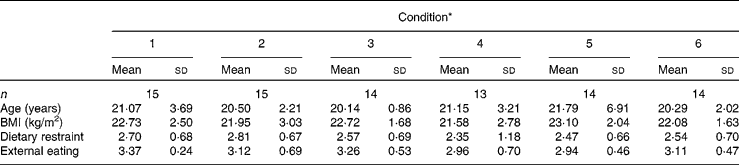
* Condition 1 = small portion, small intake; 2 = small portion, standard portion; 3 = small portion, large intake; 4 = standard portion, small intake; 5 = standard portion, standard intake; 6 = standard portion, large intake.
Manipulation checks
Participants' ratings of portion size varied significantly as a function of the portion-size manipulation (t 83 = 6·87, P < 0·001). Participants perceived the portion as smaller in the small portion conditions (4·61 (sd 2·04)) than in the standard-size portion conditions (7·10 (sd 1·14)), confirming that the portion-size manipulation was successful. Furthermore, participants significantly differed in their estimations of the confederate's intake in the different intake conditions (F 2,84 = 27·69, P < 0·001). Participants exposed to a confederate who ate 50 % more estimated the intake of their co-eater as higher than did participants exposed to a confederate who ate half a portion less or finished her portion (P < 0·001 for both). Furthermore, it was found that participants exposed to a confederate who ate a half portion less estimated the other's intake as smaller than did participants exposed to confederates who finished their portion (P < 0·05). Because participants were free to choose between four different meals, we also checked whether there were differences between meals in perceived palatability. There were no differences between meals in how their taste, smell or sight of the meal was rated by the participants (all P>0·10). Moreover, no significant differences were found between meal choice and participants' total amount consumed (P = 0·59).
Food intake
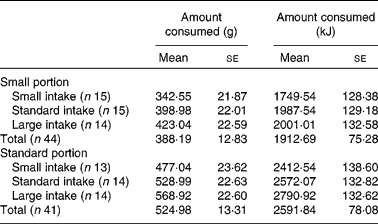
Restrained eating was significantly correlated with food intake (r 85 = − 0·23, P < 0·05) and was therefore entered into our model as a covariate. BMI, time of consumption, meal choice and external eating were not significantly related to food intake, so these variables were not included in the model. Our primary question was whether participants' intake would depend on initial portion size and/or the food intake of their eating companion. Table 3 shows the total amount consumed (in g and kJ) in the various conditions. Both portion size (F 1,78 = 54·07, P < 0·001, d = 1·59) and the intake of the confederate (F 2,78 = 7·41, P < 0·01, f 2 = 0·38) had a main effect on participants' food intake. No interaction was found between portion size and the confederate's intake (F 2,78 = 0·07, P = 0·94). Thus, the larger the portion and the more their eating companion ate, the more of the test food participants ate. In terms of effect sizes, these effects were large. These effects were obtained when we controlled for individual variations in restraint. The total model (portion-size manipulations, confederates' intake manipulations, participants' restraint levels) explained 47 % of the variance in the total amount of food consumed. Bonferroni post hoc tests showed that participants exposed to a small-intake companion consumed significantly less than did participants exposed to a companion eating a large amount (P < 0·001). The difference between participants exposed to a small-intake or standard-intake companion was only marginally significant (P = 0·06). No differences in intake were found between participants exposed to a standard- or large-eating companion (P = 0·47). We also tested whether the use of different confederates affected our findings. However, no differences were found among confederates; no confederate individually induced higher or lower intake (F 5,73 = 1·08, P = 0·38).
(Mean values with their standard errors)
Consumption monitoring
Whereas fifty-nine (70 %) of the participants reported that they had consumed as much as was typical for them, twenty-one participants indicated that they had consumed an amount less than they normally would have for dinner. Of these twenty-one participants, seventeen participants were offered a small portion. When participants were asked whether they adjusted their intake to that of their eating companion, 78 % (n 66) claimed that they had not and 21 % (n 18) said that they had consumed less because the other had consumed less. However, no differences were found between participants in the three modelling manipulations on whether or not participants believed that they had adjusted their intake to that of their eating companion (F 2,84 = 2·19, P = 0·12). Furthermore, participants significantly differed in their ratings of appropriateness concerning their eating companion's intake (F 2,84 = 18·01, P < 0·001). Participants exposed to a companion who ate half a portion less rated the companion's intake as less appropriate than did participants exposed to a companion who finished her portion or ate 50 % more (P < 0·001 for both). This effect was found in both portion-size manipulations. Finally, it was found that participants significantly differed in their rating of the eating companion as a function of the companion's eating behaviour (F 2,84 = 4·05, P < 0·05). That is, participants rated the small-intake companions as more annoying than they rated the standard- or large-intake companions (P < 0·05 for both).
Discussion
The present study examined the influences of portion size and the intake of others on young women's food intake during a single eating occasion. In accordance with our hypotheses, it was found that the effects of portion size and the intake of others were independent of one another but acted additively to promote increased intake.
The results of the present study are consistent with previous findings: serving larger portions of food causes people to eat more food(Reference Rolls, Morris and Roe13, Reference Rolls, Roe and Meengs14). Moreover, the present results also confirmed previous findings that women model other people's food intake(Reference Conger, Conger and Costanzo7–Reference Goldman, Herman and Polivy9). These findings may be explained by the notion that people are often uncertain when it comes to how much they should eat. They are eager to avoid eating excessively, because they are aware that their eating might lead them to be judged negatively. Because eating too much may be associated with various negative stereotypes, such as being deficient in self-control(Reference Puhl and Brownell27) or being less feminine(Reference Chaiken and Pliner28) and attractive(Reference Bock and Kanarek29), they search their environment for clues, allowing them to infer how much they may eat without eating an inappropriately large amount(Reference Herman and Polivy10). In the present study, participants had to eat along with a previously unknown eating companion in an eating context that was probably different from the context in which they normally would eat their dinner. Within this specific eating context, reliance on the example set by others or on portion size might have been particularly evident, because participants had no other obvious basis for determining appropriate meal size. It was found that the effects of portion size and the companion's intake were both significant as main effects; that is, both manipulations exerted an influence on young women's intake. These findings indicate that the uncertainty that people display about how much to eat is not necessarily completely removed by providing them with a single normative cue. Portion-size manipulations guide behaviour, but social norm manipulations further affect behaviour, suggesting that portion-size information does not completely satisfy the eater's search for guidance. In the domain of disinhibition of eating, Herman et al. (Reference Herman, Polivy and Lank30) demonstrated that the application of one disinhibitor effectively pre-empted further disinhibition by a second disinhibitor. In the present study, however, the application of one normative cue by no means pre-empted a second normative cue from further influencing behaviour. Abiding by two norms – the served portion and the example set by the other person – might have provided participants with some extra assurance that they were not eating excessively. An alternative explanation for why our participants ate more when they were served a larger portion may be that they have learned throughout the years that cleaning their plate is what is expected(Reference Birch, McPhee and Shoba31). Routines related to eating reflect what people have learned is an appropriate, expected or desirable amount to consume in a particular context. Once these scripts have been found to work well, they provide a level of comfort and predictability and are likely to be repeated(Reference Connors, Bisogni and Sobal32). Thus, when people have a tendency to clean their plate, this may often be repeated in a variety of contexts. Moreover, it has also been found that participants eating different amounts of foods reported similar ratings of hunger and fullness after the meal, despite large differences in food intake(Reference Rolls, Morris and Roe13). In other words, it may be that as portion size is varied, individuals adjust their perception of satiety cues while consuming more food. It is possible, then, that the larger portions in the present study may have led the participants to think that they also could eat more, whereas the smaller portions led to opposite expectations.
Although the results clearly indicated that participants' intakes were affected by the portion-size manipulation, they generally ate more than the initial small portion that was served to them. Participants were offered only 250 g of food in the small-portion conditions, an amount that was considerably lower than participants perceived as a standard-size meal (as our pilot study revealed). The initial amount served in these conditions might therefore have seemed an inappropriately small dinner, and so participants felt free to serve themselves more food without worrying about being judged to be an excessively large eater. In effect, when the initial served portion is unduly small, the portion-size effect may break down(Reference Herman and Polivy10). However, when people are simultaneously exposed to eating companions who eat beyond the initial portion, they will also eat more (resulting in the largest intakes in the small-portion condition when the confederate ate the most). Therefore, strategies for addressing the influence of portion size on intake should focus not only on the consumer, but also on the immediate environment; that is, reducing the portion sizes of food may be an overly simple approach to prevent people from overeating, especially when their eating companions are eating large amount of foods.
The effectiveness of the norm manipulations may be best seen in the fact that a vast majority of the participants claimed that they had consumed an amount that was typical for them, whereas it is evident that they altered their intake in response to both portion-size and confederate-intake manipulations. This finding is consistent with research showing that people cannot accurately identify specific influences on food intake (e.g. the presence of others)(Reference Roth, Herman and Polivy33, Reference Vartanian, Wansink and Herman34) and supports the notion that normative controls on eating may be relatively automatic and often occur outside conscious awareness(Reference Wilson and Brekke35).
The intake of participants exposed to a companion who ate 50 % more was roughly 7 % more than when the companion ate a standard amount, whereas the intake of participants exposed to a companion who ate 50 % less was on average about 12 % less than when the companion ate a standard amount. It is possible that the example of a minimal-eating companion is simply more powerful than is that of a large-eating companion, perhaps because inhibitory signals are stronger than are permissive signals. This finding, however, may also be explained by the fact that there is some built-in asymmetry in the current design. That is, the standard intake of the eating companion was two-thirds the size of the large intake, whereas the small intake was only half of the standard intake.
A final point for consideration involves the finding that participants exposed to a companion who ate 50 % less perceived the companion's intake as less appropriate than did those who were exposed to an eating companion who finished her portion or ate 50 % more. Additionally, these minimal eaters were also rated as more annoying than were those who finished their portion or ate more than the initial portion. Leone et al. (Reference Leone, Herman and Pliner36) found that people generally dislike others who eat considerably less than they do, presumably because their companions' sparse intake means that they themselves may eat only a small amount if they want to avoid the stigma of being an ‘excessive eater’. Thus, it might be that the participants exposed to the minimal eaters were unable to eat as much as they would have wanted to and therefore perceived her as more annoying and rated her intake as less appropriate. Another possibility is that because people typically clean their plates and not finishing one's portion may be considered correspondingly impolite, such concerns might have led to the less positive judgements of the minimal-eating companions.
The results of the present study show that portion size and the eating behaviour of others directly affect young women's food intake. From the present results, however, we cannot identify whether there are any particular characteristics that make some women more or less susceptible to the effect of portion size and social modelling on intake. If both portion size and the eating behaviour of others are considered as external cues that might stimulate intake, there might be large individual variation in the intensity of responsiveness to these food-related cues. Because eating behaviour is a complex interplay between biological, environmental and psychological factors, it seems important to focus on possible interactions between these factors when investigating the underlying mechanism of responsiveness to food-related cues. Identifying such individual differences (e.g. reward-sensitivity or inhibitory control) would be valuable for developing interventions aimed at counteracting the effects of environmental stimuli that induce overeating(Reference Herman and Polivy37). Next, since both situational norms were manipulated simultaneously, it remains unknown how much of the variance of the participants' total energy intake was independently accounted for by portion size and the intake of others. Third, even though both the portion size and the eating behaviour of the other seemed to have affected participants' food intake, there was no control condition in which participants ate alone from either a small- or standard-size meal, and thus no definitive statements can be made about whether portion size and/or the intake of the other increased or decreased participants' intake compared with a ‘non-manipulated’ baseline. Finally, although our sample was large enough to detect main effects of both portion size and the confederate's intake, the present study might have been insufficiently powered to detect an interaction effect. To definitely exclude the possibility of an interaction effect, it is recommended that the present study be replicated with more participants per condition.
As obesity rates continue to rise, it is important to gain insight into the question why and under what conditions people are affected by environmental stimuli. The present study demonstrates that both portion size and the intake of others can significantly affect young women's intake (apparently without their awareness). As long as people are unaware of these influences, or fail to acknowledge them, it will remain difficult to avoid overeating in a ‘toxic’ environment in which one is constantly exposed to super-sized portions and the super-sized intake of others.
Acknowledgements
The authors' responsibilities were as follows: R. C. J. H., J. K. L. and R. C. M. E. E. contributed to the study conception and design; R. C. J. H. was involved in the acquisition of the data; R. C. J. H. and J. K. L. were responsible for the analysis and interpretation of the data; R. C. J. H. drafted the article; C. P. H. contributed to the critical revision of the manuscript; J. K. L. and R. C. M. E. E. provided supervision. All authors read and approved the final manuscript. The study was supported by a fellowship grant to J. K. L. from the Netherlands Organization for Scientific Research. All authors declare that they have no relevant financial interests in the manuscript. Furthermore, they certify that there is no personal financial disclosure/conflict of interest. The organisation that funded the study was not involved in the development of the design, collection of the data, writing the paper or the decision to submit the paper for publication.



