


Growing up as a twin has been thought of as psychologically and developmentally different from growing up as a single-born child (Rutter & Redshaw, Reference Rutter and Redshaw1991; Stewart, Reference Stewart2000). For example, twins have been found to have a raised risk of neurobiological disorders (Hay & Steed, Reference Hay, Steed, Blickstein and Keith2005) and, in childhood, to have lower levels of cognitive (Ronalds et al., Reference Ronalds, De Stavola and Leon2005) and language functioning (Thorpe et al., Reference Thorpe, Rutter and Greenwood2003). It has also been suggested that growing up alongside a sibling of the same age could potentially have a different effect on behavior outcomes (Hay & Preedy, Reference Hay and Preedy2006).
Among single-born children, sibling relationships have generally been found to affect ongoing adjustment and later psychopathology (e.g., Dunn & McGuire, Reference Dunn and McGuire1992; Modry-Mandell et al., Reference Modry-Mandell, Gamble and Taylor2007; Pike et al., Reference Pike, Coldwell and Dunn2005). A common finding is that a warm sibling relationship is associated with positive behavioral adjustment (Modry-Mandell et al., Reference Modry-Mandell, Gamble and Taylor2007), while a conflicted relationship is associated with poor behavioral outcomes (Garcia et al., Reference Garcia, Shaw, Winslow and Yaggi2000). However, whether such associations hold for twin populations is unclear. The hypothesis of an inverse pattern of association from that reported for single-born children has persisted in the literature. For example, Hay and Preedy (Reference Hay and Preedy2006) suggest that a close twin relationship may restrict social interactions and social development.
The inter-twin relationship is a unique sibling relationship distinguished by the duration and intensity of time together. From conception, twin children share their environment and differ from single-born children in that they more often interact with one another compared with the same-age peer (Vandell et al., Reference Vandell, Owen, Wilson and Henderson1988). In addition, twin children typically attract the attention of others because they are a pair (Stewart, Reference Stewart2000). Thus, for twin children, the social context of growing up alongside a sibling of the same age may alter normal patterns of interactions with others, within and beyond the family context (e.g., Thorpe et al., Reference Thorpe, Rutter and Greenwood2003). Whether this context has the potential to disrupt normal patterns of social development (positively or negatively) and affect behavioral outcomes, however, is currently unknown. The unique characteristics of the twin relationship provide a key focus for examining the effects of twinning on behavioral outcomes.
Existing studies of behavioral outcomes are inconsistent in their reporting of mean behavioral differences between twin and single-born children (Gjone & Nøvik, Reference Gjone and Nøvik1995; Pulkkinen, et al., 2003; Robbers et al., Reference Robbers, Bartels, van Oort, van Beijsterveldt, van der Ende, Verhulst and Huizink2010, Reference Robbers, van Oort, Polderman, Bartels, Boomsma, Verhulst and Huizink2011; van den Oord et al., Reference van den Oord, Koot, Boomsma, Verhulst and Orlebeke1995). Similarly, the inter-twin relationship has been reported to increase the risk for behavioral difficulties in twins (Bekkhus et al., Reference Bekkhus, Staton, Borge and Thorpe2011; Stewart, Reference Stewart2000), while the sibling relationship among single-born children have been found to have positive effects on social–emotional behaviors (e.g., Buhrmester, Reference Buhrmester, Boer and Dunn1992). Whether the inter-twin relationships differs significantly from that of single-born siblings in predicting behavioral outcomes is not known.
The aim of the current study was to examine the role of the sibling relationship on behavioral outcomes for twin versus single-born children. The unique characteristics of the twin relationship provides a key focus for examining the effects of twinning on behavioral outcomes because: (1) this is the underlying mechanism commonly proposed in hypothesis of higher behavioral risk for twin pairs (Rutter & Redshaw, Reference Rutter and Redshaw1991); and (2) the relationship with the same-age sibling is the factor that most clearly distinguishes twins from other children. While other factors associated with twinning, such as obstetric adversity, occur more frequently for twin children, these are not unique to the circumstance of twinning. However, given the influences these factors may have on behavior problems, they are necessary control variables in distinguishing twinning effects from family and obstetric adversity effects. Thus, these are included in the current study. The present study first explores the mean differences in behavioral difficulties between twin and single-born children and then compares patterns of association to assess whether the twin relationship is in any way unique in influencing behavioral outcome. To date there are no studies that have compared the patterns of association of sibling relationship and behavior difficulties for twins and single-born children and this represents an important methodological focus.
In sum, this study addresses the following two research questions that are important in understanding the role of twin status in behavioral outcomes for twin children:
-
1. Are there mean differences in behavioral difficulties between twin and single-born children once family and biological variation is controlled?
-
2. Are there differences between twin and single-born children in the patterns and strength of associations between sibling relationship and behavior difficulties?
Method
Sample
Participants were part of a national Australian Research Council-funded project examining twin children's social development and the transition to school. Recruitment was conducted with the assistance of the Australian Multiple Births Association (AMBA) and the Australian Twin Registry (ATR) via mailing of study information to members and advertisements in magazines and club newsletters. The study was conducted across two time points: in the year prior to school (Time 1 [T1]; mean age 4 years 8 months, SD = 5.8 months), and again 12 months later in the first year of formal schooling (Time 2 [T2]). The families received postal questionnaires along with information about the study and consent forms. Questionnaires were returned via prepaid postal packages provided. Following identification of the twin children, a comparison sample of single-born children was recruited from the educational settings attended by the twin children. A matched same-sex single-born classmate, who also had a sibling, was randomly selected from the class lists. In the sample of single-born children, 46.1% were the younger child in the sibling pair (mean age 4–5 years; 9% missing). Mean age difference in months was 36.1 months (N = 89; SD = 21.38).
The total sample comprised 559 participants (450 twins and 109 single-born children). For the current study, one twin from each twin pair was randomly selected. In addition, we excluded children born preterm (<33 weeks gestation) or with known abnormality, as we sought to explore whether risk factors other than being born preterm or having an abnormality could explain potential differences between twins and single-born children. Thus, the total sample comprised 198 twin children and 109 single-born children (total sample N = 307). The distribution of gender for the single-born children was 59 boys and 48 girls (missing = 0.7%). For the twins, the distribution was 96 boys and 102 girls.
Measures
Behavioral difficulties: Behavioral difficulties were reported by parents using three subscales of the Strengths and Difficulties Questionnaire (SDQ; Goodman, Reference Goodman2001): emotional difficulties, hyperactivity, and conduct difficulties (five items in each subscale). Cronbach's alphas in the current sample were: Emotional difficulties at T1 α = 0.63 and at T2 α = 0.67; hyperactivity at T1 α = 0.82 and at T2 α = 0.81; and conduct disorder at T1 α = 0.63 and at T2 α = 0.60.
Sibling relationship: Sibling warmth (five items) and sibling conflict (five items) were measured at T1 by parent report on the extended version of the Share Index (for more details, see Thorpe et al., Reference Thorpe, Rutter and Greenwood2003). Warmth was measured as the frequency of concern, protection, sharing, and display of affection through kissing and hugging rated on a 4-point Likert scale from 0 (often) to 3 (never). Cronbach's alpha for sibling warmth was 0.78. Similarly, sibling conflict was measured as the frequency of verbal and physical arguments, teasing, shouting, and exclusion, rated on a 4-point Likert scale from 0 (often) to 3 (never). Cronbach's alpha for conflict was 0.82.
Demographic information: The parents reported maternal and paternal age and the number of children in the family. Distribution of number of siblings was provided as categorical data with four levels (one, two, three, and four or more). For twins, the number of siblings was counted as the number of siblings born in addition to the twins. Socio-economic status (SES) was derived from the Australian Bureau of Statistics (ABS) coding of the socio-economic index of the family's residential address (SEIFA). To determine SES, the participant's family residential postcode was matched to the corresponding SEIFA score (ranging from 10, representing top 10% socio-economic advantage, to 1, representing the 10% most disadvantaged families). The SEIFA index of relative socio-economic disadvantage (IRSD) uses a summary of information about the social and economic resources of people and households within an area to provide a broad measure of relative disadvantage for that area (Australian Bureau of Statistics, 2006).
Birth characteristics: Birth characteristics were obtained by the parent report. The modal gestation for twins is approximately 37 weeks, and 40 weeks for single-born children (Rutter, et al., Reference Rutter, Thorpe, Greenwood, Northstone and Golding2003; Thorpe, et al., Reference Thorpe, Rutter and Greenwood2003). Optimal developmental outcomes are associated with different gestations for twins and single-born and correspond to these modal gestational ages (Min et al., Reference Min, Luke, Gillespie, Min, Newman, Mauldin and O'Sullivan2000). Commensurately, optimal birth weight is 500 g lower in twins than in single-born children at optimal gestation (Min et al., Reference Min, Luke, Gillespie, Min, Newman, Mauldin and O'Sullivan2000). To ensure comparability, adjustments were made for differing points of optimal gestation and birth weight using a subtraction method (Rutter et al., Reference Rutter, Thorpe, Greenwood, Northstone and Golding2003), in which the mean birth weights for twins were subtracted from the twins’ reported birth weight. This provided a ‘distance from optimal’ score and allowed direct comparability between single-born and twin children. Similarly, we subtracted the mean from the reported birth weight for single-born children. The mean birth weight (after excluding all preterm births) for twins was 2,533.6 g (SD = 490.05 g) and ranged from 1,200 g to 3,722 g, and for single-born children (excluding preterm birth) it was 3,583.3 g (SD = 604.61 g) and ranged from 1,700 g to 5,100 g. Furthermore, the obstetric complications reported by parents (placental difficulties, umbilical cord complications, jaundice/yellow, breathing problems, and anemia) were aggregated to provide a birth complications score ranging from 0 to 5 (M = 0.37 and SD = 0.63 for single-born, and M = 0.57 and SD = 0.83 for twins)
Obstetric questions were not initially included in the parent questionnaire for single-born children and required a supplement follow-up study. Responses for this supplement yielded a response rate of 49%. We compared those with missing data (N = 57) with the follow-up sample (N = 52) on family background and no significant differences were found. Thus, in order to include as many cases as possible for the overall analyses of sibling relationship and behavioral outcomes, while controlling for obstetric data; missing data on birth weight and length of gestation were replaced with the group mean values for these two variables.
Analytic Strategy
The analytic strategy followed two steps using PAWS statistics version 20 and Mplus version 5.1 (Muthén & Muthén, Reference Muthén and Muthén2007). First, since we wanted to test whether the single-born children differed from twin children on background variables and behavioral difficulties, we used t-tests to assess mean difference in scores. Mean differences for all control and outcome measures were examined first at T1, and then at T2. Group comparisons and regression analyses were computed in step 2, using Mplus. Model fit was determined by chi-square estimates, the comparative fit index (CFI, critical value 0.90; Bentler & Bonett, Reference Bentler and Bonett1980), the Tucker Lewis Index (TLI, critical value 0.90; Little et al., Reference Little, Jones, Henrich and Hawley2003), and the root mean square estimate of approximation (RMSEA, critical value 0.08; Browne & Cudeck, Reference Browne and Cudeck1993). Chi-square difference test were computed using the Satorra–Bentler Chi-square difference test (Muthén & Muthén, Reference Muthén and Muthén2007); in addition, Wald's test were computed to examine potential differences between twins and single-born children for each of the estimates in the model. In this second step, we examined whether sibling relationships (conflict and warmth) were associated with behavior outcomes in single-born children and in twin children across two time points. A series of path models were estimated using a multiple-group approach in Mplus version 5.1 (Muthén & Muthén, Reference Muthén and Muthén2007). Before estimating the full path model, each association between sibling relationship (low sibling warmth/sibling conflict) and behavior problems (emotional difficulties, hyperactivity, and conduct disorder) were examined independently at T1 as well as T2. Next, we examined the full model (Figure 1), which estimated the direct effects of the sibling relationship on hyperactivity, emotional difficulties, and conduct disorder at T1 and T2 simultaneously, as well as T1 behavior and T2 behavior. Contemporaneous behavior problems were correlated within each time point. We also controlled for potential confounders previously found to be associated with child behavior problems. These were: maternal age, family (dis)advantage (SES), gender, low birth weight, and overall birth complications.
Behavior difficulties in sibling and peer relationships for twins and single-born children.
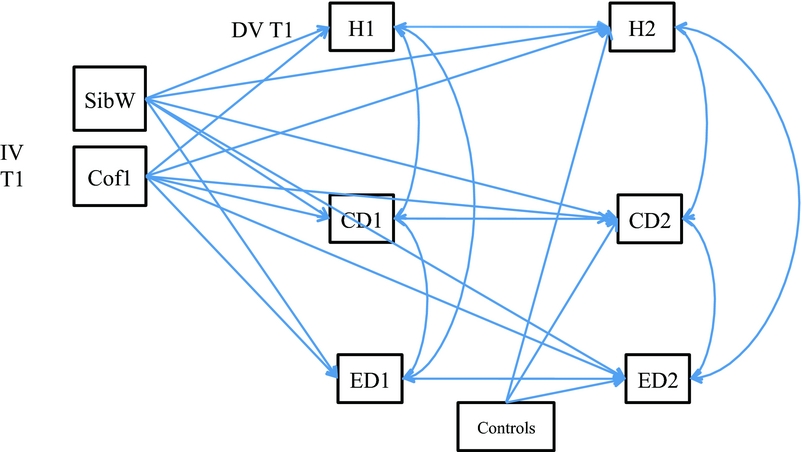
Finally, we compared the pattern of associations between the putative risks (sibling warmth and conflict) and behavior outcomes for twins and single-born children. We examined whether the associations between sibling relationship and behavior difficulties differed among single-born and twin samples by examining the chi-square difference (Satorra, Reference Satorra, Heijmans, Pollock and Satorra2000). That is, we compared the path model in Figure 1 by allowing the estimates to freely vary for single-born children and twin children (unconstrained), to a model where all parameters were held invariant between the groups (constrained). We then compared the model fit for the constrained model with the unconstrained model. In addition, Wald's test was computed for each of the estimates in the overall model.
Results
Step 1: Are there differences between twin children and single-born children on background characteristics, sibling relationship, and behavioral difficulties?
Mean differences, statistical significance, and effect sizes for twin children and single-born children on all control and outcome measures are shown in Table 1. Results show that single-born children have a higher SES compared with twin children, and twins were reported to have more birth complications.
Mean Values (Standard Deviations) for Family Characteristics, Obstetric, and Perinatal Complications for Twin and Single-Born Children

Numbers in bold show significant differences.
SES: Socio-Economic Status.
Table 2 presents the mean values, sample size, and effect size (when appropriate) for twin children and single-born children on behavioral difficulties at T1 and T2. There were no significant differences between twin children and single-born children on emotional difficulties, hyperactivity, or conduct disorder at either T1 or T2.
Mean values (Standard Deviations) for Behavioral Problems for Twin and Single-Born Children at Time 1 and Time 2

Step 2: Does sibling relationship predict behavior difficulties in twin children and single-born children?
First, before estimating the full model (shown in Figure 1), we examined associations between sibling relationships (sibling conflict, low sibling warmth, and closeness to co-twin) measured at T1, and behavior problems at T1 and T2 separately.
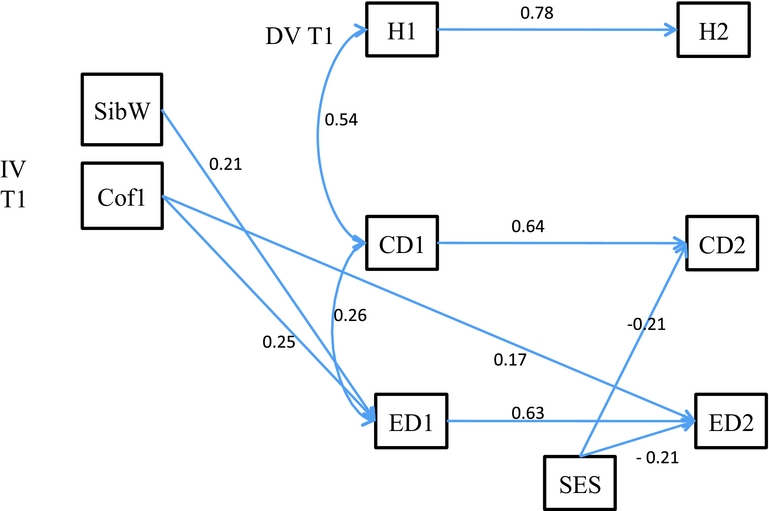
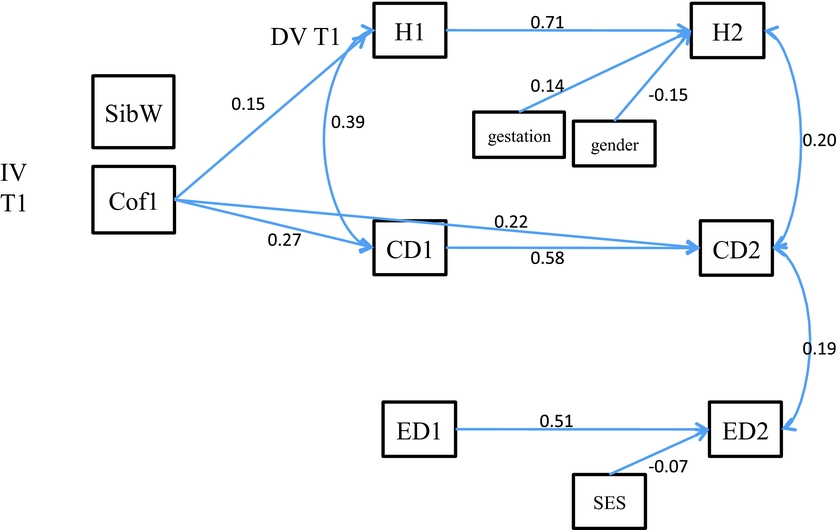
The full path model (as indicated in Figure 1) was calculated by estimating direct effects of low sibling warmth and sibling conflict on behavior problems at T1 and T2 simultaneously while controlling for potential confounders (low birth weight, length of gestation, birth complications, gender, maternal age, and family disadvantage). Figure 2 shows significant associations after adjusting for potential confounders for the single-born children, and Figure 3 shows the path estimates for the twin children adjusted for potential confounders. Across both samples there was high stability in behavior difficulties from T1 to T2. However, patterns of association varied.
Behavior difficulties in sibling and peer relationships for single-born children.
Behavior difficulties in sibling and peer relationships for twins.
Twin and Single-Born Sibling Differences
Before describing the effect of sibling relationship on behavioral outcomes, we needed to establish whether the model for single-born children differed significantly from that of twin children. Thus, we examined whether the associations, shown in Figures 2 and 3, between sibling relationship (warmth and conflict) and behavior difficulties at T1 and T2 differed for twin children and single-born children by comparing a constrained model (all parameters are held invariant across the two groups) with an unconstrained model (all parameters are free to vary between groups). The chi-square different test (Satorra–Bentler) was computed using the scaling correction factor for Maximum Likelihood Robust (MLR; Satorra, Reference Satorra, Heijmans, Pollock and Satorra2000) and showed that the model fit for the constrained model, χ2 (df = 84) = 128.47; p ≤ .001, CFI 0.92; TLI = 0.90; RMSEA = 0.06, and for the unconstrained model, χ2 (df = 42) = 62.10; p = .03, CFI 0.97; TLI = 0.90; RMSEA = 0.06, differed significantly, χ2 (df = 42) = 66.397, p < .001.
In addition, we examined whether twins and single-born children differ for each of the estimates for the main predictors (sibling warmth and conflict) on each outcome at T2. No significant difference was found for sibling warmth on conduct problems (Wald's test = 0.05, p = .8), hyperactivity (Wald's test = 1.7, p = .2), or emotional difficulties (Wald's test = 0.09, p = .4), and also no difference was found for sibling conflict on any of the three outcomes (Wald's test = 2.4; 2.8, and 0.8 respectively). However, consistent with the standard for reporting in circumstances where there is inequality of estimates in the overall model (Muthen & Muthen, Reference Muthén and Muthén2007), we report the unconstrained model in the following section.
Associations for Single-Born Children
The significant associations found for single-born children are shown in Figure 2. For single-born children, sibling conflict was associated with increased emotional difficulties at both T1 (β = 0.25, SE = 0.08) and T2 (β = 0.17 SE = 0.08). In addition, low sibling warmth was associated with increased emotional difficulties at T1 (β = 0.21, SE = 0.09). Although these effects were robust, we also note that family advantage was negatively associated with both conduct disorder (β = -0.21) and emotional difficulties (β = -0.21) measured at T2. We also note that there was no significant association for sibling conflict on conduct disorder (T2; β = -0.02, SE = 0.08), or hyperactivity (T2; β = -0.07, SE = 0.09).
Associations for Twin Children
For twins, as shown in Figure 3, sibling conflict was associated with increased conduct difficulties both at T1 (β = 0.27, SE = 0.07) and T2 (β = 0.22, SE = 0.06), and hyperactivity at T1 (β = 0.15, SE = 0.07), but not T2 (β = 0.09, SE = 0.05). No associations were found for emotional difficulties (T1: β = 0.06, SE = 0.07, or T2: β = 0.6, SE = 0.07). Moreover, low sibling warmth was not associated with emotional difficulties, hyperactivity, or conduct disorder at either T1 (β = 0.06, SE = 0.08; β = 0.08, SE = 0.07; β = 0.02, SE = 0.07) or T2 (β = 0.1, SE = 0.07; β = -0.08, SE = 0.06; β = -0.02, SE = 0.05 respectively). For twins, shorter length of gestation and gender (being a boy) were significantly associated with increased hyperactivity (shown in Figure 3). In addition, family advantage was negatively associated with increased emotional difficulties (T2).
Discussion
This study assessed differences in behavioral difficulties between twin and single-born children in early childhood, and examined the impact of sibling relationships on behavior.
There were two key findings that emerged from this study. First, despite identified differences in background variables (i.e., in number of siblings, family disadvantage and number of birth complications), there were no mean differences in behavioral outcomes or in levels of sibling conflict or warmth in this sample. This finding is consistent with some previous reports (e.g., Moilanen et al., Reference Moilanen, Linna, Ebeling, Kumpulainen, Tamminen, Piha and Almqvist1999), but not others (van den Oord et al., Reference van den Oord, Koot, Boomsma, Verhulst and Orlebeke1995). The inconsistency across studies may be partially attributable to cohort effects, but almost certainly relate to levels of statistical control. In the current study, we controlled for known population differences, such as effects of obstetric adversity. In contrast to some prior studies that have not implemented such control, we did not find any differences in mean levels of behavioral difficulties.
Second, our findings show that although there were no mean differences in behavioral outcomes between twins and single-born children, there were differences in the patterns of association between sibling relationship and behavioral difficulties when known population differences, such as effects of obstetric adversity, were included in the model. Consistent with a large body of literature based on populations of single-born children (e.g., Dunn & McGuire, Reference Dunn and McGuire1992), significant effects of sibling conflict on behavioral outcomes were evident for both twins and single-born children. Our findings support previous research on the inter-twin relationship (Bekkhus et al., Reference Bekkhus, Staton, Borge and Thorpe2011) and showed that conflict predicted externalizing behavior in twin children, in addition to the twin–single-born comparisons, which showed that among single-born children, conflict only predicted internalizing behavior. We further found that sibling warmth had only a limited predictive effect, and that this only applied for single-born children. One potential explanation for this difference could be the structural differences in the twin-sibling relationship compared with those of single-born siblings. For example, in a study on twin-specific risk factors and academic achievements, the differences between twins and their single-born sibling decreased when birth order was controlled (de Zeeuw et al., Reference de Zeeuw, van Bejisterveldt, de Geus and Boomsma2012). Twin siblings are of the same age and developmental stage. As a result there is likely greater balance in the power relations between the twin siblings compared with that of a single-born child with either a younger or older sibling. Younger siblings, for example, are less likely to be physically, socially, and intellectually matched to an older sibling; the behavioral manifestation of sibling relationship difficulties is more likely to be emotional than in a balanced relationship. To test this hypothesis, we conducted additional analyses controlling for the age difference in the single-born sample. This analysis showed that age differences were not associated with any of the behavioral outcomes (β ranging from = 0.03 to 0.15 and p ranging from .62 to .15), suggesting that differences between twins and single-born children are likely to be related to background variables for which there were significant mean differences. Nevertheless, model testing comparing twins and single-born children showed that there were significant differences between the two groups in the overall model, where all estimates were constrained to be equal across groups. Alternatively, it could also reflect a twinning effect deriving from factors not measured in this study. However, to assess this explanation further would require exploration of differences with a comparison group of single-born children with younger siblings to establish whether the findings here reflect a twinning effect, variations in family, and obstetric adversity, or an effect deriving from systematic bias of age in the control group.
Limitations
The findings of this study are subject to four key limitations. First, there was limited data on obstetrics for the single-born comparison group. However, as the single-born children with and without obstetric data did not differ on demographic variables, missing data on birth weight and length of gestation were replaced with the group mean values for these two variables.
Second, as is often the case in studies of children during early childhood, the data analyzed here are based on those acquired from a single data source: parent report. Although parents are generally a reliable source of information about their children (e.g., Shakoor et al., Reference Shakoor, Jaffee, Andreou, Bowes, Ambler, Caspi and Arseneault2011), they observe their children in a different set of circumstances and with different referent groups than teachers or peers. Future studies should expand upon the current findings by using multiple informants to examine how associations between behavior and sibling relationship are reflected across contexts.
Third, the sample in the current study was drawn from the volunteer-based Australian Twin Registry (ATR). Thus, as with all volunteer studies, there is the possibility of recruitment bias. To help overcome this, we supplemented the sample through direct requests via the Australian Multiple Birth Association (AMBA) and media with the aim of obtaining a diverse recruitment sample. In doing so, however, we limited the ability in the current sample to estimate accurate recruitment rates across the entire participant pool.
Finally, this study was limited to 2 years of the early childhood period. The need to establish longitudinal effects is evident, given conflicting findings from studies across different ages. In early childhood, twin children spend more time together than at later points in their development (Thorpe & Danby, Reference Thorpe and Danby2006), thus there is the possibility that the effects of sibling relationship, such as those found in this study, may diminish or change across time.
Conclusions
Our results indicate that there is a need to attend not only to standardize statistical control for confounding variables but also to ensure, as we have done in this study, that the measurement takes account of different developmental meanings of measures for twins and single-born children and adjusts accordingly. Our study further identified that testing of mean differences may not be sufficient to understand the differences in behavior difficulties in sibling relationship between single-born children and twins, and shows that testing difference between models, while controlling for potential confounders, provides considerably more insight into understanding twin and single-born differences.
Acknowledgments
This research was supported under Australian Research Council's Discovery Projects funding scheme (Grant number DP0666254) held by Professor Karen Thorpe, Professor Susan Danby, Professor David Hay, and Dr Elizabeth Stewart. The research is also funded by grant 185710/V50 and 154528/330 from the Norwegian Research Council, Norway, and a grant for international collaboration from the University of Oslo. We would like to thank the Australian Twin Registry and Australian Multiple Birth Association for assistance in recruiting children to the study, and the participating children, families, schools, and teachers who generously gave their time.



