


The importance of nutrition in sport is well established and its influence on health, body weight and body composition, substrate availability and ultimately sports performance has widespread acceptance. However, nutritional knowledge, beliefs and practices in sport are extremely variable, with nutritional science often having little bearing on the practices of elite performers. Many aspiring athletes may be prepared to take a risk. Results from scientific studies that are non-significant, but show even a small trend towards benefit, may be viewed as worth trying if they are thought to translate to improved performance in the field. Other athletes, however, may be ill-informed or simply lack the opportunity or funding to seek advice from competent sports nutritionists or dietitians. Many organisations delegate nutrition responsibilities to other professionals, often fitness coaches or physiotherapists who have only a basic knowledge of nutrition and may also lack the practitioner skills and expertise to effectively apply theory to practice. Furthermore, sports nutrition is currently a poorly-regulated profession, allowing unethical practitioners and individuals without the necessary skills and qualifications to practice, which results in many athletes obtaining information from less-reliable sources, which may also include the media and supplement companies. In practice there could be many aspiring elite performers who never receive support that would allow them to implement unique nutrition strategies that would actually have a beneficial effect on their performance.
Working within a sporting organisation
The role of the registered sports nutritionist or dietitian is to assess individual need and work with the athlete to develop and apply an individually-tailored evidence-based strategy to optimise exercise performance through good nutrition and hydration practices, careful use of ergogenic aids, supplements and routine monitoring. Before working with any squad or individual the dietitian has to consider many factors that will influence food intake and the dietary strategy under development. These factors are numerous and summarised in Table 1.
Essential background information

Some sports, e.g. football and endurance events such as running and cycling, have been more extensively researched than others and it is therefore easier to apply evidence-based nutrition strategies in practice. There are gaps in the literature relating to many sports, e.g. cricket, martial arts and golf, and scant information on the nutritional needs of female athletes and elite young performers. Consequently, extrapolation of theory is required alongside routine monitoring to adapt nutrient requirements and modify strategies accordingly. A nutritionist should therefore be a core member of the sports science and/or medical support teams, with regular opportunities to discuss performance with athletes and their coaches in order to inform decisions about individual, team or club nutrition strategies.
Nutrition strategies in sport
Some of the current popular nutrition strategies used by athletes are listed in Table 2. They involve food, fluids, supplements and ergogenic aids, some of which are based on science and others on popular myth. The present review selects a couple of the key issues and focuses on aspects of their practical application.
Popular nutritional strategies

Meeting carbohydrate requirements
For some time the loss of fluid and reduction in the body's carbohydrate stores have been recognised as two major causes of fatigue in prolonged exercise and remain highly influential in determining performance outcome in endurance training and events and in high-intensity intermittent exercise and competition(Reference Achten, Halson and Moseley1, Reference Maughan and Burke2). Carbohydrate is important to maintain blood glucose levels during exercise and to replace muscle glycogen. Requirements vary between 6 and 10 g/kg body weight per d depending on the athlete's total daily energy expenditure, type, duration and intensity of the sport or training undertaken, fitness and training status, gender and environmental conditions(3).
It has long been established that moderate- to high-intensity training sessions daily or twice-daily will lead to depletion of glycogen stores on a low-carbohydrate diet (40% total energy) whilst a high-carbohydrate diet (≥60% total energy) facilitates recovery(Reference Costill and Miller4). Furthermore, muscle glycogen depletion will occur more rapidly in athletes with a low fitness status, e.g. following a rest or injury period, and with increasing intensity of activity(Reference Brooks and Mercier5). To prepare for a football match, for example, adequate carbohydrate is the primary strategy to maintain optimum function of physical and tactical skills(6). It can be expected that players will deplete glycogen stores within 90 min, which may coincide with dehydration to adversely affect performance by inducing fatigue.
To enhance high-intensity intermittent exercise performance, as in a football match, it is therefore important to develop strategies to increase the availability of muscle glycogen(Reference Balsom, Gaitanos and Soderlund7) through consumption of a habitual high-carbohydrate diet of ≥5–7 g/kg(6), an increase in carbohydrate intake in the 2 d before a match(Reference Bangsbo, Norragaard and Thorsoe8) and a high-carbohydrate intake after training and matches to aid the recovery process(Reference Nicholas, Green and Hawkins9). It is therefore helpful for individual players to know and understand their carbohydrate requirements, how they vary with changing training phases and competition periods and suitable choices of food and fluid to meet them. Coaches should review their procedures to ensure that they allow their athletes every opportunity to achieve their optimal intake of carbohydrate and fluid, which may include allowing time to drink during training sessions and encouraging the consumption and provision of suitable snacks and drinks after training and competition. During confidential consultations with the author some professional football players have reported reducing their food and fluid intake in the period before routine monitoring of body weight and body fat measurements. Such procedures should therefore be carefully planned to avoid compromising nutritional preparations for intensive training and match performance.
Regular high-carbohydrate meals, snacks and fluids are needed to meet the high energy and carbohydrate requirements of a footballer on a match day. An example of a typical match-day meal plan is outlined in Table 3. Food choices should be based on individual food preference, availability and estimated requirements. Consequently, there are many alternative match-day strategies that may involve fluids, meal replacements and recovery drinks if solid food is poorly tolerated. Fluids and energy-dense sources of carbohydrate in the form of simple sugars, e.g. jelly sweets and gels, are also popular choices for players to consume at half-time. These foods and fluids increase blood glucose levels in an attempt to delay fatigue in the latter stages of a match when glycogen stores and blood glucose levels are low. Such strategies are particularly important in demanding competitions and where extra time is possible. Consumption of between 30 and 60 g carbohydrate (equivalent to 0·7 g/kg body weight per h), which is easily achieved through consumption of isotonic sports drinks or carbohydrate gels, matches glucose oxidation rates and has been shown to extend endurance performance(Reference Coggan and Coyle10).
Meal plan for a male mid-field footballer on a match day

For many sports performers achieving their theoretical requirements demands considerable dietary change; gradual and frequent dietary adjustments are usually desired for comfort and overall acceptability. Lack of supervision and guidance when increasing carbohydrate intake can easily increase total energy intake, as adjustments of the other macronutrients (fat and protein) may not be sufficient to maintain energy balance and inevitably weight gain occurs. Other difficulties in meeting carbohydrate requirements include the increased intake of bulky foods and fibre, which for some individuals may have a negative effect on performance through gastrointestinal discomfort and reduced appetite or early satiety. Refined sources of carbohydrate such as sugar, jam, jelly sweets, glucose polymers, gels and energy drinks can help some individuals achieve their goals for carbohydrate more comfortably(Reference Garden, Burke and Deakin11). Whilst these food choices are welcomed by some athletes, others may be resistant to eating foods that they perceive to be unhealthy. Ideally, the practitioner needs to work with each athlete on an individual basis to both educate and develop an acceptable dietary regimen tailored to enhance different periods of training and competition, rest and recovery.
Reliable information on the nutritional needs of female athletes is lacking, which needs to be considered when calculating requirements and applying nutrition strategies. Many women in particular report difficulty in achieving required carbohydrate intakes(Reference Burke, Cox and Cummings12) and in consultations frequently express concern over fear of weight gain. It is emerging that many female athletes may need to increase both carbohydrate and energy intake to carbohydrate load effectively(Reference Tarnopolsky, Zawada and Richmond13). For those on a normal diet of approximately 8–9 MJ (2000 kcal)/d, an intake of ≥8 g/kg per d for 4 d could mean a 30% increase in energy intake. Consequently, some female athletes may need to vary their energy intakes to a greater extent than men during different phases of training, competition and recovery, requiring education and closer monitoring to avoid unwanted weight gain.
Nutritional recovery strategies
Recovery strategies between training sessions and matches or competitions are important in facilitating a sustained high level of performance in both training and competition. At an elite level many sports now demand intense periods of training and competition throughout the year. For example, professional footballers start pre-season training in early July with one or two matches per week, interspersed with training from August through to mid-May, with the season often extended for international events. Cricketers may choose to ply their trade in both this country and overseas, which effectively means playing throughout the year in a sport that can require five consecutive days of play each week, plus additional shorter more-intense matches. Recovering nutritionally between bouts of intense activity may determine outcome by delaying fatigue; players should therefore aim to eat and drink for the efficient recovery of their liver and muscle glycogen stores and to maintain hydration. No longer is it acceptable to finish a match day with fast food and alcohol!
It is generally accepted that consuming carbohydrate food and fluids with a moderate to high glycaemic index will facilitate the most rapid recovery of glycogen stores(Reference Burke, Collier and Hargreaves14). However, precise requirements will vary with age, gender, maturity, fitness status, exercise intensity and duration, recovery period, climate, hydration status, size of glycogen stores pre- and post exercise, presence of other nutrients, muscle damage and the timing of the next training session or match(15, Reference Costill, Pascoe, Fink, Robergs, Barr and Pearson16). If glycogen stores are depleted then a carbohydrate intake of approximately 1·5 g/kg during the first 30 min post exercise and again every 2 h for 4–6 h will usually be adequate to replace glycogen stores(Reference Ivy, Katz and Cutler17, Reference Ivy, Lee and Brozinick18). A small amount of protein eaten with carbohydrate may enhance the recovery of glycogen stores(Reference Ivy, Goforth and Damon19), particularly when consumed with a lower carbohydrate intake, and is very easily available as a simple snack in 568 ml (1 pint) milk, a ham sandwich or as a mixed meal. Athletes with longer recovery periods of approximately 24 h do not need to adopt such a strict strategy but are advised to organise a pattern of carbohydrate-rich meals and snacks according to what is practical and acceptable to their individual situation(Reference Burke, Kiens and Ivy20).
Glycaemic index is a popular concept reported widely in the sports nutrition literature, but is often raised by athletes as a point of confusion. Currently, there is some debate over the relevance of glycaemic index, or glycaemic load, of foods eaten immediately post-exercise, with suggestions that glycaemic index may be of little importance as long as sufficient carbohydrate is consumed(Reference Stevenson, Williams and Biscoe21). Whilst glycaemic index can be a useful way of categorising carbohydrate-rich foods for research purposes, the concept needs to be used very carefully when advising athletes because it is dependent on the amount consumed, methods of storage, processing and cooking and other meal components(Reference Wolever22).
Meeting protein requirements
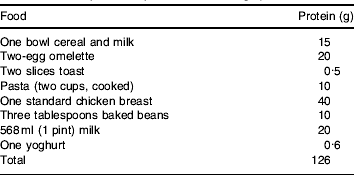
The debate about high-protein v. low-protein diets is a hot topic in most sports settings, as one of the most common misconceptions is the need for a high protein intake for gains in strength, speed and power(Reference Nissen and Sharp23). Table 4 shows theoretical protein requirements for different sports performers based on a review of the available literature(Reference Burke and Deakin24), but there remains much controversy about these recommendations(Reference Tipton and Witard25). However, there is general agreement that normal foods can supply adequate protein to support the needs of all types of athletes and all types of training, and that for most individuals protein in the diet is already consumed in excess of requirements(Reference Deuster, Kyle and Moser26–Reference Christensen, van Hall and Hambraeus28). Table 5 gives an example of how easily an athlete can meet high protein requirements through eating typical foods in standard portions.
Estimated protein requirements (g/kg body weight per d)(Reference Stevenson, Williams and Biscoe21)

Basic food intake for 80 kg male footballer (estimated protein requirement 112–136 g/d)
However, there are vulnerable groups, which include: low energy consumers such as gymnasts and divers; those frequently restricting energy intake to make the weight for competition, e.g.in judo and lightweight rowing; vegetarian athletes with restricted choice; elite young performers who may be relying on nutritionally-poor school meals as the main meal of the day; student athletes new to self-catering who are living on limited budgets. These athletes require support and advice to plan suitable meals and snacks that deliver adequate protein within a varied and healthy balanced diet.
Advocates of high-protein diets usually consider them to be harmless; however, they should be aware of the adverse effects reported, which include impaired appetite(Reference Hall, Long and Morgan29), reduction of bone mineral density(Reference New and Millward30) and loss of lean body mass when a lower protein intake resumes(Reference Millward, Bowtell and Pacy31). Athletes should at the very least be concerned about displacing other essential nutrients in the diet, particularly carbohydrate.
Use of sports drinks and supplements
Over the past decade, knowledge about the negative effects of dehydration on exercise performance has increased and many performers have attempted to improve their hydration status using isotonic sports drinks, which are widely available. There are, however, increasing concerns about their use, with frequent users reporting dental erosion and female groups in particular blaming their use for episodes of weight gain. As with all nutritional issues it is the role of the dietitian or nutritionist to educate and inform athletes on the safe and appropriate use of such drinks, which will vary with each individual depending on work rate, sweat rate, Na losses, environmental conditions and food intake(15, Reference Coyle32). Athletes need to fully understand the role of different drinks and sports drinks and their contribution to their overall nutritional intake, when they are best suited to their training and competition and to adopt monitoring procedures to adapt their intake accordingly. Whilst more sophisticated techniques are used by physiologists, monitoring urine colour and weight changes before and after activity are some of the simplest ways for individuals to regularly gauge their hydration status.
Many athletes take nutritional supplements inappropriately and unnecessarily(Reference Baylis, Cameron-Smith and Burke33). Despite well publicised advice from UK Sport(34) to be cautious about supplement use and to adapt diet first (primarily to avoid unnecessary doping offences through product contamination), athletes frequently find themselves persuaded to take them. Use of supplements is often seen as an easy alternative to dietary change and for most athletes is more accessible than seeking professional advice and involves far less effort than changing eating habits. It is commonly assumed that, even if unnecessary, supplements will not do any harm, and with ‘more’ often considered to be better than ‘less’ athletes may take high dosages in complete ignorance of the potential adverse effects on both their health and performance. The practitioner can advise, educate and offer alternative safe options, but sound advice is competing with the myths fuelled by the billion-dollar supplement market, the highly-influential sponsorship deals with individual athletes and national governing bodies, as well as those unregulated unethical practitioners who profit from selling supplements.
Applying strategies successfully in practical settings
It is well established that eating habits adopted in childhood become lifelong habits, influencing food choices and eating behaviours as adults. It makes sense therefore to engage young performers in fun and practical activities that develop knowledge, skills and behaviours appropriate to future athletic success and at the same time educating their parents and updating coaches. It is considerably easier to progress the dietary strategies of a well-informed adult athlete able to cook and shop than it is to start from the beginning with an athlete with misconceptions, little knowledge or practical skills and limited time to correct established bad habits. However, it is far more usual for sports nutritionists to be employed to work with potential podium or professional athletes than within sports academies or junior elite programmes.
Nottingham Forest Football Club has employed and fully-integrated nutrition services within their academy for the past 10 years, during which time it has consistently produced professional players and won the FA Youth Cup. Table 6 outlines some of the key features of the service. Similarly, integrated nutrition services were used to support the England Ladies cricket squad in preparation for the World Cup and various other competitions including their Ashes win in 2005. The nutritional component of the programme was rated by the players as the most important change in their training and match strategies (N Gilbert, unpublished results).
Key elements of integrated nutrition service at Nottingham Forest Football Academy

* Qualifications undertaken in vocational subjects.
Conclusion
It is clear that the competent practitioner has an on-going challenge in keeping up-to-date with scientific advances as well as maintaining and developing a wide-ranging set of skills to apply that knowledge in practical settings. However, the registered sports nutritionist is currently inadequately supported through poor regulation of the profession, inadequate funding of services and a lack of investment in research. It is surely time to recognise that the knowledge and skills of the practitioner and nutritional services in sport can be important in determining the performance of all elite performers from youth development through to world-class talent.
Acknowledgements
The author is a freelance sports dietitian and special lecturer in Nutrition at the University of Nottingham. The author declares no conflict of interest.



