

As humans, we have a graspable identity that has been shaped by our individual and collective attempts to seek answers to fundamental questions: Who am I? Where did I come from? Where am I going? Where and to whom do I belong, and how can I help myself and others? The persistence of such questions may signal the insatiability of our human curiosity, but they also offer evidence of our possibly endless search for substantive, finite meaning. We yearn to identify who we are and to be part of something greater than our own limited individuality. This desire leads people to draw strong, even vicious, us-versus-them boundaries in political and social life. But it is also a spiritual wish to connect to all of humanity, indeed to all of life and the cosmos, and to take benevolent action accordingly (Figure 1.1, chapter opener). Even when answers to our questions about identity prove inconclusive, changeable, or otherwise unsatisfying, our search continues apace.
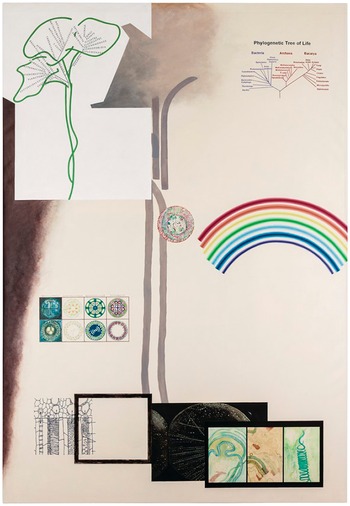
A map of the perception of plants, including a cellular-level intersection of a plant stem (center) and a phylogenetic tree (based on work by Carl Woese, who used 16S ribosomal RNA to discover a new kingdom, or domain, of microorganisms – the Archaea). Shared ancestry and genetic hereditary systems connect the entire tree of life, not just eukaryotes. The rainbow represents light, photosensitivity, and how plants can orient themselves by identifying colors. On the left is a schematic image of electromagnetic patterns in the development of a vegetable; in Clavis Medicinae Duplex, Carl Linnaeus concludes that all life consists of bark, marrow, and electricity. The depictions of xylem and phloem, osmosis, and cell morphology at the bottom reflect Nikola Tesla’s attempts to decipher electrical brain waves. Ödlund keeps a black frame empty, opening our imagination for speculation on connection, intelligence, and the possibility of communication with other life forms – the privilege of the artist. (Co-written with Ödlund.) Plant Perception 2 by Christine Ödlund (2015), painting.
In our quest for identity, we often discover that in addition to being an active and intentional subject, we are perhaps as much a passive object dancing to the tune of greater forces of many kinds – familial, social, political, ecological, and even spiritual. In fact, the search for identity and belonging can become especially urgent when these greater forces for maintaining identity are weakened. We see this in the worker who has lost her job, the refugee who has lost his state, or in the individuals who are discriminated against due to basic sexuality or ethnicity. Threats to our identities force us to a radical outside, like a fish out of water.
Who am I? This fundamental question is so central to religious and philosophical traditions across the globe because it suggests discoverable origins: Where did my talents, skills, and weaknesses come from? Where did my ancestors, and my family, come from? Which group(s), not to mention ethnicities or tribes, might have a claim on me? Why do I have the body I have? It also suggests fungibility and futurity: Can I change? Can I freely alter any of the talents, skills, and weakness that originated within me? Now? Later? So many of us, across varied cultural contexts, have sought answers both in and outside ourselves, in appeals to the soul, supernatural creation, or human nature. We look to religion, to philosophy, and to other sources for the possible causal powers and explanations we seek.Footnote 1
Of course, we also look to science. Indeed, some of the most fecund and provocative answers to our questions of origins have been pursued within the natural sciences. In the West, the field of natural science dates back to the Greeks and the very origin of reason and philosophy, but it was rebooted in the seventeenth century, when the founding of the British and French academies of sciences in the 1660s helped usher in the Scientific Revolution. Physics, chemistry, and physiology were reborn and became newly applicable to humanity’s age-old questions. Discoveries and inventions furthered our search. In England, Isaac Newton (1643–1727) articulated the universal law of gravitation and was a co-developer of calculus; Robert Boyle (1627–1691) and Robert Hooke (1635–1703) invented the air pump to create a partial vacuum and thereby started articulating the physical laws of heat and work; and William Harvey (1578–1657) discovered closed blood circulation in the body of many animals, including humans. Scientific theory and experiment took up new meanings. Mathematics became the theoretical gold standard for developing explanations, predictions, and understanding. Controlled and idealized experiments, with the air pump as a paradigm, came to be seen as central to acquiring scientific knowledge.Footnote 2
Natural science, in both content and method,Footnote 3 has proven effective in providing the platform and tools for understanding how the world works. By measuring objects and processes of many kinds, organizing and managing data, and postulating and abstracting out hypotheses, models, and theories, science builds integrated best guesses of why and how the causal swirls within and outside us happen. Background theory and empirical information feed on each other, and novelty and discovery emerge. Science is partial, dynamic, and a communal effort of inquiry. We use it to answer questions of all kinds, including those that concern us about ourselves and each other.
However, philosophy also supplies an avenue for pursuing answers to our questions of identity. Viewed as the practice of asking big questions about the nature of knowledge, reality, and human life, and as a set of methodologies for answering such questions, philosophy may not provide answers, but it certainly helps clarify our questions. As a historical intellectual tradition, it, too, can be traced in the West back to ancient Greece, where it was inseparable from science. Among the important questions posed by ancient and modern philosophers alike, philosophy helps us to ask and answer these questions:
Why is there something rather than nothing?
Are ideas real? And if so, how so?
What is human nature? Is it anything?
How is knowledge justified and tested?
What is the relation between theory and experiment, and theory and data?
What is it to be rational?
How might thoughts and feelings relate?
What is happiness? What is wisdom? What is suffering?
What do we owe to each other? To nonhuman animals? To nature?
What is the role of science in a just and fair society?
Are we free? What should we do with our freedom?
Does God or gods or any kind of spiritual dimension of reality exist? How might spirituality influence us?
These are not questions easily solved: Nearly all of us think about some of them occasionally – or we almost certainly did as children or teenagers, even if we now keep them in a glass jar in the back of our heart’s closet.
Some of us study these questions professionally. We see philosophy as a medium by which to ask questions, and by which to trouble or nuance our answers. Why? Because, in the words of John Dewey, “philosophy is criticism”:
criticism of the influential beliefs that underlie culture; a criticism which traces the beliefs to their generating conditions as far as may be, which tracks them to their results, which considers the mutual compatibility of the elements of the total structure of beliefs.Footnote 4
When asking big questions, we return to the fundamental issues of our existence and our identity. When we ask big questions critically, we refuse to automatically accept the answers handed to us by tradition, society, or family. As British philosopher Bertrand Russell said:
Philosophy, though unable to tell us with certainty what is the true answer to the doubts which it raises, is able to suggest many possibilities which enlarge our thoughts and free them from the tyranny of custom. Thus, while diminishing our feeling of certainty as to what things are, it greatly increases our knowledge as to what they may be; it removes the somewhat arrogant dogmatism of those who have never travelled into the region of liberating doubt, and it keeps alive our sense of wonder by showing familiar things in an unfamiliar aspect.Footnote 5
Far from existing cleaved from natural science, philosophical questions help drive the development of science. Albert Einstein (1879–1955) asked penetrating questions about space and time, energy, and matter as he developed his two relativity theories.Footnote 6 Isaac Newton’s conceptual questions about what makes for a proper and effective theory, and what confirms a theory experimentally, were central to his own mechanistic project and to his great influence during the Scientific Revolution and beyond. In fact, the philosophical cadence of Who am I? and related questions about identity, origins, futurity, and fungibility have a special relation to the sciences of life and mind. In addition to the variety of creation stories about how humans came to be, and to the religious narratives that seek to explain human nature, such questions have explicitly driven work on evolution and genetics. Questions about our features, our personalities, and our predilections, and about the nature and dynamics of the groups and collectives to which we each belong in multiple ways, are central to the birth and progress of evolutionary theory from the nineteenth century onward.Footnote 7 Indeed, human evolutionary genomics offers a particularly rich, if also necessarily limited, way to explore philosophical questions about why we – and not just we, but other life forms, as well – are as we are, and why we desire what we desire.
***
This book sits at the crossroads of natural science and philosophy. In it, I zoom in on crucial causal objects that help co-make who we are – genes. I argue that the field of human evolutionary genomics in general, and the study of genes in particular, permits researchers, critical thinkers, and the lay public to integrate and substantiate philosophical questions about identity and collectivity within the natural sciences. After all, genetics and genomics ultimately concern processes of the emergence, as well as the potentials and limits, of our bodies, our minds, and our selves. Through the study of genes, we learn more about who and what we are, and who and what we are not.
The scientists who brought forth genetics and statistics in the nineteenth and twentieth centuries were, like us, motivated by their curiosity about questions of origins and evolution. They were also, like us, driven by a political desire to intervene in society. Early men of genetics seem to have assumed the superiority of a specific class of educated, moneyed, white male Anglo, as well as the ubiquity of strongly heritable differences in physical features and cognitive capacities among individuals. Their work reflects that. Some, especially Francis Galton (1822–1911) and his protégé (and a committed socialist) Karl Pearson (1857–1936), promoted eugenic discoveries that proved profoundly problematic in ideation and execution.Footnote 8 Others, like strongly left-wing J.B.S. Haldane (1892–1964), worried about the medical promises and perils of genetics. It cannot be forgotten that eugenic views, so prevalent among geneticists until roughly World War II, cut across the political spectrum, from left to right.Footnote 9 In our age of hopeful diversity and equality, we justly find many of these pursuits morally suspect, if not reprehensible. Yet our contemporary investigations into the discoveries these researchers made offer insight into the questions we continue to ask of science and of philosophy about the origin and nature of body and mind, over evolutionary time and over our individual and collective lifetimes.
Biological scientists and practitioners like those mentioned above were as obsessed with questions of identity, of ancestry, and of futurity as we are today. They sought answers not in religion or philosophy, but in measurable analyses, especially as applied to questions about nature versus nurture. Statistics offered a stable, operational tool with which to locate continuity and ascertain the future. In the hands of R.A. Fisher (1890–1962), in particular, efforts to hone statistics through interpretation and application resulted in the development of evolutionary genetics. Of course, we have learned much since this time. In particular, we have learned (and continue to learn) that statistics cannot fix the future, in the sense of either prediction or repair. It is a tool, and as such it has and will always be used to serve explicitly political, and therefore limited, ends.
Nonetheless, statistics helps us negotiate the space between what is measurable and what is unmeasurable. This is to say, statistics constructs one bridge between the meaningful and knowable on one side and the meaningless or unknowable on the other. Its earliest inventors and practitioners likely grasped this, applying statistics to the space and links between similarities and differences, individuals and populations, and past, present, and future, to find answers to their most persistent questions. The answers yielded by statistics are necessarily partial and therefore fraught. In fact, the essential limitations of statistics informed the field of evolutionary genetics: Even today, evolutionary genetics is frequently understood in terms of a history theorizing and emphasizing eugenics, race, and IQ. The so-called IQ wars, which made evolutionary genetics culturally important, stand as a case in point: In 1969, on the political right, Arthur Jensen (1923–2012) argued for intelligence as a legitimate scientific concept and trait, of which genetic variance both across and within populations is highly explanatory and predictive. In the early 1970s, Richard Charles Lewontin (1929–2021), and later, Stephen Jay Gould (1941–2002), responded from the left, arguing for the effective irrelevance of genetic variance to intelligence. Meanwhile, intelligence itself came to be seen as a problematic and ambiguous property and process to define. The IQ wars raged half a century ago, but the debates, which continue to this day, as we shall see in Chapters 8 and 9, help illustrate the limits of the field.
Evolutionary genetics is not just a limiting lens, however. We can also use genetics and genomics – fields dedicated to human variance and difference – to expand rather than contract our knowledge of human identity and origins, particularly in terms of understanding community, connectivity, and collective and individual potentials. When released from the political agendas in which they are often trapped, genetics and genomics, informed by statistics, can tell us incredible things about ourselves and other species. We can learn about the past through the study of our ancestral populations; we can learn about the present through the study of our individuated and yet common experience with our bodies and minds, their presentations, and their degradations; we can learn about the future through the study of adaptation to extreme environments, the genetic basis of diseases, sexualities, and cognitive capacities, and the way genes and environment richly interact during the history and development of the individual.
Because evolutionary genomics provides a varied candidate set of answers – ranging from contemporary “genetic reductionists” and “genetic determinists” emphasizing selfish genes and human nature (Richard Dawkins and Steven Pinker) to “group selectionists” and “developmental interactionists” defending a complex human reality of genomes, brains, and bodies in social and cultural environments at many emergent levels of analysis (David Sloan Wilson and Richard Lewontin) – to our deepest questions about our place in the world. Because of this, the field has, can, and will continue to address the questions growing out of that kernel query Who am I? in political and politicized ways. Further, reasonable questions remain about the best interpretation of genomic data, statistical analyses, and theoretical results; the role of assumptions and other background context in theoretical development and mathematical modeling; and the nature of self, causation, and equality, given genomic results.
Ultimately, human evolutionary genomics can tell us much about who we are as individuals and as a collective or collectives. But also, and as I make clear throughout Our Genes, it has limited power in fully answering some of our deepest questions. The population is that entity which, according to biologists, evolves. Over the past few decades, experimental and diagnostic technologies across the life sciences and biomedicine have grown, and computational machinery has greatly increased in power and capacity. The study of the genomics of populations – especially human populations – has therefore also evolved in many new theoretical and conceptual directions, including:
developing fundamental Darwinian evolutionary theory;
reconstructing the evolutionary history within and among species, both extinct and extant, and even the entire tree or network of life;
suggesting consequences of various conservation actions for biodiversity (and other ecological measures and metrics);
enabling inferences about human population history and demography, including the history and demography of other species in the genus Homo and beyond;
studying the structure of human genomic variation for biomedical or neuroscientific purposes (e.g., disease etiology identified through genome-wide association studies, or GWAS);
assisting an understanding of the role of genes in development;
identifying genes that are targets of natural selection, for example, genes increasing survival and reproduction in epidemics and pandemics, at high latitudes or elevations, or underwater;
inferring the ancestral populations for a given individual (e.g., 23andMe or AncestryDNA); and
assessing candidate suspects in forensic criminology.
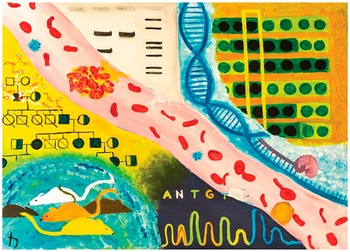
In the pages that follow, and in an effort to produce yet more answers to questions about identity, origin, and community, we shall try to make sense of the accelerating work emerging out of theoretical population genetics and human genomics, including biomedical genomics. Geneticist Kärt Tomberg brought to life genetic methods and concepts in her painting Acrylic Genetics (Figure 1.2). My main perspective is population-level phenomena: I want to know how much individuals differ genetically, both within their own groups and populations, and with respect to very different groups and populations, such as those on other continents, and how this difference is measured, and what it means. How can we use comparative studies of individuals – twin studies or genome-wide association studies (GWAS), for instance – to draw inferences about the relative causal role of genes and environment (or their interaction) in building the individual’s observable characteristics, or about the relatively recent human history of migrations and invasions over the past 12,000 years or so, or about the deepest origins of Homo sapiens and our nearest kin species and subspecies? How can we design studies and experiments using model systems such as mice or fruit flies, informed by necessarily limited interpretive frames, and assay different human populations for genetic susceptibility to disease, to try to develop medical diagnoses and treatments? By pursuing answers to these questions, we stand to learn much about our ancestry and population structure. We also stand to gain a view into the future of human evolutionary genomics, including its potentials (and its perils) for biomedicine or neuroscience, and its relevance for conservation biology.
The blood vessel in the center of the painting contains a thrombus, the phenotypic target for Tomberg and her collaborators’ genetic screen. The painting’s left side illustrates a pedigree generated from a male mouse following treatment with the chemical mutagen ENU (red or gray formula) as well as a DNA sequence tracer sequence (the bottom curves, with corresponding nucleotide sequence, where “N” indicates unknown or error), with a representative ENU-induced DNA variant sequence. The right side of the painting depicts (left) electrophoretic genotyping and (right) genetic region mapping across experimental mice to identify the causal gene variant. Acrylic Genetics by Kart Tomberg (2018), painting.
My work assumes the robustness of population genetic theory, with excellent and time-proven credentials rooted in the work of R.A. Fisher, Sewall Wright (1889–1988), and J.B.S. Haldane. I strive to illustrate the coherence, depth, and evidentiary status of the subtle, rich, and explanatory theoretical organism – not to say machinery – of human evolutionary genomics. I call evolutionary genomic theory an organism because it is robust and stable, complex and ever-developing, and made up of functionally integrated parts (with clear models, methods, and assumptions). This may not be a popular argument. Indeed, there has been recent concern that the theoretical organism is moribund, and pleas for an “extended evolutionary synthesis” have lately filled the halls.Footnote 10 Proponents clamor for a broader and more integrated evolutionary theory that includes more evolutionary forces and that respects processes of development and complex ecological organization. These skeptics suggest that modern evolutionary genomics cannot take into account variable rates of evolutionary change and speciation, phenotypic plasticity and developmental bias, niche construction and the organism’s role in influencing its environment, or nonrandom genetic mutation.
Proponents of the extended evolutionary synthesis make reasonable points: It is true that developmental dynamics and ecological conditions are often left out of standard evolutionary genomic theory. Leigh Van Valen presciently observed as much in 1973: “A plausible argument could be made that evolution is the control of development by ecology. Oddly, neither area has figured importantly in evolutionary theory since Darwin, who contributed much to each.”Footnote 11 However, it certainly does seem imperialist to call for a single theory covering all biological properties across the great web of life. Evolutionary genomics works well in its defined corner, investigating the change of allele frequencies over generations (that is, describing and explaining the changes in the relative percentages, for any given gene, of all alleles of that gene) and the distribution and composition of genetic variation across populations. And it can play exceedingly well with fields and theories close to it, such as molecular and developmental biology, and biogeography and behavioral ecology. But, while the field draws on such neighboring fields and theories, it cannot act as a substitute. Organismic homeostasis and cell differentiation, or food web networks and species–area relationships, cannot be explained through population or evolutionary genetics. Instead, human evolutionary genomics offers one very useful but very limited tool with which to answer some of our most pressing questions about ourselves, and about each other. No single theory – inside or outside of science – can or even should explain everything.
Instead, evolutionary genomics fares well, to my mind, for what it was designed to do – track allele frequency changes in and across populations due to standard evolutionary forces such as natural selection, random genetic drift, migration, and meiotic drive, and thereby explain patterns in genetic variation across populations.Footnote 12 The findings it yields can usefully inform, and also complicate, other questions and other answers. I am therefore a localist: One field of biology may work locally on its defined problems of interest. However, I am also a pluralist: Scientists, doctors, philosophers, and others should use different definitions of evolution, with their differently related models, and contemplate which predictions and understandings might follow. Indeed, population genetics is a kind of flexible theoretical organism. Theoretical evolutionary genomics works, but it is not – and never was – a “master theory.” It therefore should be “disunified” and pluralized – both within itself and with respect to other sister theories – not “extended” in some kind of monolithic, grand evolutionary synthesis.Footnote 13 This book follows this implicit injunction.
Because science and philosophy can further our understanding of ourselves, our politics, and our societies, I hope Our Genes reaches at least three audiences: First, I hope to reach philosophers and other humanities scholars, as well as social scientists, who may not be familiar with evolutionary genomic science, but who recognize its relevance to one of their central concerns – the human condition. The second audience comprises scientists who may have the technical knowledge but might be interested in and benefit from learning more about philosophical investigation both in their domain and in general. I strive to make the science accessible to the former and the philosophy relevant and interesting to the latter. Finally, I hope to reach the general reader who has an active interest in science or philosophy and who is preoccupied, as we all are to some degree, with topics of identity, origins, mutability, and futurity.
This book addresses and explores a set of specific questions within these topics. I ask about our genetic endowment, our evolutionary ancestry and future, and our heritable limits and potential. More specifically, I ask how our genes can help us understand the origin and nature of our body and mind, if not our soul. Who are the we here on Earth, in terms of tribes, nations, social classes, populations, and even local ecologies and larger ecosystems, or entire branches of the tree of life? Does our genomic dowry preordain you and me to certain behavioral or professional destinies? If so, to what extent does freedom remain possible? Outside of genes, but still at the intersection of natural science, philosophy, and human genomics, how do culture, ecology, and “randomness” or “chance” shape us? Our Genes engages with these features and functions of evolutionary genomics. I admit that I am pooling features and research questions of related fields, such as medical genetics and behavioral genetics, with evolutionary genetics. But these areas of genetics are rarely sharply distinguishable. And a panoramic view of the appropriate breadth and depth of human genomics in the context of mathematical evolutionary theory is my goal.Footnote 14
***
Our Genes started, in thought, as a reprint collection, but developed into a much more coherent and integrated book, with much reorganization, new research, and ample rewriting in light of novel research and critical reflection. Chapters have been heavily edited in multiple ways. Furthermore, this chapter and Chapters 2, 7, and 8 are new. In Chapter 2, we situate ourselves within the fields of genomics and statistics, which emerged out of the late-nineteenth-century preoccupation with questions of individual and collective identities. We also begin to familiarize ourselves with the various stages of humanity’s deep, historical genomic journeys. To enable our study, I also supply a genomics glossary at the end of Chapter 2. Chapter 3 discusses the contextual frames that shape the interpretation and meaning of populations and collectivities, in evolutionary genetic theory and beyond. Chapters 4 and 5 address methodological matters about how human population genetics is statistically modeled and, in some cases, philosophically conceptualized. Metrics and measures (Chapter 4) and models and methodologies (Chapter 5) in human evolutionary genomics come in many shapes and sizes – there are no one-size-fits-all questions or themes. We must be careful about using the contextually objective, proper tool for a given question.Footnote 15 Chapter 6 presents six basic empirical patterns of human evolutionary genomics and their representation of the evolutionary history and demographic structure of global populations of Homo sapiens. These patterns suggest that our genome, and the multileveled populations and individual bodies housing it, are more similar than different (although our differences are equally suggestive). Chapter 7 presents an in-depth discussion of selection, including a case study investigation of one of the clearest depictions of selection as a shaping influence in human populations. In so doing it also explores, philosophically and conceptually, the power that distinctions can have and the way we can integrate different explanatory paradigms.
Chapters 8 and 9 explore some consequences of evolutionary genomics for our ontological, personal, and political understandings of intelligence, sexuality, disease, and race. Chapter 8 discusses two case studies relevant to the past development of human evolutionary genomics as a field but also to its future: intelligence and the evolution of female orgasm. By focusing on two ambiguous topics, topics that are still the subjects of ongoing investigation and analysis, I illuminate what human evolutionary genomics can help us see, but I also show what human evolutionary genomics can help to hide. Moreover, I indicate how the distinction between gene and environment, and the associated dichotomy between nature and nurture, which drove the development of both genomics and statistics, remain vigorous drivers in and of the field today.
Chapter 9 applies information from the preceding chapters to a topic that has long preoccupied geneticists, in both incredibly limiting and somewhat expansive ways, to plead emphatically for the separation of genomics from political and social deliberation. Chapter 9 takes as a principal philosophical concern the potential dangers of conflating or perniciously reifying model with world.Footnote 16 This occurs when we fall in love with a model or theory and take it to be absolutely and irrevocably true. I return to this motif throughout the pages of this book, since one of my central worries in how we “do” science is the all-too-frequent systematic and communal ignoring or silencing of the multiple, reasonable alternatives to the few, dominant, orthodox representations. All theories or models are partial and satisfy only a particular subset of specific purposes. The concern with the dangers of reification is best synopsized as the question at the core of Chapter 9: In what sense, if any, can and should we say that race is real?
Chapter 10 takes a step back, considering the relation between statistics and evolutionary genomics in light of a thought experiment of different kinds of universes, and with the exploration of certain foundational matters surrounding statistics, including its possible futures.
***
While very different tasks, reading and writing books share at least one requirement: empathy. Writing means trying to place oneself in the mind and heart of many different readers – imagining what would make them giggly, fascinated, or engaged; trying to avoid boring them with irritating pedantry; and working hard to engage their sense of curiosity and wonder. Of course, there is some hit-and-miss, and the best an author can do is try. Similarly, you, as reader, have many choices about what to do with your time, including which books to hold in your hands or stare at on a screen. If your experience is anything like mine, once a book catches your attention, you try to give it an honest chance by bending your mind to the book’s perspective or paradigm. You do this because you hope to gain something from it. Why else spend your precious resources on it?
A number of exciting books about human evolutionary genomics are available. Spencer Wells’s The Journey of Man (Reference Bamshad, Wooding, Watkins, Ostler, Batzer and Jorde2003), David Reich’s Who We Are and How We Got Here (Reference Reich2018), and Adam Rutherford’s How to Argue with a Racist (Reference Cerdeña, Plaisime and Tsai2020) are each written by geneticists who know their core material exceedingly well. Other books present the scientific material in a more ideological manner, whether from the left or the right, including Jonathan Marks’s Human Biodiversity (Reference Marks1995) and Charles Murray’s Human Diversity (Reference Murray2020). What I bring to the subject is a philosophical investigation of both our subject and the results of our investigations. This includes addressing ethical and political issues, and considering deeply rooted psychological questions of identity and belonging, outside of any ideology (to the extent that is possible). It also means exploring the late-nineteenth-century historical and conceptual interweaving of statistics, genetics, and evolutionary theory. The philosophical and statistical-mathematical level of detail in Our Genes will perhaps require more theoretical stamina on the reader’s part than will engaging with the other books on the market. But I have worked to make this approach appealing and comprehensible (by focusing on assumptions, definitions, and the stakes of the questions, rather than on mathematical equations as such). With that said, readers who might be put off by even a hint of mathematics or statistics could jump from Chapter 3 to Chapter 6. I believe our shared exploration, however challenging, will be worthwhile for those who wish to dig deeper into the political promises and limits, as well as the technical apparatus, surrounding the coevolving fields of genomics, evolutionary theory, and statistics.
This book is inspired by two overarching theses: one political and one philosophical. The contemporary political landscape, somewhat independently of national context, tends to deploy our best genomic science in one of two ways. The political left generally interprets human evolutionary genomics as unequivocal: Contemporary social and economic inequalities cannot be justified – or explained in a morally salient sense – on the basis of human genetics. After all, genomics has shown or proven that we are all “the same,” biologically. The political right almost invariably reads a moral hierarchy into the human genetic story, emphasizing genomic differences at both the individual and population levels. The former finds a genomic basis for its desire for a flat and equal society; the latter reads off genes a vertical and hierarchical society.Footnote 17 Who is right? Does evolutionary genetics prove that humans are essentially the same or that we are fundamentally different, and what does or would this answer tell us about how we ought to behave socially?
As I have indicated, the radically understated political thesis of this book is that genomics is not a good basis for arguing about human rights, regardless of political inclinations, left or right. This is meant in at least two ways. First, genes tell a changing story. As scientific findings change, any attempt to use them as a moral basis is precarious. Our Genes points out problematic examples (e.g., sickle-cell anemia, “Out of Africa” and “Out of Europe” migrations, Neanderthal genes in African populations). Second, genes tell an ambiguous story. Even when what we know stays constant, interpretation can be taken in different directions. There is a plurality of views regarding how to interpret genomic data and model results, as this book demonstrates. Assuming that some scientific fact was found regarding, for example, the robustness of five continental genomic clusters, what broader social and ethical inferences would then be possible?
These fundamental contingencies should inspire a humility and cautiousness toward reading strong political lessons from genomics: The genome neither proves human equality nor demonstrates human hierarchy. The contingencies should also underscore the importance of learning some of the details of human genomics. We must learn so as to begin to understand the simultaneous power and limits of science, especially with respect to complex social and ecological systems. In fact, justifying moral positions on the basis of genes, such as an embrace or grounding of human rights, is strategically, conceptually, and ethically flawed. Genetics has been used to justify all kinds of political positions and actions, especially oppressive, violent, and discriminatory ones. But even if one human population were clearly and explicitly shown to have an intrinsically high cognitive capacity, whether genetically based or not, no such biological facts would actually justify a particular political or ethical norm.
The philosophical thesis of this book is that we should be vigilant and wary of using genomics (and biology more generally) to perniciously reify population-level or category-level differences. In particular, such differences should not be viewed as absolute or strongly explanatory of individual-level differences – or as painting a full picture of individuals in the absence of complex information about personality or culture.
Bluntly put, even if evolutionary genomics is sometimes useful in the doctor’s office, in forensic criminology, or for identity-seekers using DNA tests such as 23andMe, it does not and cannot provide stable ground for our social visions in Parliament or Congress, or in our public discourses. We are each much more than members of particular populations or categories – even if we also stand in deep relationality to other life – and we must be wary of conflating our properties with those of our groups.
We simply cannot chart a path toward equality and freedom using only scientific information. We must move forward according to morality and law. Political and moral philosophy provide arguments premised on intrinsic equality and fairness, not genes. Philosophy may also help us expand the moral universe of our empathy and of our concern for others, including other kinds of living beings. Accordingly, Our Genes invites you to continue contemplating Who am I? as a philosophical question. We will explore themes of individuality and connectivity, of accurate representation and deceptive misrepresentation, of similarity and identity, and of difference and multiplicity in the context of critical thinking, the history of genetics, and the targeted use of statistics. We will find only incomplete, inconclusive answers. These will nonetheless shape our search.


