5 - The Uniform Anatomical Gift Act
Published online by Cambridge University Press: 14 September 2019

Summary
Only a small percentage of potential donors die under circumstances that permit transplantation, particularly for organs … For organs, after thedonor is declared brain-dead, the body must be kept on a respirator and life support until the organs are taken. The OPO and/or Eye/Tissue Banks are notified as required by federal law of a potential donor, and they begin developing a medical and family history to determine whether the dying or deceased person is a suitable donor.
INTRODUCTION
In2004, an effort was underway to respond to great medicaldemandfor organs. The National Conference of Commissioners on Uniform State Laws(NCCUSL) convened a panel of commissioners, chairedbyCarlyle C. Ring, to begin retooling the Uniform Anatomical Gift Act (UAGA). On December 3, 2004, at a small hotel in Chicago, Illinois, observers, advisers, and commissioners began the process of redrafting the UAGA. Commissioners invited participation from a broad pool of specialists and interest groups, including representatives from the tissue banking industry, organ procurement organizations, UNOS, the American Medical Association (AMA), the American Bar Association (ABA), the National Association ofMedical Examiners, and even funeral directors. The committee was fortunate to have one of the original drafters participate and I was more than pleased to be part of a process that was at the core ofmuchofmyresearch.Redrafting theUAGAis not uncomplicated exactly because there are so many distinct interests in this process and some of those are competing interests. The original UAGA was drafted and passed over a summer. The current drafting process could take 2 years.
The committee's charge is to redraft the UAGA in light of organ demand, respect for donor and family autonomy, consistency with federal laws, and with attention to clarifying ambiguities found in prior versions. The committee is also challenged to draft adaptable legislation thatcanaddress future medicalandbiotechnological needs.Nearly 40 years ago when the original act was drafted, neither commissioners nor federal legislators foresaw the great demand for human biological resources, nor did they predict the multitude of ways in which body parts would be used.Humangenome mapping, cloning, and aggressive stem cell studywere off the radar even in 1987 when the last revisions of theUAGA were adopted. TheUAGA draft currently in development will serve as the third revision of the act. Section A historicizes the Uniform Anatomical Gift Act, analyzing its early development and application.
Information
- Type
- Chapter
- Information
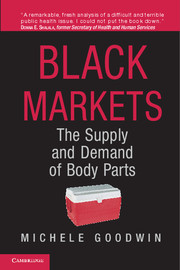
- Black MarketsThe Supply and Demand of Body Parts, pp. 109 - 116Publisher: Cambridge University PressPrint publication year: 2006
Accessibility standard: Unknown
Why this information is here
This section outlines the accessibility features of this content - including support for screen readers, full keyboard navigation and high-contrast display options. This may not be relevant for you.Accessibility Information
Accessibility compliance for the PDF of this book is currently unknown
and may be updated in the future.