

At Zonguldak, located on the western Black Sea coast of Turkey, coal has been mined since the 1840s. It was the largest coalmining area in Turkey, and the sole source of the hard coal that fuelled the Ottoman navy, transport, government installations, and utilities. In fact, Zonguldak was the engine of Turkey’s industrialization. Its workforce, reaching over 60,000 at its peak in the late 1950s, was the largest in the country, with the longest history. During the 1980s and 1990s coal became strategically less important, and by late 2014 the number of miners at Zonguldak had fallen to around 9,000. The Zonguldak coalfield covers an area of 13,350 square kilometres, of which 2,250 square kilometres lie under the sea. All production involved underground mining. The coal stocks at Zonguldak have officially been estimated at 1.34 billion (US) tons in 52 different seams of variable thickness, of which only 37 are workable. The inclination of these seams varies between 0 and 90 degrees and in thickness from 70 centimetres to 10 metres.Footnote 1
Although the area surrounding Zonguldak, including Ereğli and Amasra, has an ancient history, the history of the city of Zonguldak itself goes back only 170 years. The city owes its existence to the mining industry. Until 1896 Zonguldak was a sub-district of the village of Elvan, in the Ereğli district. In 1896 Zonguldak was given the status of a district itself; in 1924 it became a province. That year the population of the city was 29,000; the population of Zonguldak province as a whole was 240,000. Early coal production was located at the centre of the city and in its immediate vicinity. Looking at the city’s relatively short history and rapid population growth, it can be stated that the vast majority of its inhabitants in these years were migrants.Footnote 2 As more mines and the port opened, businessmen and workers filtered in from across the empire and beyond.
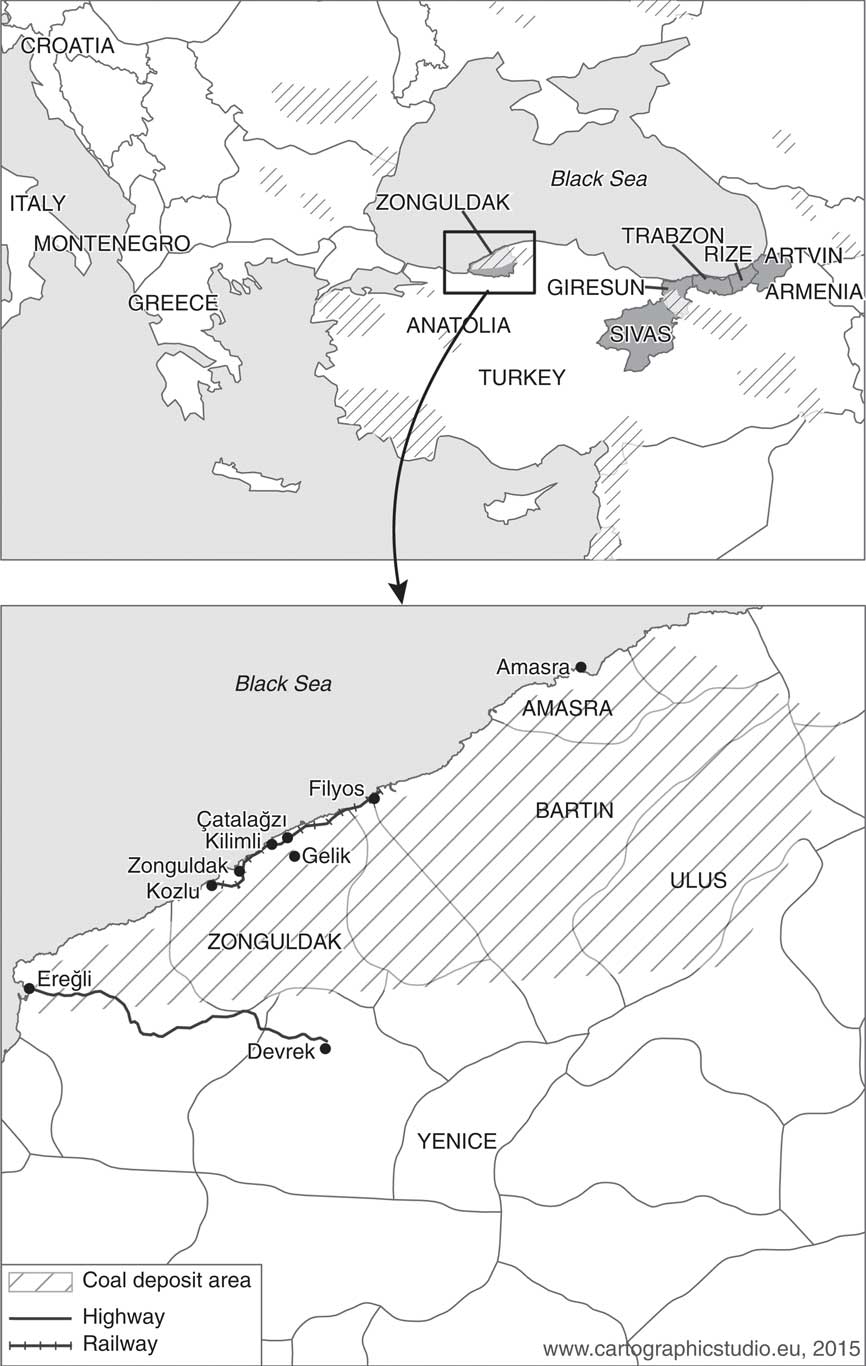
The Zonguldak coalfield in Turkey.
The Zonguldak coalmines were not privately owned, but contracted by the state to various foreign and native investors. At the start of operations, skilled migrant workers from Croatia, Montenegro, Britain, and France were brought in by contracted companies. Later, other workers migrated from the northern Black Sea area (these migrants were ethnically referred to as Laz) and eastern Turkey (Kurds). Donald Quataert, one of the foremost specialists in Ottoman labour history in general and of the early Zonguldak coalfield in particular, reproduces some first-hand accounts from the recollections of two expatriates from Zonguldak: “You could find people of all nationalities here: Greeks, Armenians, French, Turks, Italian, Kurds”; and “In the past Zonguldak was insignificant […]. Everybody, Turks as well as Greeks, came from somewhere else. There was no native population. There were no indigenous Zonguldaklis. Whoever settled there was a foreigner.”Footnote 3 Almost all miners in the city of Zonguldak were migrants. Some came from surrounding villages, others from further afield. Migration brought an ethnically diverse people together. Throughout the years, migration and ethnic divisions in the labour force had a significant impact on the lives of Zonguldak miners.
Mine operators, whether they are working with state or private capital, can deploy a host of strategies to overcome the lack of labour or the unwillingness of a local population to endure the unsafe and harsh working conditions in coalmining. In some cases, scarcity of labour resulted in advantages for the miners in terms of better wages and social provision. But shortage of labour could also prompt extraordinary measures to coerce workers into forms of forced-labour and slave-like conditions. The highly centralized Ottoman state had a particular impact on the lives of workers in general, and always had the upper hand in the recruitment, retention, and the determination of the rights of labour.Footnote 4 In the case of Zonguldak, unskilled underground, and particularly coalface, miners were recruited from its surrounding villages by extra-economic coercion. Peasants were forced by the state to work in the mines of Zonguldak on a rotational basis. In this respect, some of the experiences of the Zonguldak peasant-miners show a remarkable resemblance to those of miners in other parts of the world, in Africa, Latin America, and elsewhere.Footnote 5
Among the growing number of studies on Ottoman labour history, there are no contemporary studies looking at migration and ethnicity in the Zonguldak coalfield.Footnote 6 In this article, I will examine the impact of the ethnic divisions in the Zonguldak mining labour force in terms of the labour process, different types of labour relations, working conditions, and company provisions. The article highlights the existence of two historical regimes of forced labour, each with its impact on subsequent forms of labour relations.
PEASANT-MINERS AND THE FIRST FORCED-LABOUR REGIME, 1867–1921
At the beginning of the Crimean War (1853–1856), primitive conditions characterized the small amount of mining carried out in the Zonguldak area. Only about 500 people were reported to be employed in the mines. Those cutting the coal and boring the galleries were mainly Croats; there were also some British miners. Increased coal production was needed to meet the extra demand from the Ottoman navy, transport, and other government installations and utilities.Footnote 7 To provide more coal, the state began to develop the coalfield more systematically in the 1850s, by opening up a new shaft to exploit the more deeply concealed seams, constructing a basic railway network between the mines and the harbour, and adopting more efficient mining methods. This development encouraged Laz migrants from the eastern Black Sea area to work in the mines, in addition to a small number of Greeks and Armenians, as well as local peasants. Nevertheless, during this period, mine labour continued to be in short supply. Indeed, the government assigned soldiers from the local army barracks around Zonguldak to work as coalminers during their military service.Footnote 8
Until 1867, the state’s efforts to develop the mines met with little success, mainly because there were few experienced miners.Footnote 9 In May 1867, however, the government established guidelines for the exploitation of the mines that would have a decisive influence on the fortunes of coalmining in the area, and which would affect operations also later on in the era of republican Turkey. It was Rear Admiral Dilaver Paşa,Footnote 10 mine director and chief official (kaymakam) of Ereğli (Zonguldak), who issued this set of mining regulations, laying down the rights and duties of mine operators and standards for the boring and reinforcement of the galleries. The regulations consisted of 100 articles, many of them seeking to regulate labour in the mines.Footnote 11
According to the new regulations, villagers in the fourteen districts of Ereğli (Zonguldak) were obliged to fulfil certain tasks at the mines. Each village was assigned to provide labour for a particular mine, a service that was to be compensated in wages. Healthy, able-bodied men between thirteen and fifty years old were registered in a book kept by the muhtar (the village headman). He assigned workers at each pit to one of two groups, each of which would work twelve days rotationally, until the other group arrived. The miners were expected to spend the next twelve days cultivating the land in their village before returning to work. The regulations recognized four categories of worker: kazmacıyan (hewers), küfeciyan (basketmen), kiracıyan (who provided animals to transport coal), and sütünkeş (who supplied, transported, and erected pit props). Kiracıyan were to work in the mines with their animals on fifteen-day rotations. No kiracıyan was allowed to disrupt transport in the mines, so they had to provide their animals on time. If a kiracıyan gave up coal transport for other work, he would be punished.Footnote 12
In the regulations, kazmacı (hewers) were sharply distinguished from the other groups. They could not be forced to work in a particular pit and were permitted to negotiate with the pit operator over their wages and to leave their work for better wages. Hewers’ ability and experience were to be taken into account in wage negotiations.Footnote 13 So, the regulations accorded hewers the partial status of wage labourers. They were free to work for a mine operator of their choice, but they were not free to give up minework.
Some historians consider the 1867 regulations an improvement for the Zonguldak peasants. However, to a very high degree they were powerless vis-à-vis the mine operators, and abuses were numerous.Footnote 14 Although articles on wage arrangements required cash payments, these were made for the first time by the Gurci Company only in 1885, seventeen years after the regulations had been passed. Payment was often given in merchandise, valued at 50 to 75 per cent above the standard price. As the miners needed cash for basic commodities, they were forced to sell the merchandise at reduced prices.Footnote 15
Since the peasant coalminers considered themselves primarily farmers gaining supplementary income in the mines, they retained their village orientation, failing to develop a group identity based on job function or, as a result, any sense of a working-class consciousness or a desire to organize. This largely explains both the wage stagnation and the docile obedience of the workers, which was so highly prized and favourably commented on by company officials and other Europeans.Footnote 16 Indeed, an 1893 company report noted that “these populations appear to us gentle, docile, robust, they have a great respect for authority”.Footnote 17
While the company profited from the fact that its workforce considered itself to be peasants as well as miners, the workers’ self-identification as peasants also posed a challenge, since they were not completely at the mercy of the firm for their livelihood, and remained independent. In 1901, for example, when the company suspended operations because of low coal prices, full-time miners would have been deprived of their income by a disastrous lengthy shutdown, but peasant-miners could survive because, not being employed full-time, they could live on the food grown in the villages when they were not working in the mines. Conversely, in the event of a crop failure, which would have meant real hardship in a purely agricultural society, those who worked in the mines had an alternative means of support. Because of the poor harvest in 1904, for example, the company found itself with more abundant manpower than usual.Footnote 18
MIGRANT LABOUR
In a provision of long-reaching and crucial importance, the government in its 1867 regulations had restricted the obligation to work in the mines to villagers from the surrounding fourteen districts. By blocking the entry of outsiders, it sought to assure the local population of sole access to these jobs. The state also made sure that the income would be supplementary, that is, work in the mines was to be carried out on a part-time basis, in order to ensure that the villagers remained cultivators. The 1867 regulations initially assumed that more demanding and skilled tasks such as boring the galleries could also be carried out by villagers.
The primitive mining methods prevalent at the beginning of the industry perhaps limited the need for skilled labour. However, the development of mining and the increasing demand and production of coal required a wider range of more skilled labour, including drift developers to work within the rock strata to reach a coal seam, workers to pump out water, air, and gas, a foreman, and repair shop mechanics. Fifteen years after the regulations, the state stopped running the mines directly and licensed operations to a third party. In April 1882, a mining concession was granted to Serkis Bey, chief engineer of the Ottoman Empire and architect to the Sultan. Under the terms of the concession, the foreman and workers in the repair shops at the new mines would be foreigners. Miners would be hired locally; since the countryside was poor, it was said, they were readily available at a low price.Footnote 19
In 1891 the Ereğli Coal Company (or Société Anonyme Ottomane d’Héraclée) was formed with French capital. Within a short period it would dominate the coal basin, extracting 60 per cent of its total production.Footnote 20 In 1893, two of the company’s engineers filed an internal report on the mines, noting the earlier efforts made by the state to assure manpower. They described the practice of attaching a certain number of nearby villages to each mine, the part-time and rotational labour provided by the villagers, and the exemption from military service as compensation. The report, and a briefer one submitted to the authorities earlier, in 1877, indicated that Ottoman subjects from the Balkans, and even some foreigners, had also been hired to work in the mines. The earlier report noted the hiring of Bulgars and Croats, recruited by immigration agencies in Istanbul.Footnote 21 The later report also mentioned a small number of Italian and Montenegrin workers, residing permanently at the mines.
At the beginning of the twentieth century, as many as 10,000 people were employed in the coal basin, on either a full-time or part-time basis. Nearly all were Muslims. An estimated three-quarters of coalfield workers were rotational, being recruited from the farming communities of the surrounding districts; these underground and coalface workers remained at the mines for two to three weeks at a time. The remaining one-quarter was more permanent, and consisted of Kurd and Laz surface workers. After 1882, when the mine operators were first permitted to sell a portion of their coal on the open market, these permanent workers migrated from the more densely populated districts of Trabzon, Artvin, and Rize (all located in the north-eastern Black Sea area of today’s Turkey) and remained for periods from four months to several years. The Laz coming from these areas were highly regarded by the companies and received better medical care, pay, and housing than the rotational workers.Footnote 22
In the early twentieth century migrant labour began to have an impact on industrial relations. In the months following the July 1908 revolution, for instance, the Ereğli Company was wracked by labour unrest.Footnote 23 A June 1909 report to the stockholders noted four strikes during the previous year. Foreign workers, the company claimed, prevented local labourers from operating the trains and working in the mines. The company reported its decision “to release [newly hired] miners from the Sivas and Trabzon provinces gradually and to seek to develop manpower among the local inhabitants”, these migrant workers having been a disappointment.Footnote 24 As full-time professionals, the migrant miners were well aware of the value of their skills and organized themselves readily, becoming “foreign agitators” and stirring up the remaining 90 per cent of the labour force, whom the company claimed were willing to work.Footnote 25
However, the mining engineers also reported that Montenegrin, Croat, and Kurdish workers were particularly appreciated for their energy and robustness in comparison to local labourers. In the interests of the company, and to preserve this labour force, the company offered benefits, according to the status of employees. Two primary schools, one for boys and the other for girls, were built by the company for the children of foreign personnel. In 1907 the school called Santa Barbara was attended by 53 pupils in 2 classes, with 4 Roman Catholic brothers as teachers. In 1914 there were 116 pupils, 4 classes, and 7 teachers. These paternalistic company policies did not apply to the local underground labour force.Footnote 26 The only elementary school in Zonguldak for Muslims held just 20 pupils in 1905.Footnote 27
The company also spent at least 1 million francs on new housing, mainly for foreign and salaried employees.Footnote 28 The Ottoman subjects were lodged in collective buildings made of stone and wood; European employees (sixty of them French) resided in individual houses, while the upper management’s and engineers’ houses were located on the hillside (the “French quarter”) that overlooked the Black Sea and the town. These houses were offered at very moderate prices. In its 1912 report, the company noted that lodging for European workers and supervisors was sufficient, but that the quarters for local workers were not.Footnote 29
An analysis of the 1913 Ereğli Coalbasin Administration Reports shows that in comparison with a surface miner an underground miner was twenty-two times more likely to be injured fatally, and ten times non-fatally.Footnote 30 Despite the lack of health and safety precautions and lack of compensation, no demand was made during the strikes to improve conditions for underground workers.
Although the government had already, in 1906, announced the abolition of the restriction on underground minework to the Zonguldak villagers, and opened employment to all Ottoman subjects, this did not alter the forced-labour regime for the Zonguldak villagers. It remained in effect until it was formally abolished with the introduction of the 1921 Labour Law.Footnote 31
PEASANT-MINERS AFTER THE FIRST FORCED-LABOUR REGIME
Agriculture and animal farming remained important for the Zonguldak villagers, because the extremely mountainous geographical conditions limited the area of cultivation in general and mechanized farming in particular; about 50 per cent of the land was steeply sloping (20 degrees and over). In addition, the land in Zonguldak is not very fertile, and farms were smaller than the average in what in 1923 had become Turkey.Footnote 32 Therefore, peasant-miners had never been entirely self-sufficient. The development of the mining industry enabled the villagers to participate in the commercial market.
Although no longer forced to work in the mines by law, they continued to do so after the abolition of the forced-labour regime in 1921 in order to supplement their incomes and pay off debts to the village usurer (tefeci). The Zonguldak mines thus remained an important source of cash for many peasant-miners. They were located within walking distance of the peasant communities (although in some cases the journey took two days). Work opportunities at the mines would almost be guaranteed for the peasants. The construction of the Filyos–Zonguldak railway in 1935 further extended the labour market throughout the neighbouring regions of Zonguldak (i.e. Bartın, Ulus, Amasra, Tefen, and Yenice), while the opening of the Devrek–Ereğli highway in the 1930s also contributed to labour mobility. Both transport infrastructures enlarged the range of villages connected to Zonguldak, with the distance between the villages and the Zonguldak mines now varying between 25 and 110 kilometres.
The peasant-miners worked in rotations of 15 to 20 days. These workers usually went to a particular pit in groups; sometimes whole villages worked in the same pit. The reputation of the section boss and the recommendations of the village usurer were central in the villagers’ choice of a particular pit. In the 1920s and 1930s companies commissioned village usurers for mass labour recruitment, a practice that guaranteed the usurer that his loan would be returned, as well as bringing him commission from mine operators. Among the mine operators, in turn, these usurers enjoyed considerable popularity and appreciation for their ability to recruit the maximum number of workers.Footnote 33
Relatively wealthy labourers took their own beds to the mines, others slept on a piece of wood covered with a sack. Relatives and close friends shared the same “bed” rotationally on their shift turn. The dormitories had earthen floors, leaking roofs, and no windows, with only one fireplace for up to 100 workers. One miner said: “It was nice to sleep all together in the winter months, you could hardly feel the cold. During hot summer nights we slept under the bushes in the open air.”Footnote 34 The old miners still speak about the lice, fleas, bedbugs, and ticks they were infested with.
The miners brought their basic foodstuffs (i.e. bread, olives, halva, and cheese) with them from the villages. After finishing their supplies in their first week in the mines, the miners used to buy food on credit from the ekonoma (mine store). This foods was expensive and its cost was deducted from workers’ wages. The usurers or their representatives came to the mines on payday to collect their money. Since the miners’ main source of livelihood was their agricultural produce, the companies were able to set their wages very low. Moreover, a large portion of the wages paid to the miners was deducted by the usurers and by the company store.
DIVISIONS IN THE LABOUR FORCE: “GREEKS”, “KIVIRCIK”, “LAZ”, AND “KURDS”
The regional and cultural characteristics of the Zonguldak miners presented themselves in every sphere of the mining community. The traditional Ottoman social system reinforced the interpretation that the Zonguldak villagers were kul (servants of the Sultan), while Croats, Montenegrins, Greeks, and other minority groups were considered to have the higher status of subjects. The Pontic Greeks were called Laz by other Greeks, just as Black Sea Turks were called Laz by other Turks.Footnote 35 During the Greco-Turkish war of 1919 and 1922, most of the Greek population left Turkey, and in 1923 the Turkish and Greek governments agreed upon a compulsory population exchange of Greeks and Turks (defined by religious adherence) between the national territories. The exchange also had an impact on the ethnic make up of the Zonguldak coalfield, as the number of skilled Greek miners dramatically declined.
Further developments during the early republican period included the Sheikh Said Rebellion in eastern Anatolia, leading to the resettlement of an estimated 1 million Kurds across the country.Footnote 36 Some moved to Zonguldak, where they settled in approximately ten new villages, increasing the number of Kurds employed in the mines. Large numbers of the Kurdish population and migrants from the eastern Black Sea region subsequently became full-time mine labourers. These permanent workers were employed on the surface in washeries and repair shops, and underground in maintenance, drift developing, transport, and other skilled work. Separated from their communities and fields, full-time miners could not rely on agricultural production for any substantial portion of their livelihoods and were entirely dependent on selling their labour power to the coal operators.
After the 1932 Law on Work and Occupation for Turkish Citizens had banned foreigners from working in Zonguldak, ethnic groups in the mines came to consist only of groups mobilized from within the Turkish nation-state. This development further helped the eastern Black Sea and eastern Anatolian migrants to fill permanent and skilled jobs. Miners were identified as Kurd, Laz, or Kıvırcık (peasant-miners from the Zonguldak villages), and each group was attributed a certain identity, creating an environment of ethnic division. This division also manifested itself in the distinction between skilled and unskilled labour, the permanent or rotational nature of labour, the paternalistic (or discriminatory) policies of the coal company, the emergence of trade unionism, and the provision of welfare. All these aspects influenced the complex entanglement of work and ethnicity in the Zonguldak mines. Within these relations, the peasant-miners of Zonguldak were disadvantaged, which they themselves interpreted through the lens of ethnicity.
As the percentage of full-time migrant labour increased, the segmentation within the Zonguldak miners deepened in terms of skill, tasks, wage scales, rotational or permanent work patterns, and company provisions such as housing. From the 1930s onwards, the segregation between peasant-miners and migrant labourers became even more noticeable. Apart from their social differences, both groups held deeply prejudiced views about each other. Migrants called local miners Kıvırcık (a kind of sheep), because of their cramped sleeping conditions and what they perceived as their docile and obedient behaviour. In return locals called the migrants, particularly the Laz, Çakal (jackal), because they were considered opportunist, lazy, and parasitical on the coalface miners.Footnote 37 This division also found voice in the literature: one of the best known novels on the Zonguldak miners is titled Kıvırcık, inspired by real-life stories of the Zonguldak peasant-miners in the 1930s, i.e. the period before a second forced-labour regime was installed in 1940.Footnote 38
THE SECOND FORCED-LABOUR REGIME, 1940–1947
As coal became a vital element in the government’s industrialization policy, in 1937, when the Second Five-Year Development Plan was launched and the French Ereğli Coal Company nationalized, the Ministry of Justice and the newly formed Türk-İş Coal Company (successor to the French company) signed an agreement to gain access to a new labour supply, allowing the company to use convict labour.Footnote 39 First, 50 prisoners were set to work constructing workers’ dormitories; in May 1937 they were joined by another 100 prisoners. A new mine prison was established at Zonguldak and within a short period the number of prisoner-miners reached 1,600. These prisoners worked in coal extraction, construction, in repair shops, and on the transport of coal and tools. They wore different clothes from the rest of the labour force. One day of work in the mines cut two days from their sentences. Their nominal wages were held in a bank account until their release. This practice seems to have lasted until the mid-1940s.Footnote 40
Deployment of convict labour in the mines had already revealed the lack of labour there. This, however, was not enough to tackle the labour-shortage problem. A solution emerged in the shape of the National Protection Law (NPL, Milli Korunma Kanunu), promulgated on 18 January 1940. Justified by World War II, this law implemented a very repressive labour regime and reintroduced forms of paid forced labour. A co-ordination committee was established in Ankara, which issued over 600 different regulations throughout its existence.Footnote 41 One month after the law was promulgated, specific regulations were introduced for Zonguldak. These imposed a legal requirement that labour be rendered by males over the age of sixteen who were from mining families and were familiar with the work. The unemployed were similarly assigned to work in the mines. In 1940, an agency to organize this re-established form of forced labour was opened at Zonguldak, with offices in the surrounding area. Chief engineers in the coal districts gave details of labour requirements to the company’s Production Department, which passed them on to the agency. The surrounding offices then obtained the labour through the muhtars. An armed body was formed to escort villagers to work and prevent escape.
These new forced labourers in the coalmines were required to work 3 hours longer per day than those in Ottoman times, and were prohibited from changing their work location. In this way, the Zonguldak coal basin was able to draw upon 58,000 workers in 1942. Of these, 46,000 came from the immediate vicinity, 40,000 of them working for periods of 45 days on a rotational basis. The remaining miners were allowed only occasional rest days. A further 12,000 forced labourers from the Black Sea region were also put to work on a rotational basis, forced to work 2 months on, 2 months off. The management’s production requirements or bad weather could add to the time spent at the mine.Footnote 42
AFTER THE SECOND FORCED-LABOUR REGIME: A PATERNALISTIC APPROACH
After 1947, forced labour was abolished again, making it impossible for the mining company to maintain the 58,000 workers who had been drawn upon under the NPL. It was no wonder then that its director, concerned by the shortage of labour and the decline in coal production, strongly opposed the removal of the forced-labour regime.Footnote 43 After eight years of a forced-labour regime, mining in Zonguldak was considered an unfavourable workplace, with no prospect of immediate improvement. Because of low wages, harsh working conditions, including long working hours and high industrial injury rates, many workers abandoned the mines as soon as the forced-labour regime ended. Some of the retired miners who had experienced the forced-labour regime said in interviews that they were reluctant to work in the mines after 1947, unless they were particularly in need of money. In 1948, the average working period for a miner was only two months.Footnote 44
Alarmed by the shortage of labour, the company started to adopt a more paternalistic approach.Footnote 45 From the late 1940s onwards, the company built 1,900 houses in the Üzülmez, Karadon, and Kilimli regions for permanent workers, who paid nominal rents, and provided bus services between their homes and work stations. In 1960 the company employed around 39,000 workers; 6,000 non-married workers and 19,000 rotational workers lived in company dormitories, the latter returning to their villages after completing their rotations. Around 1,900 workers lived in company houses, 8,600 lived in gecekondu (shanty towns), and the rest stayed in their villages, travelling daily to their workplaces.Footnote 46 Although illegal, the company tolerated its workers building their own gecekondu on state-owned lands around Çatalağzı, Gelik, and Kozlu.
It also opened 9 private elementary schools and 1 secondary school. By 1960 the number of students attending the company schools was around 7,000, taught by 150 school teachers employed by the company. In all the company booklets published in the 1950s and 1960s there was a particular emphasis on the commitment to the provision of houses for workers and education for their children. A retired miner who lived in a company house in the Üzülmez region said that in the 1950s and 1960s the company security forces regularly patrolled the houses in order to prevent miners keeping farm animals in their gardens.Footnote 47 The company also opened 13 cinemas, 22 co-operatives, 1 summer camping area, and 3 private beaches for its workers.
CONTINUATION OF ROTATIONAL LABOUR
From 1935 onwards the more traditional types of mining at Zonguldak, oda-topuk (pillar and stall) and baca (rising cut), progressively gave way to the uzun-ayak (longwall) method. However, unlike Europe, where the introduction of longwall mining was associated with heavy mechanization,Footnote 48 at Zonguldak the longwall method did not provide a break from the reliance on labour-intensive work. Although some new technologies were introduced, investment in Zonguldak coalfields remained notoriously low. Throughout the period reviewed, mining consisted of pick and shovel work, miners lying on their sides and crouching in the seams to cut and shovel the coal. Miners were still burrowing upwards with ropes tied round their bodies in order to pull up pit props and tools when new faces were opened and when mining took place in severely sloped conditions, as was often the case. Hewers, prop men, and many other miners still had to provide their own tools – pickaxes, shovels, hatchets, and mattocks.Footnote 49
Systematic mechanization in the mines would necessarily have meant a sharp reduction in the number of temporary, unskilled workers. To drive up productivity by mechanization, the mines would have had to steer the miners away from the old model of semi-peasant, semi-industrial worker. However, because the government never provided sufficient investment to modernize the Zonguldak mines, the underground mining methods did not require a new composition of the labour force. As a consequence, after 1948, underground workers, recruited from the peasantry, continued to work on a monthly basis, dividing their time between mining and agriculture, while surface workers were employed on a permanent basis. Even in the 1990s, over 50 per cent of the underground labour force continued to work rotationally. The policies of the mining company resulted in certain sections of the labour force becoming full-time industrial workers,Footnote 50 but it was impossible to overcome the divisions within the labour force. Labour continued to be divided in terms of locality, work patterns, and ethnicity, and such divisions were further deepened by the favouritism shown by the company to permanent workers.
The ethnic divisions of labour, already introduced in the nineteenth century, thus survive to the present day. The rotational workers perform the less skilled and more labour-intensive underground work.Footnote 51 The permanent workers generally hold more skilled underground and surface jobs; thus, there are no rotational surface workers. Hewers have always been predominantly rotational labourers, so that as late as 1972 95 per cent of them fell into this category, as did 60 per cent of all underground workers. Non-rotational work was performed mainly by foremen, maintenance workers, surface, and shop-floor workers. Even by the 1980s and 1990s, when economic decline in the wages of miners forced the rotational miners to transfer to permanent status, 7 out of 10 hewers were still employed on a rotational basis, as were nearly 50 per cent of all underground workers. Those employed rotationally received no wages for the time they were not at work.
In the early 1990s, a surprisingly large number of Zonguldak miners still saw the composition of the population, not only in Zonguldak, but in Turkey in general, in terms of their own experiences as being made up of Laz, Kıvırcık, and Kurds.Footnote 52 Workers also made reference to the divided nature of the labour force. Some told stories about their early experiences in the mines, when they were unaware that the labour force had traditionally drawn people of an ethnic and geographical origin different from their own, and how this had been an awkward situation for them. Their accounts also highlighted the locality-based division of labour and group identity. One testified: “My village is a taramacı [gallery opener into the coal seam] village. But when I first started, I was assigned as a transport worker. There were many Laz workers in my work group. We had nothing in common, so I became a taramacı.” And another:
When I first started to work in the mines I was a lağımcı [gallery opener into stone strata]. I’m not a Laz, but here all the lağımcı are from Trabzon and Giresun. They are Laz. We didn’t get on well. Soon after, I became a construction worker, where all my hemşehri [people from the same area] work.Footnote 53
TRADE UNIONISM
The same divisions were reflected in trade unionism. The Zonguldak Mineworkers’ Trade Union (ZMTU) had come into existence in 1947. It had started in 1946 as a Mine Workers’ Society. Significantly, it was formed by 11 foremen and section bosses, all permanent workers, mainly from the eastern Black Sea region, 7 of whom lived in company houses. The society managed to register 4,148 miners, a substantial majority of the permanent workers. To solve problems in collecting the monthly membership fee, the company offered help by deducting the fee from their pay slips.Footnote 54 This event marked the beginning of a long-standing collaboration between the company and the union. At the end of 1947, the number of union members reached 19,373, making it the largest trade union in Turkey. The check-off system of dues collection and the large membership permitted the union to operate from a position of relative financial stability.
From 1947 to 1963, the year in which, successively, laws regulating unions and collective bargaining, strikes, and lockouts became effective, the union’s main activities were confined to mutual aid and assistance. In this period, it was impossible to carry out “normal” union activities, such as protecting workers’ rights, wage negotiations, involvement in disputes between company and workers, and engaging in political activities. The union was, in fact, primarily a mutual aid society. As a company union, the ZMTU organized workers in only one company, and while as such it took a collaborative stand towards management, as a trade union it was, all in all, powerless and ineffective.
The original founders of the union continued to lead it until 1960. Almost all were Laz coming from the eastern Black Sea region (Trabzon, Rize); all were permanent workers.Footnote 55 This domination by permanent workers could be seen in all positions within the union leadership and in all positions of control. Less than 10 per cent of the delegates to the General Assembly were from the ranks of rotational workers. Until well after the 1960s miners’ leaders were recruited exclusively from surface workers. They were insulated from the ordinary membership by their permanent positions, and adopted a collaborative stance towards the state-appointed management. In spite of some militancy, the position of the Zonguldak miners was one of powerlessness. Although the union leadership changed radically in 1989, the dominance of permanent workers continues to the present day.
CONCLUSION
Zonguldak as a city came into existence with the opening of the mines. It developed through and with them into the most important industrial site of the Ottoman era and later of the Turkish republic, until the beginning of its demographic and economic decline in the 1980s. From the start, skilled labour recruited by contracted companies was imported from other areas within the Ottoman Empire and beyond, while unskilled labour was recruited from the surrounding villages. From the 1860s until 1920, a first forced-labour regime in the coalfield gave specific tasks to Zonguldak villagers, assigning them solely to underground work, such as hewing coal and supplying as well as putting up pit props. Over the years, local villagers became familiar with coalmining practices and techniques. With the development of the mines and increased production, Zonguldak attracted quarry workers, iron miners, and others with experience in mining, and also other skilled workers such as blacksmiths, mechanics, and drivers. Migrant workers concentrated on skilled underground and surface work. This marked the beginning of a division of mine labour based on migration and ethnicity. Over the years this pattern became reinforced, fed by generations of migrant miners and Zonguldak villagers.
Over 150 years, the state has structured the lives of Zonguldak miners in multiple ways, by regulating and determining labour relations, as well as by its macroeconomic policies. Miners were affected, inter alia, by the state-backed influx of European finance capital into the Zonguldak coalfields in the late nineteenth and early twentieth centuries, through the introduction of 5-year industrial development plans in 1933, and through further liberalization and coal import policies since the mid-1970s. In addition, since 1940 the state has had a more direct relationship with the Zonguldak miners as employer.
In the 1860s, the government imposed a regime of forced labour on the mines in order to balance its desire for coal with that for domestic stability and continuation of the prevailing agricultural system. In a provision of far-reaching and crucial importance, it restricted labour in the mines to villagers from the fourteen surrounding districts. The state ruled that the income should be supplemental, that is, work in the mines was to be carried out on a rotational basis. This first forced-labour regime at Zonguldak was formally abolished in 1921. However, one of the major aims of the new republic throughout the 1930s and 1940s was to maintain a docile labour force in order to reach the level of production needed for the 5-year industrial development plan. Zonguldak was used by the state to subsidize the developing industries through the provision of low-priced coal, and the state was reluctant to incur increased costs by investing in mechanization and technology. A second forced-labour regime, introduced in 1940, once again served to supply the cheap manual labour on which Zonguldak coal production heavily relied.
Throughout the period reviewed in this article, the analysis of state–capital–labour relations in the Zonguldak coal basin reveals a lack of investment, a relatively low level of technology, and an accumulation policy that has remained steadfastly labour-driven. The Zonguldak mines have continued to subsidize the developing industries, without adequate investment. The powerlessness of the miners in relation to the state has been aggravated by their ambiguous position as wage labourers and continuing divisions among themselves. This is perhaps why Zonguldak mine operators chose not to introduce a viable alternative to the system of peasant-miners, unlike their counterparts in Britain, Chile, Peru, and Rhodesia.



