


The assessment of personality and its range of abnormality, a range that is much greater than that implied by the conventional label of ‘personality disorder’, is one of the critical elements of a psychiatric examination. However, it is frequently omitted in clinical assessments, and even in research studies it is rarely assessed formally, even now, at a time when personality disorder is highly topical and its diagnosis possibly a reason for compulsory admission and treatment. When personality is assessed it is often done in a cursory and brief manner, and again this extends to research studies. Thus, for example, a review of all the 152 original papers published in the British Journal of Psychiatry in 2005, revealed 13 (8.6%) in which personality assessment was at least part of the focus of the paper, in 5 of which (3.3%) it was the main subject, and 14 other papers (9.2%) in which general psychopathology was assessed but personality status was omitted. One might have expected that most of the papers addressing personality status would have used a formal assessment instrument. However, only 3 of the papers did so. These were: (a) a careful review (Reference Cooke, Michie and HartCooke et al, 2005) of cross-national variations with the Psychopathy Check-list – Revised (Reference HareHare, 1991); (b) a study of risk factors for repeated self-harm (Reference Sokero, Melartin and RytsäläSokero et al, 2005), which used a structured interview for personality disorders (SCID–II; Reference Spitzer, Williams and GibbonSpitzer et al, 1987);and (c) an examination of personality comorbidity (Reference Khan, Jacobson and GardnerKhan et al, 2005), which assessed personality by self-ratings using Cloninger's Tri-Dimensional Questionnaire (Reference Cloninger, Przybeck and SvrakicCloninger et al, 1991) and Eysenck's Personality Questionnnaire (Reference Eysenck and EysenckEysenck & Eysenck, 1975). The other two papers devoted to personality described new methods of assessment (Reference Bradley, Heim and WestenBradley et al, 2005; Reference Thompson-Brenner and WestenThompson-Brenner &Westen, 2005), which reflects the low level of belief in existing ones. Seven of the studies merely used standard ICD (editions 8–10; World Health Organization, 1992) or DSM–III–R/DSM–IV (American Psychiatric Association, 1994) diagnoses of personality disorder from case records. Perhaps the most interesting revelation came from what is probably the first structural neuroimaging study of lying (Reference Yang, Raine and LenczYang et al, 2005). One might have thought that this was a subject for which standard personality assessment would have been both natural and essential. However, the authors felt it necessary to construct a portmanteau instrument derived from the PCL–R, DSM–IV and an extra criterion for malingering. It is hardly surprising that the findings of the study (increased pre-frontal white matter in liars) has attracted a great deal of attention when the authors are unable to find an existing rating instrument that can even make a passable attempt at discriminating liars from non-liars.
Nevertheless, there have been advances in the assessment of personality disorder and currently a great deal is expected of it in terms of accuracy and precision, particularly in forensic psychiatry. Indeed, a great deal was expected of it in the past, particularly in military psychiatry during the USA in the Second World War, but there it had a poor record of success and had to be abandoned (Reference WesselyWessely, 2005).
Assessment is linked closely to classification and the two subjects need to be discussed in tandem before examining ways of improving current assessment strategies, particularly in the context of new forensic initiatives.
BRIEF HISTORY OF CLASSIFICATION AND ASSESSMENT
Classification of personality has a long history. Hippocrates hypothesised that all illness was a result of imbalance in the four humours of yellow bile, black bile, phlegm and blood, and Galen extended this further to personality by describing personality types linked to excess of each of these: choleric (yellow bile), melancholic (black bile), phlegmatic (phlegm) and sanguine (blood). Although other attempts were made to formalise groupings of abnormal personality, they really did not attract any following until Schneider (Reference Schneider1923) formulated his famous list of psychopathic personalities that he conceptualised as distinct from other mental illnesses. He regarded the term ‘psychopathic’ literally (i.e. as a pathology of mind) rather than as a synonym for ‘antisocial’ as was commonly used by English-speaking writers. Schneider's ten categories of psychopathic personality were: hyperthymic, depressive, insecure (sensitive and anankastic sub-categories), fanatical, attention-seeking, labile, explosive, affectionless, weak-willed and asthenic. Many of these have persisted in one form or another since 1923 and Standage (Reference Standage1979) found that the asthenic, explosive, depressive and affectionless were the most reliably rated. The current categories of dependent, impulsive (ICD only), depressive (extended DSM only) and schizoid are very similar to Schneider's descriptions of these four personalities.
When DSM–III was formulated (American Psychiatric Association, 1980) two critical decisions were made. The first was to give personality disorders a separate axis (Axis II) in the classification. The official reason for this was a pragmatic rather than a scientific reason. There was concern, probably justified in view of subsequent developments, that the diagnosis of personality disorder would be forgotten when it competed with other disorders. The unofficial reason was that the psychotherapists advising the task force were very unhappy with much of DSM–III and were offered a separate axis as a quid pro quo for accepting the main Axis I descriptions. ICD–10 (World Health Organization, 1992) retained personality disorder on Axis I and introduced Axis II for disability and function, so in this respect, and this only, did it differ fundamentally from DSM. Which is right remains open to much debate, and, after reviewing the arguments Kendell (Reference Kendell2002) wrote:
‘This separation ensures that consideration is given to the possible presence of disorders that are frequently overlooked when attention is directed to the usually more florid Axis I disorders’ (American Psychiatric Association, 1980, p. 23).
‘it is impossible to conclude with confidence that personality disorders are, or are not, mental illnesses; there are ambiguities in the definitions and basic information about personality disorders is lacking’.
The second decision was to use clearly defined operational criteria to define the behavioural elements of personality disorder according to the 11 chosen categories in the classification. This was understandable in view of the success of this approach in depression and schizophrenia, but was a mistake with personality disorder. The main reason for the failure of the classification was that the definitions of personality disorder used heterogeneous descriptions, and when all their operational criteria were assessed carefully their distribution was quite unlike that of DSM (Reference Livesley, Schroeder and JacksonLivesley et al, 1994). The alternative of a dimensional classification, most commonly based on traits rather than behaviour, existed before the introduction of DSM–III and has been revised and reformulated many times since (Reference Persly and WaltonPersly & Walton, 1973; Reference Tyrer and AlexanderTyrer & Alexander, 1979; Reference Clark, Livesley and SchroederClark et al, 1996; Reference Mulder and JoyceMulder & Joyce, 1997; Reference Widiger and SimonsenWidiger & Simonsen, 2005), but only now is beginning to have a realistic possibility of being adopted by the world community.
The dimensional system contemplates personality as a continuum, with normal variation at one extreme and what is currently called personality disorder at the other. The best fit is based on four dimensions which are not unlike the original classification system of Hippocrates and Galen (Table 1), particularly when one realises that in the past ‘sanguine’ or ‘full of blood’ was synonymous with confidence and stubborn determination, and ‘phlegmatic’ was equivalent to dull and cold indifference. There continues to be some debate over whether the normal/abnormal personality continuum is best served by three, four or five dimensions (Reference Widiger and SimonsenWidiger & Simonsen, 2005), but a very strong case can be made for sticking to four to maintain historical continuity as well as general accuracy (Table 1).
Similarities between the four basic (higher order) dimensions of personality as originally described by Hippocrates and Galen, with their wording rephrased by subsequent researchers

| Description | Personality dimension | ||||||||
|---|---|---|---|---|---|---|---|---|---|
| Hippocrates/Galen | Choleric | Melancholic | Phlegmatic | Sanguine | |||||
| Tyrer & Alexander (Reference Tyrer and Alexander1979) | Sociopathic | Passive-dependent | Schizoid | Anankastic | |||||
| Eysenck (Reference Eysenck1987) | Extraversion | Neuroticism | Psychoticism | ||||||
| Livesley (Reference Livesley1990) | Dissocial | Emotional dysregulation | Inhibition | Compulsivity | |||||
| Costa & Macrae (Reference Costa and McCrae1990) 2 | Disagreeable | Neurotic | Introverted | Conscientious | |||||
| Mulder & Joyce (Reference Mulder and Joyce1997) | Antisocial | Asthenic | Asocial | Anankastic | |||||
| Current cluster model (DSM–IV) | Cluster B | Cluster C | Cluster A | ||||||
| Proposed cluster model | Cluster B (Dissocial) | Cluster C (Dysthymic) | Cluster A (Detached) | Cluster D (Dutiful) | |||||
1. Cloninger et al (Reference Cloninger, Przybeck and Svrakic1991) proposed a tridimensional structure to personality in 1987, and expanded this subsequently to four and then seven dimensions. The four-dimensional model (novelty-seeking, reward dependence, harm avoidance and perseverance) has some similarities to the above dimensions but is not a good fit
2. A fifth factor, openness, is identified in this scale but not included here
In examining the assessment of personality disorder it is therefore necessary to examine both dimensional and categorical approaches even though at present both world classifications in psychiatry adopt the categorical model of disorder. However, even if DSM–V and ICD–11 persisted with the present unsatisfactory system, an alternative one would have to be used to link with studies of normal personality and its variation. As Widiger and Simonsen (Reference Widiger and Simonsen2005, p. 126) stated:
‘even if the diagnostic manual does not explicitly include normal personality traits, it should be closely coordinated with them so that the APA diagnostic manual of personality disorders is itself well-integrated and coordinated with basic science research on general personality structure’.
The first problem arising in the assessment of personality disorder is the level of agreement between different systems of diagnosis. Others include the stability (or, more accurately, the instability) of current assessment methods in personality disorder, the problem of defining severity, particularly relevant in forensic psychiatry, and the source of information for assessing personality status.
ASSESSSMENT OF PERSONALITY DISORDER BY CATEGORIES AND DIMENSIONS
The first basic requirement of an assessment is that it should be accurate. Accuracy includes elements of both reliability and validity. The latter is often more difficult to determine, as it requires a true measure of that which is being measured, and this genuine ‘gold standard’ is very hard to find in personality research (Reference Cicchetti, Tyrer and TyrerCicchetti &Tyrer, 1988). However, reliability, the extent of agreement between assessors (interrater or test–retest reliability) is an essential first step. Zimmerman (Reference Zimmerman1994) and Clark &Harrison (Reference Clark, Harrison and Livesley2001) have carried out an extensive review of published studies and their results are similar. Personality is assessed by a combination of self-report questionnaires, check-lists and interviews, of which the structured interview is currently considered the most robust.
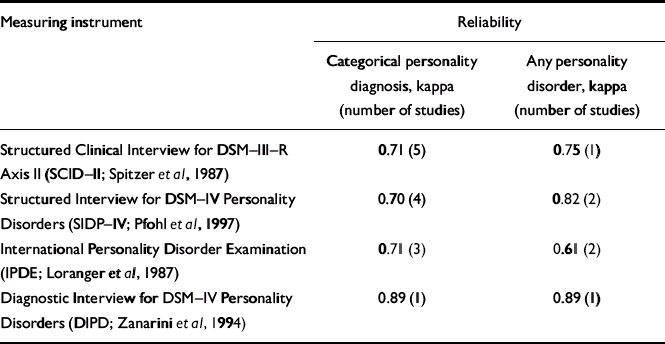
The best possible level of interrater reliability should therefore come from a structured interview in which assessments are carried out jointly (i.e. the same material is assessed by the two assessors). The disappointing level of agreement shown in such settings is illustrated in Table 2; only one study (carried out with the interview schedule's creator; Reference Zanarini, Frankenburg and ChaunceyZanarini et al, 1987) reached the kappa agreement of 0.75 or above necessary to confirm excellent agreement (Reference Cicchetti and SparrowCicchetti& Sparrow, 1981) for clinical purposes.
Summary of levels of agreement (kappa statistic with values for individual diagnoses combined) in the assessment of personality pathology using DSM Axis II structured interviews at joint interview (after Reference Clark, Harrison and LivesleyClark & Harrison, 2001)
| Measuring instrument | Reliability | ||
|---|---|---|---|
| Categorical personality diagnosis, kappa (number of studies) | Any personality disorder, kappa (number of studies) | ||
| Structured Clinical Interview for DSM–III–R | 0.71 (5) | 0.75 (1) | |
| Axis II (SCID–II; Reference Spitzer, Williams and GibbonSpitzer et al, 1987) | |||
| Structured Interview for DSM–IV Personality | 0.70 (4) | 0.82 (2) | |
| Disorders (SIDP–IV; Reference Pfohl, Blum and ZimmermanPfohl et al, 1997) | |||
| International Personality Disorder Examination | 0.71 (3) | 0.61 (2) | |
| (IPDE; Reference Loranger, Susman and OldhamLoranger et al, 1987) | |||
| Diagnostic Interview for DSM–IV Personality | 0.89 (1) | 0.89 (1) | |
| Disorders (DIPD; Reference Zanarini, Frankenburg and SickelZanarini et al, 1994) | |||
However, the level of agreement for the presence or absence of personality disorder is more satisfactory (Table 2), and this tends to be a uniform finding across a range of studies (Reference Bronisch and MombourBronisch & Mombour, 1994; Reference ZimmermanZimmerman, 1994, Reference Clark, Harrison and LivesleyClark & Harrison, 2001). The mean kappa values for the categorical diagnoses (Table 2) hide tremendous variation as agreement for individual diagnostic categories varies from 0.25 to 0.9. By contrast, when similar assessments are made using the dimensional system the level of agreement tends to show agreement that is consistently 0.1–0.2 correlation points higher than categorical diagnoses (Reference Loranger, Lenzegweger and GartnerLoranger et al, 1991; Reference Vittengl, Clark and Owen-SaltersVittengl et al, 1999). This even applies to individual traits. Thus, for example, in a cross-national reliability study of the Personality Assessment Schedule (PAS; Reference Tyrer, Cicchetti and CaseyTyrer et al, 1984) the individual levels of agreement across the separate ratings of 24 traits with both informant and participant interviews (i.e. 48 assessments) ranged from 0.52 to 0.94, with a mean agreement of 0.82 (informant assessment) and 0.75 (participant assessment) (Reference Cicchetti, Tyrer and TyrerCicchetti & Tyrer, 1988: p. 71).
If these levels of agreement for categorical diagnosis are the best that can be achieved in ideal research settings with generally cooperative patients using instruments that take between 90 and 360 min to complete, it bodes ill for their reliability in general clinical practice. The problems are made even more profound by the lack of agreement between different instruments. There are now over 60 different interview assessments and self-rated questionnaires for personality disorder and cross-instrument reliability is remarkably poor. Clark et al (Reference Clark, Livesley and Morey1997) found a grand median agreement of 0.27 (kappa) for comparisons of self-report and interview assessments, even though these are allegedly addressing exactly the same personality pathology.
So from these data we have a clear reason why researchers and clinicians are not rushing to assess personality status in their patients, and, when they do, why they use the diagnosis of ‘personality disorder – not otherwise specified’ (PD–NOS) most frequently (Reference Clark, Watson and ReynoldsClark et al, 1995). As two leaders in the field put it, ‘When researchers use different instruments (interview or self-reports) to identify individuals with personality disorder – either in general or with a specific diagnosis– they may identify groups of individuals with substantially different characteristics. This virtually guarantees that research results will not replicate, despite the fact that the groups carry the same diagnostic label or both scored highly on scales with similar names’ (Reference Clark, Harrison and LivesleyClark & Harrison, 2001).
The major reason for the poor agreement is clear, if the operational criteria for individual diagnoses overlap then their identification will lead to the diagnosis of several personality disorders, even when they may be assessing the same single clear construct. The presence of multiple personality disorders is euphemistically called comorbidity, implying the presence of several independent disorders. However, when a diagnostic system fails and splits a common condition into several, the outcome is still called comorbidity when the correct term is consanguinity (Reference TyrerTyrer, 1996). An attempt to redress the confusion created by multiple personality disorders (a term that also cannot be used as it has been appropriated by dissociative disorders in the international classifications) is the cluster model. This has been used in the DSM classification for many years (Reference Reich and ThompsonReich & Thompson, 1987) and has the advantages of reducing the overlap a little, bringing the odd, eccentric, withdrawn group (paranoid, schizoid and schizotypal; cluster A), the flamboyant, erratic and dissocial group (antisocial, histrionic, borderline and narcissistic; cluster B) and the anxious fearful group (dependent, avoidant and obsessive–compulsive; cluster C), into more natural groupings. However, to fit in well with the four-factor dimensional model (Table 1) there should be a fourth cluster (cluster D) devoted to the obsessional group alone.
CATEGORIES AND CLUSTERS OF PERSONALITY DISORDER
Although DSM experts give only the faintest of praise to the cluster model (Widiger, 2005) and it has not been endorsed by ICD–10, it is becoming increasingly used (Reference Evans, Tyrer and CatalanEvans et al, 1999; Reference Bowden-Jones, Iqbal and TyrerBowden-Jones et al, 2004; Reference Simeon, Guralnik and SchmeidlerSimeon et al, 2004; Reference Bradley, Heim and WestenBradley et al, 2005; Reference Moran, Coffey and MannMoran et al, 2006) in both clinical and research studies because it simplifies what otherwise becomes a morass of comorbidity. To use this with ICD it is necessary to exclude schizotypal from cluster A, narcissistic from cluster B (but adding impulsive) and renaming antisocial as dissocial and obsessive–compulsive as anankastic. The advantages of the cluster system follow mainly from its links to basic personality structure (Table 1) but also can be helpful in improving reliability, even though this can only be a qualified improvement as the basic disorders remain unaltered. This is illustrated by a recent comparison of the reliability of a short assessment of personality (Quick Personality Assessment Schedule (PAS-Q; Reference Tyrer and TyrerTyrer, 2000a ) with a longer structured version based on ICD–10 (PAS-I; Reference Tyrer and TyrerTyrer, 2000b ) in 72 patients in an assertive outreach team. All had one or more prominent mental state diagnoses, as well as many personality disorders (Reference Ranger, Methuen and RutterRanger et al, 2004), and approval for assessments of personality were agreed by the patients and by St Mary's Hospital Ethical Committee. Both assessments were carried out by M.R. using a clinical informant interview. Informants had all known the patients closely for at least 2 years) and to reduce carry over of information assessments were separated in time by a mean period of 9 months. The results showed the expected great variation in the reliability of individual diagnoses (kappa=0.26–0.70) (another reason for avoiding use of these in clinical practice) but somewhat greater agreement (kappa= 0.4–0.78) for the three clusters (Table 3). In general the cluster B diagnoses tend to be rated more reliably than cluster C as there is less overlap between their clinical features and those of other mental illness. This overlap is one of the main sources of difficulty when attempting to improve the accuracy of diagnosis (Reference Tyrer, Strauss and CicchettiTyrer et al, 1983; Reference Hassiotis, Tyrer and CicchettiHassiotis et al, 1997). With the separation of cluster D (inhibited or obsessional group) from cluster C the level of agreement is improved. For those involved in forensic assessment, the higher level of reliability for dissocial personality disorder is encouraging; the same level of superior agreement has been found in a forensic sample (Reference Tyrer, Cooper and SeivewrightTyrer et al, 2005a ).
Agreement between two personality interviews (Quick Personality Assessment Schedule (PAS–Q) and a longer version based on ICD–10 (PAS–I)) separated by personality category, cluster and severity in 72 patients with severe mental illness tested a mean of 9 months apart 1

| Personality group or category using ICD–10 criteria | Agreement level, kappa |
|---|---|
| Paranoid | 0.45 |
| Schizoid | 0.59 |
| Dissocial | 0.70 |
| Impulsive | 0.55 |
| Borderline | 0.50 |
| Histrionic | 0.45 |
| Anankastic | 0.28 |
| Anxious | 0.26 |
| Dependent | 0.33 |
| Cluster A | 0.53 |
| Cluster B | 0.78 |
| Cluster C | 0.40 |
1. For severity of personality disorder (0–4) the intraclass correlation coefficient was 0.66
INSTABILITY OF PERSONALITY ASSESSMENT
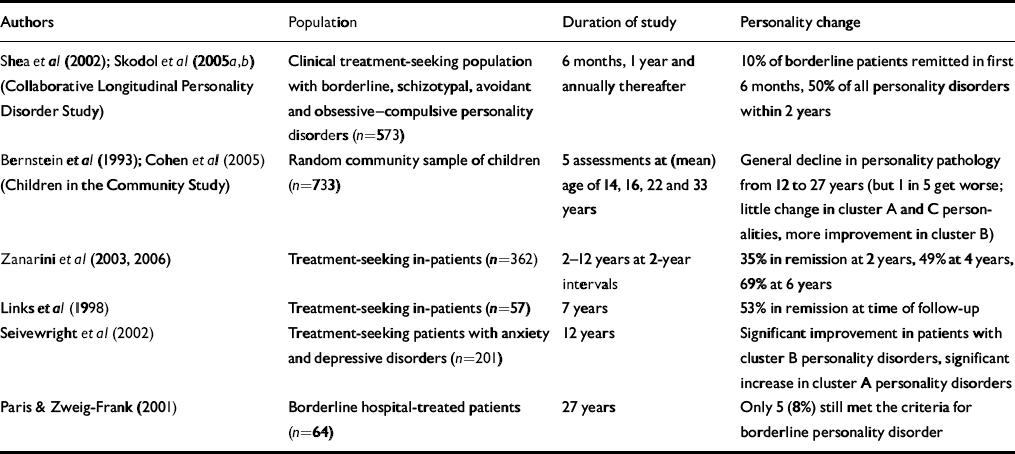
One of the main defining features of personality disorders in both ICD and DSM classifications is that they are ‘pervasive’ and ‘ingrained’. It now looks as though this definition is also wrong, as we now have abundant evidence that personality status, at least that assessed by our current instruments, is unstable (Paris, Reference Paris2002, Reference Paris2003; Reference Seivewright, Tyrer and JohnsonSeivewright et al, 2002; Reference Shea, Stout and GundersonShea et al, 2002; Reference Shea and YenShea & Yen, 2003). Whereas in the past this lack of stability was regarded as a ‘contaminating’ effect of mental state or a poor assessing instrument, the evidence now that it seems to be universal has prompted a change in view. A consistent finding from all studies is that both in the short and longer term those patients who present for treatment with their personality disorders show a steady improvement (Table 4). This is generally greater for those with borderline personality disorder than others, but in the Collaborative Longitudinal Personality Disorder Study similar improvement was found in all four personality disorders (borderline, schizotypal, avoidant and obsessive–compulsive) after 2 years, with the highest rate of remission being 61% in schizotypal personality disorder (regarded as belonging to the schizophrenias in ICD–10) and the lowest 50% in avoidant personality disorder (Reference Shea, Stout and GundersonShea et al, 2002; Reference Grilo, Shea and SanislowGrilo et al, 2004). However, in personal studies using a self-rated instrument for dependent personality (Reference Tyrer, Morgan and CicchettiTyrer et al, 2004) dependent personality features show greater stability (Reference SeivewrightSeivewright, 2005). In the longer term we have very clear accumulating evidence that borderline personality disorder in a treatment setting has a good outcome, but still have to be aware that suicide, the worst of outcomes, can occur at any stage, often late in the course of illness when the worst pathology seems to be over (Reference Paris and Zweig-FrankParis & Zweig-Frank, 2001).
Recent studies demonstrating change in personality status in both clinical and population samples 1
| Authors | Population | Duration of study | Personality change |
|---|---|---|---|
| Shea et al (Reference Shea, Stout and Gunderson2002);Skodol et al (Reference Skodol, Pagano and Bender2005a , Reference Skodol, Oldham and Bender b ) (Collaborative Longitudinal Personality Disorder Study) | Clinical treatment-seeking population with borderline, schizotypal, avoidant and obsessive–compulsive personality disorders (n=573) | 6 months, 1 year and annually thereafter | 10% of borderline patients remitted in first 6 months, 50% of all personality disorders within 2 years |
| Bernstein et al (Reference Bernstein, Cohen and Velez1993); Cohen et al (Reference Cohen, Crawford and Johnson2005) (Children in the Community Study) | Random community sample of children (n=733) | 5 assessments at (mean) age of 14, 16, 22 and 33 years | General decline in personality pathology from 12 to 27 years (but 1 in 5 get worse; little change in cluster A and C personalities, more improvement in cluster B) |
| Zanarini et al (Reference Zanarini, Frankenburg and Hennen2003, Reference Zanarini, Frankenburg and Hennen2006) | Treatment-seeking in-patients (n=362) | 2–12 years at 2-year intervals | 35% in remission at 2 years, 49% at 4 years, 69% at 6 years |
| Links et al (Reference Links, Heslgrave and Van Reekum1998) | Treatment-seeking in-patients (n=57) | 7 years | 53% in remission at time of follow-up |
| Seivewright et al (Reference Seivewright, Tyrer and Johnson2002) | Treatment-seeking patients with anxiety and depressive disorders (n=201) | 12 years | Significant improvement in patients with cluster B personality disorders, significant increase in cluster A personality disorders |
| Paris & Zweig-Frank (Reference Paris and Zweig-Frank2001) | Borderline hospital-treated patients (n=64) | 27 years | Only 5 (8%) still met the criteria for borderline personality disorder |
1. Only those studies which had a formal assessment of personality status at baseline and follow-up are included
The high level of instability of personality pathology, only a little less than that of major depressive disorder and more so than anxiety (Reference Shea and YenShea & Yen, 2003), has led to doubts that current instruments, working as they do with a failed classification system, do really indicate that personality is quite so unstable (Reference WigiderWigider, 2005), and there is also evidence of greater stability of social dysfunction in longer-term studies (Reference Nur, Tyrer and MersonNur et al, 2004; Reference Seivewright, Tyrer and JohnsonSeivewright et al, 2004; Reference Skodol, Pagano and BenderSkodol et al, 2005a ; Reference Tyrer, Nur and CrawfordTyrer et al, 2005b ). However, the genie is out of the bottle. We can no longer plod forwards developing new instruments that we hope will take us to the Holy Grail of temporal stability (Reference TyrerTyrer, 2005a ) and refuse to accept that spontaneous change in personality features can take place independent of any treatment effects.
However, in acknowledging the improvement in clinical samples being treated for disorder we must also note that these populations are relatively uncommon in epidemiological terms. Most individuals with personality disorder (3 out of 4) in contact with services are treatment resisting (Type R) rather than treatment seeking (Type S; Reference Tyrer, Mitchard and MethuenTyrer et al, 2003), and in the normal population this proportion is even higher (C. Kirby, personal communication, 2007). Those with borderline (mainly) and avoidant personality disorders (less prominently) (Reference Emmelkamp, Benner and KuipersEmmelkamp et al, 2006) are the ones involved in most of the recent studies, although other approaches, particularly nidotherapy, which changes the environment, not the patient (Reference TyrerTyrer, 2002; Reference Tyrer and BajajTyrer & Bajaj, 2005), may be suitable for the Type R majority. The findings that one in five children with abnormal personalities get worse in the Children in the Community Study (Reference Cohen, Crawford and JohnsonCohen et al, 2005) and that older people who have had anxiety and depressive disorders in the past have a higher rates of cluster A personalities than when young (Reference Seivewright, Tyrer and JohnsonSeivewright et al, 2002) is a reminder that personality pathology can go in different directions. There is also evidence from epidemiological studies that cluster A pathology persists into older age (Reference Reich, Nduaguba and YatesReich et al, 1988).
MEASUREMENT OF SEVERITY OF PERSONALITY DISTURBANCE
Epidemiological studies suggest that between 5% and 13% of the population has at least one personality disorder (Reference Casey and TyrerCasey & Tyrer, 1986; Reference de Girolamo and Reichde Girolamo & Reich, 1993; Reference Torgersen, Kringlen and CramerTorgersen et al, 2001; Reference Coid, Yang and TyrerCoid et al, 2006a ), so it is clear that it is a common condition. It is also equally apparent that some form of severity assessment is necessary to decide on priorities for management. This has become increasingly necessary when expensive provision is being made for small groups, such as those in the Dangerous and Severe Personality Disorder (DSPD) Programme in England (Home Office & Department of Health, 1999). The concept of dangerousness is often invoked when deciding on the severity of personality disorder, but this is mistaken. Dangerousness is not a function of personality disorder, as it can be present with many other mental disorders, or indeed, in the absence of disorder.
Unfortunately there is no measure of severity of personality disorder in the ICD or DSM classifications. This absence has caused significant concern, as it is highly relevant to the planning and provision of services. What is clear from empirical research studies is that those with more severe personality disorder do not have stronger manifestations of one single disorder as often postulated (Reference Tyrer and JohnsonTyrer &Johnson, 1996), but instead their personality disturbance extends, ripple-like, across all domains of personality, so that in the most severe disorders there is virtually no satisfactory personality function in any area (Reference Oldham, Skodol and KellmanOldham et al, 1992; Reference Dolan, Evans and NortonDolan et al, 1995; Reference Tyrer and JohnsonTyrer & Johnson, 1996). By using this measure of severity, and by giving special attention to those with marked antisocial personality features, thereby giving a separate level of ‘severe personality disorder’, it is possible to use the cluster system to get a measure of severity and a reasonable level of agreement (Table 3). This assessment is also relevant in assessing those with the most severe personality disorders, as there is some evidence of a different response in this group in high secure settings (Reference Tyrer, Barrett and ByfordTyrer et al, 2006).
PAS-DOC STUDY OF DOCUMENT-DERIVED PERSONALITY ASSESSMENT
Who provides the information for personality assessment is often overlooked. It is commonly assumed that the patient is the best source of information but, following the Robert Burns dictum, ‘O what gift would the lordie gie us, to see ourselves as others see us’, a close informant may be a much more accurate judge. Although there is no clear way of deciding whether an informant's ratings are more accurate than those of the patient (Reference ZimmermanZimmerman, 1994), the additional information derived from interviewing an informant can be extremely valuable (Reference Zimmerman, Pfohl and StanglZimmerman et al, 1986), particularly if the informant is closely related and is female (Reference Brothwell, Casey and TyrerBrothwell et al, 1992).
However, the value of written records describing the patient's attitudes and habitual behaviour has only been appreciated fully by one group, those who measure psychopathy with the Psychopathy Checklist (Reference HareHare, 1991). Although the record of inter-rater reliability and predictive reliability of instruments assessing personality disorder is disappointingly poor, the PCL–R, and its briefer fellow traveller, the screening version (PCL–SV; Reference Hart, Cox and HareHart et al, 1995) go against the trend. These instruments attach great importance to written records without which the full PCL–R cannot be completed. The success of the PCL–SV in being the best single predictor of violence following the discharge of a psychiatric patient from hospital (Reference Monahan, Steadman and SilverMonahan et al, 2001) is unlikely to result from just the presence of superior psychometric properties; the bonus of the additional information derived from records is almost certainly critical, and helps over other methodologies (Reference Moran, Walsh and TyrerMoran et al, 2003). This is also important when the data show that half of all people with antisocial personality disorder show no significant violence (Reference Coid, Yang and RobertsCoid et al, 2006b ).
We have developed a document-derived version of the PAS (PAS–DOC) (Reference TyrerTyrer, 2005b ) that has the same underlying structure as the parent instrument (Reference Tyrer and AlexanderTyrer & Alexander, 1979) but has been adapted for written records, including those about children and adolescents. This latter process has been helped by the modification of the original PAS for use in adolescents where it has been of value (Rangel et al, Reference Rangel, Garralda and Levin2000, Reference Rangel, Garralda and Hall2003). In an extension of the study of patients in the assertive outreach team we assessed both reliability and validity of the PAS–DOC.
Reliability study
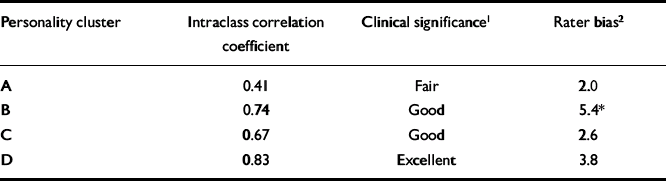
A single typed summary (2 pages) from the case notes of 20 patients involved in the earlier study with patients in an assertive outreach team (Table 3) was selected at random by an independent administrator and given to two assessors (N.C. and F.I.) who scored them independently using the PAS–DOC, which gives personality status after completion of a computer algorithm. The dimensional ratings of the four main clusters (A=withdrawn cluster, B=flamboyant cluster, C=dependent cluster, D=inhibited (obsessional) cluster) were rated for agreement using the intraclass correlation coefficient and also tested for rater bias (Reference Cicchetti, Aivano and VitaleCicchetti et al, 1976). The results are shown in Table 5. The best agreement was reached for the obsessional cluster (R I=0.83), with the cluster B group (R I=0.74) close behind. The scores for the withdrawn cluster, A, showed the lowest level of agreement (R I=0.41).
Levels of agreement between two raters assessing a single typed summary of the 20 patients involved in the Document-Derived Version of the Personality Assessment Schedule (PAS–DOC) study
| Personality cluster | Intraclass correlation coefficient | Clinical significance 1 | Rater bias 2 |
|---|---|---|---|
| A | 0.41 | Fair | 2.0 |
| B | 0.74 | Good | 5.4 * |
| C | 0.67 | Good | 2.6 |
| D | 0.83 | Excellent | 3.8 |
1. After Cicchetti & Sparrow (Reference Cicchetti and Sparrow1981)
2. F ratio with 1 and 19 degrees of freedom
* P<0.05
Validity study
The 20 patients examined in the reliability study were all very well known to the clinical team and a consensus agreement of personality status had been agreed and recorded. A team of five raters, who had received some prior training only in the original PAS (this included N.C. and F.I. after they had completed the reliability study and before their data were analysed), each made an independent assessment of one volume of case notes (which contained none of the research information on personality status) using the PAS–DOC. In assessing the validity of the raters' assessments it was assumed that a satisfactory assessment would make a correct decision as to whether personality disorder was present and, if so, in which of the four clusters it would be placed, or, in the case of more complex personality disorders, which ones. Diagnostic accuracy was only regarded as positive if both type and presence or absence of personality disorder were correct.
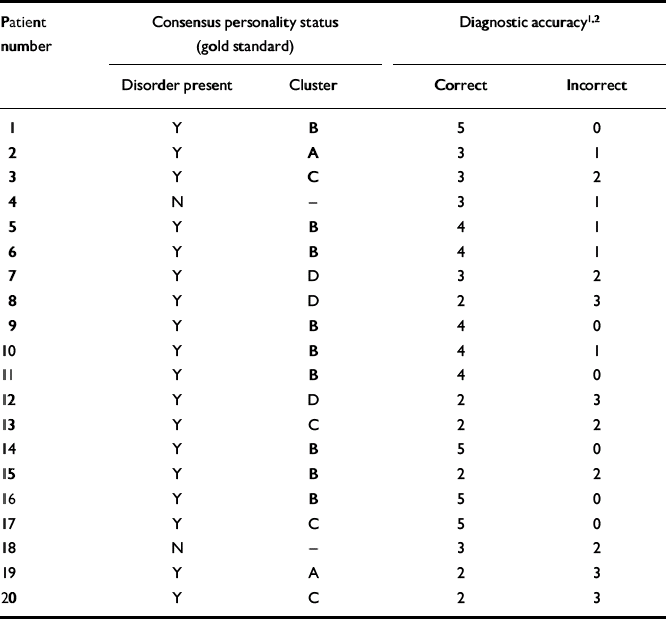
The results showed that overall diagnostic accuracy was 71%, cluster B personalities were the most accurately identified (88%) and, in contradistinction to the reliability study, cluster D (obsessional/inhibited group) were the least well detected (47%). There was also considerable variation in accuracy between the raters (Table 6). In the context of the results it should be emphasised that all 20 patients had complex pathology (schizophrenia or schizoaffective disorder (11), bipolar disorder (5), recurrent self-harm (1), psychotic depression (1), multiple phobias (1) and obsessive–compulsive disorder (1), with 9 also having a history of drug misuse).
Comparison of the accuracy for both personality type and disorder of the Document-Derived Version of the Personality Assessment Schedule (PAS–DOC) using masked assessment of one volume of case notes for 20 patients whose personality status had been determined independently by consensus meetings of a clinical team.
| Patient number | Consensus personality status (gold standard) | Diagnostic accuracy 1 , 2 | ||||
|---|---|---|---|---|---|---|
| Disorder present | Cluster | Correct | Incorrect | |||
| 1 | Y | B | 5 | 0 | ||
| 2 | Y | A | 3 | 1 | ||
| 3 | Y | C | 3 | 2 | ||
| 4 | N | – | 3 | 1 | ||
| 5 | Y | B | 4 | 1 | ||
| 6 | Y | B | 4 | 1 | ||
| 7 | Y | D | 3 | 2 | ||
| 8 | Y | D | 2 | 3 | ||
| 9 | Y | B | 4 | 0 | ||
| 10 | Y | B | 4 | 1 | ||
| 11 | Y | B | 4 | 0 | ||
| 12 | Y | D | 2 | 3 | ||
| 13 | Y | C | 2 | 2 | ||
| 14 | Y | B | 5 | 0 | ||
| 15 | Y | B | 2 | 2 | ||
| 16 | Y | B | 5 | 0 | ||
| 17 | Y | C | 5 | 0 | ||
| 18 | N | – | 3 | 2 | ||
| 19 | Y | A | 2 | 3 | ||
| 20 | Y | C | 2 | 3 | ||
1. With four and five raters using PAS–DOC for both type of personality disturbance and presence of personality disorder
2. Overall diagnostic accuracy (for all patients)=67/94 (71%); diagnostic accuracy for primary cluster A patients (n=2)=5/9 (56%); diagnostic accuracy for primary cluster B patients (n=9)=37/42 (88%); diagnostic accuracy for primary cluster C patients (n=4)=12/19 (63%); diagnostic accuracy for primary cluster D patients (n=3)=7/15 (47%); diagnostic accuracy for patients with no personality disorder (n=2)=6/9 (67%). There was also considerable variation between the overall diagnostic accuracy of the five raters, being 87%, 84%, 75%, 60% and 55%
IMPLICATIONS FOR FUTURE ASSESSSMENT OF PERSONALITY
There are two main conclusions arising from this review of studies and recent experimental work. The first is that personality and its disorder can no longer be regarded as a clear and stable entity that will yield eventually to the right form of assessment. What can be assessed accurately at a point in time is personality function, not disorder. Just as mental state can be dependent on environmental influences, so can personality status, and this can be made use of in therapy (Reference TyrerTyrer, 2002; Reference Tyrer and BajajTyrer & Bajaj, 2005). The notion of personality function, first expressed clearly by Bronisch & Klerman (Reference Bronisch and Klerman1991), has been confirmed by recent studies showing that personality functions in different ways at different ages and in response to different needs. At the same time we must also recognise that there are some underlying characteristics, best described as traits, which do show some tendency to stability, but it must be acknowledged that this is not an absolute tendency and cannot be allowed to form the only prediction of the future. At the same time it should not be ignored, as although personality assessment is still defective, it is still a strong predictor of outcome when present with other mental disorders (Reference Newton-Howes, Tyrer and JohnsonNewton-Howes et al, 2006).
The second conclusion is that a revision of the current classification of personality disorder is overdue. Any changes must take account of the abundant evidence that normal and abnormal personalities merge into each other and it is not appropriate to have one classification for normal variation and another for pathological variation. It is suggested here that four dimensions cover the range of normal and abnormal pathology and that this is the best separation available.
In future, for better assessment we need to have improved global assessments of personality status that can be applied across all age-groups. At present, many investigators, particularly in assessments of children and adolescents, are compelled to pick one aspect of personality functioning at the neglect of others and this may lead to different results between investigators. Thus the study by Viding et al (Reference Viding, Frick and Plomin2007, this issue) describing the significance of callous–unemotional traits in the onset of conduct disorder, would be helped greatly by having a much greater breadth of personality assessed, not least because the presence of some more adaptive traits may alter the progression of the maladaptive ones. Similarly, the follow-up of the Aberdeen Children's cohort has had to rely on the Rutter Scale (Reference RutterRutter, 1967) for recording personality pathology in the flamboyant cluster (Reference Wiles, Peters and LeonWiles et al, 2005), something that was unlikely to have been anticipated by its originator. In other childhood studies, such as those in which internalising and externalising features are examined (Reference Fergusson, Horwood and BodenFergusson et al, 2006), grouping these features by personality status might help to explain much of subsequent pathology (Reference Mervielde, De Clercq and De FruytMervielde et al, 2005; Reference Westen, Dutra and ShedlerWesten et al, 2005). At the very least this hypothesis should be tested.
With greater awareness of the variability of personality function over time it is also necessary to take more notice of written and other independent evidence about personality status at successive points in time. At present, reliability remains hamstrung by the deficiencies of the current classification, so all attempts to meld and merge diagnoses are bound to fail to some extent because the building blocks are faulty. However, the results with the PAS–DOC suggest that personality pathology in the flamboyant and antisocial group can, as with the PCL–R, be rated both reliably and accurately, but this is more difficult for those aspects of pathology that do not ‘hit the headlines’ as it were, and are confined to more private settings where documentation is poor.
These problems need to be resolved. The work described here suggests that they are being addressed, and this is essential if clinicians are to feel confident about diagnosing clinical problems comprehensively, planning care and predicting outcome for the disorders they commonly treat.
Acknowledgements
We thank Sandra O'Sullivan for help in organising the selection of notes and papers, Drs Andrew McDonald & Katarina Miloseska for coordinating the reliability studies, and the patients and members of the Paddington Outreach Rehabilitation Team (PORT) and Community Outreach Rehabilitation Team (CORT), Central North West London Trust for their good-natured cooperation. This work was partly funded by a grant from the National Programme on Forensic Mental Health.




eLetters
No eLetters have been published for this article.