

Everything in its own good time?
‘Ah, time is a riddling thing, and hard to define is its essence!’
Thomas Mann, Der Zauberberg Footnote 1‘Time – it is a strange thing’ (‘Die Zeit, die ist ein sonderbar’ Ding’) muses the Marschallin in a famous passage near the end of Act I of Der Rosenkavalier. Hugo von Hofmannsthal's text is replete with numerous ruminations on the enigmatic nature of time and our perception of change and temporal passage, questions familiar from centuries of Western thought, but which scarcely invade the consciousness of any previous operatic character to quite the extent found here. ‘While one's life is passing it is absolutely nothing, but then suddenly one is aware of nothing else’, the Marschallin laments. ‘It is all around us, it is also inside us. It trickles across our faces, it trickles in that mirror there, it flows around my temples. And between you and me it flows too, silently like an hourglass.’ Yet time is not always silent, she confides to her lover, the youthful Octavian. ‘Oh Quinquin, sometimes I hear it flowing, inexorably. Sometimes I get up in the middle of the night and stop all the clocks, every one of them.’Footnote 2
Time, as philosophers have long argued, is a curious entity, in that it cannot be perceived directly through any of our senses. ‘What is time?’ asks Thomas Mann's fictional Hans Castorp in Der Zauberberg (The Magic Mountain, 1912–24), a self-styled ‘novel of time’ virtually contemporaneous with Der Rosenkavalier. ‘Space we perceive with our organs, with our sense of sight and touch. … but which is our organ of time – tell me that if you can?’Footnote 3 It is not clear that the Marschallin claims to see time trickling and flowing, so much as she speaks figuratively of its mysterious permeation around objects, as a hidden fourth dimension to the three visible ones of the world around us. (Seeing time would certainly be something peculiar, though the Marschallin, in her mid-thirties with a seventeen-year-old lover, has become very conscious of her age: just a short while before she had looked in the mirror and noticed with dismay the change from the face to which she was accustomed.) However, a rather stronger assertion is made for time's audibility: sometimes she even hears it flowing. Time cannot be seen, but perhaps it may just occasionally be heard.Footnote 4
Richard Strauss's musical setting of this passage is well worthy of note. We might initially wonder how a composer would seek to express in music the silent flowing of time, but when it comes to conveying its audible flow, and especially the stopping of clocks, one obvious recourse is to hand. As a hush descends on the music, in delicate chimes from the celesta and harmonics in the two harps we hear a clock striking in the background, marking the course of time; and just as the Marschallin sings her final word ‘steh'n’ – ‘I let all the clocks stand still ’ – the clock falls silent (Ex. 1).
Strauss, Der Rosenkavalier, Act I, ‘Manchmal steh’ ich auf mitten in der Nacht’.
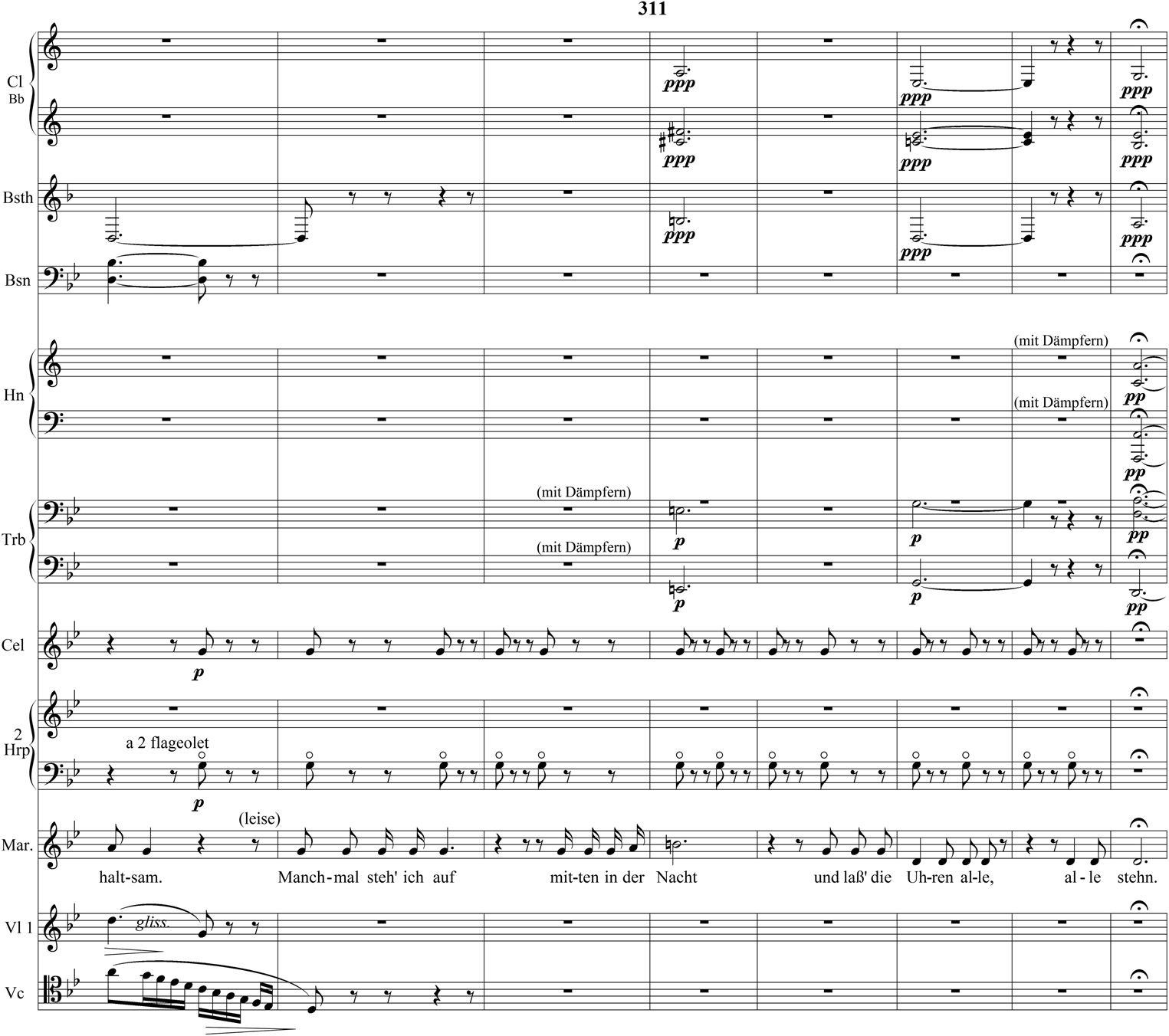
Of course, the Marschallin's gesture is in one sense futile: stopping the clocks at midnight will not stop time; at best, it will just stop her perception of the passing of time as signalled through the convention of marking temporal passage by the chiming of hours on a clock. Moreover, adding to the irony, the clock we hear has just finished striking the hour at this moment; not only is stopping it futile but also it is already too late. In fact, Strauss has smuggled in a wry musical joke at this point. If you listen very carefully, you may hear that the clock has in fact struck thirteen.
What this admittedly rather trivial example demonstrates is a straightforward way in which music – and more broadly speaking, sound – can indicate aspects of time, and how in turn such a capacity for signalling temporal properties gives rise to the possibility of confusing or complicating them, of problematising how we measure temporal succession. Thirteen does not belong to the temporal metric of the twelve-hour clock: it is an error in chronology, in the calculation of time. Thirteen is an anachronism.Footnote 5
Anachrony, in the more widely used sense of the term, is a familiar charge laid against Der Rosenkavalier. Not only does Hofmannsthal's text include historically spurious, invented traditions (such as the celebrated presentation of a silver rose by a knight clad in silver as the formal proposal of marriage in eighteenth-century Viennese high society) but also the claim of anachronism is one of the enduring critical responses to Strauss's score. From the time of the work's premiere in 1910 to the present day, critics have wondered aloud why in an opera expressly ‘set in Vienna in the early years of the Empress Maria Theresia's reign’, that is, around 1740, the Viennese waltz – a nineteenth-century dance, famous above all from its late nineteenth-century flowering in the music of Strauss's namesake Johann and his family – should figure quite so prominently. In a review of the local Viennese premiere, for example, the Wiener Abendpost noted disapprovingly that ‘the Viennese waltz was not yet born and … the waltz was not the rhythm of that era. The impression it makes in these surroundings is spurious.’Footnote 6 ‘It is characteristic of Strauss's carelessness in the matter of style that these waltz melodies are flagrant anachronisms’, Eric Blom would write in 1935 – ‘they belong to a time nearly a century later than the period of the play’.Footnote 7 One of the strongest of such responses came from Thomas Mann, who wrote to Hofmannsthal following the first Munich performance, complimenting the latter's libretto but sparing little when expressing his distaste for the music to which it was set:
what in God's name do you really feel about the way Strauss has loaded and stretched your airy structure? A charming joke weighed down by four hours of din! … Where is Vienna, where is the 18th century in this music? Hardly in the waltzes. They are anachronistic[.]Footnote 8
Hofmannsthal might well have remained silent: it was in fact he who had suggested this idea to Strauss a year before, during the creation of the work, urging his composer ‘do try and think of an old-fashioned Viennese waltz, sweet and yet saucy, which must pervade the whole of the last act’.Footnote 9
Did Richard Strauss and (the exceptionally cultivated) Hugo von Hofmannsthal not know their music history as well as other critics and writers? Or was such precise historical authenticity unnecessary and undesired: the point, as Hofmannsthal's ‘old-fashioned’ epithet gives away, is the nostalgic value, the sense of indicating ‘the past’ (historical verisimilitude, after all, is hardly a prerequisite for a work of fiction)? Or might there be yet other good reasons for this anomaly? The historical incongruity has often been downplayed by Strauss's supporters who viewed it as unimportant – either irrelevant to critical evaluation or, at worst, a minor conceptual blemish on a mainstay of the operatic repertory that hardly detracts from the enduring popular appeal of the music. Michael Kennedy is typical of many in asserting that ‘the waltz, as has often been pointed out, is an anachronism … . But the whole opera is an anachronism. The Vienna of the 1740s is a Vienna invented by Hofmannsthal.’Footnote 10 Seldom, though, has this anachrony actively been defended as a positive quality.
One of the most interesting of such defences, however, has been offered by Lewis Lockwood, who rightly observes how the ‘element of time’, one of the overriding subjects of Hofmannsthal's libretto, finds an apt musical parallel in Strauss's treatment of historical styles. Lockwood bases his claim on what he views as the use of three different musical styles: 1) a contemporary background idiom provided by Strauss's ‘modern’, up-to-date musical language of circa 1910; 2) stylistic allusions to the nineteenth-century waltzes of Johann Strauss the younger (the ‘Waltz-King’) found in the waltzes throughout the opera; and 3) pastiches of an eighteenth-century Mozartian classicism, seen most clearly in the final duet between Sophie and Octavian. The result of this ‘kind of collage … is to give the music, like the drama, a sense of the layering of history’:
Like the plot and its hypersensitive characters, the music evokes a feeling of the passage of time through a single place, Vienna, in various phases of its existence. And like the Marschallin, who questions her sense of identity across the years of her life and her varied perceptions and identities, the three musical styles evoke three different periods of music history.Footnote 11
Lockwood's short but perceptive account only really considers the temporal theme of persistence versus transience – the problem of identity across time, as encapsulated in the thoughts and worries of the Marschallin. One can go further, however. For Der Rosenkavalier foregrounds and thematises (both verbally and musically) a number of different approaches to the philosophical problem of time. One is the setting of the temporal against the eternal: as Lockwood observes, persistence amidst transience already characterises the Marschallin's questioning of time, but the notion of the temporal is itself set against the ideas of eternity and the transcendent moment (‘seliger Augenblick’) that run through the youthful love between Octavian and Sophie. Another approach, as we have briefly seen, is the play of different historical styles, witnessed not only in Hofmannsthal's verbal virtuosity – his self-styled historical Sprachkostüm – but also in Strauss's evocations of the musical past and the opera's often self-conscious allusions to operatic tradition. Yet another approach, at a meta-level, understands the historical situation of the opera both within Strauss's career and amidst customary narratives of music history. This opera is famous, or for some infamous, as marking the turning point in Strauss's music away from the daring modernity of his previous two operas Salome and Elektra and back to a comfortable juste milieu. For the composer's modernist critics, Strauss ‘sold out’ here, retreating from the cusp of Schoenbergian atonality into a traditional tonal language that ensured lasting popularity with his bourgeois public just as it removed him from playing any meaningful part in the progress of art. In this sense, Der Rosenkavalier might be considered as opting out of the course of history: it is untimely. Such a simplistic reading, however, ignores wider questions about the nature of history and tradition that were felt by many intellectuals in Strauss's time, and which are paralleled in the approach to historical time articulated in this work – questions that are worth closer examination now.
This article advances Strauss's opera as an ideal case study in the problematics of temporal representation in art, specifically through the medium of music. It works in this sense from two opposite directions at once. On the one hand, proceeding from the particularity of the artwork, it offers an interpretation of Der Rosenkavalier and its position within Strauss's œuvre from the perspective of its treatment of time. On the other hand, on a critical and methodological level, this opera is used to make a more general philosophical argument about the ability of music to convey temporal qualities. In three independent though interrelated sections, I propose to show that Der Rosenkavalier – both Hofmannsthal's text and Strauss's music – is in numerous ways deeply concerned with the nature of time: the temporal and the eternal, the historical and what for want of better term I will call the ‘metahistorical’. Taking a leaf out of Thomas Mann's as-then unwritten novel, we might even style it an ‘opera of time’.
The temporal
A conceptual opposition runs through Der Rosenkavalier between the temporal and transitory on the one hand and the eternal and transcendent on the other, articulated most clearly in the respective figures of the Marschallin and Sophie. This is plainly manifest in Hofmannsthal's text – the Marschallin continually dwells on the passing of time, change and the inevitable coming of the future; Sophie is constantly speaking of eternity and heavenly bliss – but it is also articulated in important respects by Strauss's music.
The two principal passages articulating the Marschallin's perspective on time are found in the latter stages of Act I: the monologue in which she remembers her youthful self and reflects on the inevitability of ageing and the curious fact of her continuing identity amidst the passing of the years (figure 271:2), and the ‘Time’ aria already briefly discussed (306:2), in which she ruminates on the enigmatic being of time.
Left on stage alone following the departure of the boorish Baron Ochs, the Marschallin recalls how she herself was once a young girl fresh out of the convent, ordered into holy matrimony. Looking in the mirror she asks herself where that girl is now: ‘But how can it really be, that I was once little Resi, and that also someday I will be an old woman?’ To evoke the backward glance of the Marschallin, Strauss conjures up a consciously nostalgic mood through the introduction of a gentle, rather old-fashioned theme (271:2), which both introduces the Marschallin's reflections and goes on to provide the musical basis for this following section (Ex. 2). Restrained in its scoring for front-desk strings and solo woodwind and in its self-consciously classical phrase structure, the theme is somewhat akin to a gavotte in its graceful poise. There is certainly something broadly eighteenth century about the passage, but the key point is surely the old-world nostalgia the idea evokes (not perhaps coincidentally it is a close relation to the ‘once upon a time’ frame of Till Eulenspiegel).Footnote 12
Strauss, Der Rosenkavalier, Act I, ‘doch der Lauf der Welt / Kann mich auch an ein Mädel erinnern’.
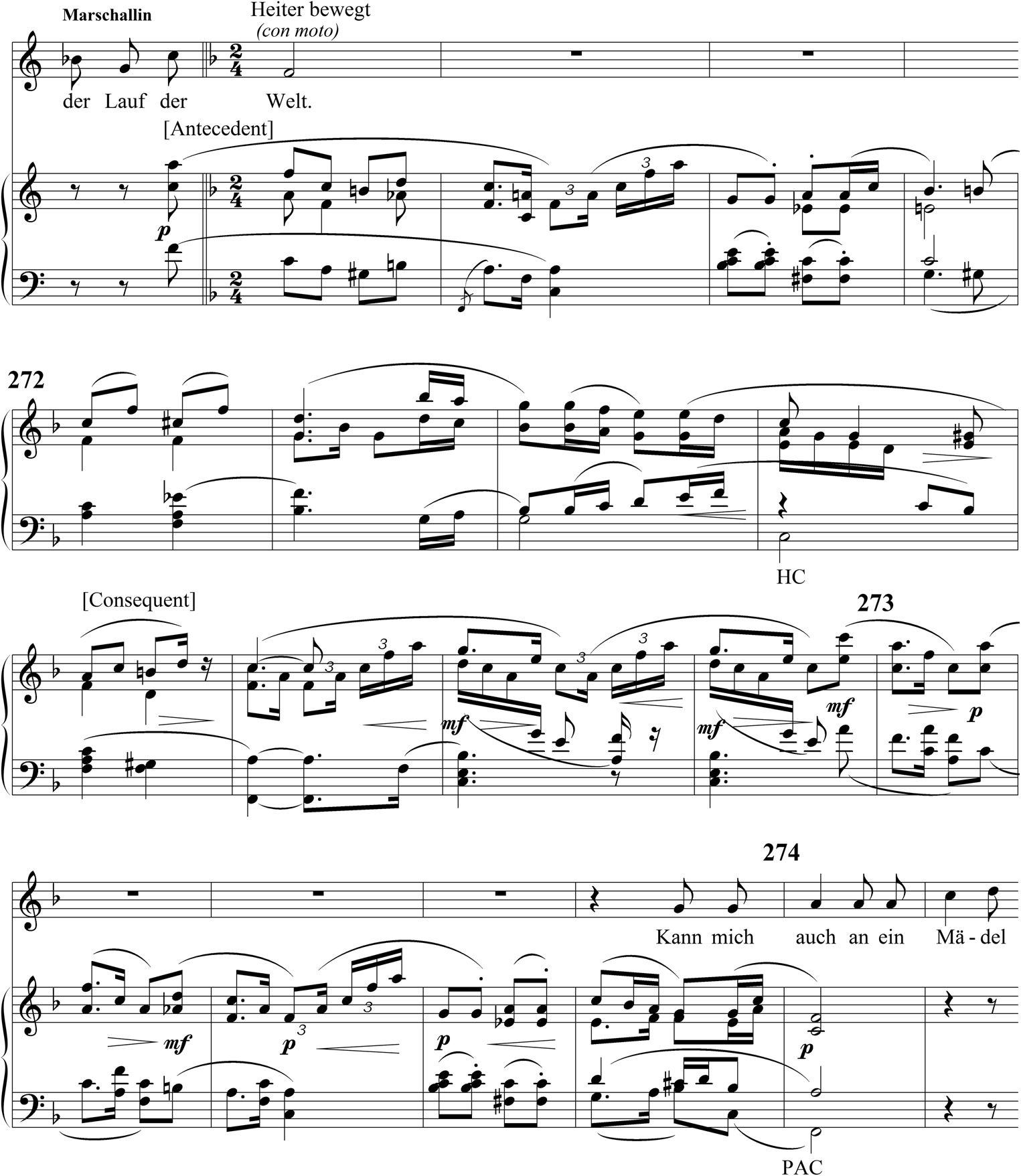
Strauss's setting of the Marschallin's monologue is based on the continual variation and expansion of ideas set out in this opening theme. But what begins as utterly uncomplicated in harmony, texture and phrase structure becomes increasingly distorted and estranged – perhaps even ‘modernised’ – as the section progresses, corresponding to the changes that assail the Marschallin's youthful identity, even as some sense of common core, provided by the reuse of motivic ideas, remains intact. The first eight bars, moving from tonic to dominant, are formed as a clear antecedent in a projected sixteen-bar period, but already the consequent phrase shows a slight irregularity, developing the initial two-bar motive far beyond what was given in the model, and being expanded to ten bars with the contrasting idea from the third and fourth bars of the antecedent used unexpectedly to close the phrase. Despite the phrase overlap with the entry of the voice at 274, a perfect authentic cadence (PAC) in the tonic F major is given at this point: stability is ultimately found. The security of this opening old-fashioned world will, however, be subjected to significantly greater threat in the ensuing music; no further cadence to the tonic will in fact be given until the very end of the section, each potential intervening point of cadential confirmation being undone by unexpected harmonic turns that threaten the return to the opening state.
The Marschallin's first phrase (‘Kann mich auch an ein Mädel erinnern’) shows clear signs of further loosening in melodic construction and leads after ten bars unexpectedly to a Phrygian cadence on V of A minor at mention of her being ordered into wedlock – the first change to her state of girlish innocence. Though the music subsequently moves back towards the tonic, a diminished seventh that seems to serve a predominant (vii/V) function in a cadential progression to F major then shifts unexpectedly onto an A♭ 6/4, the thought of her future transformation into an ‘alte Frau’ being mirrored by a similar harmonic transformation. Thereafter, the music again approaches the tonic but this time to the parallel minor, at the thought of her becoming the forbidding ‘old Marschallin’. Throughout the monologue, Strauss uses such movement away from the tonic F major to more remote keys – V of A minor, A♭ major, or the parallel minor – in order to express challenges to the Marschallin's sense of personal identity over the course of her life. Nevertheless, she concludes, she is ‘always the same’ (‘Wo ich doch immer die gleiche bin’), this enduring identity musically affirmed through the long awaited PAC to F major just prior to 280.Footnote 13
Yet greater harmonic fluidity characterises the ‘Zeit’ aria a short while later, as the Marschallin is joined by the returning Octavian and reflects pensively on the transitoriness of everything – including, she finally observes, Octavian's love. Some day he will leave her: whether ‘today or tomorrow or the next day’, he will find someone ‘younger and more beautiful’ than her. The central part of the setting occurs between figures 307 and 313, a virtual monologue on the nature of time that complements the Marschallin's earlier discourse on identity and aging, though the material for this section is prefigured a little while earlier. The primary motive first insinuates itself at 299:4, as the Marschallin comments on the frailty of all that is temporal – ‘how we can hold nothing … everything slips through our fingers’ (Ex. 3). A sinuous scalic figure in the violas and clarinet climbs over several bars only to fall back at the end of the phrase, the 6/8 metre given a soft siciliano lilt with the dotted-quaver–semiquaver rhythm. A swifter moving melodic counterpoint in flowing semiquavers introduced at 301 in the flute suggests the elusive flowing of time between her fingers, its constant, ungraspable slipping away.
Strauss, Der Rosenkavalier, Act I, ‘Die Schwäche von allem Zeitlichen’.

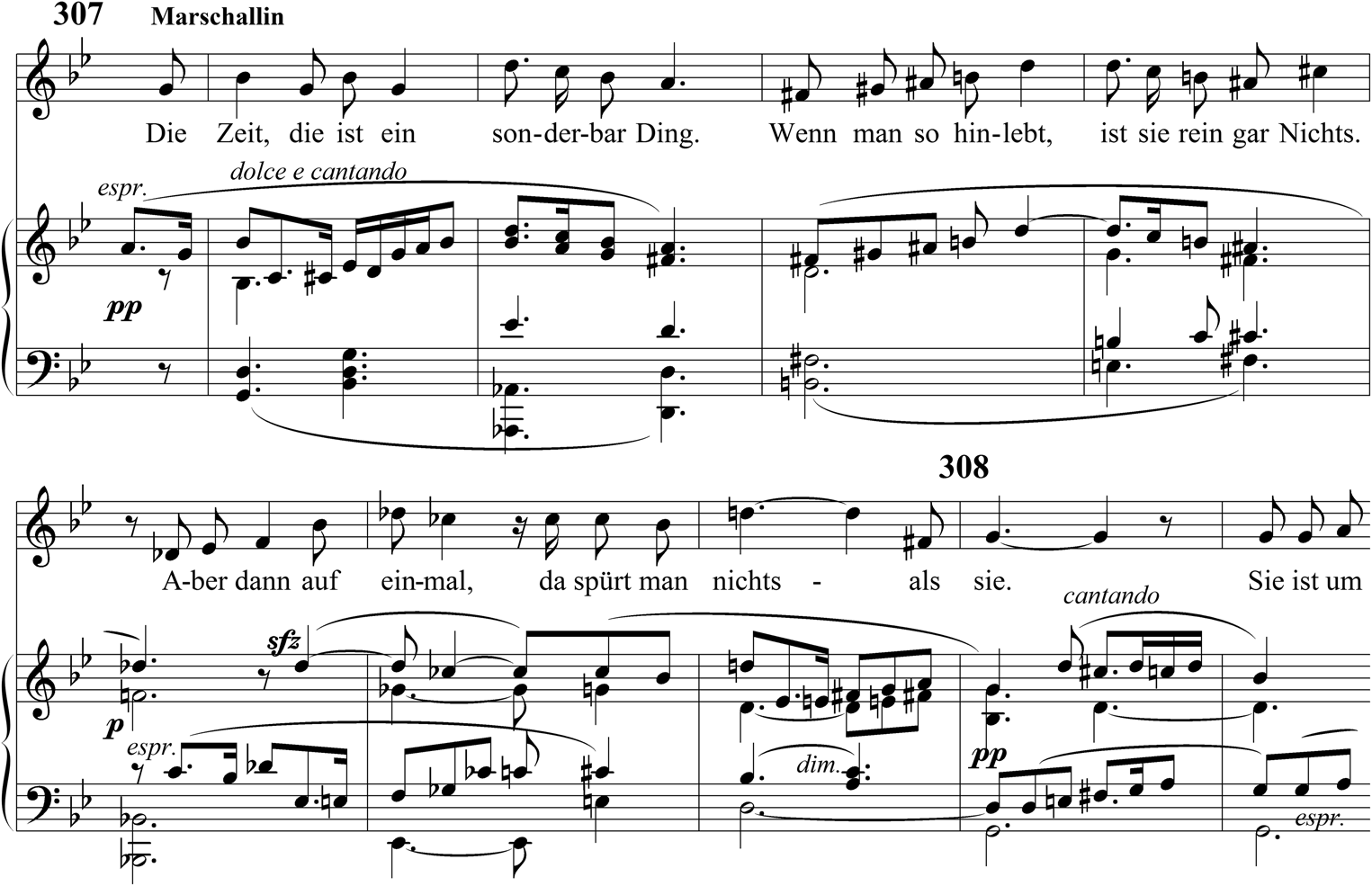
This conception is taken up in the central part of the section (‘Die Zeit, die ist ein sonderbar' Ding’, Ex. 4), in which the winding motive is combined with a leitmotif closely associated with the Marschallin (first heard at figure 8 in the orchestral Einleitung), now heard in diminution to open the phrase. It is not just that time is flowing over and around objects, around people; effectively the Marschallin's own being is ebbing away in time too. Underpinned by the constant flowing of the winding figure across the texture, the music slips unstably between temporary minor key centres, and combined with the dark harmonic colouring, at times takes on an almost sinister aspect. The continuous harmonic fluidity, variegated timbral colouring, and suppleness of motivic proliferation convey the ceaseless flowing of time – time that for the Marschallin has apparently become audible at this moment.
Strauss, Der Rosenkavalier, Act I, ‘Die Zeit, die ist ein sonderbar' Ding’.
In her approach to time, the Marschallin contrasts markedly with the young lovers Sophie and Octavian.Footnote 14 The older Marschallin's awareness of the inevitability of time's passing, and with it, love and the current status of human relations, is opposed by the younger pair who (more naïvely, we presume) believe their love is eternal – existing in a blessed moment of time that intersects with eternity (i.e. the timeless) – and make the more questionable assumption that it is therefore sempiternal (will endure for ever).
Sophie, first seen in Act II, is constantly orientated to the eternal. Her speech throughout is filled with references to ‘Ewigkeit’ (‘eternity’), ‘himmlische’ (‘heavenly’) and the ‘selige Augenblick’ (‘blessed moment’), no doubt reflecting the fact that she has just come from a convent.Footnote 15 For Sophie, clearly, love holds the promise of transcendence from the temporal and transitory. Octavian, meanwhile – the middle term between the two female figures – adopts some of the language of Sophie, but also sends up the temporal viewpoint of her rival, the Marschallin. In the persona of ‘Mariandel’ – a maid-servant disguise resourcefully adopted to outwit Ochs – Octavian in Act III parodies with ironic sentimentality the melancholic perspective on time expressed by the Marschallin, until a few hours ago his lover: ‘it's always the same, the hour passes away as the wind, so us two will soon be gone … nobody will weep for us’.Footnote 16 The self-consciousness exhibited here extends to the idea of music serving as the expression of such ephemerality – indeed Strauss's own music. What, following a sip of wine, has apparently set the lachrymose Mariandel off on such ruminations is the sound of music (‘Die schöne Musi!’), specifically the most famous waltz in Strauss's score played by musicians off stage – ‘one has to cry … ’cos it's so beautiful’.Footnote 17 A different type of parody is employed by Octavian in Act II, using a sardonic version of Sophie's turn of speech to get across to his rival Ochs Sophie's refusal to marry him: ‘das Fräulein hat sich resolviert. Sie will Euer Gnaden ungeheirat’ lassen in Zeit und Ewigkeit!’ (‘the lady has decided. She will let your Grace remain unmarried now and forevermore!’).
Such an ironic approach, however, is sustained even in approaching the moments of purported transcendence of time that characterise the perspective of Sophie and Octavian. It might be hard, of course, to convey a literal eternity – a state outside time – in music, but one more promising approach is to take up the idea of the ‘Augenblick’ or transcendent moment, in which time intersects with the eternal, a concept long familiar from mystic thought and more recently promulgated by writers such as Goethe, Kierkegaard, Baudelaire, and Nietzsche. This moment of epiphany is both in- and outside time: ‘It is time and eternity in one blessed moment’ (‘Ist Zeit und Ewigkeit in einem sel'gen Augenblick’) as Sophie remarks, which transcends the temporal passing that so concerns the Marschallin. The central moment of such epiphany in the opera is formed by the celebrated ‘Presentation of the Rose’ scene in Act II: clad in silver, the aristocratic Count Octavian enters Faninal's residence to offer the silver rose to the young Sophie on behalf of the Baron Ochs; this is the first time the two have set eyes on each other, and it of course turns out to be love at first sight.
The way this scene is set up is as a deliberately choreographed moment of epiphany. By the start of the twentieth century, music's purported ability to convey the transcendent was a commonplace of musical aesthetics in the wake of Schopenhauer and early Nietzsche, and any talented post-Wagnerian composer would have known the means to call up such an effect. Strauss himself had already provided an exemplary contribution to this practice in Tod und Verklärung. Here in Act II of Der Rosenkavalier, the audience more or less knows that something special is coming up. The composer has to create a sense of epiphany through the power of music, and Strauss does not disappoint.
For quite some time the events ‘offstage’ – the resplendent figure of the Knight of the Rose arriving in a pair of coaches outside – have been described onstage by Sophie's duenna Marianne, to general mounting excitement: by now the audience, just like Sophie, is on tenterhooks to glimpse the Rosenkavalier when he finally enters. As the doors fly open to reveal the shining vision of Octavian, the music, which had been around E major, abruptly breaks off from the preceding G major 6/4 harmony and lands on a resplendent, unforeseen F♯ major, the vision shimmering through a string and celesta tremolo and floating in a radiant 6/4 inversion (Ex. 5). Here, F♯ major is already a key with strong symbolic import of the visionary and transcendent in romantic music. With six sharps in its key signature, it is as far as music normally goes round the ‘brighter’, sharp side of the tonal system, but particularly worthy of note is the way in which the music ‘falls’ into this key. The abrupt tonal switch from one 6/4 to another in a quite unrelated key is a Straussian hallmark, but here the very tonal surprise is part of the effect. It is as if F♯ major ‘falls from heaven’ – the epitome of late romantic ‘breakthrough’, a moment outside the immanent course of the preceding music, seemingly unheralded and imposed from outside by transcendent means.Footnote 18
Strauss, Der Rosenkavalier, Act II, Presentation of the Rose, opening of scene.
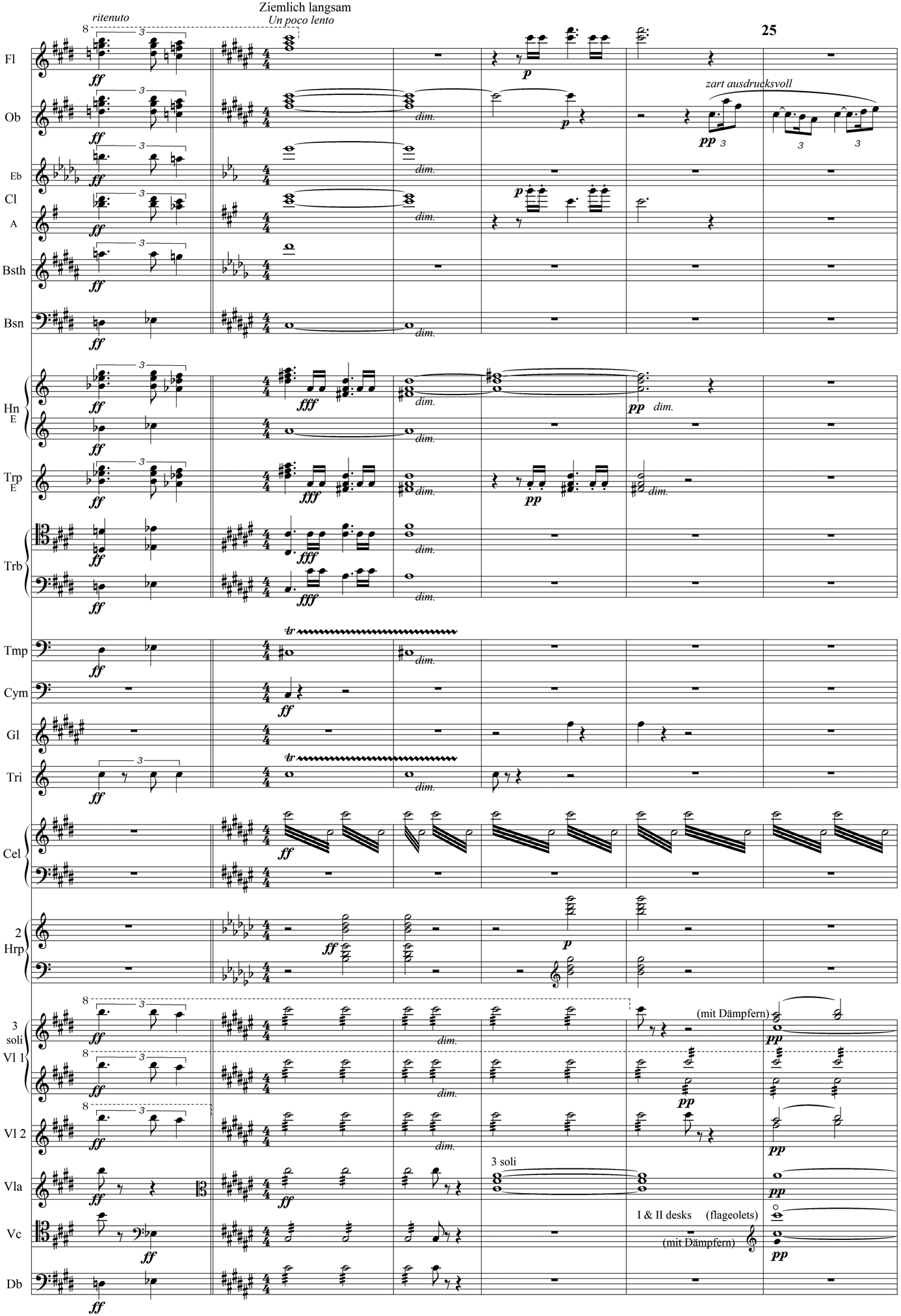
After a few convoluted exchanges by the pair, already embarrassed by unexpected emotions, the blushing Sophie smells the silver rose that has been presented to her. ‘It has a strong fragrance. Like that of living roses’, she comments. ‘Yes, there's a drop of Persian rose-oil inside’ responds Octavian without a moment's hesitation. Hofmannsthal's ironic rejoinder seems to shatter any pretence of genuineness in this scene. The silver rose stands as a symbol of the transcendent, the sacred bond of marriage, and the silver-clad knight bearing it as an envoy from heaven, ‘like an angel’ as Marianne has just remarked. But it is not a real rose, living, natural: it is manufactured, the result of human artifice (just as the very idea of the silver rose is an unashamedly invented tradition on the part of Hofmannsthal), yet it masquerades as genuine through the drop of rose-oil that provides the semblance of a spurious authenticity.Footnote 19 Not only is the whole thing an artificial construction, but also our attention is drawn to this fact – just as with the romantic conceit that music will provide a moment of genuine transcendence here, on demand. The whole passage is in this sense ‘fake’ and marked as such. An epiphany should by rights be ‘genuine’, ‘authentic’, falling God-given from the skies, not manufactured through human artifice, though as we well know, the post-Wagnerian musical epiphany is nothing if not a carefully calculated, technically adept simulacrum of transcendence. The authors of Der Rosenkavalier are ironically undermining the reality of the moment of transcendence that they are putting before us, even as they do so.
But is the illusion really shattered? Sophie, at least, appears undismayed. The rose is indeed not earthly, but heavenly, ‘like a rose from highest paradise’. What we are perceiving may be artificial – not a product of nature – but may nevertheless touch something that seems transcendent (especially for two impressionable teenagers in the bloom of first love). And with the word ‘heavenly’ – ‘himmlische’ – Sophie soars up to her heavenly heights. Strauss's epiphany is now underway.
Sophie's apostrophe to the silver rose is framed by the key of F♯ major, though it moves through third-related keys, sustaining the visionary effect of the unexpected tonal shift already seen in the section's initial F♯ major breakthrough. Much of the expressive effect lies in how Strauss exploits the ecstatic upper register of the soprano voice, in particular concentrating on the pitch a♯3/b♭3, to which the vocal line is repeatedly drawn like a magnet, besides his intertwining of Sophie's voice with Octavian's mezzo-soprano in the lead up to the climax.Footnote 20 The soaring opening gesture on the word ‘Himmlische’ returns throughout in different keys, the initial ascent marking the return of crucial words denoting heavenly or transcendent qualities (‘Himmlische, ‘Himmel’, ‘Ewigkeit’; Ex. 6).
Strauss, Der Rosenkavalier, Act II, Presentation of the Rose: reiterated highpoints in Sophie's vocal line.
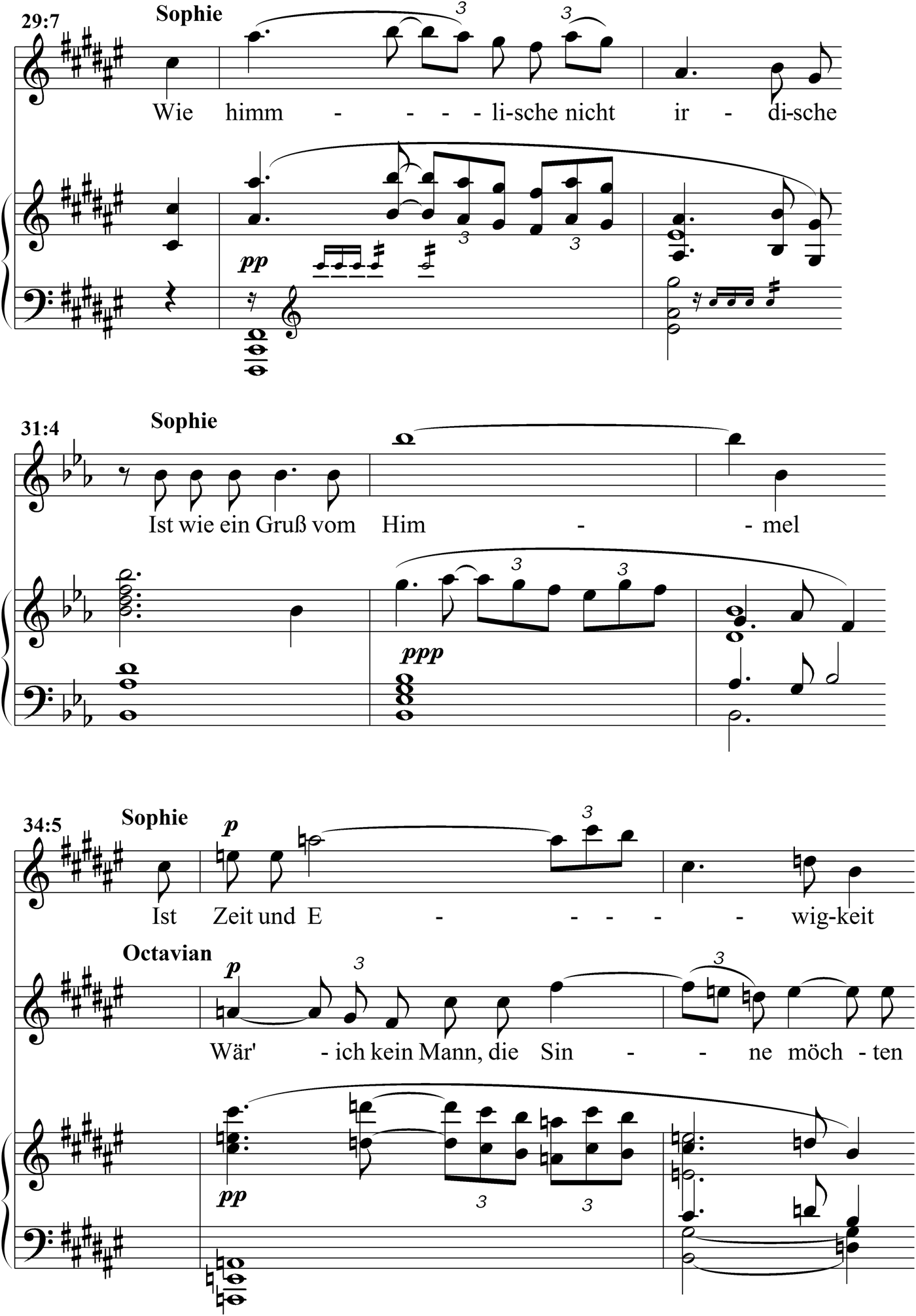
First the music shifts down from F♯ to E♭, allowing Sophie to touch once again her highpoint of a♯3 (enharmonically spelt as b♭), recontextualising it from  $ \^3 $ of F♯ major to $ \^5 $ in E♭ major (her original motive is given now in oboe and clarinets). Thereafter the music moves via A♭ minor to D♭, which is soon reinterpreted as the dominant of G♭, enharmonic equivalent of the original F♯; but just as the music seems set to return to the tonic it slips again through another magical tertiary shift to A major, coinciding with the climactic line ‘Ist Zeit und Ewigkeit in einem selig'n Augenblick’. Sophie's line at this climax initially reaches only an a3 – a semitone lower than her familiar a♯/b♭ – but uses this pitch as a springboard to soar yet higher, up past her previous ceiling of b3 to a stratospheric c♯4, an ecstatic highpoint for the section.
Prominent throughout this scene is an accompanying figure in dissonant parallel chords, whose high tessitura and shimmering orchestration impart an extraordinary, otherworldly effect (Ex. 7a). Thirteen times they are heard (coincidentally or otherwise, the time that was indicated by the Marschallin's clock), forming intermittent interjections between the musical phrases. Presented softly in the ethereal soundworld of celesta, harp, flutes and three muted violins, the magical shimmer of their glittering, non-functional harmonies is often taken as evoking the shining silver rose offered to Sophie by Octavian. Yet with all their tinsel-like glitter, they are more than merely decorative. They, too, convey something of the nature of time. In Alan Jefferson's view, ‘this perfumed parenthesis, in which Strauss's harmonics fall from heaven like flakes of sound’ forms ‘the sharpest contrast to the Marschallin's perception of the endless flow of corroding time’.Footnote 21 Equally for other commentators, the effect of these ‘rose chords’ is to ‘transport the listener to a musically distant realm where indeed, time seems to stand still’.Footnote 22
a) Strauss, Der Rosenkavalier, Act II, Presentation of the Rose, ‘rose chords’; b) Strauss, Der Rosenkavalier, Act II, ‘rose chords’ (pitch level of second statement); c) Strauss, Der Rosenkavalier, Act I, Marschallin's ‘resignation’ motive; d) Strauss, Der Rosenkavalier, Act I, opening ‘Marschallin’ motive.
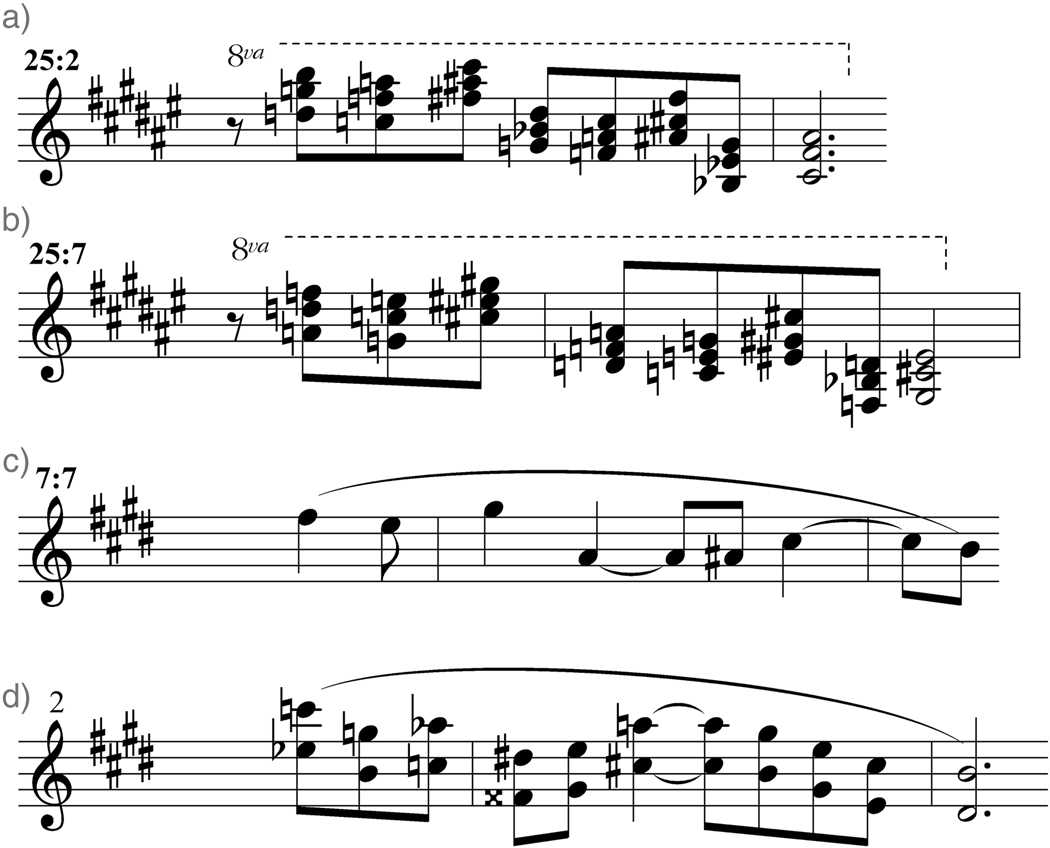
In fact, these parallel chords are a variant of material closely associated with the Marschallin since the start of the opera that has featured prominently in her meditations on the passing of time and the transience of life. They are clearly a diminution of the theme first heard at figure 8 in the orchestral introduction, which has been used throughout the first act to characterise the more wistful aspects of the Marschallin's character (Ex. 7c): shared is the distinctive contour, profuse with appoggiaturas and chromatic lower-neighbour notes, and when in their second statement these chords are heard transposed down a fourth (25:6, Ex. 7b), we can see that it is virtually identical with the earlier theme.
This ‘resignation’ theme itself derives from an even earlier idea heard in the second bar of the opera, the progression of parallel triads that respond to the opening horn figure and which has always been taken to stand directly for the Marschallin, in contrast to the vigorous opening gesture of Octavian. Unsurprisingly, this initial motive also bears some resemblance in contour to the ‘rose chords’, but the two have an even more direct link in their use of parallel triads and characteristic rhythm (the three-quaver anacrusis; Ex. 7d). Significant, surely, is the fact that we have already heard a similar diminution of the ‘resignation’ head-motive in the Marschallin's ‘Time’ monologue (307, see Ex. 4), while the latter stages of that first act dwelt on it at length.
Given the nature of Strauss's score – his resourceful manipulation of themes and motives to create a web of interconnected material – it may not always be plausible to argue that thematic commonalities were intended to bear hermeneutic significance. The derivation of the work's final trio from Octavian/Mariandel's rather trivial waltz theme earlier in the act is a case in point, where Strauss seems simply to have alighted on an idea because it seemed musically (and not obviously hermeneutically) suitable.Footnote 23 But here in the Presentation scene there is surely a deeper meaning to this thematic relationship. One may immediately think of the apt musical irony, in that the Marschallin was once musing on the inexorable flow of time that would bear her young lover away from her, while now, to the accompaniment of this very same music, he is falling in love with another, ‘younger and more beautiful’ than her. But the deeper insinuation may well be that even while the two young lovers naively think they are experiencing eternity, time is still passing. Rather than conveying a timeless eternity, the steady quaver tick-tock of these chords if anything suggests the relentless passing of time, even while the characters on stage, caught up in their own epiphany, seem oblivious to it.
Yet equally, this very same feature could support the converse reading of temporal transcendence felt by Sophie and Octavian at this moment. The fact that this figure is no longer heard continuously but is interspersed through the soaring phrases of the duet shows how the flow of time is temporarily stilled by the moments of musical epiphany.Footnote 24 Rather than simply demonstrating that time is still passing even during this apparent moment of transcendence, the rose chords’ intermittent quality might suggest, in contradistinction to the quaver motive in the Marschallin's ‘Time’ aria, that for brief moments the corroding flow of time is suspended. These chords will reappear, moreover, in the opera's final scene, in which the two young lovers finally attain their union, ‘together for all time and eternity’.
Of course, the final answer to such questions is not given in the text but left open to interpretation. It is up to the listener to decide whether all is transitory, as the Marschallin believes, or whether there is yet something that offers transcendence from time, as Sophie – despite her evident naivety – believes. And even with his tendency towards irony, Octavian seems to keep the possibility open that this moment of bliss might, just possibly, offer a glimpse of the eternal.Footnote 25
Both Hofmannsthal's and Strauss's contributions to Der Rosenkavalier are highly ‘knowing’, manifesting a strikingly ironic self-awareness in foregrounding the artificiality of the moment of transcendence that they seek to provide. And yet, like Sophie, even while acknowledging this, we may still find the result deeply moving, perhaps even more so because of this initial ironising. This ‘knowing’, self-reflexive quality is something that we will return to in the ‘Metahistorical’ section of this article. But to get there we turn first to a theme that has already emerged earlier in this section, the idea of the historical. The preceding discussion shows how Strauss's music, in its own way, reinforces one of the overriding themes of Hofmannsthal's libretto: the opposition between two conceptions of time, or more precisely the opposition between the temporal and the supratemporal. In such a reading, music possesses the capacity to evoke different time senses. This is a view, however, which some writers in this period disputed.
The historical
‘What music cannot express’, averred Søren Kierkegaard (or more precisely one of his pseudonymous authors, ‘A’), ‘is the historical in time’.Footnote 26 What Kierkegaard was getting at is how music, through its very immediacy, its status as the temporal art par excellence, seems unable to detach itself from the time it occupies, in this sense unlike language. For him, ‘music always expresses the immediate in its immediacy’, whereas ‘in language there is reflection and therefore language cannot express the immediate’.Footnote 27 But such immediacy comes at a heavy price. Music exists only in the fleeting moment, which ‘signifies the present as that which has no past and no future’ as Kierkegaard puts it elsewhere.Footnote 28 Lacking language's ability to distinguish medium from message, signifier from signified, this moment can never point to anything more than itself. Since it is ‘a perpetual vanishing … of which it is true that it is over as soon as it stops playing and only comes back into existence when it starts again’, to be sustained it needs constantly to be replenished, to flow in a continual stream from one moment to the next.Footnote 29 For ‘A’, this makes Don Giovanni the exemplary subject for a musical work, for the protagonist of Mozart's opera demands an insatiable supply of new conquests to sustain his existence. To make a pause in the constant stream of novelty spells death. Caught in the flux of time, no possibility is offered of transcending it.Footnote 30
Kierkegaard clearly loved Mozart's music, though he was probably not the most musically proficient of philosophers. The viewpoint set out by ‘A’ here is grounded in a Hegelian understanding of music, which even by the 1840s was in certain respects aesthetically reactionary, and entirely neglects the role of memory in accounting for music. But more musically informed authors in Strauss's own era voiced similar reservations. One such musical connoisseur was Thomas Mann, resident at this time in Strauss's native Munich, who took up the argument in his contemporaneous ‘novel of time’ The Magic Mountain. ‘Can one tell – that is to say, narrate – time, time itself, as such, for its own sake?’ ponders Mann in a chapter entitled ‘Strandspaziergang’ (‘By the Ocean of Time’ in Helen Lowe-Porter's contemporaneous English translation). Mann – or his narrator – appears at first to think not: ‘that would surely be an absurd undertaking’ he quickly responds. ‘A story which read: “Time passed, it ran on, the time flowed onward” and so forth – no one in his senses could consider that a narrative. It would be as though one held a single note or chord for a whole hour, and called it music.’ In other words, ‘narration resembles music in this’, he argues, ‘it fills up time’. Or more precisely, ‘time is the medium of narration, as it is the medium of life’, just as, ‘similarly, time is the medium of music’. ‘Music divides, measures, articulates time, and can shorten it, yet enhance its value, both at once. Thus music and narration are alike, in that they can only present themselves as a flowing, as a succession in time, as one thing after another.’ Yet on further reflection, he proposes that narrative differs from music in that it might meaningfully ‘tell a tale of time’, that is, it might make time its content as well as its medium, whereas music cannot do this.Footnote 31 One can conceive of a ‘novel of time’, a ‘Zeitroman’ as Mann styles his work, but there can be no ‘musical composition of time’ – no ‘Symphony of Time’ or (at least from a musical perspective) ‘Opera of Time’.Footnote 32
The problem here revolves around the distinction Mann makes between what is now usually called the ‘time of the narration’ and ‘narrated time’.Footnote 33 ‘A narrative must have two kinds of time’, his narrator asserts: ‘first, its own, like music, actual time, conditioning its presentation and course; and second, the time of its content, which is relative – so extremely relative that it can either coincide nearly with the actual, or musical, time, or can be a world away’. In contradistinction, ‘the time element in music is single’: music is confined to the time of its performance, to its presentation. Echoing views placed in the mouth of the good-natured but prosaic Joachim Ziemssen earlier in the novel, the narrator continues, ‘A piece of music called a “Five-minute Waltz” lasts five minutes, and this is its sole relation to the time element. But a narrative which concerned itself with the events of five minutes, might, by extraordinary conscientiousness in the telling, take up a thousand time five minutes.’Footnote 34 It thus follows, for Mann's narrator, ‘that time, while the medium of the narrative, can also become its subject. Therefore, if it is too much to say that one can tell a tale of time, it is none the less true that a desire to tell a tale about time is not such an absurd idea.’Footnote 35
A recurring theme throughout The Magic Mountain, we realise by now, is how the length of the narrative can vary drastically in relation to the duration of the events narrated. The opening weeks of the story proceed very slowly: Mann's narrative takes many pages to recount a short period of time measured by the clock or calendar, while later events that occupy much larger temporal spans (adding up to seven years) are successively compressed into a much shorter number of pages. The ‘time of the narration’ becomes proportionally smaller in relation to the ‘narrated time’. All this reflects the subjective sense of time felt by the protagonist Hans Castorp: the wealth of new events he experiences near the start as he arrives at the Sanatorium, high in the Swiss Alps, seems to fill calendar time with a rich profusion of contents. As he settles into a routine, later ones blend into an extended present, into the sameness of ‘soup everlasting’, where the subjective sense of time becomes levelled and extenuated into almost nothing.Footnote 36 This is enabled, of course, because verbal language can designate temporal qualities – can point to a time scale separate from that of its own presentation. Music, it is contended in Mann's novel, cannot do this, however, and remains rooted in its own immanent time – the very same problem that afflicted this art form in the estimation of Kierkegaard's ‘A’. But is this even true?
In fact, Mann's narrator will partly undermine the neatness of any such division later in the novel when describing the effect on Hans Castorp of music played on gramophone records (the allusion here is to Debussy's Prélude à l'après-midi d'un faune):
More and higher instruments came in rapidly, one after another, until all the previously lacking richness and volume were reached and sustained in a single fugitive moment that yet held all eternity in its consummate bliss. The young faun was joyous on his summer meadow … . Forgetfulness held sway, a blessed hush, the innocence of those places where time is not.Footnote 37
Such flowery rhetoric does not go so far as to claim that music can narrate time, but it is apparently predicated on music's ability to convey an eternal moment (i.e., that the time of the narration is not fully identifiable with, and does not completely collapse into, the conveyed temporal ‘contents’). The argument advanced in The Magic Mountain already seems far from watertight.
This is getting at a thorny and usually unexamined question – the problem of temporal signification in music. And as so often the case, an absolute dichotomy between music and language proves hard to sustain here. One can, however, dispute the claim made in Mann's novel, at least in substantial part. Music is generally less precise than language in its ability to signify temporal qualities, but it still possesses several important sources of designative potential.Footnote 38
First, at its own, immanent level, there is the temporal marking implicit in music's own syntactic conventions, broadly corresponding to the relative notions of ‘earlier’ and ‘later’ (what, in the philosophy of time, is covered by McTaggart's ‘B-series’).Footnote 39 Music can manifest a strong sense of syntax, that is, a logical temporal order in its internal organisation, though as with different languages, different types of music possess this capacity to varying degrees. In recent years, for instance, it has become a truism that the music of the Viennese Classical style is particularly rich in syntactic definition, largely as a result of its strongly defined forms of articulation (the use of beginning, middle or end gestures; the ‘projective potential’ of certain types of medium-scale organisation such as periodic antecedent and consequent phrases).Footnote 40 With such a high degree of syntactic sensitivity, the possibility arises of exploiting the experienced temporal sense by presenting events in an order incongruent with the apparent normative ordering implied by their syntax (Haydn often plays with such conceits, starting a piece for instance with a concluding gesture). In other words, in order to understand the music, two timescales must be brought into play in the listener's mind. It is arguable that certain musical styles possess this temporal quality to a greater degree than any verbal language (without any appreciable semantic content to convey, they certainly concentrate on these syntactic aspects far more). In so doing, they draw much of their expressive effect and meaning from articulating their temporal qualities. Later in the twentieth century much would be made of music's potential for ‘structuring’ and ‘reordering time’, especially in post-tonal music utilising broadly speaking ‘serial’ procedures (famous advocates include Messiaen, Stockhausen and Xenakis, though the question of auditory perceptibility can be unclear in some such accounts).Footnote 41
Second, though much less precise in this ability than language, music may still strongly imply a differentiation of levels between the (‘A-series’) modalities of past, present and future. The question here revolves around what is often termed music's ‘designated time’. Framing devices, for instance, can set off certain passages as interpolations, the two different types of musical material being understood as occupying different temporal levels, while music returning in a generically non-normative formal location may readily evoke an effect of memory or flashback. Similarly, ‘visionary’ episodes or processes of thematic prefiguring might suggest a glimpse of a future state.Footnote 42 Especially conspicuous when found in conjunction with a verbal text or dramatic action on stage (though not necessarily confined to examples of such mixed musical–verbal signification), the interplay of returning musical themes or motives can convey a complex temporal system of foreshadowing and reminiscence, most famously utilised in the Wagnerian technique of leitmotif.Footnote 43
Third, moving on from the previous two internal means of temporal signification, we come to music's potential ways of designating an ‘absolute’ location in time (or rather a location relative to conventional historical timescales). Music does not, admittedly, possess the ability to denote the historical location of events with the same precision as language. Strauss might have boasted that he could represent anything in his music – such as, notoriously, the water going down the plughole of the baby's bathtub in the Sinfonia Domestica – but even his virtuoso orchestration could not convey the historical contents of a proposition such as ‘In 1492, Columbus sailed the ocean blue’ (the blueness of the ocean might have appealed to a synaesthetic composer, and sea voyages have been evoked by many, but 1492 would have defeated them). However, there are straightforward ways in which music designates the actual historical past. Certain styles are marked with respect to their historical origin. Organum sounds early medieval, the ‘Palestrina’ style evokes the Renaissance, J.S. Bach the early eighteenth century (even if he was considered a little old-fashioned by some in his age). In works such as Louis Spohr's Symphony No. 6, the Historische Symphonie of 1839, in which each of the four movements represents a historical period through pastiche of the musical style of the time, this historicity can become the subject of a whole composition.Footnote 44 The historical location will probably not be traceable to the precise year, but in broad terms the reference can be understood. (Obviously recognising the historical style evoked requires contextual knowledge on the part of the listener, but all such significations do.Footnote 45) Indeed, music's historical sensitivity – the history embedded in its style – is probably even more pronounced than in other art forms; a hundred years in the development of the English language is nothing compared with the change in musical style in this period.Footnote 46 The idea that music is far less precise than verbal language in denoting particulars of chronology is broadly true, but the understandings of musical temporality proposed in both Kierkegaard's and Mann's works are plainly inadequate.
We might now be in a position to return to Der Rosenkavalier. And as is no doubt beginning to dawn on the reader, the habitual charge aimed at Strauss in this opera already exposes the falsity of the claim that music ‘cannot express the historical in time’, that music's ‘time sense is singular’. This is namely the charge of anachronism.
Recall Thomas Mann's charge against Strauss's music in Der Rosenkavalier: ‘Where is Vienna, where is the 18th century in this music? Hardly in the waltzes. They are anachronistic’.Footnote 47 If music really possesses only one time sense, that of its immediate presentation, how can anachronism possibly occur? To be heard as anachronistic – to be designating the wrong time – necessitates at least two temporal levels or time senses. (Otherwise, the only time sense Mann would have heard attending this opera in 1910 would have been those very same four hours in 1910, ‘filled out’ – or for him ‘weighed down’ – ‘by four hours of din’.) The criticism Mann expressed in his private correspondence undermines completely the doctrines delivered by his narrator in The Magic Mountain only a few years later.
To this extent, not only can music express the historical in time and designate time senses other than the brute fact of its immediate performance, but it can also further, in a sense, be about time – tell (in its own, non-verbal way) a tale about time. Thus, applying the argument offered in The Magic Mountain, not only is a ‘novel about time’ possible, but also so is a ‘symphony about time’, or indeed an ‘opera about time’. And this is essentially what I am arguing Der Rosenkavalier constitutes. ‘Time’ – the passing of personal time, the passing of historical time, the possibility of temporal epiphany – is the subject matter of the opera's music, just as it is an overriding concern of Hofmannsthal's text.
In order to develop this reading further, it is worth examining more closely the work's purported anachronisms. Anachronism is a comparative concept. One temporal scale does not fit with another. But which is out of place? Is the musical style of late nineteenth-century Vienna out of place in the rococo world of the 1740s, or are both not in fact anachronisms in early twentieth-century Munich (home to both Strauss and Mann) or Dresden (the city of the work's premiere)? I would propose that the argument can easily be turned around; in fact, in the context of Strauss's score, the references to old-fashioned historical styles – the ‘archaisms’ as it were – sound more readily ‘anachronistic’, and not the other way round. This is witnessed as early as the first passage marked ‘Waltzertempo’ in the score, a few minutes into Act I (48:2; Ex. 8). The lilting clarinet melody introduced over simple pizzicato accompaniment in the strings is a world away from the musical style of the preceding act. Far from the nineteenth-century Vienna of the (Johann) Strausses, this unmistakably calls up the later eighteenth century, specifically the world and tone of Mozart.Footnote 48 Less of a true waltz than an evocation of the dance's leisurely eighteenth-century predecessor, the ‘German dance’ or Ländler, the paired back scoring and classical, periodic phrasing call up a bygone era, a Golden Age in the city's musical life. To be sure, this is the Vienna of the later 1780s, when the clarinet was just coming to prominence, not the city of the young Maria Theresia forty years earlier. But for modern purposes it serves clearly enough to mark the passage as ‘eighteenth century’, rococo, pre-revolutionary. And most pointedly of all, this passage has been set up by the Marschallin's preceding words: ‘jedes Ding hat seine Zeit’ (‘everything has its own time’, or even ‘everything in its own good time’).
Strauss, Der Rosenkavalier, Act I, ‘Jedes Ding hat seine Zeit’ – Waltzertempo.
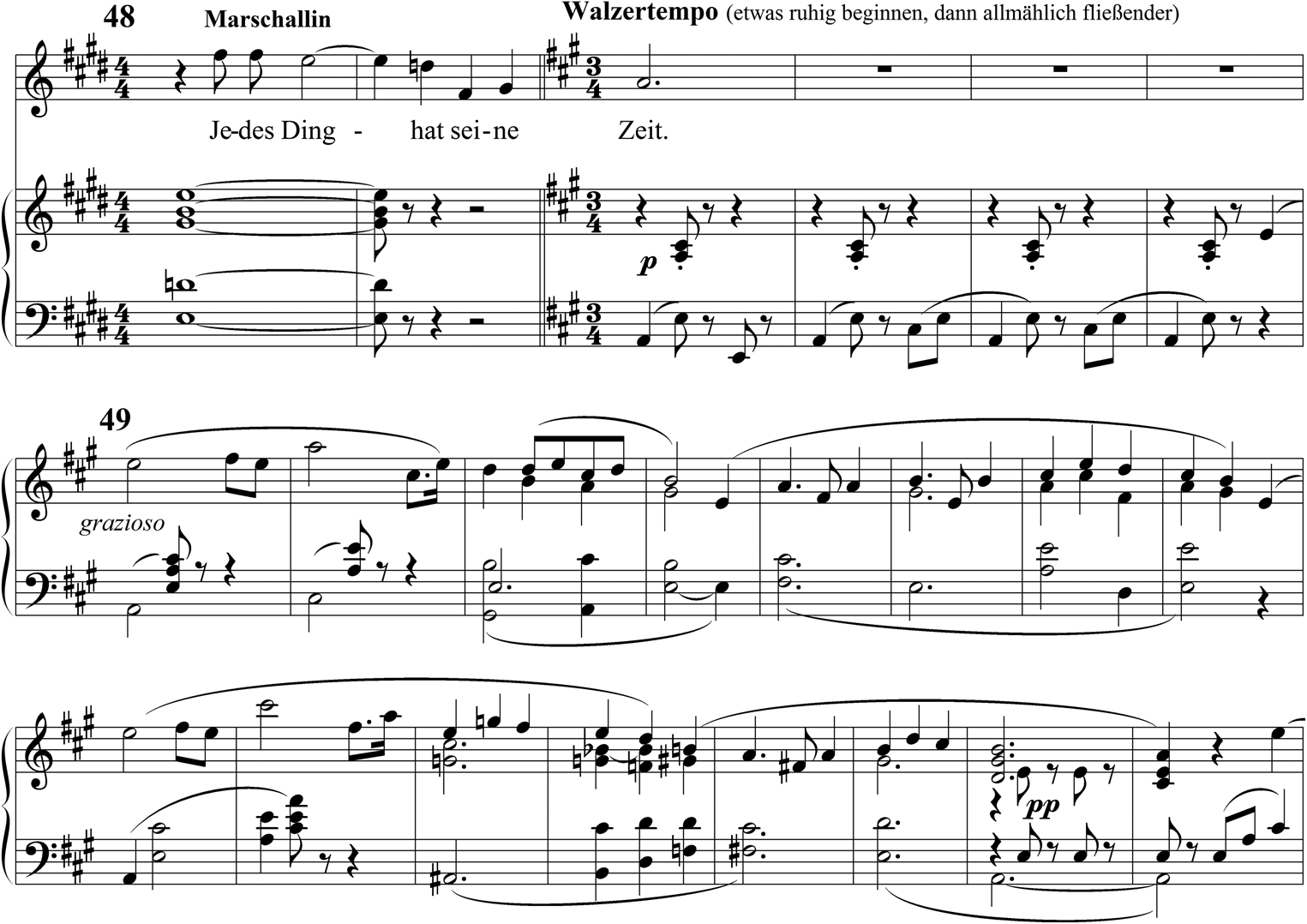
Straight on cue – and ironically reinterpreting the more trivial reference to breakfast that is meant by the character on stage – we hear something that clearly belongs to its ‘own time’. But such is the contrast with the overriding style of the preceding music, and the self-conscious way in which this has been introduced, that we are more likely to hear this passage as the anachronism, not vice versa. This is the first old-fashioned sounding music in the opera – the first time Strauss has moved outside a lush, though chromatically restrained late Romantic idiom – and the effect seems deliberately marked.Footnote 49
In contrast, most of the following ‘Waltzertempo’ episodes in this first act are not so obviously old-fashioned: though hardly ‘modern’ by the standards of 1910, their more recent, nineteenth-century idiom blends in quite well with the rest of the score (as Mann accurately remarked, they ‘put the stamp of operetta on the entire work’, and could easily hail from a more popular genre of music theatre around this time).Footnote 50 They are more obviously anachronistic for the dramatic setting – as is most of the musical language – but do not stand out as incongruous in musical terms. The critical abuse directed at the use of the waltz in this work is most likely provoked by the diegetic nature of the most famous waltz of all, that associated with Ochs and given the accompanying words ‘Ohne mich, ohne mich’ by him.Footnote 51 Introduced quietly near the end of Act II (236:3) before going on to feature prominently at the very close of the scene and again in Act III, the idea becomes something like Ochs's own ‘theme tune’. ‘That beautiful music!’ sighs Mariandel in Act III as the strains of this waltz are heard, played by the offstage musicians outside the tavern; ‘It's my favourite song, d'you know that?’ responds the amorous Baron. It is one thing to have historically anachronistic music used in the background, ‘non-diegetically’, but quite another to have early eighteenth-century characters on stage both consciously recognising and singing late nineteenth-century waltz ditties – and doing so with evident relish.
It is a point worth raising, however, that throughout most of operatic history, no one would have expected, let alone demanded, the use of a ‘historically authentic’ musical language to accompany stage events set in a past age. And even the idea proposed previously – that the criticism of anachronism is largely brought about by the highly foregrounded diegetic quality of the historically incongruous material – is questionable as a valid criticism in this context, as this, likewise, can be found in operas from an earlier age. This point can be demonstrated by examining some of the other offstage waltzes heard earlier in Act III.
Following the extended pantomime sequence that opens the final act, at figure 51 the sounds of an offstage band are heard playing a lively waltz. The orchestra in the pit fades out for a short while as the offstage waltz continues, before rejoining (56). They are playing a quite different idea – dance-like, to be sure, but more slyly, in a quite different metre, 4/4 (Ex. 9). Though four bars of 3/4 fit into one bar of 4/4, there is nonetheless a split effect, against the 4/4 quavers, of 3/4 against 6/8. The conceit very obviously echoes – pays homage to – the famous scene in the Act I finale of Don Giovanni, where Mozart introduces and then combines three different dances in three different time signatures, shared between onstage musicians and the orchestra in the pit. The reference is apt, as in both works a philandering aristocrat (Don Giovanni, Baron Ochs) is attempting at this point to seduce an apparently naïve peasant girl, though in neither work is the cavalier successful.
Strauss, Der Rosenkavalier, Act III, combination of onstage and offstage dances.
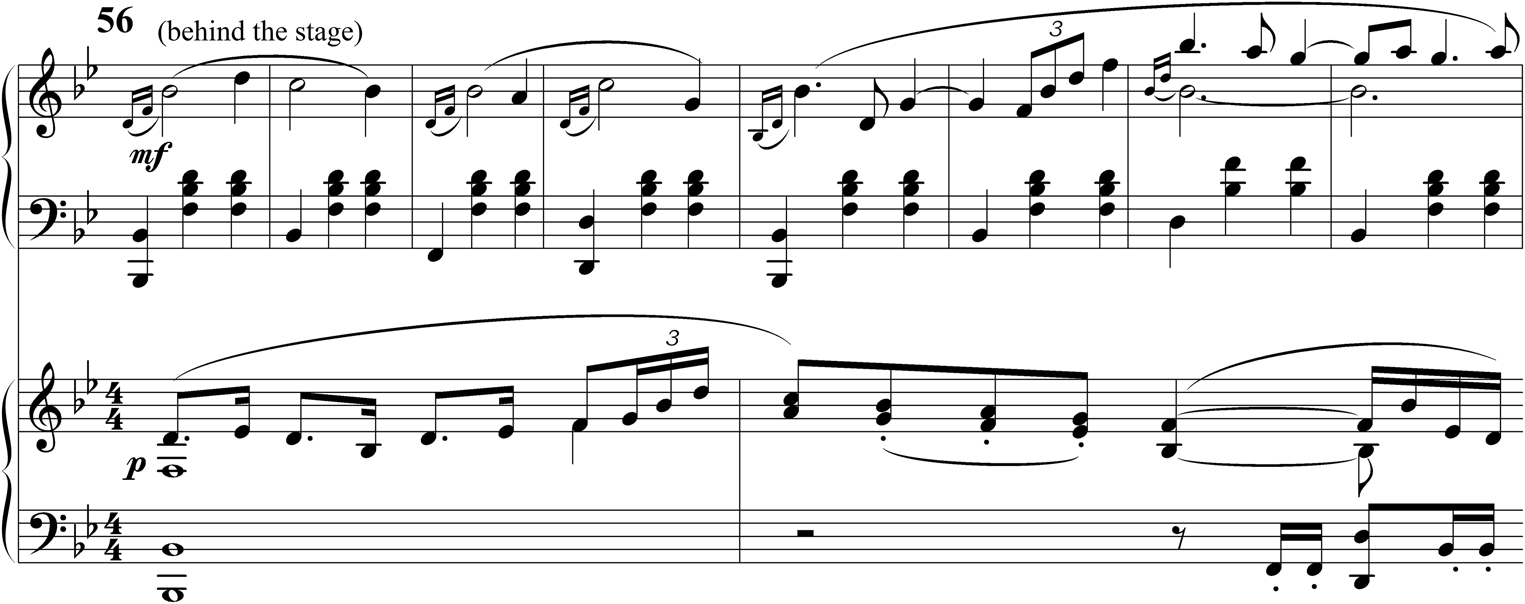
Mozart's procedure is celebrated not only as a virtuoso piece of compositional craft but also as a canny characterisation of the society presented on stage. Each social class is given its own form of dance: a 3/4 minuet for the aristocracy, a 2/4 contredanse for the middle classes and a lively 3/8 ‘taitsch’ or German dance for the peasants. But what is less often commented upon is the historical fuzziness of the musical portrayal. These are all dances that were current in late eighteenth-century Hapsburg Austria. But they have no relation to the world of the historical Spain in which the action is set. The minuet was an aristocratic dance hailing from France and popular from the mid-seventeenth century onwards, while the contredanse was a popular eighteenth-century French development of the late seventeenth-century English country dance; the German dance (or quick Allemande), progenitor of the Ländler and waltz, became established only in the second half of the eighteenth century. None of them is conceivable in sixteenth-century Spain.Footnote 52 Mozart's dances are historically inaccurate for the characters dancing to them on stage: they are, in other words, ‘anachronistic’.Footnote 53
So why has Strauss, since the time of his opera's premiere, got a bad press, while Mozart has eluded any hint of pedantic criticism? The answer surely lies in history, reflecting the different historical outlooks of the age into which each was born. Mozart lived in the eighteenth century; Strauss straddles the nineteenth and twentieth centuries. And to unravel this point we need to turn our attention to the wider position of Der Rosenkavalier in history – within historically changing conceptions of history – and within the personal histories of its creators.
The metahistorical
Reinhart Koselleck begins his influential study of the changing concept of time, Vergangene Zukunft (Futures Past), with the pregnant example of a painting by Albrecht Altdorfer from 1529 depicting Alexander the Great's victory at the battle of Issus (333 bc). Why, Koselleck asks, are the combatants attired as if in contemporaneous – sixteenth-century – costume? Was it because viewers in that earlier century simply did not know that people two thousand years earlier did not dress as they do now? Of course, concludes Koselleck, it reflects something deeper – a different conception of history. Such historical verisimilitude was simply not conceived of as being significant in the earlier age; it may not even have been considered. For the early sixteenth century, ‘the present and the past were enclosed within a common historical plane’, in which historical differences were negligible and thus unacknowledged; ‘the battle not only appears to be contemporary; it simultaneously appears to be timeless’. Seeing this historical inaccuracy as an anachronism is only really available to us moderns; it reflects the growing historical awareness, the ‘temporalisation of history’, that has occurred in the last two hundred years or so.Footnote 54
The charge of anachronism applied to an opera's music only appears at a certain historical moment, when audiences had become highly conscious of the historicity of musical style, and for whom historical sensibility was so ingrained that they could unthinkingly place a self-evident value on accuracy in this regard. And it is hardly surprising that this should occur in the period in which Hofmannsthal and Strauss were writing. After that historically most self-conscious of centuries, the nineteenth, anachronism is a concept for Strauss's contemporaries in a way it simply was not before.
Strauss belonged to a generation that grew up in the aftermath of the great age of historicism, the age of Niebuhr, Ranke, Droysen and Burckhardt, of Hegel and Marx. But history, for this era, could be an inhibiting force. Like others reaching maturity in the final decades of the nineteenth century, Strauss faced the challenge of what Hayden White has termed the ‘burden of history’ – ‘the incubus of the past, a surfeit of history’.Footnote 55 And strikingly, Strauss's response in Der Rosenkavalier is not at all historicist. To be sure, historical styles feature, but they do not create any pretence of authenticity. Eighteenth-century idioms are fleetingly called up, but not only do they belong to the wrong half of that century but they are also marked as incongruous while historically inappropriate styles proliferate gaily. Nowhere does there seem a concern with the antiquarian, with the ‘wie es eigentlich gewesen ist’ of nineteenth-century historicism. Quite the opposite (this is of course the perceived critical problem).
Is this an accident? Did Strauss have a particular stance on history? Though he did not intend his artworks to be taken as grandiose philosophical statements in the manner promulgated by his great operatic predecessor Richard Wagner, Strauss was far from the unthinking or unread image he semi-deliberately cultivated of himself. Indeed, his studied image of bourgeois philistinism and mercenary superficiality was an intrinsic part of his philosophical Weltanschauung.Footnote 56 And the thinker with whom Strauss clearly and repeatedly aligned himself was Friedrich Nietzsche; not the early Nietzsche of the Birth of Tragedy and the Schopenhauerian metaphysics of instrumental music, music as the noumenal mouthpiece of the beyond, but the mature thinker, the sceptical, cheerfully cynical scourge of metaphysicians and Wagner alike.Footnote 57 And indeed Nietzsche's critical view of history, expressed most directly in the 1874 essay ‘On the Uses and Disadvantages of History for Life’, chimes with the playful anachrony (and indeed, the very ‘musical’ nature) of Strauss's score.
In this comparatively early work, Nietzsche diagnoses the current age and culture as ‘suffering from the malady of history’. There is too much of it around, and rather than serving to promote life, it instead stifles it under the weight of the dead past. The solution, in Nietzsche's view, lies in what he styles ‘the unhistorical and the suprahistorical’:
With the word ‘the unhistorical’ I designate the art and power of forgetting and of enclosing oneself within a bounded horizon; I call ‘suprahistorical’ the powers which lead the eye away from becoming towards that which bestows upon existence the character of the eternal and stable, towards art and religion.Footnote 58
He concludes: ‘The unhistorical and the suprahistorical are the natural antidotes to the stifling of life by the historical, by the malady of history.’Footnote 59
Nietzsche, as Hayden White argues, was setting the tone for a period of deep scepticism that set in against a naïve historicism or antiquarianism in Strauss's time. ‘In the decade before the First World War’, argues White, ‘hostility towards the historical consciousness and the historian gained wide currency among intellectuals in every country of Western Europe’.Footnote 60 Those artists and thinkers of Strauss's generation often resisted the claims of history as a science that could ever show things ‘as they really have been’, as well as doubting its value for the present. For White, in his major study of nineteenth-century historical method, Metahistory:
Nietzsche's purpose as a philosopher of history was to destroy the notion that the historical process has to be explained or emplotted in any particular way. The very notions of explanation and emplotment are dissolved; they give way to the notion of historical representation as pure story, fabulation, myth conceived as the verbal equivalent of the spirit of music.Footnote 61
In this way, ‘The historian is liberated from having to say anything about the past; the past is only an occasion for his invention of ingenious “melodies”.’Footnote 62
The resonance with the (anti-)historical conception in Der Rosenkavalier is striking. Both Strauss and Hofmannsthal were, of course, creating a work of artistic fiction for a cultivated bourgeois audience, not a philosophy of history, and we need not reduce Der Rosenkavalier simply to a sceptical statement on the nature of history for the benefit of intellectuals. But Strauss's well-attested inclination to a Nietzschean outlook on art and life is nevertheless clearly mirrored in the historical quality of his music. In this context, those contemporaries of Strauss who, like Mann, criticised the historical inaccuracy of his musical depiction are labouring under the assumptions of an antiquarian aesthetic. For Strauss, on the other hand, history is something to be played with. Rather than being a burden, it is a source of creation, of myth-making, which makes no claim to historical authenticity. Such an attitude is consistent with other works from the preceding decade, in which Strauss reveals an increasingly playful, irreverent attitude to the august Austro-German musical tradition. Ein Heldenleben plays with the romantic paradigm of the Beethovenian hero, but rather than celebrating any great world-historical figure, it is the compositional persona of Strauss himself who egotistically takes the limelight (and a few pot-shots at music critics too); the Sinfonia Domestica bathetically renders the Strauss family's domestic routine as a full-blown symphony; and Till Eulenspiegel turns the ‘Tristan chord’ into an involuntary release of wind. Self-referentiality, overt, albeit ironic, self-aggrandisement, deliberate trivialisation and parody of the mighty German musical tradition are the order of the day. Whereas composers of an earlier generation such as Brahms felt the weight of history, Strauss treats it more ironically. Like Till, he thumbs his nose at all such responsibility.Footnote 63
Even more clearly, Hofmannsthal's approach to the past and the weight of his literary heritage was nothing if not highly self-conscious. In his precocious early work the teenage poet reveals how strongly the ‘burden of history’ affected his generation; his 1890 poem ‘Gedankenspuk’ (‘Haunted Thoughts’) pointedly prefaced by a line attributed to Nietzsche (‘Könnten wir die Historie loswerden’ – ‘could we be rid of history’), laments the fact that everything a poet might sing merely echoes the ghosts of past achievements.Footnote 64 The theme of time and the problem of time similarly runs like Ariadne's thread throughout Hofmannsthal's work. Significantly, almost a decade before Rosenkavalier, he had tried to interest Strauss in working on a ballet entitled Der Triumph der Zeit (‘The Triumph of Time’) – what would have been their first collaboration (the attempt was unsuccessful; Alexander Zemlinsky ended up writing the music).Footnote 65
By the time of Der Rosenkavalier this relation to history had taken on a more light-hearted aspect. For the mature Hofmannsthal, the past was a contemporary problem to be grappled with, not isolated and inoculated through dusty antiquarianism or a monumental approach, but treated playfully, artificially, above all to be understood artistically. In his published accounts of his ‘Komödie für Musik’, Hofmannsthal openly calls attention to the constructed and anachronistic quality of Der Rosenkavalier, its deliberate blurring of historical authenticity and artistic fiction. The Vienna of 1740 it presents is ‘half real, half imaginary’: ‘many of its customs and traditions that are real and handed down one would take as invented, and many of those that have been invented appear genuine’.Footnote 66 And just as Nietzsche calls up the ‘suprahistorical’ as the counterpart to the unhistorical, so Hofmannsthal also points to what, conversely, endures over history: ‘There is more of the past in the present than one dreams of’ he writes apropos his operatic characters, ‘and neither Faninal nor Rofrano nor Lerchenau have died out’.Footnote 67
These qualities are exemplified in Der Rosenkavalier's relation to its operatic forebears. By the early twentieth century, the sense of operatic canon was already strongly developed. A German repertoire stretching back to Mozart and Gluck, as well as the dominant Italian and French traditions, formed the staple of what was seen on the stages of Germany and Austria, sustaining the musical past in a still growing tradition that extended to present verismo, Puccini's and Strauss's own previous successes. The correspondence between Hofmannsthal and Strauss shows how clear sightedly the two were laying plans for the success of their new work, based in part on replication of successful elements from the operatic heritage – not in thrall to history, but using it for their own ends.Footnote 68 Dramatic situations in the new work openly echo previous comedies, most clearly Le nozze di Figaro (e.g., Octavian's Cherubino-like cross-dressing escapades), though with further strong affinities with Falstaff (the inn scene in Act III) and Die Meistersinger (the climactic conflagration of Act II and the Marschallin's self-renunciation in favour of a younger rival in Act III). Furthermore, particular situations or phrases in Hofmannsthal's text deliberately call up the spectre of past operatic icons.Footnote 69 The opening pseudo-philosophical reflections given to Octavian send up the obscurer pretentions regarding personal identity and the relative valuations of day and night found in the love scene of Tristan (and perhaps something of the linguistic crisis expressed by Hofmannsthal himself in the ‘Lord Chandos Letter’ a few years earlier).Footnote 70 Sensibly, the Marschallin shortly after advises her teenage lover ‘Philosophier Er nicht, Herr Schatz und komm’ Er her’.Footnote 71 Later in the Levée, the entrance of the three noble orphans – ‘Drei arme adelige Waisen’ – cannot but call up the ‘Drei holde Knaben’ from Die Zauberflöte. To be sure, the allusion is initially underplayed by Strauss: these ‘Drei Waisen’ do not initially appear to Mozartian music but to the strains of a more exotic (even ‘gypsy’) scale; although after they have got their money they behave with more respectable, eighteenth-century decorum. In such a richly allusive context, lines such as ‘as all men are’ (‘wie alle Männer sind!’), repeated three times lest we miss the point, surely suggest a male counterpart to a well-known Mozart comedy of the sexes. An allusive, self-conscious approach to the operatic past runs throughout, at times ironic, at others emulative, sometimes both at once.
This curious mix of the historical and the unhistorical is mirrored in Hofmannsthal's use of language, which effects a remarkable array of styles and forms. The non-native speaker encountering Hofmannsthal's libretto is often a little bewildered by the obscurity of the language placed in the mouths of some of its characters. Not only does the author differentiate between the speech of different social classes, using Viennese and country dialect to connote the diverse origins of characters, but Hofmannsthal also famously creates what Alan Jefferson calls his ‘own manufactured ceremonial of formal language’ – a pseudo-eighteenth-century mode of aristocratic speech, drawing on diaries he discovered in a friend's library written by Prince Johann Josef Khevenhüller-Metsch, Master of the Household to Empress Maria Theresia.Footnote 72 Hofmannsthal referred to this as his ‘Sprachkostüm’ – the linguistic costume in which he clads his characters. But this, while based on obscure antiquarian research, is nevertheless completely fabricated. ‘Die Sprache ist in keinem Buch zu finden’ (‘One can't find this language in any book’), Hofmannsthal insists; it is the ‘imaginary language of the time’.Footnote 73 As with the musical styles employed by Strauss, the historical is used in a deliberately ‘inauthentic’, creative way.
To sum up the argument of the previous two sections, then, the critical acknowledgement of the existence of anachronisms in Strauss's music shows that music can and in certain cases does express the historical in time. To this extent, this potential capacity to ‘narrate’ time, to tell the tale of history, supports Lockwood's reading of this opera, in which ‘the music evokes a felling of the passage of time through a single place, Vienna, in various phases of its existence’.Footnote 74 However, rather than creating a straightforward chronology, a sense of ‘one thing after another’, Der Rosenkavalier undermines any sense of linear progression or overarching historical narrative. This is not the earlier, nineteenth-century historicism of Spohr's Historische Sinfonie. The effect is more of a thick layering of the historical and unhistorical within the present, where cheerful anachronisms coexist check by jowl with pseudo-historical fabrications – an artificial, nostalgic Wiener Mélange knowingly served up for the public's delectation.
Such a position undeniably places Strauss in opposition to a traditional modernist viewpoint insisting on a congruence between history and musical style, both of which are taken to be singular and progressive. Foremost among such critics has probably been Theodor W. Adorno, who in his notorious 1964 essay on the composer commented scathingly on Strauss's world of ‘neutralized culture’: ‘The fact that styles cannot be freely selected as though from a mail-order catalogue – today Veronese, tomorrow Goethe's Fairy-tale – scarcely occurred to him.’Footnote 75 What Adorno objects to – what he, with his heavy investment in a Hegelian-Marxist historical process had to object to – was the Nietzschean notion that history is a fiction best served with liberal doses of irony, the ‘posthistorical’ neutralising of progress through the levelling of historical style, by which all styles are now permitted. But in his desire to dismiss the offending party, Adorno is guilty of making an unwarranted assumption, ascribing Strauss's transgression to unthinking ignorance. As we have argued, the historical conception in Der Rosenkavalier is nothing if not ‘knowing’. The temporal assumptions resulting from Adorno's indebtedness to the older historical visions fail to do justice to a position espousing a more sceptical, Nietzschean critique of any such ‘metahistorical’ ideology.Footnote 76
A more productive approach would be to see this quality as utterly deliberate. In more recent decades commentators have picked up on this non-synchronous layering as part of a new aesthetic and approach to history adopted by Strauss in his music from around Der Rosenkavalier onwards. A useful argument along such lines has been put forward by Leon Botstein, for whom ‘the crucial aspect in Strauss's modernism was his concept of style’:
Strauss was the first composer to deconstruct the conventional historical narrative (in the sense of the German historical tradition, from Ranke and Burckhardt to Wilhelm Dilthey) in which style in the arts was evidence of a spiritually unique and unified discrete historical period … . Strauss, given his historical pessimism, sought in the past distinctive stylistic elements that could be appropriated by him entirely for antihistorical purposes.Footnote 77
In Botstein's view, ‘Strauss, beginning with Der Rosenkavalier, helped to invent a new twentieth-century form of self-critical historicism’, distinguished from mid-nineteenth-century historicism in ‘the fragmentation in the use of the past and the irony associated with Strauss's (and Hofmannsthal's) approach to historical appropriation’. What differentiates Strauss's strategy from the slightly later manifestations of neo-classicism in France after the First World War is ‘its disregard for consistency as a dimension of historical appropriation. … A mélange of non-contiguous or overlapping historical sources was used, not only in musical terms but with the sets, the language, and the characters on stage.’Footnote 78 Similarly, for Bryan Gilliam:
What Strauss sought in Der Rosenkavalier was a critical layering of musical styles. … Strauss realized that the musical language for the new century should be one that intentionally lacks stylistic uniformity, a language that reflects a modernist preoccupation with the dilemma of history, one that arguably foreshadows the dissolution of the ideology of style in the late twentieth century.Footnote 79
These views complement very neatly the argument I am putting forward in this article from the perspective of the sense of time articulated within the work. More broadly, too, such reflections also help us to understand the position of Der Rosenkavalier in Strauss's oeuvre, specifically the ‘turn’ that commentators have conventionally attributed to his output, beginning with this opera.Footnote 80 One of the truisms of Strauss's reception – one that has only in recent decades begun to be dismantled – is that his music after 1910 marks a retreat from the high-modernist watershed of Salome and Elektra. Der Rosenkavalier, his greatest popular success on the operatic stage, also marks the start of a decline. The result is that Strauss's music after 1908 is seen as curiously ‘unhistorical’ in its adherence to a tonal language and idiom that were outdated.Footnote 81 Rather than taking part in the course of history (in other words, the necessary evolution of musical style), Strauss opts out, into a self-indulgent, illusory world of escapist nostalgia, enclosing and immuring himself against the progression of historical time. The observation is not entirely incorrect at the level of musical style. But the underlying metahistorical assumptions are naïve: viewed from the position outlined here – and that proposed by Botstein, Gilliam and others – Strauss's practice is consistent with a more sceptical, Nietzschean critique of history, the ideology of a history that would claim to be a science or give us access to some abiding truth. The use of history in the mature works of Strauss is highly knowing: both critical of antiquarianism on the one hand, and sceptical on the other of the dogma of historical progress.
Are the two collaborators just playing with history, confusing and confounding it for unhistorical ends through their deliberate anachronisms? Or might there be something more to the procedure? Nietzsche, we remember, proposes both the ‘unhistorical’ and the ‘suprahistorical’ as antidotes to the surfeit of history. The ‘unhistorical’ has been considered, in a manner, but the ‘suprahistorical’ largely left to one side. This, it will be recalled, is ‘that which bestows upon existence the character of the eternal and stable’.Footnote 82 And it is here that the category of the moment, introduced in the first section of this article, may play a part. The moment, ‘outside’ the linear course of time, which appears to touch the eternal, is both in time and above time: it is temporal and supratemporal at once. In a comparable manner, by suggesting the persistence of the past across history, the presence of earlier historical styles in the present, Hofmannsthal and Strauss might be considered as articulating something that stands against the ever-renewing stream of linear history. Just as Sophie and Octavian experience a sense of ‘time and eternity in one blessed moment’, so in hearing this work we may think we hear something of the suprahistorical in the historical. (And yet in doing so the listener may be open to just the same charge of romantic naivety as the young lovers, sanctifying the ‘timeless’ quality of the work of art.)
The temporal qualities articulated in the text and music of Der Rosenkavalier are reflected, in part, at a larger level in the historical characteristics of the composer's œuvre. With its numerous, knowing historical references, Der Rosenkavalier contains the historical, but in an anachronistic manner that ultimately does not serve to narrate time in a linear fashion but serves virtually to negate the value of historical time, it also proposes the category of the transcendent moment, but again does so in a knowing way. Ultimately, it arrives at a condition that is both unhistorical and suprahistorical. Similarly, Strauss's later music draws on the historical, knowingly and critically, in order to suggest something at once against and – just possibly – above history.
Schlussszene
How to find an ending that's not trivial? Strauss's preferred manner was not to end, but to leave open, to question, even to foreground self-consciously the very gesture of ending. And perhaps introduce the odd, self-aware triviality for good measure.
At the end of the opera, following the celebrated trio in which the three female voices intertwine ecstatically in a languorous transformation of Mariandel's waltz-tune heard earlier in the act, the two young lovers are left alone on stage. The Marschallin's acceptance of the inevitability of temporal change and selfless generosity towards her younger rival leaves the path open to Sophie and Octavian to come together. Their G major duet is the consummation of the ‘Zeit und Ewigkeit’ theme that runs throughout the opera – their opportunity to realise their purported eternity in a blessed moment of time which seems to intersect with the eternal.
Unusually, for this passage Strauss wrote the music first, and then asked his librettist to provide words to his rhythm, which he conveyed in four lines of self-confessed doggerel.Footnote 83 Hofmannsthal confessed to liking Strauss's idea, since he found in his music ‘something Mozartian and a turning away from Wagner's intolerable erotic screaming’.Footnote 84 His final text for Sophie takes up the ‘Zeit und Ewigkeit’ theme suggested in Strauss's scribbled lines, which had anyway been a leitmotif throughout his conception: ‘Ist ein Traum, kann nicht wirklich sein, dass wir zwei beieinander sein, beieinand’ für alle Zeit und Ewigkeit!’ (‘It's a dream, it cannot really be, that we two are together, together for all time and eternity!’).Footnote 85
What is conspicuous here is the historical quality of the ‘very pretty tune’ Strauss claimed to have found – less of an anachronism than something approaching a direct homage. As Hofmannsthal perceived, the tone is Mozartian: the probable source – noted by many writers over the years – is Pamina and Papageno's duet ‘Könnte jeder brave Mann’ from Die Zauberflöte, the two even sharing the key of G major.Footnote 86 To express this blessed moment, the simplicity of a folksong allied to a Mozartian grace seems to be chosen. After all, in forming one of the foundations of the musical canon, Mozart's art, while historically situated, is also in a sense suprahistorical, existing across the ages. Maybe, though, this reflects something more of the sweet naivety of the two figures, still only in their teens, childlike, essentially foolish, like another Papageno.
But when this passage returns, following Faninal's eventual consent to his daughter's union, the effect quite different. The orchestration is changed – only slightly, but tellingly; the sound is quite un-Mozartian, indeed more modern (Ex. 10).
Strauss, Der Rosenkavalier, Act III, closing scene, duet ‘Ist ein Traum’.
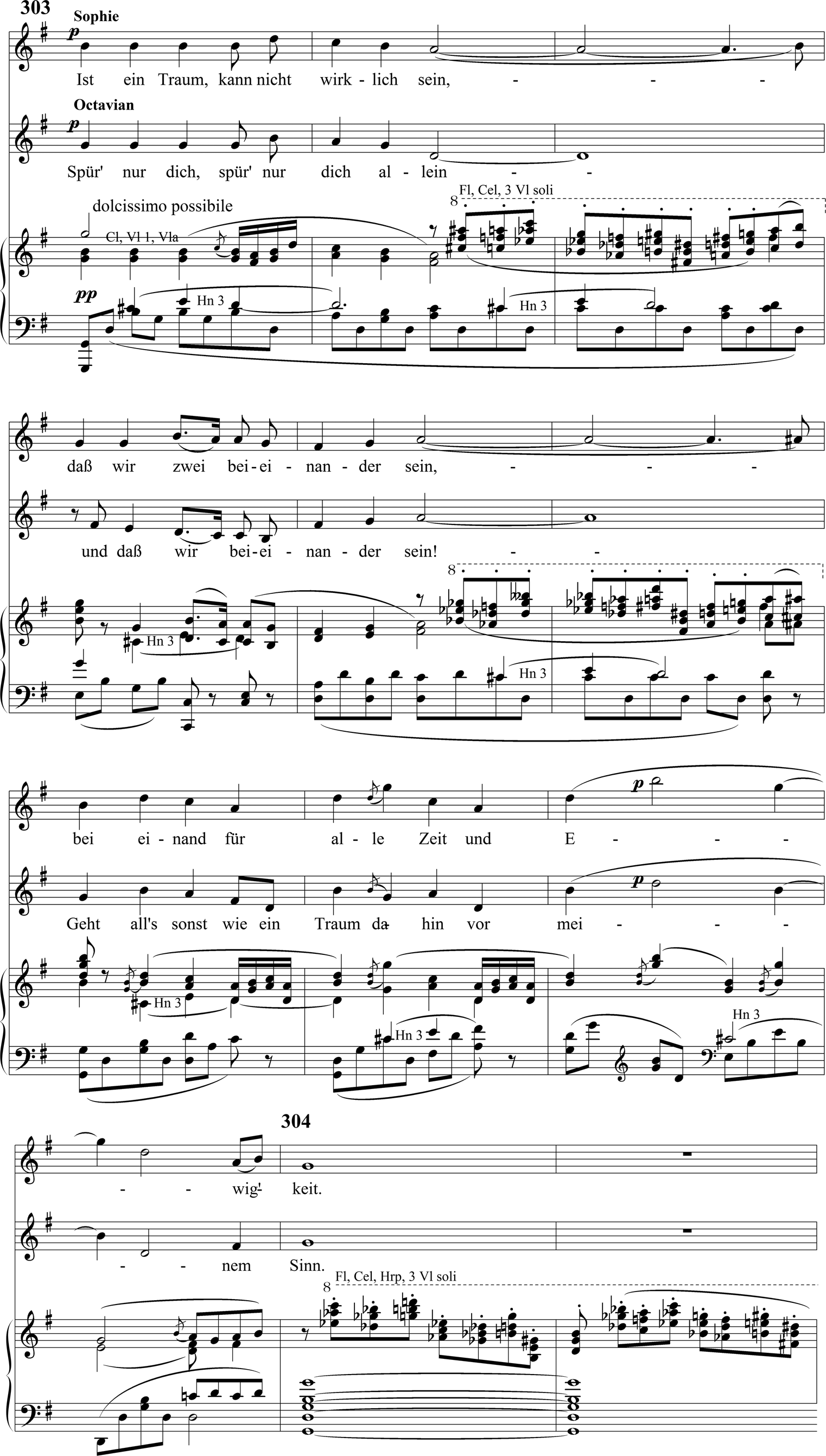
The  $ \^4\ndash\^6\ndash\^5$ figure in the third horn forms a dissonant counterpoint rubbing against the original melody. Taken from the motive that initiated the duet by transforming D♭ major into a G major 6/4 (295:4), the figure is undoubtedly ‘motivic’, but in dwelling on that threshold moment it suggests something of its dreamlike irreality, and in this context the glittering sparkle of the trilling second violins sounds ever more dissonant. The vision is clouded. No longer pristine, luminous, the echo of a make-believe eighteenth century, the anachronistic quality is gone, the rococo dream decayed in time. And there is also the return of the dissonant ‘rose chords’ from the Presentation scene, now interrupting the melodic phrases of the Mozartian ditty, fragmenting it, as it fades softly into the distance, imbuing it with the all the luminous ‘shine of the temporal’ as reflected in the ‘polished mirror of Strauss's music’.Footnote 87
These chords, it will be remembered, are formed of the head-motive of the theme associated with the Marschallin, and they seem to suggest something of the inexorable flowing of time even while the young lovers enjoy their timeless moment.Footnote 88 They suggest that as Octavian and Sophie celebrate what they perceive as their ‘sel'ge Augenblick’, time is still passing: passing for the Marschallin, but also for themselves. And on a larger, historical level, passing for us too, from a reconceived Mozartian epoch to the present – rounding off the opera's ‘interior’ time, that of its characters, with historical time, that time in which we ourselves are situated. (After all, despite its ostensibly ahistorical or suprahistorical qualities, Der Rosenkavalier came into being at a particular moment in history. Both an ‘opera of time’ and an ‘opera of its time’, its antihistorical ethos reflects the concerns of its age. It, too, cannot escape from the passing of time.)
At the very end, as the young lovers depart in the Marschallin's coach, the stage is left empty. The Marschallin's little black page boy scampers back on; to the sounds of his miniature march theme from Act I, he triumphantly retrieves Sophie's handkerchief that she had inadvertently let fall, and hurries off. After the sentimentality of the preceding minutes, the opera ends on a note of sly good humour. The implication, as numerous commentators have observed, is that this love will likely not last; Sophie will probably have her affairs, just as the Marschallin has had hers, and as for Octavian – it is a dream, it cannot really be. Their Augenblick, their moment of temporal transcendence, is fleeting. And yet – moments are nothing if not fleeting.
So which is it to be? The transitory or the transcendent? The historical or suprahistorical? How to decide? Philosophier Er nicht, Herr Schatz und komm’ Er her. Breakfast is served.


 Open access

