


I. Description of the Glacier
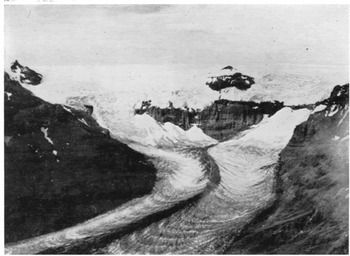
Morsárjökull drains a small part of the south-western area of Vatnajökull. It is one of the smallest outlet glaciers, being less than 5 km. in length and having an average width of 900 m. The glacier is divided into two parts by a conspicuous medial moraine derived from the rock wall exposed at its head. The two sections are supplied differently; the north-west stream derives most of its ice via a thin, steep ice fall, that to the south-east is fed entirely by avalanches (Fig. 1, p. 416).
The rock-wall of Morsdrjökull, showing the connected ice fall, the exposed roch-wall and the avalanche fans of the unconnected part of the glacier. The medial moraine can be seen in the right foreground. (See text, p. 423)
The average gradient of the glacier is 1 in 11.5. A profile was surveyed using a surveying aneroid and prismatic compass. The slope is fairly uniform, but a slight increase of gradient, with the associated increase of seracs immediately upstream, probably reflects a subglacial valley step (see Fig. 2, p. 425).
Map of Morsárjökull, Iceland. The medial moraine, which divides the glacier into two parts, is shown. While ogives occur on both parts of the glacier, they are shown only on the south-east part. Their pattern was drawn from field observations and photographs. The estimated position of the bulge at various dates is indicated. A profile of the south-east part of the glacier is also shown

The crevasses tend to run at right angles to the ogives as indicated on the map (Fig. 2). They appear to be mainly longitudinal in type according to Nye’s classification.Reference Nye 1 Their arrangement is characteristic of his theoretical pattern which should result from compressive flow. This type of flow, according to Nye, should occur in the ablation area or where the bed of the glacier is concave, and be associated with curved surfaces of maximum shear stress within the ice, which dip up-glacier. These may cause movement of ice along surfaces of rotation, thus carrying material up from the bed of the glacier.
The arrangement of the crevasses indicates that, in the lower part of the glacier at least, it is moving as one unit and not as two separate ice streams, as only one complete pattern of crevasses is present.
The speed of flow was measured on the upper part of the glacier. As the valley walls were very steep and inaccessible the theodolite was perforce placed on the medial moraine. This necessitated the re-setting of the theodolite on line with reference to fixed points on the valley side. Direct measurements by tape could then be made between the original and new position of each peg. The peg positions are shown on Figs. 2 and 3 (p. 425).
Movement of Morsdrjökull from 29.July to 14 August; the cross profile of the glacier is shown

Movement between 29 July and 14 August on the faster parts of the glacier was of the order of 26 cm./day. Although the period of measurement was short some general conclusions can be drawn as to the characteristics of glacier movement in this zone. The medial moraine moved least of all, the speed of flow increasing with increasing distance from the moraine (see Fig. 3). This indicates that at least in the upper part of Morsárjökull there are two separate ice streams.
II. OgivesFootnote *
Ogives are conspicuous features on some of the outlet glaciers of south-west Vatnajökull and Önefajökull. In the immediate vicinity of Morsárjökull, the large outlet glacier of Skeidarárjökull does not show any sign of this type of banding, while the ogives on Morsárjökull are very well developed. To the south-east Skaftafellsjökull has poorly marked ogives, but on the neighbouring Svinafellsjökull they are very well developed and appear as almost circular arcs. The distribution of ogives reflects the variations in steepness of the glaciers concerned. It is on those with marked ice falls and breaks in slope that the bands are best developed, a correlation which has frequently been noted by other observers.
Ogives were noticed and described in 1842 by ForbesReference Forbes 2 on glaciers in Switzerland, particularly on the Mer de Glace. He, also, was aware of the annual rhythm of the ogives and suggested that they were due to alternating rapid flow in summer and slower flow in winter. This caused the glacier to move in jerks. The wrinkles would form when the resistance of the ice beneath an ice fall is overcome and results in “detrusion” of the ice particles, which move upwards and forwards to initiate the bulges.
Collins in 1846 and MilwardReference Milward 3 in 1849 drew attention to the similarity between the movement of a glacier and that of a mud slide. It was noticed that the bands in a mud slide were of different consistency and they were compared with the observed alternation of porous and compact ice in bands on the glacier. It was suggested that the porous ice of the dark band accumulated below the ice fall in winter. While the broader band of compact ice was the result of winter frosts consolidating the saturated ice, reaching the base of the ice fall in summer. This theory also accounts for the annual rhythm in the formation of ogives and their presence below ice falls.
More recent suggestions on the problem of ogives were made in 1947 by FisherReference Fisher 4 as a result of work done in Alaska. He describes two distinct features which he called “Forbes’ bands” and “Alaskan bands” respectively. The former type only form below an ice fall. He considered that they could be explained by the filling of glacier-wide crevasses in the ice fall with clean snow. These alternate with wider belts of dirty firn ice. “Alaskan bands,” only found in the Arctic, get closer together towards the snout of the glacier and always have a narrower dark band. They represent, in Fisher’s opinion, the annual stratification of the glacier, a sodden summer surface alternating with the dry winter snow.
ChamberlinReference Chamberlin 5 in 1928, in pointing out the various methods of glacier flow, suggested that dirt bands indicate surfaces of shearing and that tension crevasses developed at right angles to these shear surfaces.
Godwin,Reference Godwin 6 discussing Vareschi’s work on pollen analysis on glaciers, considered the pollen content of the ogives of the Great Aletsch Glacier. These showed that the dark band had a strong concentration of summer, spring and autumn pollen, while the clean zone only contained winter ice. This suggests that here the ogives represent the original firn layers more or less undisturbed.
Observations made during the excavation of the tunnel through the Mont Collon Glacier were reported by HaefeliReference Haefeli 7 He noted that the speed of flow equates to the distance apart of the ogives. He pointed out the similarity between the formation of pressure waves and the formation of ogives beneath an ice fall. He considered that new ogives form owing to the difference in speed of the annual rhythm of the glacier. Wave crests form by the plastic upward spread of the ice when the pressure reaches a maximum. In answer to this suggestion FisherReference Fisher 8 pointed out that the ice forming the dark and light bands differed, the dark band being clear ice and the light band ice with air bubbles. He found it hard to visualize a process whereby rhythmic compression could produce this effect.
During work on the Juneau Ice Field, MillerReference Miller 9 has observed several glaciers with well-marked ogives. He follows Lewis in considering that the bands are three-dimensional features related to zones of shearing and overthrusting below ice falls. He accounts for the alternations of clear and dirty ice by seasonal variations. In the East Twin Glacier, Alaska, clean ice moves over the seracs in winter, while in summer the ice is made dirty by the addition of dust. The variation in volume moving over the seracs at different seasons is also significant. It may control the position, amplitude and wave length of the bands beneath the ice fall, by affecting the thrusting process, which is affected by variations in pressure. In other glaciers, however, it may take years for ice to pass through the ice fall.
Miller also describes a glacier in Patagonia which is almost entirely fed by avalanches and which shows banding of regenerated stratification type, due to alternating layers of dirtier summer avalanche material and cleaner winter layers. This particular glacier showed few, if any, thrust surfaces in the upper part. The bands dipped gently down-glacier at the base of the lowest avalanche fan, but at the snout they dipped up-glacier at 72 to 86 degrees.
An attempt may be made to summarize the factors necessary for the formation of ogives from the brief discussion of the observations and theories of other authors. It seems to be agreed that true ogives are related in some way to the annual rhythm of the glacier movement. They form most conspicuously below ice falls where the gradient of the glacier eases off. It seems to be generally thought that the ice varies in character between the dark and light bands. Most authorities claim that there are two distinct types of bands which are formed by different processes and possess different characteristics.
Morsárjökull is particularly interesting from the point of view of the development of ogives, because the glacier is in two parts, on both of which they are equally well formed. The ice fall which used to connect the south-east branch to the ice fields was severed between 1937 and 1938, as shown on the photographs taken in both years by Ingólfur Ísólfsson. For the last fourteen years this part of the glacier has been fed only by avalanches. Ogives have, however, been formed since then on both parts of the glacier. The bands are formed equally far up both sides of the glacier and the same number are found on both parts. The conclusion is therefore reached that a connected ice fall is not essential to the formation of the ogives.
The annual character of the bands on Morsárjökull was confirmed in two ways. The movement of the glacier averaged for the year was 103 m., which corresponds reasonably closely to the average wave length of the ogives at their apices, which was 110 m. These measurements were made between the seventh and eighth ogive from the head of the glacier. The photographs of the glacier taken in 1937, 1938, 1948, 1952 and 1953 indicate that the number of bands upstream of a recognizable point on the medial moraine increases by one for each year as closely as can be estimated. From the top of Kristínartindur (1126 m.) 37 bands were counted on the glacier surface. This gives some indication of the age of the glacier ice, assuming that one ogive forms each year.
The form of the ogives, which can be clearly seen only from above, gives information concerning the flow of the glacier (see Fig. 1). The gradual acceleration of the centre of both ice streams is clearly indicated as the two sets of bands become more arcuate downstream. However, each set remains symmetrical for some distance down the glacier, which indicates that the medial moraine in this part must be moving slowly. This agrees with the flow measurements (Fig. 3) to suggest that the glacier is flowing in two separate streams at this point. Further downstream the ogives become more asymmetrical, showing that the medial moraine is moving more rapidly here. The frictional drag of the valley side is clearly indicated. From the gradual change in shape of the bands it must be assumed that the speed of flow of the medial moraine is gradually accelerated. The distance between the apex of the band and the position where it reaches the medial moraine gradually decreases down-glacier. This can only be explained by the assumption that the moraine is moving faster than the centre of the south-east ice stream, near the lower part of the glacier. The conclusion is reached that the flow of the ice here is as one continuous stream and not two units.
An explanation of this flow pattern may be given by considering the forces at the head of the valley. The two steep ice streams provide pressure to induce glacier flow, but this force is lacking below the rock wall in the centre. The faster moving ice has probably eroded the glacier bed and formed a double subglacial valley. This in turn would cause drag to reduce the velocity of the medial moraine. The double valley probably becomes one unit where the centre of the whole glacier is moving most rapidly.
On the surface of the glacier the ogives become more distinct near the rock wall. In the lower part, when viewed from above, the dark and light bands often appear of nearly equal width. Towards the head of the glacier the dark ogives become much more distinct but narrower.
Most of the ogives did not affect the level of the surface of the glacier. The fifth from the top, on the south-east part, was particularly clearly marked by a considerable concentration of dirt in a zone 3.0 m. wide. In this instance the glacier surface gradient, at the site of the dirty band, was considerably steeper than the neighbouring clean ice. The dirty ice of the band appeared to be separated from the cleaner ice by discrete surfaces. Their dip varied from 30 degrees up-glacier in the centre of the ogive to about 80 degrees up-glacier near the medial moraine. Here the out-crop of the band ran almost parallel to the moraine for about 100 m. The upper surface was undulating in places with minor thrusts diverging, causing wedges of cleaner ice to penetrate down between zones of dirty ice. Gravelly material, often 1.5 cm. in diameter, lay along these surfaces. The dirt was spread uniformly through the dirty zone and was not merely a superficial covering. The character of the ice changes somewhat abruptly from the relatively unconsolidated avalanche debris above the first band to ice very similar to that of the rest of the glacier below the first band. The surfaces of separation forming the ogives dip up-glacier throughout at angles ranging from 30 degrees to 80 degrees. Blocks of stratified ice avalanched onto the glacier were gradually distorted in shape down-glacier but remained recognizable to about the fifth ogive.
In considering possible methods of origin of the ogives it is necessary to postulate a process which will account for their formation below both an ice fall and below avalanche fans. The fact that the bands form from avalanche ice shows that they cannot be related to original stratification in the firn zone, as the original structure is broken up by the avalanches. But they could be related to a regenerated type of stratification of the avalanche material. The evidence suggests that there is a more complicated structure on the unconnected part of Morsárjökull than on the unconnected glacier described by Miller in Patagonia, which shows regenerated seasonal stratification bands.
The presence of the discrete surfaces at the top of the dirty band and in some cases also at its base may suggest that overthrústing or rotational slipping is an important process in the formation of the ogivesReference Lewis 10 , Reference Clark and Lewis 11 Another fact which adds weight to this suggestion is the presence of a considerable amount of debris including quite large blocks, often rounded (up to 0.5 m. diameter), on the surface of the glacier below the first ogive. There is very little surface debris on the avalanche ice above the first ogive. The only debris seen here consisted of widely scattered, well-rounded pebbles and fine dust, which made the surface of the older avalanche ice appear dirty. Ablation may, however, account for the exposure of the material below the first band.
Another factor is the rather abrupt change in the character of the ice near the highest ogive. The subsequent change in the character of the ogives further downstream could be accounted for by the plastic deformation as the bands move downstream. Ablation would expose lower and lower layers at the surface as the glacier moves down.
It seems possible that the formation of ogives may be due to the uneven addition of weight at the rock wall of the glacier during periods of greater and lesser avalanche activity. This might cause the movement of ice, as clear cut overthrusts, along zones of maximum shear stress. The movement could only take place in this way if the differential force were sufficient for clear-cut thrusts to develop. At other times flow would probably be more even. A relatively large amount of cleaner ice would probably be avalanched onto the glacier during winter and spring, while in summer and autumn less ice and more dirt would fall onto the glacier. A similar variation in supply probably affects the connected part of the glacier, so that a similar process could act under the ice fall and avalanches on the north-west and south-east parts respectively. The resulting ogives would be very similar on both parts of the glacier.
Conclusions
-
The upper part of the glacier is in two distinct streams, but it becomes one unit towards the snout. This is shown by the flow measurements, the form of the ogives and the crevasse pattern.
-
The ogives, which are so conspicuous on this glacier, form equally well below the thin ice fall and the avalanche fans.
-
The distance apart of the ogives was found to agree closely with the annual movement of the glacier deduced from the flow measurements. This confirms the importance of annual processes in the formation of the ogives.
-
The ogives, which are three-dimensional features, may be due to some form of rotational movement on the evidence of the true dip of the dirty layers.
Ackowledgements
The work received considerable financial assistance from the Royal Society, the Royal Geographical Society and the University of Nottingham. The Scott Polar Research Institute and the Geography Department of Cambridge University kindly supplied instruments. The Authors also wish to express their gratitude to all firms and individuals who assisted financially and materially, and to W. H. Murray, whose fine lecture raised funds for the expedition. We wish to express our thanks to Professor Thórarinsson for his great interest and assistance, and to the National Research Council of Iceland for their permission to undertake this work. Mr. Ragnar Stefánsson of Skaftafell proved an indispensable assistant, and his kindness and friendliness will never be forgotten. The United States Air Base at Keflavik kindly supplied a helicopter with which our camp on Vatnajökull was established. Mr. Ingólfur Isólfsson has kindly given us some photographs of Morsárjökull taken over the last twenty years.
We wish to express our gratitude to Professor A. A. Miller, Mr. W. V. Lewis and Mr. M. M. Miller for the interest and encouragement they have shown.
Finally, thanks are due to all members of the party who assisted so vigorously.



