



The WHO recommends a daily intake of 400 g of fruits and vegetables, which corresponds to five portions of 80 g per day(1). This recommendation is far from being accomplished worldwide(1). In Portugal, 69 % of children younger than 10 fail to achieve it according to recent data from the National Food Survey(Reference Lopes, Torres and Oliveira2). The health benefits of eating at least 400 g of fruits and vegetables per day are well documented, being associated with a decreased risk of all causes of mortality, particularly cardiovascular mortality(Reference Wang, Ouyang and Liu3). Fruits and vegetables are rich in bioactive compounds, such as minerals, vitamins and antioxidants(1). Vegetables differ from fruits mainly in their lower sugar and higher fibre content, and its consumption, independently of fruits consumption, has the potential to protect from several diseases(Reference Appleton, Hemingway and Saulais4). Although these low sugar and high fibre levels are advantageous to health, they also contribute to a bitter taste and a hard texture, which makes promotion of vegetable acceptance in children, a challenge(Reference Poelman, Delahunty and de Graaf5). In addition to that, the low-energy density of vegetables may also undermine the development of liking, based on a possible taste-energy conditioning(Reference de Wild, de Graaf and Jager6–Reference Nicklaus and Schwartz8).
Promoting vegetable consumption in early childhood is particularly important, because studies indicate that consumption during this stage is below the recommended level and that dietary habits at this age tend to persist into adolescence and adulthood(Reference Brug, Tak and te Velde9). We are born with an innate liking for sweetness and a disliking for bitter and sour tastes and therefore children may need to be exposed repeatedly to bitter and sour vegetables to learn to like them(Reference Appleton, Hemingway and Saulais4). Considering that children show resistance to trying new or disliked vegetables(Reference Appleton, Hemingway and Saulais4) and that the number of eating exposures to a vegetable may determine its acceptance(Reference Appleton, Hemingway and Rajska10), positive strategies to motivate children to taste these foods are needed. It has been suggested that interventions that promote familiarisation with foods should add an element of sensory exposure unrelated to tasting, to reduce the pressure to try the food(Reference Dazeley, Houston-Price and Hill11). It is also known that, letting children choose from a variety of fruits and vegetables improves intake(Reference Appleton, Hemingway and Saulais4). Introducing children to the biodiversity existing within each species of fruits and vegetables (i.e. intraspecific biodiversity) will increase the range of available choices and may be a successful approach to promoting acceptance. Different varieties of the same vegetable have distinct growth characteristics and distinct attributes, for example, size, colour, shape, taste, texture, aroma and nutrient content(Reference Podsędek, Wilska-Jeszka and Anders12). These attributes can determine distinct preferences for different varieties of the same vegetable, but this is often not recognised by the child who refuses to try or to eat the vegetable, or by their parents(Reference Lanza, Sabatini and Bacceli13). Supporting this hypothesis, studies that exposed children or adults to colour diversity in a given vegetable or fruit reveal enhanced impact on its acceptance and intake(Reference Rioux, Lafraire and Picard14,Reference Vadiveloo, Principato and Morwitz15) .
The school represents a particularly interesting context for the promotion of fruits and vegetables intake because it allows the enrolment of children from different socio-demographic groups, on an almost daily basis, with a large range of possible contexts for promotion, from classroom to canteen(Reference Bundy16). School-based interventions include programmes that distribute free fruits and vegetables and school activities, included or not in the official programmes, potentially extending or not to families(Reference Evans, Christian and Cleghorn17). Hands-on approaches, such as gardening, cooking or tasting sessions, have been shown to have a larger effect on eating behaviour change than traditional nutrition education(Reference Evans, Christian and Cleghorn17,Reference DeCosta, Moller and Frost18) . However, the school-based interventions described in the literature still had minimal impact on vegetable intake and new methodologies are needed(Reference Evans, Christian and Cleghorn17). Additionally, these are often isolated activities, not integrated into the curriculum and therefore difficult to sustain(Reference Dudley, Cotton and Peralta19). The development of hands-on educational activities that could be led by teachers as part of their regular activities while they work on other components of the curriculum would contribute to more sustainable nutrition education(Reference Schmitt, Bryant and Korucu20).
We postulate in this study that an educational programme in which primary school children engage in experimental classroom work exploring the taste and other properties of different varieties of a vegetable can improve the acceptance of vegetables. We aim to test the effects of this educational programme on children’s willingness to try and liking for vegetables, compared to a control group. To increase the probability of primary school teachers further adopting and autonomously performing this activity in their classrooms, it is designed to simultaneously address other learning goals of the official primary schools’ curricula.
Materials and methods
Participants
The participants were children in the third grade (8–13-year-old children) at three public primary schools in Porto, Portugal (Girls: 41·6 %; Age: M = 8·88; sd = 0·65). Two schools (three out of the six participating classes) were part of the Program for Priority Intervention Educational Areas(21), characterised by a low socio-economic status context, in which problems such as school failure and school dropout were present. The three other participating classes were part of a school from a high socio-economic status context, characterised by a high students’ academic success.
A sample size of 120 children (60 per group) was calculated based on a power of 80 %, a significance level on P = 0·05 and an effect size of 0·25 in the increase in the target vegetable liking(Reference Faul, Erdfelder and Lang22). Parents of eligible children (137 from 6 classrooms) were invited to allow their children to participate.
Study design
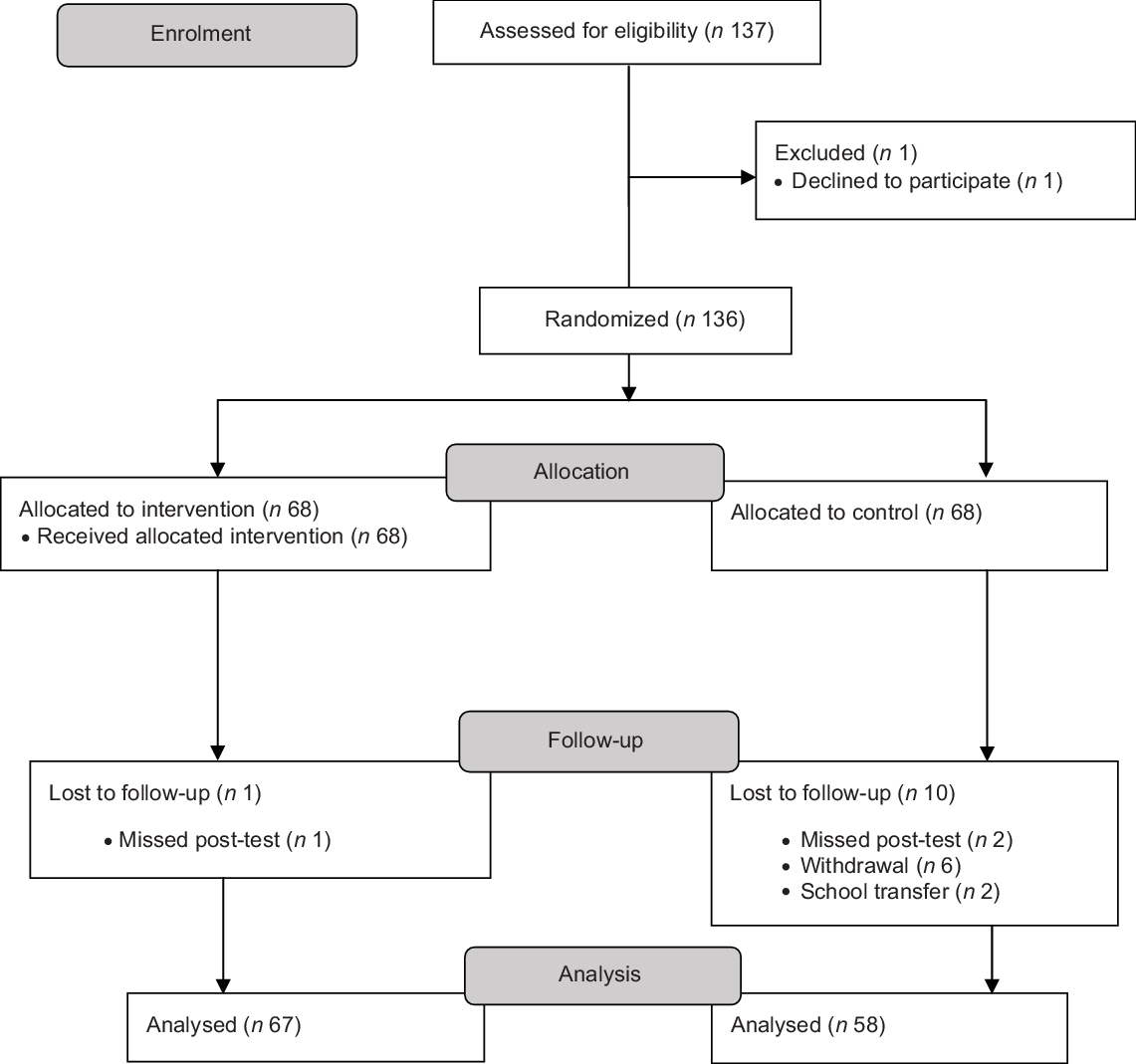
Of the 137 eligible children invited, only 1 did not obtain consent to participate. Afterwards, 136 children were randomised (1:1) within classrooms to form an intervention group (n 68) and a control group (n 68), using the random number generator of Excel®. Children performed the baseline test in school answering a questionnaire applied by a trained researcher. Children allocated to the intervention group did not differ significantly from the control group prior to the intervention, in age, gender and baseline scores (P > 0·05). Children allocated to the intervention group attended the educational programme composed of three sessions during three consecutive weeks, led by a group of researchers. This happened in their schools, in an available room. Meanwhile, the control group remained in the class, as usual. All children repeated the questionnaire, in the post-test, a week after the last session of the intervention group took place. After this, the educational programme was offered to the children in the control group.
We ended up with data for 125 children (67 in the intervention and 58 in the control group), due to exclusions caused by withdrawal (n 6), school transfer (n 2) and missing post-test (n 3). To perform an intention-to-treat analysis, we included children with session’s absences (n 9) in the final dataset(Reference Moher, Hopewell and Schulz23). CONSORT flowchart of this study is represented in Fig. 1.
CONSORT flow diagram of the study
Intervention
The educational programme was designed to simultaneously address learning goals for science education at the Portuguese primary school curricula, which also fit with the recommendations for primary education at European level:
Environmental literacy
Discussions about biodiversity loss and conservation and its impacts on our environment and food security(24,25) .
Scientific literacy
Engagement in scientific practices, by planning and implementing experiments, that is, (i) hypotheses postulation; (ii) planning and carrying out experimental procedures; (iii) analysing and interpreting data (mathematical thinking and graphs elaboration); (iv) engaging in argumentation from evidence and (v) obtaining, evaluating and communicating evidence(25–Reference Quinn, Schweingruber and Keller27).
Health literacy
Discussions about the importance of a healthy diet and the importance of the correct chewing for proper functioning of the digestive system(25).
The tomato was chosen as the vegetable to be explored in the intervention because several varieties of it are commonly available in Portugal. The educational programme consisted of three sessions, ranging from 60 to 90 min long each (overall intervention duration: 240 min), with 10–20 children.
Session 1: Sensory education with three varieties of tomato
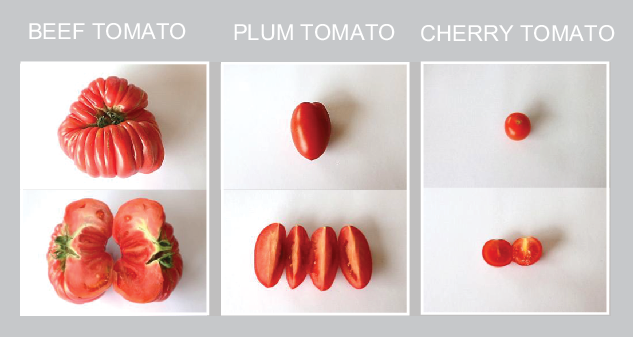
Three common varieties of tomato, in a similar maturation stage, were used: beef tomato, plum tomato and cherry tomato (Fig. 2). Tomatoes were cut into pieces approximately of the same size and each child had one plate with two pieces of each variety.
Specimens of tomato varieties used in the educational programme
Children were enrolled in sensory-based food education(Reference Dazeley, Houston-Price and Hill11,Reference Kahkonen, Ronka and Hujo28) . Firstly, we invited them to identify and describe differences between varieties, both of an entire tomato of each variety (e.g. shape and colour) and of its pieces (e.g. seeds and pulp colour). After this, children were told that during the activity they would learn how to become ‘professional food tasters’ by chewing each piece of the distinct tomato varieties several times, while closing their eyes and inhaling deeply. Children who refused to taste the tomatoes were encouraged, by being explained that it would be important for the activity to get their classification of the sweetness and acidity of each variety and that they may want to try again because preferences can change as we grow up. Additionally, they were asked if there was a certain variety of tomato they do not like, and if they were sure that the distinct varieties tasted the same. For the most reluctant children, we allowed them to taste without swallowing the pieces. If they kept refusing to taste, we asked them to smell and touch the tomato and to classify based on those sensations.
We then asked children to be aware of the level of sweetness of each tomato variety and to classify it to one of the following classes: not sweet, slightly sweet, moderately sweet, sweet and very sweet. The children repeated the full procedure to classify the acidity. Hereupon, children tried tomato at least six times (twice per variety of tomato). Children built bar graphs representing their classifications, using a blank poster and self-adhesive paper.
Session 2: Hypotheses postulation and experimental procedure design
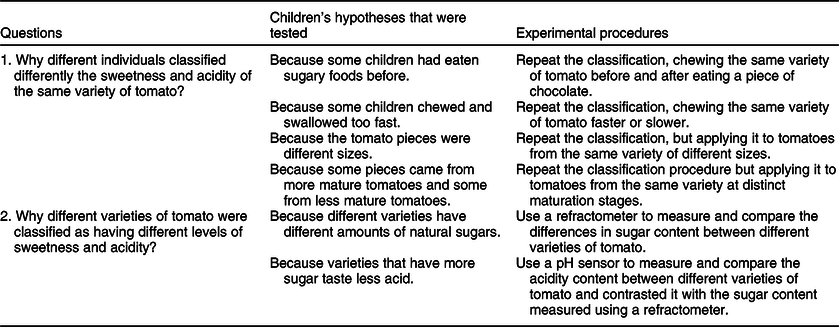
In session 2, children analysed the bar graphs built in session 1. These analyses resulted in two questions that were posed to students to be answered through an inquiry-based learning approach(Reference Pedaste, Mäeots and Siiman29): (1) different children classified differently the sweetness and acidity of the same variety of tomato and that (2) different varieties of tomato were classified as having different levels of sweetness and acidity. Children were invited to postulate explanations for these observations, in a class discussion. These explanations were rephrased to hypotheses by the research team.
Children were then divided into groups of three to five and asked to collaboratively select one hypothesis and plan an experiment to test it, using a worksheet adapted from an official Portuguese educational set(Reference Martins30) that asked them to describe (i) the hypothesis rephrased as a question, (ii) what would need to be kept constant to test the hypothesis, (iii) what would vary, (iv) what was going to be measured, (v) how were they going to register data, (vi) what would be the experimental procedure, (vii) what was needed to perform such experimental procedure, (viii) what were the predicted and (ix) observed results, and (x) what conclusions could be taken. During this task, they were assisted by the researchers who helped them identifying problems in their experimental design and fostered discussion in the groups to find solutions to overcome those problems. When necessary, they were introduced to the sugar-measuring device (refractometer) and to the pH-measuring device (pH sensor)(Reference Martins30).
Session 3: Experimental procedure
Within small groups, children tested their hypotheses, following the experimental procedure planned in the previous session. Some of the experimental procedures implied to taste the tomato again and the group of children themselves performed those tastings. They obtained and analysed the results, shared it and drew conclusions within groups. Additionally, children shared their results with the other groups of their intervention session and identified the strengths and weaknesses of their experimental design. They also discussed the implications of their results and conclusions for vegetables intake and biodiversity conservation.
Evaluation of the acceptance of vegetables
Children over the age of 6 years are able to answer hedonic scales over three items and to perform discriminatory tests(Reference Guinard31,Reference Lawless and Heymann32) . Therefore, the children’s willingness to try vegetables and liking were assessed by questionnaire, before (baseline test) and after (post-test) the intervention. Children were asked individually to answer to an age-appropriate 5-point pictorial Likert scale(Reference Guinard31). Children were shown a picture with different varieties of tomato and were asked about: (a) their willingness to try tomato from ‘Not at all’ (1) to ‘Very much’ (5) and (b) their liking of tomato from ‘Dislike very much’ (1) to ‘Like Very much’ (5). The same procedure was repeated for lettuce and cabbage, to test an eventual carry-over effect.
Statistical analysis
Data normality was tested using the Kolmogorov–Smirnov test. To find the differences between the two groups in willingness to try and liking for vegetables, before and after the intervention, we compared the change scores, calculated by post-test punctuations minus baseline punctuations, between the intervention and control group. Chi-squared tests were used for categorical variables and Mann–Whitney U tests for continuous variables. All statistical analyses were performed with SPSS v24(33).
Results
Intervention
When asked to identify variable features in the varieties, children mentioned features such as the colour, the size, the shape, the texture, the seeds, the smell and the juice. When asked to taste the slices, between three and five children per session were reluctant to taste tomato, explaining they did not like it. After encouragement, all children but one accepted to taste tomato.
To answer the research questions, children were invited to postulate hypotheses (session 2). From the list of hypothesis posed by students, those selected to be tested are depicted in Table 1. Table 1 also describes a summary of the corresponding experimental procedures (session 3).
Summary of children’s hypotheses that were tested and corresponding experimental procedures
Effect of intervention on the acceptance of vegetables
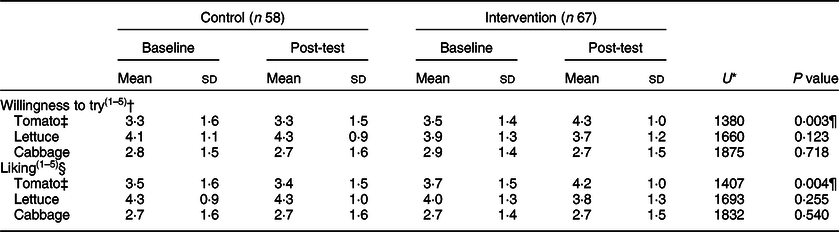
The data describing the baseline and post-test scores for intervention and control group are depicted in Table 2.
Baseline and post-test scores regarding vegetables acceptance
* Mann–Whitney U test, to compare differences in scores between control and intervention group.
† Answers on a 5-point Likert scale, where 1 = not at all to 5 = a lot.
‡ Vegetable explored in the educational programme; Lettuce and cabbage acceptance was evaluated to test an eventual carry-over effect.
§ Answers on a 5-point Likert scale, where 1 = totally dislike to 5 = like extremely.
|| P < 0·05.
¶ P < 0·01.
The post-test scores of willingness to try and liking of tomato were greater for intervention group (mean (sd) = 4·3 (1·0) and mean (sd) = 4·2 (1·0), respectively) than for control group (mean (sd) = 3·3 (1·5) and mean (sd) = 3·4 (1·5), respectively). The Mann–Whitney U test confirmed that these differences were significant comparing to the baseline scores, for both willingness to try (U = 1380; P = 0·003) and liking (U = 1407; P = 0·004) of tomato. No significant differences between intervention and control group were found for lettuce and cabbage, regarding the willingness to try (U = 1660; P = 0·123 and U = 1875; P = 0·718, respectively) and liking (U = 1693; P = 0·255 and U = 1832; P = 0·540, respectively).
Discussion
Our results showed that an educational programme exploring intraspecific biodiversity by promoting sensory-based education and engaging children in scientific practices contributed to increasing their willingness to try and their liking for the vegetable explored in the intervention. Several features of this activity may have contributed to its positive effects. In fact, the activity was designed to: (i) promote exposure to the vegetable; (ii) encourage children to taste the vegetable while paying full attention to its properties; (iii) offer choice with distinct varieties of the same vegetable; (iv) use the experimental procedure to encourage children to taste the vegetable and to manipulate it in other ways than through taste and (v) provide opportunities for children to engage in hands-on activities and explore the distinct properties of tomato while planning and performing experiments.
In the first session, we promoted sensory education with three varieties of tomato and children were expected to taste it at least six times. Some of the experimental procedures implied that they should taste the tomato again. Altogether, these repeated exposures to the vegetable over the three sessions may have enhanced their acceptance of it. In fact, the repeated exposure to the same vegetable (from 7 to 14 times) was shown to be an effective way of improving its acceptance by children under the age of 5 years(Reference Holley, Farrow and Haycraft34). This was also supported by a study in which 6-year-old children were subject to repeated exposure to an unfamiliar vegetable in a school setting, what increased both liking and intake(Reference Wardle, Herrera and Cooke35). However, studies indicated that the effect of repeated exposure to vegetables on liking and intake by children was enhanced by exposing them to a variety of vegetables(Reference Appleton, Hemingway and Rajska10). Offering more than one variety of tomato to the children may have also contributed to this increased likelihood of their acceptance of at least one variety given the variation in organoleptic characteristics(Reference Pinela, Barros and Carvalho36) and also the possibility of a carry-over effect between varieties(Reference Appleton, Hemingway and Rajska10). The argument that different varieties taste differently may have been especially important to convince children who initially rejected to taste it (three to five children in each group). Children were also asked to taste the tomato attentively to better classify its sweetness and acidity as the first step of the experiments. Mindful eating practices (i.e. eating foods with fully awareness) have been shown to promote more enjoyment of previously disliked and avoided foods in adults, but studies with children on this topic are needed(Reference Hong, Lishner and Han37).
It should be noted that the experimental procedure might also have been essential in convincing the children who had initially refused to taste tomato. In fact, by asking them if different tomato varieties had similar or different flavours, we introduced the need to taste and classify each variety’s flavour. Conditioning strategies, that is, associating the experience of the taste of a vegetable with additional positive experiences (such as a reward or positive mentions/messages about it) have shown to increase liking and acceptance for the exposed vegetable(Reference Appleton, Hemingway and Rajska10,Reference Poelman, Cochet and Cox38–Reference Laureati, Bergamaschi and Pagliarini40) . The approach used in this study may be seen as a conditioning strategy because the classification of the tomato that was necessary to contribute to the group work was conditioned to tasting and this may have motivated those children who initially refused to try the tomato. Even the child who continued to refuse to taste tomato was invited to identify differences based on other senses, such as vision and smell, thereby reducing the pressure to try it. These elements of sensory exposure, not only related to tasting, may have reduced the pressure and improved the children’s willingness to try the tomato. Previous studies have shown that promoting children’s contact with fruits and vegetables through looking, listening, feeling and smelling activities may improve their willingness to taste these foods(Reference Dazeley, Houston-Price and Hill11,Reference Kahkonen, Ronka and Hujo28,Reference Holley, Farrow and Haycraft34,Reference Dazeley and Houston-Price41–Reference Coulthard, Williamson and Palfreyman44) . Even the repeated exposure in children to pictures of diverse vegetables has been associated with higher levels of acceptance of these unknown vegetables(Reference Rioux, Lafraire and Picard14). However, the majority of these studies were directed at children under 6 years old and more research of children above this age is needed(Reference Holley, Farrow and Haycraft34).
During the experimental procedure, the children interacted with the vegetable in ways beyond having to taste it. Other non-tasting activities with foods in school have been shown to improve the children’s acceptance of specific food items: gardening activities increased children’s liking and intake of fruits and vegetables, in several studies(Reference Robinson-O’Brien, Story and Heim45,Reference Savoie-Roskos, Wengreen and Durward46) ; and cooking sessions were found to improve eating habits, while increasing the children’s cooking competences(Reference Evans, Christian and Cleghorn17,Reference Hersch, Perdue and Ambroz47,Reference Muzaffar, Metcalfe and Fiese48) . The types of hands-on activities that built knowledge and meaning from real-life experiences (e.g. cooking or gardening) exhibited a greater effect in promoting healthy eating in primary schools, when compared with other approaches, such as those that were curriculum-, game- or web-based(Reference Dudley, Cotton and Peralta19,Reference Battjes-Fries, Haveman-Nies and van Dongen49) . By inviting children to postulate their own biodiversity-related hypotheses, we allowed them to deliver explanations that were based on their own experiences. The advantage of our activity, compared to cooking or gardening, is that it does not require outside space or specialised cooking or gardening equipment, thus making its replication and sustainability simpler. Although for some experiments a refractometer and a pH sensor were used – equipment not always available in schools – other experiments do not require such devices. In the future, it would be useful to test the effect of a teacher-leaded intervention using only equipment available in schools, to increase the sustainability of this educational programme. The fact that children were asked to test their own hypotheses may have also created an emotional bond that may have promoted their interest in the vegetable(Reference Hornsey and Fielding50). Additionally, this educational approach that invites children to ‘act like a scientist’ may have by itself contributed to change their attitudes over tomato(Reference Potvin and Hasni51).
A recent meta-analysis suggested that exposure to foods of the same category resulted in some transfer of the acceptance of novel foods(Reference Appleton, Hemingway and Rajska10). We found no differences in the willingness to try and liking for cabbage and lettuce; therefore, suggesting that this concept does not translate to other foods in our study. However, perhaps it has occurred a carry-over effect of the acceptance between the different varieties of tomato. This hypothesis needs to be tested in the future, eventually by evaluating the acceptance of each variety separately. Perhaps to have a carry-over effect, there is a need to explore the biodiversity of a specific food or maybe we need to undertake more than one exposure to the educational programme with different vegetables. Eventually, this educational programme may also be extended, adding a session that explicitly targets generalisation. Additionally, we could have considered at least one vegetable with more similarities to tomato; as lettuce and cabbage are leaves, they do not have characteristics that were part of the experience (such as juiciness, seeds or skin).
Our study has some limitations that deserve discussion. We evaluated the effect of the intervention on children’s willingness to try and liking for tomato; however, there is a need to evaluate the effect of the activity on tomato consumption. This may happen through a FFQ applied to parents, or evaluating children’s selection and intake in the school lunches or snacks. Despite this, willingness to try and liking for vegetables are determinants of intake in children(Reference Brug, Tak and te Velde9) and in longitudinal studies, early vegetables’ liking predicted consumption years later(Reference Fletcher, Wright and Jones52). Replication of this activity in other populations needs to be studied, as well as the stability of the effect over time, by performing a follow-up. In the future, it would also be important to conduct a study of this educational activity driven by teachers, using only equipment available in schools, to guarantee that it is effective in a real-world setting. We also acknowledge that randomisation within classrooms, rather than between classrooms, may have contributed to some contamination between subjects. Thus, it would also be advantageous to run a cluster randomised controlled trial in the future, to overcome this limitation.
The strengths of our study were that we developed an educational programme that teachers can adopt to improve children’s knowledge and simultaneously improve their skills relating to environmental and scientific literacies, as requested in the official educational guidelines. Additionally, this activity was tested in a randomised controlled trial, allowing for comparison of the effects with a control group.
Conclusions
Inviting primary school children to explore different varieties of a vegetable by science and sensory education could be a new and promising approach to improve the acceptance of the target vegetable. This educational approach could be applied to other vegetables or fruits. It could also be applied to different versions of the same food, after industry processing, seasoning or cooking, reducing the likelihood of the child to reject it before tasting by the realisation that these methods alter their flavour(Reference Zeinstra, Vrijhof and Kremer53). These methods also alter their physical and chemical properties, providing new opportunities to carry out experiments. To the best of our knowledge, this is the first study that has promoted vegetable acceptance by exploring different varieties of a vegetable through the design and implementation of experiments and it appears to be a promising approach. Our results reveal new research questions and directions worthy of pursuit, especially regarding the impact of offering and tasting intraspecific diversity on primary school children’s preference for a vegetable and the impact of exploring foods’ characteristics though experiments on the acceptance of a certain food. Further work may explore the impacts of exploring biodiversity on vegetable’s intake and establish whether the results are stable over time and replicable in different contexts and populations.
Acknowledgements
Acknowledgements: We would like to acknowledge the teachers and the students who participated in this study (along with their parents) and the school board team. We gratefully thank to Helena Szrek for carefully reading this paper and for her advices. Financial support: This work was funded by the Research Centre on Didactics and Technology in the Education of Trainers at the University of Aveiro, the Portuguese Science Foundation (FCT UID/PSI/00050/2013, UID/CED/00194/2013, SFRH/BPD/103613/2014) and EU FEDER through COMPETE 2020 programme (POCI-01-0145-FEDER-007294). Conflict of interest: None. Authorship: LA, SA and XSP participated in the conception and design of the study. All authors participated in the literature review and performed the data collection. LA and XSP carried out the statistical analysis, and all authors interpreted and discussed the results. LA prepared the manuscript and all authors reviewed and approved the final version submitted for publication. Ethics of human subject participation: This study was conducted according to the guidelines laid down in the Declaration of Helsinki and all procedures involving research study participants were approved by the University of Aveiro Ethics Committee (process number 10/2018) and by the board of the schools enrolled. Written informed consent was obtained from all parents.



