



Several studies in the USA have found that food insecurity is significantly associated with higher BMI and greater risk of obesity among women overall( Reference Adams, Grummer-Strawn and Chavez 1 – Reference Wilde and Peterman 3 ) and for specific subgroups such as Latina women( Reference Kaiser, Townsend and Melgar-Quiñonez 4 , Reference Leung, Williams and Villamor 5 ). However, little is known about the association between food insecurity and BMI among immigrant women or the role of length of residence in the USA on this relationship. Evidence suggests that although BMI is lower among immigrants compared with US natives( Reference Bates, Acevedo-Garcia and Alegría 6 ), BMI increases with longer US residence( Reference Antecol and Bedard 7 – Reference Sanchez-Vaznaugh, Kawachi and Subramanian 11 ) particularly among women( Reference Sanchez-Vaznaugh, Kawachi and Subramanian 11 ).
Immigrants tend to come to the USA from developing countries undergoing epidemiological and nutrition transitions. In these countries, the prevalence of obesity is increasing( 12 , Reference Mendez, Monteiro and Popkin 13 ) and food insecurity is generally higher than in the USA( 14 ). Processed, energy-dense foods have been typically less available in developing countries than in developed countries, although this is changing with the increasing distribution of processed foods around the globe( 14 ). Even though immigrant women may have experienced food insecurity in their countries of origin, longer residence in host societies may increase exposure to energy-dense diets as well as vulnerability to higher BMI, overweight and obesity. Thus, although immigrant women may have lower average BMI than their US-born counterparts, over time, immigrant BMI patterns may mirror those of social groups in their host societies.
Initially, nativity outside the USA and dietary norms in countries of origin may act as protective factors against higher BMI among US immigrants. With longer residence in host societies, changes in fruit and vegetable consumption( Reference Bermúdez, Falcón and Tucker 15 , Reference Yeh, Ickes and Lowenstein 16 ) and lack of access to healthy foods in poor neighbourhoods( Reference Inagami, Cohen and Finch 17 – Reference Morland, Wing and Diez Roux 20 ) where low-income immigrants are more likely to live may increase food insecurity and lead to higher BMI and overweight/obesity among immigrants. Thus, we might expect food insecurity to be associated with higher rates of overweight and obesity among immigrant women with longer US stays, as compared with immigrants with shorter US stays.
To inform current and future interventions to prevent obesity and improve health among all women, research is needed to disentangle the role of both food insecurity and length of residence in the variation of obesity among US-born and foreign-born women. To strengthen knowledge about the roles of food insecurity and length of residence in the epidemiology of obesity among US immigrant women compared with native women, we utilized a large sample of women in California to investigate whether the association between food insecurity and overweight/obesity varied according to birthplace and length of residence.
Methods
Participants
We used four years of data from the California Women’s Health Survey (CWHS) 2009–2012. CWHS is an annual, cross-sectional, population-based telephone survey of non-institutionalized households, and methods have been described elsewhere( Reference Induni and Hoegh 21 ). Briefly, using random digit dialling, one woman aged 18 years or older per household was randomly selected to participate in a telephone interview. Respondents were interviewed in English and Spanish. CWHS data are weighted to account for the complex sampling design and adjust for non-response and households without telephones. In the combined four years, there were a total of 18 930 respondents. After excluding pregnant women (n 235), those with implausible (>65 or <10 kg/m2) or missing BMI values (n 2385) and respondents missing information on food insecurity (n 51) or birthplace/length of residence (n 251), our analytic sample included 16 008 women. Women with missing BMI values refused to provide either weight and/or height, usually because the respondents did not complete the entire survey (partial completes).
Weight status
BMI was calculated as self-reported weight in kilograms divided by the square of self-reported height in metres. Obesity, overweight and normal weight were defined using standard cut-off points: BMI≥30·0 kg/m2 as obese, BMI=25·0–29·9 kg/m2 as overweight and BMI=18·5–24·9 kg/m2 as normal weight. Women who were underweight (BMI <18·5 kg/m2) comprised 2·6 % of the total weighted sample (n 328) and were excluded from all analyses due to small sample size (cells with ten or fewer observations) when compared by food security status and birthplace–length of residence.
Food security
Food security was assessed using the six-item short form of the US Household Food Security Module, developed and validated by the US Department of Agriculture( Reference Bickel, Nord and Price 22 ). Each question in the six-item short-form module was scored following the US Department of Agriculture protocol. The scores for each question were summed to create a food security score for each participant. Women were classified using the US Department of Agriculture guidelines as follows: food secure (raw score=0–1), low food security (raw score=2–4) or very low food security (raw score=5–6)( 23 ). Food insecurity refers to both low and very low food security categories.
Birthplace–length of residence
Birthplace and length of residence were combined into one single variable with three categories: (i) US-born; (ii) foreign-born living in the USA for 10 years or longer; and (iii) foreign-born living in the USA for less than 10 years. We used this 10-year threshold because prior research among immigrants has reported that BMI tends to increase after 10 years of US residence( Reference Goel, McCarthy and Phillips 9 ).
Covariates
We used directed acyclic graphs to select covariates to include in multivariable models. Directed acyclic graphs are useful tools to select covariates that meet criteria as potential confounders( Reference Greenland, Pearl and Robins 24 , Reference Pearl 25 ). We selected the following demographic and socio-economic factors: age centred at its mean; a quadratic term for age to assess potential non-linear age effects on overweight/obesity; self-reported race/ethnicity (white, African American/black, Hispanic/Latina, Asian); marital status (married/living with partner, separated/divorced/widowed, never married); education (less than high school, high school or some college, college graduate or higher); and federal poverty level (<185 %, ≥185 %). Food assistance (defined as participating in the Supplemental Nutrition Assistance Program (SNAP) or the Special Supplemental Nutrition Program for Women, Infants, and Children (WIC) in the past 12 months) and having children under 18 years old in the household were included as covariates in sensitivity analyses. Due to small sample size, we excluded 304 women who did not self-identify with these four race/ethnicity categories: white, African American/black, Hispanic/Latina or Asian.
Statistical analysis
We compared average BMI and prevalence of normal weight, overweight and obesity along with distributions of other variables among women in each food security group. We used χ 2 statistics for categorical variables and ANOVA for continuous variables to assess the statistical significance of observed differences.
Adjusted prevalence ratios (PR) of overweight/obesity and their 95 % confidence intervals were calculated using Cox proportional hazards models for complex surveys (PROC SURVEYPHREG) in the statistical software package SAS version 9.3. Due to small cell sizes for immigrants with less than 10 years of US residence, we combined overweight and obese categories to calculate PR and confidence intervals. To examine potential effect modification by birthplace–length of residence, a product term (food security and birthplace–length of residence) was included in Cox models using the overall sample. Because a Wald test for product terms is not calculated in PROC SURVEYPHREG, we used PROC SURVEYLOGISTIC to calculate the P value for a Wald test for the product term. Because the P value for the product term was 0·1, additional models were stratified by birthplace–length of residence.
SAS version 9.3 survey procedures were used for all analyses to adjust for the complex survey sampling design. The level of significance was defined as P<0·05 for all tests except for product terms.
Results
In the overall sample, 28 % of women reported food insecurity (17 % had low food security, and 11 % had very low food security; Table 1). Food-insecure women were more likely to be immigrants; immigrants born in Mexico comprised the largest group (33·6 %) of all food-insecure women. Food-insecure women were also less likely to be married and to be more socio-economically disadvantaged than food-secure women.
Characteristics of the sample by food security status, California Women’s Health Survey (CWHS) 2009–2012Footnote *, Footnote †

* Chi-square tests of heterogeneity are statistically significant between food-secure, low food-secure and very low food-secure groups (P<0·01). Percentages may not add to 100 due to rounding.
† All percentages and means corrected for the complex design of the CWHS using SAS survey procedures.
‡ Defined using WHO epidemiological sub-regions.
§ Not reported due to small cell sizes.
Overall, the prevalence of obesity was highest among women with very low food security (43 %), and second highest among women with low food security (35 %; Table 2). This pattern persisted among the US-born and immigrants with longer and shorter US stays. The prevalence of overweight was generally similar among low and very low food-secure women, for all groups except immigrants with US residence of less than 10 years, although their sample size was small.
Unadjusted prevalence of overweight and obesity according to food insecurity, for the overall sample and by birthplace–US length of residence for women in California, California Women’s Health Survey (CWHS) 2009–2012Footnote *

* All percentages corrected for the complex design of the CWHS using SAS survey procedures.
In the overall sample, low and very low food security were positively associated with overweight/obesity, compared with food-secure women, adjusting for age, age-squared, race/ethnicity, marital status, education, poverty and birthplace–length of residence (Table 3).
Adjusted obesity/overweight prevalence ratios (PR) according to food insecurity, overall and by birthplace–US length of residence for women in California, California Women’s Health Survey (CWHS) 2009–2012Footnote *
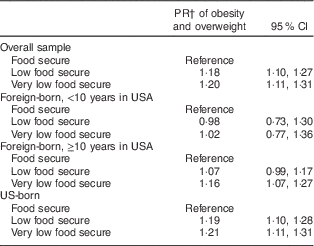
* All prevalence ratios and confidence intervals corrected for the complex design of the CWHS using SAS survey procedures.
† Prevalence ratios adjusted for age, age-squared, race/ethnicity, marital status, education, poverty and survey year. In the overall model, also adjusted for birthplace–length of residence and food security × birthplace–length of residence.
PR stratified by birthplace–length of residence and adjusted for age, age-squared, race/ethnicity, marital status, education and poverty are presented here. Among US-born women, very low food security (PR=1·21; 95 % CI 1·11, 1·31) and low food security (PR=1·19; 95 % CI 1·10, 1·28) were significantly associated with overweight/obesity compared with food-secure women. Among immigrant women with 10 or more years of US residence, relative to food-secure women, very low food security was significantly associated with greater likelihood of overweight/obesity (PR=1·16; 95 % CI 1·07, 1·27); low food security was positively associated with overweight/obesity, but the confidence interval included the null (PR=1·07; 95 % CI 0·99, 1·17). Among immigrant women with less than 10 years of US residence, neither very low food security (PR=1·02; 95 % CI 0·77, 1·36) nor low food security (PR=0·98; 95 % CI 0·73, 1·30) was significantly associated with overweight/obesity. In sensitivity analyses adjusting for food assistance (SNAP or WIC) and children under 18 years old in the household, PR were similar to those reported above.
Discussion
In a large representative sample of women in California, we found that food insecurity was associated with higher likelihood of overweight/obesity among US-born women and immigrant women with longer US stays, after adjustment for sociodemographic factors. These results concur with other US studies using cross-sectional data which found that food insecurity was associated with higher BMI, overweight and obesity among women in California( Reference Adams, Grummer-Strawn and Chavez 1 ) and Latina women( Reference Kaiser, Townsend and Melgar-Quiñonez 4 , Reference Leung, Williams and Villamor 5 ). Similarly, using measured weight and height, one longitudinal study found that food insecurity was significantly associated with weight gain in a large representative sample of women in the USA( Reference Wilde and Peterman 3 ).
Our study builds upon this literature by investigating whether the association between food insecurity and weight status varied according to birthplace–length of residence. We found that the association between food insecurity and weight status was more pronounced among immigrant women with longer residence in the USA than among immigrant women with shorter residence in the USA. Prior research has found that compared with men, women may be more susceptible to higher BMI with longer US residence( Reference Sanchez-Vaznaugh, Kawachi and Subramanian 11 ). Among women, food insecurity is associated with obesity in Mexico( Reference Morales-Ruán, Méndez-Gómez Humarán and Shamah-Levy 26 ), South Korea( Reference Chun, Ryu and Park 27 ) and some ethnic groups in Iran( Reference Rezazadeh, Omidvar and Eini-Zinab 28 ). Food insecurity was associated with underweight, but not excess weight, among women in Colombia( Reference Isanaka, Mora-Plazas and Lopez-Arana 29 ).
Our study’s findings suggest that food insecurity may be an important pathway that may influence susceptibility to overweight/obesity as immigrant women live longer in the USA. The experience of food insecurity combined with greater exposure to some features of a developed society may be underlying mechanisms that lead to higher BMI, overweight and obesity among immigrant women.
For example, in the USA, lower-quality diets rich in energy-dense but nutrient-poor foods, such as refined grains, ground beef and processed meats, are more likely to be consumed by people with lower socio-economic resources( Reference Darmon and Drewnowski 30 ) and tend to be cheaper per kilojoule than diets high in nutrient-dense foods like fruits and vegetables( Reference Drewnowski and Darmon 31 , Reference Ledikwe, Blanck and Khan 32 ). The high cost per kilojoule of fruits, vegetables and other healthy foods may be out of reach for low-income populations to purchase and consume regularly( Reference Drewnowski and Darmon 31 ). Limited availability of supermarkets in some poor and minority neighbourhoods (where immigrants of low socio-economic status are likely to live) may impede access to fruits, vegetables and other nutrient-rich foods( Reference Larson, Story and Nelson 33 ). Observational studies have found that access to supermarkets is associated with a healthier diet( Reference Larson, Story and Nelson 33 , 34 ). However, experimental studies with control groups have found that supermarket access is not significantly associated with diet or weight status( Reference Zhang, Laraia and Mujahid 35 – Reference Cummins 37 ). Marketing incentives for low-cost, energy-dense foods are particularly damaging to groups of low socio-economic status( Reference Darmon and Drewnowski 30 ); this may in turn influence food-insecure immigrant women with longer US stays to replace healthier diets for energy-dense, nutrient-poor foods that represent a source of affordable energy. In contrast, recent immigrant women may escape the influence of such incentives, as they may hold on to purchasing behaviours from their countries of origin or because they may not be as exposed to heavy food advertising and marketing in the USA as the general population( Reference Zimmerman 38 ). Nutrition education interventions may be less effective at increasing the consumption of healthy foods for those of low socio-economic status, compared with those of higher socio-economic status( Reference Oldroyd, Burns and Lucas 39 ).
The obesogenic environment in the USA may affect immigrants slowly over many years. Foreign nativity and norms in countries of origin may act as protective factors against higher BMI and may be more powerful than the influence of food insecurity alone. Some studies have found that immigrants from Mexico and Korea are more likely to consume fruits and vegetables than US natives( Reference Bermúdez, Falcón and Tucker 15 , Reference Neuhouser, Thompson and Coronado 40 , Reference Yang, Chung and Kim 41 ). A prior study found that Latino immigrants may rely on staples that are rich in fibre, such as beans and corn tortillas, and micronutrients, such as tomatoes, during periods of food insecurity( Reference Kaiser, Townsend and Melgar-Quiñonez 4 ). These patterns could buffer against the harmful effects of food insecurity among immigrant women in their first few years of residence in the USA. However, with longer residence in the USA, immigrant women may begin to respond to food shortages in similar ways as their counterparts with longer US residence and women born in the USA; for example, they may decrease consumption of lower-energy-density foods rich in micronutrients and fibre, and replace them with cheaper, energy-dense, low-nutrient foods that are frequently consumed by those in socio-economically disadvantaged groups in the USA( Reference Darmon and Drewnowski 30 ).
Additionally, the observed food insecurity patterning in BMI by birthplace and length of residence may be due to factors closely linked to food insecurity such as psychosocial stress and biological functioning (e.g. allostatic load)( Reference Szanton, Gill and Allen 42 ). A prospective study found that experiencing psychosocial stress was associated with increased BMI over a 13-year follow-up period among black women( Reference Fowler-Brown, Bennett and Goodman 43 ). Some evidence suggests that women with greater central fat have greater levels of cortisol secretion when experiencing stress( Reference Epel, McEwen and Seeman 44 ) and that experiencing chronic stress, as measured by allostatic load, may cause increased weight gain( Reference Adler and Rehkopf 45 ). This could explain the difference in our study’s observed association between food insecurity and overweight/obesity among recent immigrant women v. those with longer US stays. During longer exposure to US culture and social norms, immigrant women may have had longer exposure to psychosocial stress associated with experiences of discrimination and integration into the new society( Reference Sher and Vilens 46 – Reference Hattar-Pollara and Meleis 49 ), as well as stress related to prolonged food insecurity; recent immigrant women may not have had a sufficient dose of such stressors to manifest in higher BMI.
We were unable to assess the role of environmental and social factors that may influence the differential association between food insecurity and overweight/obesity by birthplace–length of residence because such data are not available in the CWHS( Reference Induni and Hoegh 21 ). Future research is needed to improve our understanding of this relationship and particularly explain why the association between food insecurity and overweight/obesity differs by birthplace–length of residence. Social programmes such as food assistance like SNAP and WIC may be important mediating factors of the relationship between food insecurity and overweight/obesity. Future studies should examine the potential mediating role of food assistance programmes in the food insecurity–overweight/obesity association among native women as well as immigrant women with various lengths of residence in the USA. Future studies should also examine whether immigrant diet changes are differentially patterned by food insecurity status and whether these patterns explain the increased BMI with longer US residence. The relationship between food insecurity and risk of obesity has been found to differ by race/ethnicity, where the prevalence of obesity increased with increasing food insecurity for Asians, blacks and Hispanics, but not for non-Hispanic white women( Reference Adams, Grummer-Strawn and Chavez 1 ). Additional research is needed to examine the interaction between food insecurity and birthplace and length of residence within racial/ethnic groups. Finally, we could not examine the association between food insecurity and overweight/obesity according to country of origin due to small sample sizes; future studies should investigate these associations with samples disaggregated by country of origin.
The current study used cross-sectional data; thus, we are unable to make causal inferences. Self-reported height and weight were used to calculate BMI, which is highly correlated with technician-measured BMI among adults( Reference McAdams, Van Dam and Hu 50 ). However, because self-reported BMI has also been found to underestimate BMI and prevalence of overweight/obesity by age and race/ethnicity( Reference Gillum and Sempos 51 ), we controlled for these factors, so underestimation of BMI may have been minimized.
Conclusions
The present study provides evidence suggesting that the association between food insecurity and overweight/obesity is more pronounced among immigrant women with longer US stays compared with recent immigrant women. Our findings imply that food insecurity combined with prolonged exposure to a developed society may increase vulnerability to higher BMI, overweight and obesity among immigrant women. Further investigations on the possible influences of food insecurity on stress, changes in diet and biological mechanisms underlying such differences are needed. To promote healthy weight among all women, programmes and policies should focus on reducing food insecurity and increasing access to healthy foods. Food assistance programmes should consider both birthplace and length of residence in their eligibility criteria and programme implementation. Overweight and obesity prevention programmes may be more effective at reducing overweight and obesity among women overall by addressing food insecurity among socio-economically disadvantaged women, including recent immigrant women.
Acknowledgements
Acknowledgements: The authors would like to recognize and thank the participants in the CWHS 2009–2012. This study would not have been possible without their valuable time and willingness to share personal information. Financial support: This research received no specific grant from any funding agency in the public, commercial or non-for-profit sectors. The authors acknowledge salary support by a grant from the National Heart, Lung, and Blood Institute of the National Institutes of Health (E.V.S.-V., grant number K01HL115471). The content is solely the responsibility of the authors and does not necessarily represent the official views of this institution. Conflict of interest: None. Authorship: S.R.-I. and E.V.S.-V. designed the study. S.R.-I. conducted analyses and wrote the first draft of the article. E.V.S.-V., C.L. and M.I. contributed to revisions and editing of the article. M.I. contributed to data collection. Ethics of human subject participation: This study was conducted according to the guidelines laid down in the Declaration of Helsinki and all procedures involving human subjects/patients were approved by California’s Health and Human Services Agency, Committee for the Protection of Human Subjects. Verbal informed consent was obtained from all subjects. Verbal consent was witnessed and formally recorded.



