


Concerns that people may imitate suicidal behaviour have a long history (Reference PhillipsPhillips, 1974). Ascertaining the reasons for a suicide after the event is often difficult or impossible so investigators have looked for clustering of suicides as indirect evidence of imitation. Different types of clustering have been reported (Reference Gould, Wallenstein and DavidsonGould et al, 1989; Reference JoinerJoiner, 1999): time clustering following media coverage of a suicide, real or fictional, and point clusters, localised in time and space, have been put forward as evidence for imitation (Reference StackStack, 2000; Reference GouldGould, 2001; Reference StackStack, 2003). There are fewer reports of imitative suicide among people with mental illness. Several case studies of sequential suicides report strong clinical grounds for believing that imitation took place (e.g. Anonymous, 1977; Reference Zemishlany, Weinberger and Ben-BassatZemishlany et al, 1987; Reference Taiminen, Salmenpera and LehtinenTaiminen et al, 1992). Three studies that used statistical methods to detect suicide clustering found inconclusive results, although two of the studies reported clinical grounds for believing imitation had occurred (Reference Modestin and WürmleModestin & Würmle, 1989; Reference HawHaw, 1994; Reference Taiminen and HeleniusTaiminen & Helenius, 1994).
METHOD
We used data collected by the National Confidential Inquiry into Suicide and Homicide by People with Mental Illness (NCI; Reference Appleby, Shaw and AmosAppleby et al, 1999) to look for clustering of suicides in space, time and method among people with mental illness over the whole of the UK, using epidemiological techniques first suggested by Knox (Reference Knox1964) and Mantel (Reference Mantel1967) for the study of infectious diseases.
Since 1996 information on deaths with a verdict of suicide or an open verdict in a coroner's court has been forwarded to the NCI, who then submitted identifying details to the main hospitals or trusts providing mental health services in the victim's health district. Hospital records were checked to identify those who had had contact with mental health services in the 12 months preceding their death by suicide. A questionnaire was sent to the responsible medical officer (RMO) requesting further information about the suicide and care provided in the period before death. For the purposes of this study, date of death, method of suicide and coded identities for trust and person completing the questionnaire were used to test for clustering of suicide in time, space and by method. Prior ethical approval was obtained.
To investigate clustering, all possible pairs of suicides were considered and, following Knox (Reference Knox1964), the number of pairs ‘close’ in space and time (or space, time and method) according to chosen criteria was taken as the test statistic. Knox showed that under certain assumptions this statistic follows a Poisson distribution under the null hypothesis of independence of suicide location and time. A permutational approach suggested by Mantel (Reference Mantel1967) enables the distribution of the test statistic to be derived empirically, avoiding such assumptions. The spatial labels of the suicides are randomly permuted while holding the time labels fixed (or vice versa). The number of close pairs is calculated for each permutation. A one-sided P value of the test is given by:
P=(1+number of permutations where value of test statistics ≥ observed value)/(1+number of permutations).
Similarly, to test the null hypothesis of independence of suicide location, time and method the labels of two of the variables can be independently permuted to derive the distribution of the space–time–method test statistics under the null hypothesis.
The Knox procedure required selection of criteria for closeness in space, time and method.
Closeness in space
The selection of a criterion for closeness in space required taking into account the model of ‘suggestion’ as a cause for clustering: closeness in space should define an appropriate ‘communication unit’ whose members become aware of the suicide of one of their number and may go on to imitate the suicidal behaviour. It was assumed that patients meet and interact socially primarily at the level of a geographical sector served by a single community mental health team and ward team under the clinical leadership of a consultant psychiatrist (the RMO). Some contact would be expected between patients of adjacent sectors within a single trust, allowing news of a suicide to spread within a trust. Data on sectors were not collected as such, although where the RMO completed the NCI questionnaire it was possible to use the identity of the RMO as a proxy for sector. This had certain limitations: the RMO did not always complete the questionnaire, leading to potential gaps in the data, and it was evident from descriptive analysis of the data that there was a fairly high rate of turnover of RMOs, so that the same RMO was not necessarily covering the same sector for the whole period of data collection. The trust was therefore our primary choice as a variable for categorising communication units, and pairs of cases were defined as close in space if they occurred in the same trust. We repeated the analysis defining suicide cases as close in space if their suicide was recorded by the same RMO in the same trust.
A further consideration was mergers between trusts. Trusts were set up in the mid-1990s by the then government as part of the creation of the internal market in healthcare. They were typically based on the services provided by one or two local hospitals. The current government made changes to the commissioning of healthcare and encouraged trusts to merge into larger units. A number of the merged trusts comprised geographically dispersed community teams and in-patient units much larger than the ideal ‘communication unit’ referred to previously. It was unlikely that news of a suicide would spread through all the different constituent sites. Hence it was decided to include only trusts that did not merge before the end of the study period. This also reduced the possibility that changes in management structure could have given rise to gaps in identifying cases that had been in contact with mental health services.
Closeness in time
There was no a priori principle on which to base the criterion of closeness in time. It might be expected that news of a suicide would take some time to disseminate through the patient population and the recollection of the suicide would remain with a patient for some time and might influence suicidal behaviour some time after the index event. This might happen, for instance, if a patient later experienced a period of low mood and suicidal ideation and the previous suicide seemed to offer a way out. It seemed plausible that a suicide could influence behaviour for several months and it could even be that the 1-year anniversary of a suicide might influence another patient to take their own life. The test procedure was repeated for a range of plausible threshold values for ‘closeness’ from 30 to 360 days. As the different threshold test statistics are highly correlated, the significance level should not be greatly affected by multiple testing.
Closeness in method
Suicides were defined as close in method if the method employed was the same using the classifications given in Table 1. The percentages of suicides according to method in the sample studied are also shown. Cases for which the suicide method did not fall into one of the broad categories or was not known were excluded from the assessment of space–time–method clustering.
Classification of method of suicide1

| Method | Deaths (%) |
|---|---|
| Hanging | 33.1 |
| Self-poisoning | 31.8 |
| Carbon monoxide poisoning | 6.9 |
| Jumping from height or multiple injuries | 7.1 |
| Jumping or lying in front of moving | 2.6 |
| vehicle | |
| Drowning | 6.1 |
| Firearms | 0.9 |
| Cutting or stabbing | 1.5 |
| Suffocation | 1.5 |
| Burning | 1.6 |
| Electrocution | 0.3 |
| Other or not known | 6.5 |
Choice of study period
Since systematic gaps in the data could also give rise to space–time clustering, steps were taken to ensure that the data were as complete as possible. The NCI assessed the accuracy of detecting a previous contact with mental health services and found a 97% detection rate (Reference Appleby, Shaw and AmosAppleby et al, 1999). By comparing the accumulated sample at two points 1 year apart, mid-2001 and mid-2002, a period from February 1996 to February 2000 was identified when the annual number of suicides had built up to a fairly constant level, indicating that data collection was approximately complete. As additional safeguards, to ensure full reporting: (a) only those trusts were selected that had a first case on or before the first day of the study period and a last case on or after the last day; (b) where trusts subsequently merged the merged trust did not have a first case before February 2000. The optimum study period was chosen so that it maximised the number of suicides to be included within these limits.
Estimation of effect size
If significant clustering were found it would be important to estimate the effect size. The non-parametric test did not automatically provide estimates of parameters that could lead to an estimate of numbers of imitative suicides. However, the test statistic (observed number of close pairs) and its empirical distribution under the null hypothesis provide some information about suicide imitation parameters.
We defined an excess pair statistic as the difference between the observed number of close pairs and the number expected under independence. This is affected by the delay time (between index case and imitative suicide) and rate of imitative suicide. Assuming that imitative suicides occur in the same space unit (and by the same method) as the index case we expect that the excess pairs will reach a maximum when the threshold used to define closeness in time approaches the true maximum delay in imitative suicide, T: with increasing time threshold the observed number of close pairs, and hence the excess pairs statistic, gradually includes more imitative suicides close to their index cases until T is reached. However, as the time threshold increases beyond T, more and more pairs involving imitative cases are also included in the expected number of pairs under independence and hence excluded from the excess pairs statistic. The combined effect of these two opposing mechanisms should result in a maximum value for excess pairs at time threshold T. It can be shown (see data supplement 1 to the online version of this paper) that under certain restrictive assumptions the excess pairs statistic at threshold T provides an estimate of the number of imitative suicides and the relative excess (number of excess pairs divided by the sample size) an estimate of the suicide imitation rate.
To obtain an unbiased estimate of the suicide imitation rate and to quantify its precision we used simulation models. This approach (see data supplement 2 to the online version of this paper) entails simulating values of the test statistics from a suicide model with a given imitation rate to generate a distribution under the model. Such distributions are generated for a range of possible suicide rates and then the suicide rate is estimated by the rate of the model that fits the observed value of the test statistic most closely. Since each computer simulation took an appreciable time to complete, we limited the number of simulations to 200 for each possible suicide rate. An attractive feature of the chosen procedure for simulating is that it maintains the marginal distribution of suicide times and locations and can be thought of as a generalisation of the Mantel permutation procedure.
RESULTS
The study period that maximised suicide numbers was 1330 days from 10 June 1996 to 30 January 2000. There were 2741 suicides recorded by 105 unmerged trusts deemed to be recording during this period (minimum 1 suicide per trust, maximum 72, median 22). The suicide method was identified in 2562 cases (see Table 1). Approximately 15% were in-patients at the time of death.
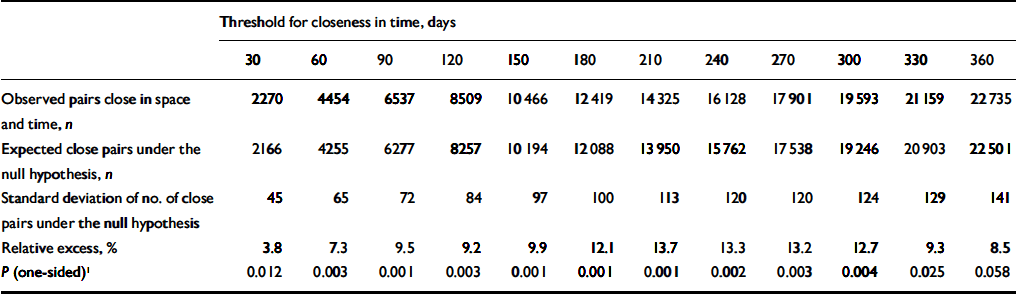
Space–time clustering and space–time–method clustering were tested for separately and the results are shown in Tables 2 and 3. Each table shows the total number of possible distinct pairs of suicides and the observed and expected numbers of close pairs for increasing thresholds of closeness in time. Significant space–time clustering (Table 2) and space–time–method clustering (Table 3) were found for time thresholds from 30 to 360 days.
Tests for space–time clustering based on 2741 suicides in 105 trusts over 1330 days. There were 3 755170 possible distinct suicide pairs
| Threshold for closeness in time, days | ||||||||||||
|---|---|---|---|---|---|---|---|---|---|---|---|---|
| 30 | 60 | 90 | 120 | 150 | 180 | 210 | 240 | 270 | 300 | 330 | 360 | |
| Observed pairs close in space and time, n | 2270 | 4454 | 6537 | 8509 | 10 466 | 12 419 | 14 325 | 16 128 | 17 901 | 19 593 | 21 159 | 22 735 |
| Expected close pairs under the null hypothesis, n | 2166 | 4255 | 6277 | 8257 | 10 194 | 12 088 | 13 950 | 15 762 | 17 538 | 19 246 | 20 903 | 22 501 |
| Standard deviation of no. of close pairs under the null hypothesis | 45 | 65 | 72 | 84 | 97 | 100 | 113 | 120 | 120 | 124 | 129 | 141 |
| Relative excess, % | 3.8 | 7.3 | 9.5 | 9.2 | 9.9 | 12.1 | 13.7 | 13.3 | 13.2 | 12.7 | 9.3 | 8.5 |
| P (one-sided)1 | 0.012 | 0.003 | 0.001 | 0.003 | 0.001 | 0.001 | 0.001 | 0.002 | 0.003 | 0.004 | 0.025 | 0.058 |
Tests for space–time–method clustering based on 2562 suicides in 105 trusts over 1330 days. There were 3 280 641 possible distinct suicide pairs

| Threshold for closeness in time, days | ||||||||||||
|---|---|---|---|---|---|---|---|---|---|---|---|---|
| 30 | 60 | 90 | 120 | 150 | 180 | 210 | 240 | 270 | 300 | 330 | 360 | |
| Observed pairs close in space, time and method, n | 552 | 1054 | 1512 | 1977 | 2420 | 2903 | 3351 | 3783 | 4206 | 4627 | 4978 | 5310 |
| Expected close pairs under the null hypothesis, n | 483 | 951 | 1400 | 1838 | 2271 | 2694 | 3109 | 3512 | 3912 | 4294 | 4663 | 5020 |
| Standard deviation of no. of close pairs under the null hypothesis | 22 | 32 | 40 | 47 | 55 | 60 | 65 | 70 | 74 | 80 | 86 | 89 |
| Relative excess, % | 2.7 | 4.0 | 4.4 | 5.4 | 5.8 | 8.2 | 9.5 | 10.6 | 11.5 | 13.0 | 12.3 | 11.3 |
| P (one-sided)1 | 0.004 | 0.002 | 0.003 | 0.004 | 0.005 | 0.001 | 0.001 | 0.002 | 0.001 | 0.001 | 0.001 | 0.002 |
The relative excess pairs close in space and time (Table 2) provides an estimate of the suicide imitation rate and increases from 3.8% at 30 days to reach a maximum value of 13.7% at a 210-day time threshold. (The pattern of steady increase to a maximum value followed by decrease remained when values of relative excess pairs were calculated for delay times <30 days and >360 days.) Assuming that imitative suicide is the sole reason for space–time clustering and such suicides occur in the same trust as the index cases, the maximum delay between an index case and an imitative case can be estimated as in the region of 6–9 months. A model simulation with a maximum imitation delay of 7 months gave an estimation of 13.3% (95% CI 3–22) for imitative suicides as a percentage of all suicides that copy the act of suicide of an index case but not necessarily the method of the index case.
The relative excess pairs close in space, time and method (Table 3) reaches a maximum value of 13.0% at a 300-day time threshold. Assuming a true maximum delay of 10 months, the model simulation including method gave an estimation of 10.1% (95% CI 4–17) for imitative suicides as a percentage of all suicides that copy the act and method of suicide of an index case.
The clustering analysis was repeated using RMO as the space variable. The optimum study period was determined as 845 days, during which 328 RMOs reported 888 cases of suicide. Space–time clustering was again highly significant for time thresholds from 60 to 360 days. Space–time–method clustering did not reach significance, perhaps because reduced numbers limited the power to detect clustering. The relative excess pairs statistic reached a maximum value of 10.2% at a time threshold of 8 months.
DISCUSSION
We have found highly significant time–space and time–space–method clustering of suicides among people with mental illnesses who were in contact with mental health services or had been within 12 months of death. The clustering of suicides occurred over a 44-month period from June 1996 among patients of one of 105 mental health trusts distributed throughout the UK.
Imitation as cause of clustering
The observed clustering might have been caused by several factors operating singly or together. The first of these is imitation of suicidal behaviour. If this were the sole cause of the clustering, a model used to simulate the effect of imitation gave a possible effect size of about 10% (95% CI 4–17) of suicides imitating the method of and being close in time to an index case in the same trust. Imitations appear to build up in number steeply initially and then level off over a 7- to 10-month time scale.
Strengths of study
A strength of the study is the much larger numbers of cases and locations analysed than in previous studies, leading to greater statistical power to detect clustering. The methodology also has the advantage of being sensitive only to space–time or space–time–method interactions and so is not confounded by local differences in rates or method of suicide that do not change over the study period, or changes over time affecting all locations equally, such as seasonal variations (Reference PretiPreti, 2000; Reference Hakko, Rasanen and TiihonenHakko et al, 2002).
Other possible causes of observed clustering
A weakness of the study, shared by other studies of clustering, is that the evidence for imitative suicide is indirect and other causes for the observed clustering cannot be ruled out.
Quality of care or socio-economic conditions
A change in local factors, such as the quality of care or socio-economic conditions, that alters the suicide rate in some trusts but not others can result in time–space clustering. It is less plausible, however, that this mechanism on its own could also account for the observed space–time–method clustering of suicides. The time scale of about 9 months suggested by the analysis, with clustering also observed at time thresholds down to 30 days, seems too short for differential changes in the quality of care in trusts or other local factors affecting the suicide rate to have occurred.
Missing data
Systematic gaps in data collection can also give rise to apparent clustering. This possibility was minimised by including only trusts that identified a first case on or before the start of the study period and a last case on or after the last day, thereby ensuring as far as possible that the trusts had systems in place for reporting during the whole of the study period. Trusts that merged during the study period were excluded, thereby eliminating possible gaps in reporting caused by changes in management structure after a merger. In addition the NCI conducted an audit of the accuracy of reporting by trusts and found a 97% identification rate of cases (Reference Appleby, Shaw and AmosAppleby et al, 1999).
Coroners'courts
Variations over time between coroners’ courts in identifying suicides and cause of death could also cause apparent clustering. It seems unlikely, however, that there could have been sufficient variation between coroners’ courts in identifying cases on the timescale suggested by the data.
Findings from previous studies
Support for imitation as an explanation of the observed clustering of suicides among people in contact with mental health services is given by studies which have explored imitation of suicidal behaviour in the general population. It seems likely that imitation would occur to an equal or greater degree among people with mental illnesses. Various mechanisms have been proposed: low mood and low self-esteem may render an individual less able to resist copying a behaviour that seems to offer a way out. Of three previous quantitative studies of clustering of suicides among those with mental illnesses only one found significant clustering (Reference HawHaw, 1994) although two found clinical evidence suggesting that imitation had occurred (Reference Modestin and WürmleModestin & Würmle, 1989; Reference Taiminen and HeleniusTaiminen & Helenius, 1994). The latter studies may have had sample sizes that were too small to detect clustering that was present.
Conclusion
If imitation is implicated as a causal factor in a significant percentage of suicides, it will be important to consider how best to reduce its impact as part of a drive to cut the national suicide rate among people with mental illnesses (Department of Health, 2002). Suggestions for prevention of suicide ‘epidemics’ were made by Rissmiller & Rissmiller (Reference Rissmiller and Rissmiller1990) but more research is required to identify effective strategies, and parallel efforts should be made to raise mental health professionals’ awareness of this phenomenon.
DATA SUPPLEMENT 1
Derivation of the excess pair statistic as an underestimate of the number of imitative suicides
We assume a suicide imitation model:
-
• A1 imitation is the sole reason for space–time interaction in suicide rates;
-
• A2 imitative suicides imitative suicides occur within the same space unit as the index case;
-
• A3 imitative suicides occur with a maximum delay time, T, equal to the time threshold chosen to define closeness in time;
-
• A4 the imitation process is such that each imitation causes only one close pair.
Assumption A4 that an index case gives rise to only one imitative case is an approximation. However, for the observed imitation rate of about 10%, the probability of an index case giving rise to two or more imitations decreases rapidly with the number of imitative cases.
A suicide can be classified as either imitative or spontaneous, where spontaneous suicides occur purely by chance.
By assumptions A1 to A3, pairs of cases can be close in time and space either: (1) as a result of imitation (such pairs consist of an imitative suicide and its index case) or (2) by chance.
The expected number of close pairs P is given by:

where P (i) is the expected number of close pairs in category i ∈ {1,2}.
The observed number of pairs that are close in space and time, O, is an unbiased estimate of the theoretical quantity P.
The mean number of close pairs of the permutation distribution, E, resulting from the Mantel procedure carried out with the whole sample size, n, is an estimate of the number of close pairs expected by chance under the independence model. Provided imitative suicides are rare, E can be considered an estimate of P (2), that is the number of close pairs expected by chance under the suicide imitation model. However, in this case the estimator suffers from upwards bias since the Mantel procedure counts all close pairs, including those from permutations that allocate imitative cases close in space and time to their respective index cases.
Owing to assumption A4, the number of close pairs due duetoimitationis, to imitation is, in fact, the number of imitative suicides in the sample, s. Thus P (1) = s and a downwards-biased estimate of s is given by the excess pairs statistic

Similarly the suicide rate s/n can be estimated by the relative excess pairs statistic

DATA SUPPLEMENT 2
A suicide imitation model that maintains the marginal distributions
The model described below enables values of the test statistic (number of close pairs) to be simulated for a range of imitation rates to generate a distribution under the model. The suicide rate is estimated by the rate of the model that fits the observed value of the test statistic most closely (i.e. the mean simulated value under the model is nearest the observed value). There were 200 simulations for each imitation rate. The limits of a 95% CI are found by determining the smallest (largest) rate under which at least 2.5% of the simulated values were above (below) or equal to the observed value of the test statistic.
With assumptions A1 to A3 from Appendix 1, the following algorithm generates a set of suicide locations and times for n cases that are consistent with the specified model and maintain the observed marginal distributions of suicide time and location.
-
(a) Let S denote the set of observed space units. This set contains a space unit as many times as the number of suicides that occurred in the space unit.
-
(b) Define a set of n suicide identities I that contains pn ones (imitative suicides) and (1 – p)n zeroes (spontaneous suicides).
-
(c) Order the observed suicide times and stepwise allocate a suicide space unit to each time, starting with the smallest time. Allocate a space unit as follows to the ith smallest time:
-
(i) pick a suicide identity at random from I;
-
(ii) if the identity is a spontaneous suicide pick a space unit at random from S;
-
(iii) if the identity is an imitative suicide take the subset of units in S which have previously been allocated to suicide times not more than T days ago provided another instance of the space unit remains unallocated in S; give each space unit in the subset a selection probability which is inversely proportional to the time passed since the last suicide in the same location; select a space unit for the imitative suicide according to the given probabilities;
-
(iv) take the selected identity out of I and the selected space unit out of S;
-
(v) iterate through the ordered suicide times until the sets I and S are depleted.
-
The set of n cases was chosen as the set of observed cases within the selected study period. A run-in period had to be specified during which suicide times, locations and methods remained fixed to ensure that there were index cases available for imitation at the start. The chosen run-in period was T days prior to the start of the study period.
The procedure was extended to accommodate the additional assumption that an imitative suicide employs the same method as the index case. A set M of methods is defined containing each method as often as it has been observed. A spontaneous case is allocated a method at random without replacement. If, following the procedure above, the selected identity specifies an imitative suicide and a spatial location has been selected, the method is chosen to be that previously allocated to this space unit. Should the method no longer be available in the set of methods, the choice of space unit (and associated index case) is discarded and a new space unit chosen until a match is found.
Clinical Implications and Limitations
CLINICAL IMPLICATIONS
-
▪ Imitative suicide probably occurs among those with mental illness and may account for about10% of suicides.
-
▪ Mental health professionals should be aware of the risk of imitative behaviour after a death by suicide.
-
▪ More research is needed on ways to reduce the risk of imitative suicide.
LIMITATIONS
-
▪ Factors other than imitation cannot be ruled out as a cause of the observed clustering of suicides.
-
▪ News of an index suicide may not have reached all members of the group considered at risk in the analysis.
-
▪ The sample was restricted to suicides in smaller trusts that had not merged into large units.




eLetters
No eLetters have been published for this article.