

Introduction
I undertook a research project into teaching Latin language and Roman culture at a 7th grade class (students were aged 13-14 years), due to my intention to make my students aware of the usefulness of this subject in everyday life. In Romania, Latin is compulsory in the 7th grade and in high school, only if the students choose a humanities program. There is no exam that they must pass at the end of the school year, but they just need a minimum of two grades per semester. The student's work is evaluated and expressed numerically on a scale from 1 to 10. The new curriculum for Latin developed in 2017 presents signs of change compared to the previous one as it focuses on a more interdisciplinary and transdisciplinary approach, to facilitate for students an easy and flexible adaptation to the society of which they are part and to the European cultural context as Europe and Romania have Roman influences (the voting system, the Senate, the architecture etc.). This interdisciplinary approach entails a lack of disciplinary boundaries of the contents of Latin language and Roman culture. The implications of focusing on a transdisciplinary approach determine a teaching style which is focused on daily life and on the possible situations that the student may encounter: the students observe the influence of this discipline in contemporary times, such as architectural influences, the political system, in biology (as the scientific names of animals/plants/birds are in Latin), some names or sentences in films such as Harry Potter etc. According to the new curriculum, Roman culture is taught more than Latin language in terms of contents and time allotted.
I set out to see how teaching Latin based on activities as a journey from present to past would help the students to understand the world around them by making connections between contemporaneity and the Latin language and Roman culture. These principles are:
Designing the Latin classes as a journey from present to past. By building an approach to teaching Latin language and Roman culture from present to past, students will discover that ‘back’ actually means ‘forward’. At the beginning they start the classes with the idea that they will study the past, but they will see that they will discover the present: the Romanian language (the students’ mother tongue is a Romance language) and the modern languages that they study at school and the European culture as Romance languages (French, Spanish, Portuguese, Italian, Romanian) and other Germanic languages (English, Dutch) have many words from Latin. It is frequently said that Romanian and Latin are closely linked and it is true. In terms of vocabulary Romanian has more than 60% Latin words from the total number of words and in most cases the words are almost identical, and it is very hard to form a meaningful sentence without words from Latin. With a closer look at Table 1 below you will quickly find that the Latin words in Romanian can be categorised in words which are related to an urban lifestyle. This is because Dacia (almost today's territory of Romania before the Roman conquest) had a rural lifestyle and when the Romans conquered Dacia, its people got to know the urban lifestyle. Nowadays, the Romanian words that describes the rural lifestyle come from the Dacic language and the words that describe an urban lifestyle come from Latin:
Comparison of Romanian, Latin and English vocabulary

Table 2 shows how, in terms of grammar, the Romanian verb has four conjugations, just like Latin:
Integrated learning - valuing students' acquisitions in other disciplines, as well as in everyday life. Information should no longer be captured only within one discipline, but it can also be used in other disciplines. This approach entails a lack of disciplinary boundaries of the contents of Latin language and Roman culture. An integrated learning approach implies a teaching style focused on everyday life and on the possible situations that the student may encounter. This way the students observe the influence of this discipline in contemporary times. The aspects mentioned above helps on the formation of the student as an active citizen and one aware of his/her own identity. Through this approach of teaching Latin and Romance culture, at the level of contents, it is possible to relate to other subjects from different curricular areas (Mathematics, Science, Citizenship, Art and Design), not only to Languages, in order to show students the integrative nature of Latin language and Roman culture and the usefulness of it in everyday life.
Making connections between contemporaneity and Roman culture. The students should make comparisons or connections between their world and the Roman culture to gain a better understanding over the world they are living in. In the absence of comparisons between the world in which students live and the past, the study of Roman culture seems meaningless and useless. They must draw parallels to understand why the world in which they live has a constitution, why we can vote and why there is an institution in Romania called the Senat (like the Roman Senate), why there are roads and aqueducts (as the concepts of roads and aqueducts were brought into Dacia by the Romans).
Comparison of verb conjugations: Romanian and Latin

Literature Review
Learning Latin raises many negative opinions about its usefulness today in Romania among students and parents. Personally, I heard negative opinions from students that have not studied it yet they heard from older students that the subject does not help you in any way. Also, online there are some articles written in RomanianFootnote 1. These negative feelings towards the Latin language and Roman culture also spread among parents as they believe that a dead language would not help their children to become better at school in any other way, but more hours of a modern language would do. A dead language and a culture far too far from students’ reality and preferences seems a dusty subject from past times that no longer arouses interest in the student. Thus, the question arises whether it would not be better to replace something that is no longer of curiosity and interest with something much more useful and current. I don't think so! What should be replaced is the traditional way of teaching with another approach that helps students to see how they can use the Latin language and the knowledge about Roman culture in everyday life. The students’ lack of interest in Latin and the decline of this discipline's status in schools around the world are because of boring teaching methods that involve memorisation or are focused on the grammatical aspect and not at all on the presence of Roman culture and Latin language in contemporaneity; one of the biggest drawbacks is that Latin has come to mean only a sum of rules and exceptions (del Col, Reference del Col1998, 19). In Romania, the traditional teaching methods appear even in the students’ books made in accordance with the new curriculum where students have to fill in the blanks with the nouns in a certain grammatical case or with the proper form of a verbFootnote 2. Instead, I think that it will be better to analyse an inscription in Latin that can be found on a ruin in Italy or Roman ruins in Romania – something that the students may encounter in a trip or in a museum. Thus, the exaggerated importance given to grammar and the minimisation of Roman culture, but also of its presence in contemporaneity led to the perception among students that Latin is useless and that it seems more like a punishment than a way of understanding the present. In Latin Hoy, Jose Juan del Col (Reference del Col1998) presents possible directions with reference to what modern teaching of Latin and Roman culture should be. He states that everything that represents Roman culture cannot be reduced to classical values and traditions as it means also the modern European culture (del Col, Reference del Col1998, 78). Moreover, our way of thinking and looking at life is influenced by the Roman culture. This might be because there is a lack of coherence in terms of the aims of learning Latin and Roman culture and the methods by which the contents are taught: in class the emphasis is on translating from Latin into the mother tongue, comprehension questions based on a text in Latin and analysing speech while it is desired to highlight the interdisciplinary and integrative aspect of Latin (Hunt, Reference Hunt2016, 12). Through such a practice, which is often encountered in Latin classes, there is a gap between students and the Latin language and Roman culture, because the predominantly grammatical study does not show them how to use the information learnt in the class in everyday life, in other disciplines or to understand the world, and they do not know how knowledge about Roman culture would help them in real life. Moreover, students memorise conjugations and declensions by heart, but do not use them for anything specifically: the goal most often is to have success in class and nothing else (McGuiness, Reference McGuinness2014). I believe that Latin must be grammatically simplified and taught from the perspective of this language's influence on modern languages, but also the influence of Roman culture in contemporaneity should be taught. Thus, at the present time students must pay attention to the detail of the Latin language and memorise its contents, but it no longer corresponds to the current needs of students, the approach is inappropriate and inefficient, especially as they are using a lot of social media: today's students are digital natives – they are accustomed to be familiar with the latest news, gadgets and to get things easy and fast. So, the strategy in selecting the proper teaching methods for them is to take account of their preferences. This I did with an initial test and a short questionnaire, where I found what they knew about the Latin language and Roman culture, what they did not know, and what they wanted to know more about.
Class and Assignment
The research took place in a secondary school in Bucharest, the capital of Romania, during the 2020-2021 school year. I did the research at a 7th grade class as Romanian students have this subject in the secondary school for only one year and it is mandatory. The classes were exclusively online on Google Meet because of the COVID-19 pandemic. The activities themselves lasted almost three months. The students were at a medium and high level of attainment at school in terms of grades. Most of them participated in school competitions and most of them got financial scholarships for good grades and participation in student contests. In the class there were 30 students aged 13 to 14.
The context in which I decided to carry out this research was at first not favourable to the teaching of a classical language, because the students were very connected to what was happening around them and to everything that was new, and they encountered the presence of Latin and Roman culture in their schedule with great reluctance. This hesitation is supported by the fact that there is no continuity from secondary to high school in terms of studying this discipline in Romania – they have Latin in 7th grade and then from 9th grade to 12th grade, so during the one-year gap they forget almost everything which they have previously learned. There are two main reasons that made me carry out this research:
The students were reluctant to study Latin and they questioned the usefulness of this subject in everyday life. In their very first class, my students asked me the following questions: Why are we studying a language that nobody speaks it anymore? What's the point of it? How is studying a dead language going to help me in my everyday activities? All these questions came before I even started talking to them about this new discipline and about the opportunities brought by studying it. This reserved attitude towards the study of a classical language and culture is in fact a perspective received from the outside and internalised as an opinion. This starts from the image created in the online environment, through articles that argue the uselessness of such a subject in a school of the 21st century, invoking the arguments that the study of Latin is for those who want to do research and that students should learn only what they use in their daily lives, and Latin is considered only a remnant of a world too far from contemporaneity.
Lack of coherence between the learning goals in the Latin Curriculum for secondary schools and the methods by which the contents are taught. Most of the teachers still use a traditional approach, like translating Latin texts into Romanian, the mother tongue of the students. Also, the contents regarding Roman culture are just presented as it is, making no connections with the present.
My goals with this research were to make my students able to identify the cultural heritage of Ancient Rome in the following sections: language (the presence of Latin influence in Romanian and other Romance languages); culture (Greco-Roman pantheon, arts and literature); and to make connections between Roman culture and civilisation and the world in which they live in.
To measure results, I gave students a test before the activities to see what they knew about Latin language and Roman culture from other disciplines or from other sources. The test contained the following questions:
Have you seen movies about Romans / Roman personalities? If so, what is it called? / What was it about?
Choose the phrase that contains information about the Roman world known by you:
a) Caesar's death in the Senate following a plot;
b) Caesar's relationship with Cleopatra, queen of Egypt;
c) Romulus and Remus were raised by a she-wolf;
d) The Roman emperor had the right of life and death over gladiators;
e) In the Colosseum most of the fighting was between gladiators and between gladiators and animals.
Do you have a favourite Roman god? If so, what is it called?
Have you read any books / comics about Roman gods / personalities? Choose the images that represent aspects of the Roman world.
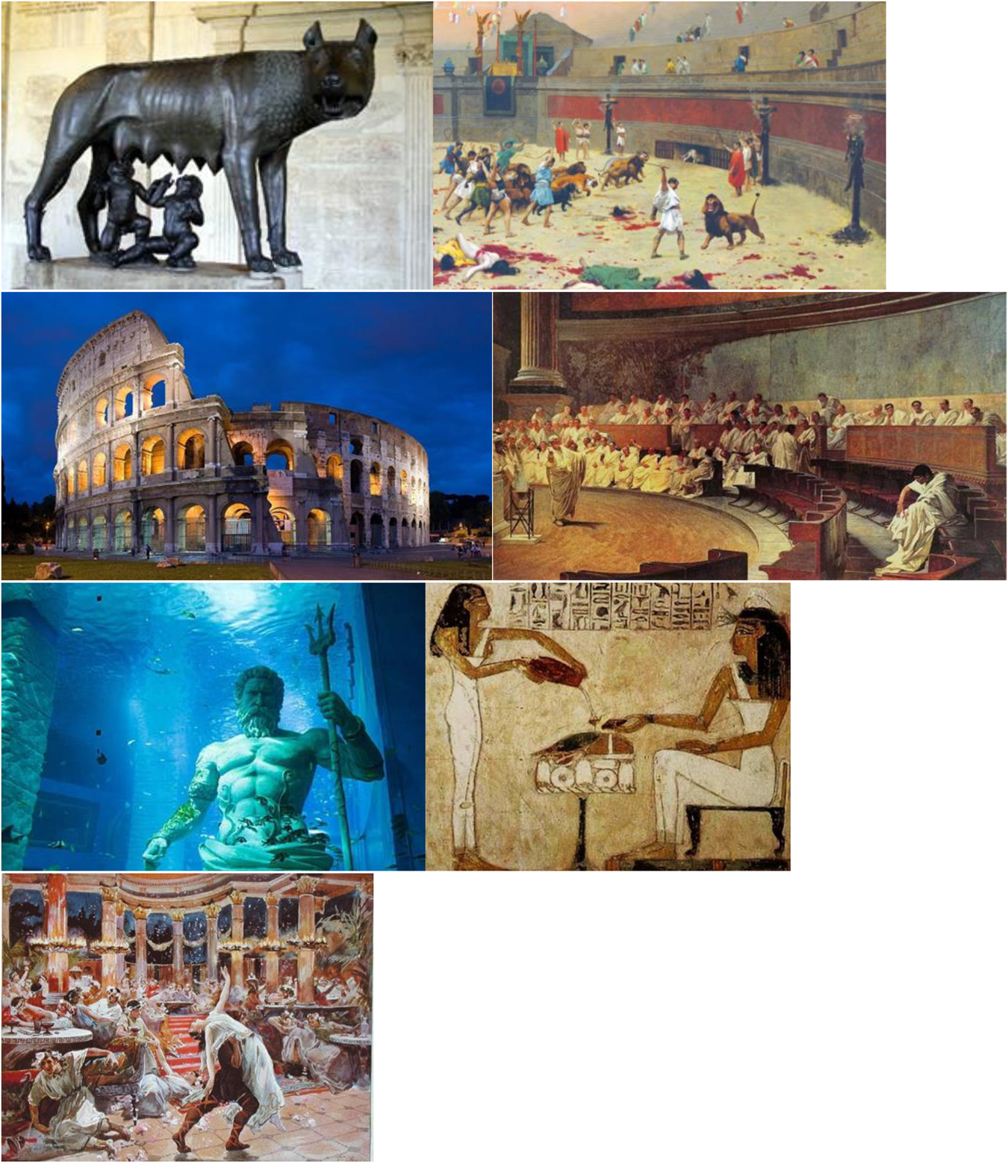
Which of the images below are related to the Roman world? (see Figure 1).
Choose an image above and specify what it refers to.
Circle the letter that has only Latin words that are still used today:
a) In vitro, non, urbe, barba, octo, index, ego, incipit, summa;
b) Sana, one, foot, ego, potato, chemistry, atom, glory, old man;
c) sum, cocoș, moș, incipit, viezure. (These are Dacic words, Latin words)
Choose a theme from the variants below or propose a different one yourself for a project:
Selection of images presented to students about the Roman world.
a.the life of the Romans (what they did on a typical day);
b.Roman gods;
c.the mentality of the Romans (how they thought, what values they had, etc.);
d.elements of Roman culture around us;
e. something else
After collecting the answers of all students to all the questions I created the activities/exercises/project according to the answer to the question ‘How will I do the research activities according to these answers?’ From my students’ answers I found out that they confuse Roman and Greek mythology; that they can identify Roman symbols or sculptures as they have seen them in movies, but that they do not know information about them; that they have not read any books or comics about Roman gods and personalities besides Legends of Olympus by Alexandru Mitru (a book about Greek mythology); and that the students did not differentiate between Latin words and words that do not come from Latin. I therefore carried out some language activities that involve the presence of Latin words in the contemporary world, and activities with Latin suffixes and prefixes that enter the composition of Romanian words.
At the end I felt I could use the project as an assessment method as it is a more complex method which can provide information about students' competencies and the progress they have made over a longer period.
Teaching Sequence
I introduced the activities after students had already been introduced to Latin language and Roman culture and after I observed that they found the subject useless for their development and were not engaged in the classroom activities as I had expected them to be. The activities focused on language and culture. The order I presented them to my students was based on my year plan, so I did not do the language activities first and then the activities about culture as I wanted my students to learn that language is not separate from culture, but that these two influence each other. Otherwise, students will start to prefer the language or the culture, based on their previous experience with modern languages, and they will not gain a better understanding of their world just by studying Latin or Roman culture on their own.
The first language activity was on the Wordwall appFootnote 3. I provided the students with the link to the game. They had to look carefully at the pictures and choose which Latin words were inherited in Romanian, matching each picture with the words related to it. This way, they establish the semantic fields to which the words of Latin origin inherited in Romanian belong. They had to choose the words based on the similarities between the Latin words and the Romanian ones (see Supplementary Appendix 1).
They did well in terms of relating Latin to Romanian words, based on the graphic similarity between them. But, some of them didn't chose the word malus as it in Romanian transformed into măr – I believe that they had a difficulty in choosing this word because of the consonantal alternation l/r (the majority of the Latin words ended in -US, lost it in Romanian and the last L in Latin transformed into R in the majority of cases malus – măr).
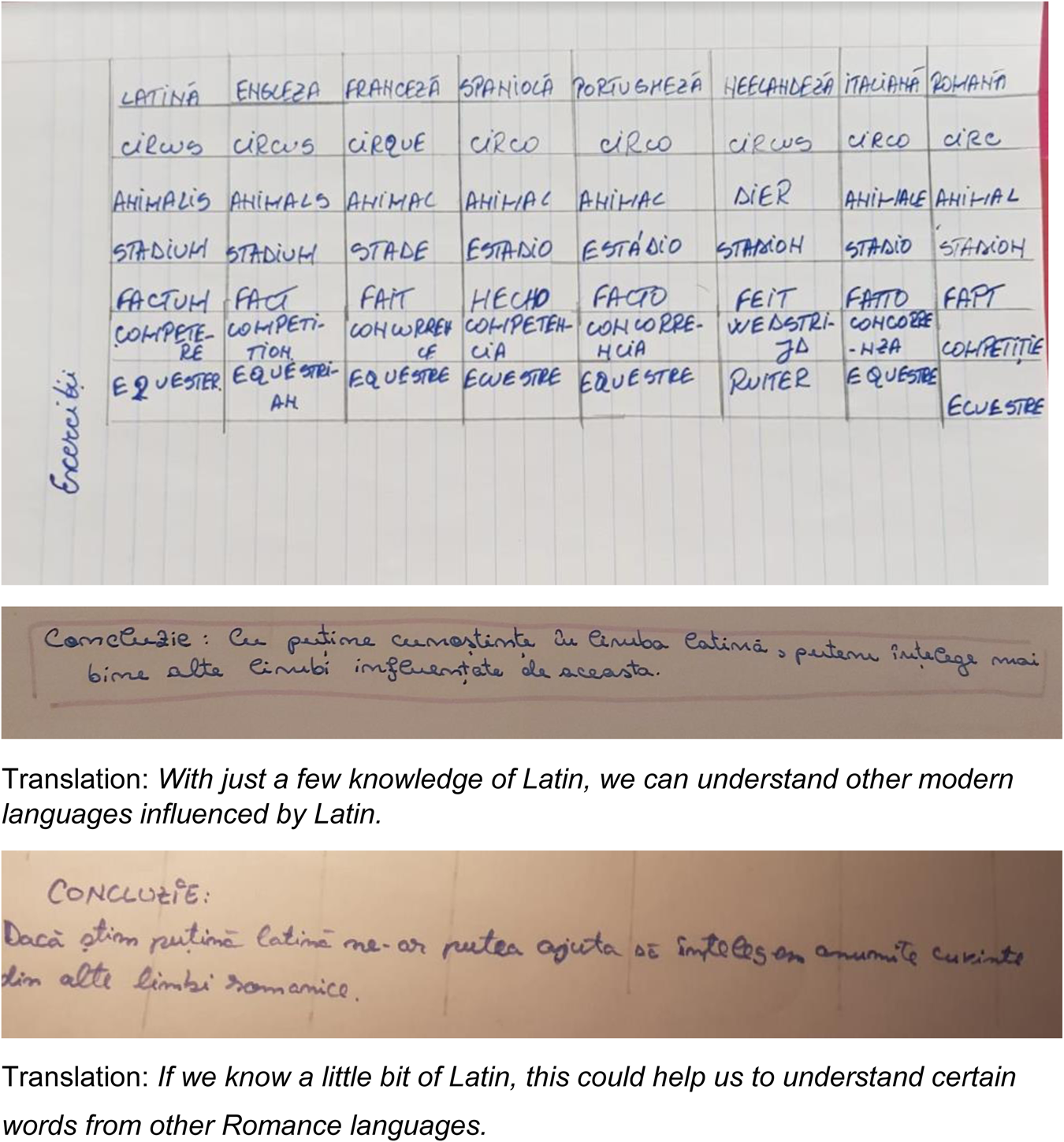
The next language activity was designed to show students that if they know a little bit of Latin language, they will be able to understand other Romance languages or modern languages that were influenced by Latin. I gave the students a small dialogue in Romanian and the translation of it in French, Spanish, Italian, Portuguese, English and Dutch. They had to find the corresponding words written in bold type in the Latin dialogue in the other languages and complete a table (see Figure 2). After this, the students had to answer to the following questions:
Latin language activity

What conclusion can you draw from this activity?
Why do you think you managed to figure out the meaning of some words even though you don't know those modern languages?
The students managed to identify the equivalent of the bold-type words in other languages. Here are some responses (Figure 3):
Student responses to Latin language activity
The other language activity ‘The story of Latin words’ focused on how Latin words evolved in their mother tongue. The students find more enjoyable a language activity if it seems different from a normal language activity like showing the evolution of a word through a story. The students have to write a story explaining the evolution of a Latin word in their mother tongue in terms of meaning and form. They had to choose from a given list.

The story can be written on the first person singular (to present the journey / adventures of a word from the perspective of that word, like the word would be the narrator) or on the third person singular. Here's an example (Figure 4):
Student response to ‘The story of Latin words’.

The first activity about culture is called ‘The Colosseum’. The students had to watch a 3D video about the ColosseumFootnote 4 and name a construction from Romania that they think has inherited many characteristics of the Colosseum (shape, size, purpose of construction, facilities, type of events which took place there, the people who performed the events, the audience, etc.). Then, they had to write down the name of this construction from Romania and to write down the similarities/differences between these two constructions. Here's a response of one of my students (Figure 5).
Student response to ‘Colosseum’ activity.

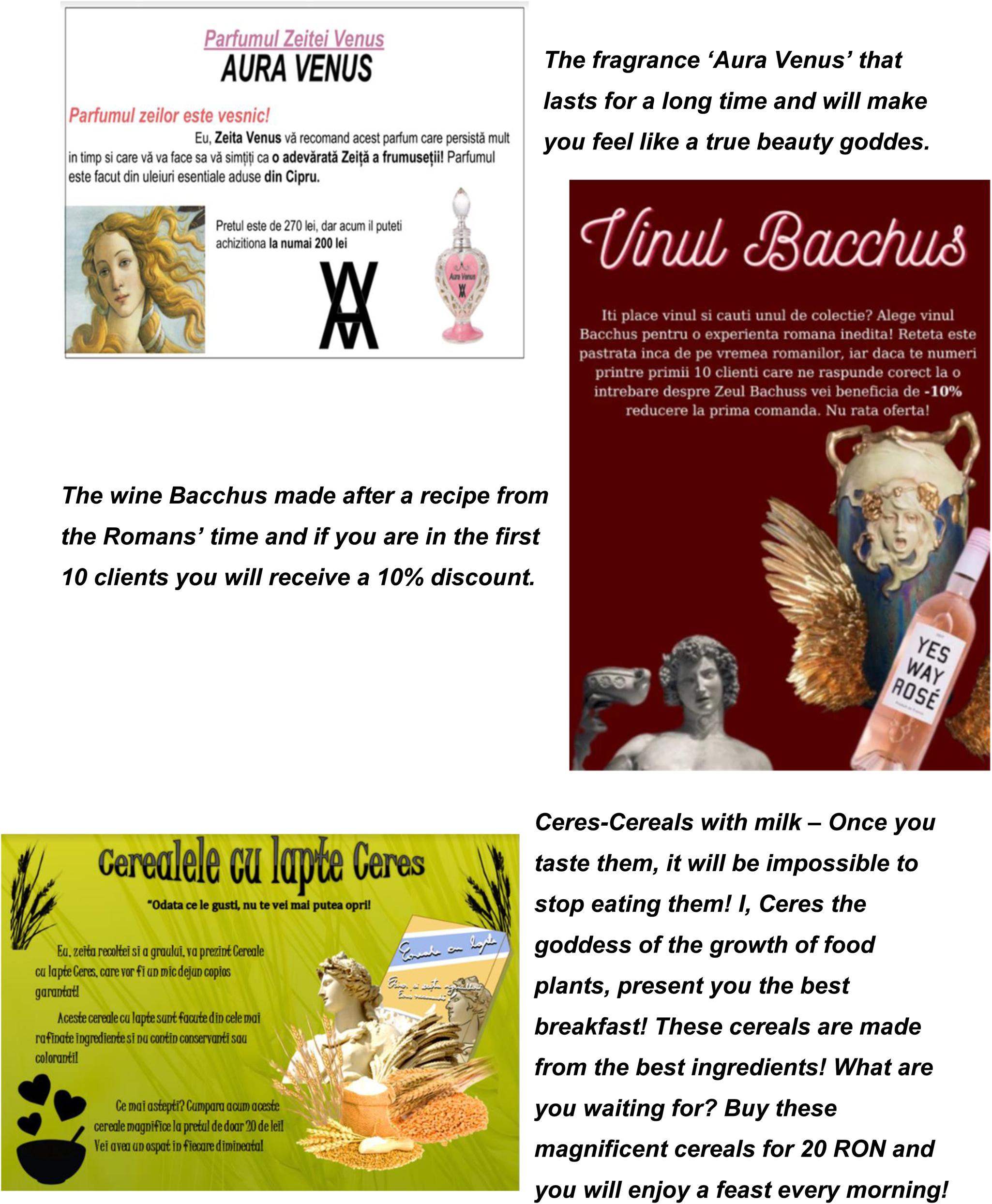
‘The Roman Gods endorse’ is the name of another culture activity. A lot of brands today use associations with the gods of Roman and Greek mythology to increase product sales. So, the students heard of Nike shoes, Pegasus bicycles, Hermes bags, Apollo metal products and so on. It was a great opportunity for them to learn more about the gods and to use this knowledge in everyday life for example to make a commercial. For this one, the students had to advertise a product promoted by a god from Roman mythology. The advertisement took various forms: a poster or a short video. The promoted product must be closely related to the god (eg Neptunus -a ship cruise, an underwater hotel etc.; Venus - make-up, fragrance, clothes etc.). The advertisement had to contain the product name, a short text about the product, a picture with the product and one of the chosen deity, and a slogan. Here are some commercials made by my students (Figure 6):
Student responses to ‘The Roman gods endorse’ activity.
The students, sometimes, find reading boring as it doesn't have anything that can stimulate them visually, so a comic strip would be just great for them. So, for the next activity, students had to watch animated videos about everyday life in Rome and make a comic strip with the title ‘A Day in the life of a Roman teenager/gladiator /emperor/slave/politician/businessman etc.’ Then, they will have to make comparisons between the life back in Ancient Rome and the contemporary times. Here's an example of one of my students - the comic was about a day in the life of a Roman woman (Figure 7).
Student response to ‘A Day in the Life’ activity.

The final form of assessment was a project about ‘How present is the Roman culture in today's world?’ My advice for my students to get this project done was to get out of the house and look at the world around you and the community in which you live! If you find things or aspects that have been influenced by Roman culture, name them, add a picture with them and write some sentences about the connection with Roman culture.
Before they started to do the project, I had presented some aspects on how Roman culture influenced the present and still exists around us. Then, I gave some relevant examples to the students on how this project should be carried out. Initially, all the projects should have been posted in the Padlet application, and students will be able to take a virtual ‘gallery tour’, but the students returned to school, and they didn't have online classes, so everyone presented the project in front of their colleagues. Examples can be found in Supplementary Index 2.
Another activity about culture was called ‘The Facebook Profile of a Roman Personality’. The students had to imagine that they were friends with a Roman personality whom they had studied in the Latin class and they asked for their help in building a Facebook profile. They had to draw the Facebook profile on a white paper or enter the Fakebook application on the www.classtools.net platform. The profile must contain the following aspects: the name of the personality, a picture of his/her face (optional), residence, place of work, studies, hobbies, qualities and flaws, friends and a post in which to say something that the chosen personality would think of (a quote or phrase, a song, a video, etc.) Then, everyone had to read the Facebook profile information without specifying the name, and the colleagues had to guess the personality based on the description provided. The did very well at this activity and I have notice that they did complex research about the life of the chosen Roman personality and enjoyed to guess the personalities chosen by their colleagues. Examples can be found in Supplementary Appendix 3.
‘The Gods – then and now’ (an application based on the novel The Lightning Thief by Rick Riordan) is another culture activity. The gods of Greek and Roman mythology are not just higher beings covered by the passage of time with a layer of dust: they can even become our contemporaries just like in Rick Riordan's book The Lightning Thief. The students had to read through Percy Jackson's adventure in search of lightning, then to find the characters in the book that corresponded with the Greek gods, specifying the field/power, at least one physical characteristic, at least one moral characteristic, and at least one specific symbol for each. Optionally, they could draw both the god from Greek mythology and the character in the book as they imagined them. Examples can found in Supplementary Appendix 4.
This specific activity was very catchy for my students as they found out a lot of information about Greek gods that are similar to the Roman ones, as only the name differs, through some characters (teachers, teenagers, mystical creatures) how a god would look and act like today. Before reading this book, my students only read legends about Greek and Roman gods and they confessed that they never imagined about how a god would be in their times.
Results
In the completed activities, students struggled with the first language activity where day had to do connections between the Latin language and their mother tongue. After this activity they started to make connections or comparisons more easily. This fact is due to the lack of activities where they had to find similarities or differences between two things.
I noticed that the students made clear and reasoned connections between elements of Roman culture and the world in which they live for the final assessment. They can also nuance the answers they provide depending on how great the similarity or difference between the compared elements is.
The activities took place over a relatively long period, so the students had the necessary time to internalise the contents of Latin language and Greco-Roman culture and to constantly use the connections between the world in which they live and what was in the past. This way, students become aware that the information about the Latin language and Roman culture can prove its practical utility in everyday life and in other disciplines if you manage to find bridges between what is around you now and what was long ago.
Conclusion
After reviewing the results, I analysed and interpreted the students’ products following the activities. I could draw the following conclusions: students' reluctance towards language and culture content can be dispelled by using animated videos and images (paintings, sculptures, etc.); language activities are more attractive if they are presented in the form of comparisons with Romanian or other modern languages; language contents are more easily studied by students if they are taught in an integrative manner, such as the presentation of a language fact in the form of a story written by students; I noticed that when students are involved in creative and artistic activities (drawing), they make relevant works appropriate to the topic received, proving rigour. Also, I noticed that the students made clear and reasoned connections between elements of Roman culture and the world in which they live. They can also nuance the answers they provide depending on how great the similarity or difference between the compared elements is. An integrative learning approach in teaching Latin language and Roman culture, as we observed during the research, can increase the students’ interest and level of involvement in activities and, implicitly, stimulates an in-depth knowledge of the discipline.
Reflection
From the results, I believe that students get engaged in Latin classes if they learn how they can use all the information in everyday life and to understand the world they are living in. Also, this didactic path could be applied in the classes of other disciplines because today's students are digitally native and very well anchored in the present, so they must always know the practical usefulness of what they are learning. In my future activities with students, I will consider the integrative aspect at the level of the same discipline because I have noticed that the students tend to be interested in one aspect of the discipline (language or culture) and not really engaged in the other one.
Amalia-Elena Gheorghe been teaching Latin language and Roman culture for two years in Romania in four schools. Now she teaches at the Secondary School nr. 97 and the Secondary School nr. 129 in Bucharest. She has a Bachelor's degree in Philology and a Master's degree in Didactics of philological disciplines/subjects.
Supplementary material
The supplementary material for this article can be found at https://doi.org/10.1017/S2058631022000113


 Open access

