Introduction
Death attributed to cardiovascular events is considered preventable or avoidable cause of death. In 2010, >80 000 deaths in the United Kingdom were attributed to ischemic heart disease (Nowbar et al., Reference Nowbar, Howard, Finegold, Asaria and Francis2014). In the same year, mortality data from the National Vital Statistics System in the United States showed that >200 000 avoidable deaths from heart disease, stroke and hypertensive disease occurred. The later report enforced the importance of controlling cardiovascular risk factors and clinical preventive strategies such as aspirin use when appropriate, blood pressure control, cholesterol management, smoking cessation, and low sodium, trans fat-free diet (Centers for Disease Control and Prevention, 2013).
Controlling cardiovascular risk factors was associated with substantial decrease in the incidence of cardiovascular disease (CVD) in various ages and in both genders (Lloyd-Jones et al., Reference Lloyd-Jones, Leip, Larson, D’Agostino, Beiser, Wilson, Wolf and Levy2006; Robinson et al., Reference Robinson, Rahilly-Tierney, Lawler and Gaziano2012). In a study evaluating Physicians’ Health Study participants, 4182 male participants were enrolled with a mean age of >73 years. The study evaluated the relationship between controlling four modifiable risk factors and primary prevention of CVD; the risk factors studied were smoking, non-high-density lipoprotein cholesterol, blood pressure and aspirin use. After a follow-up period of a mean of 9.3 years the study found that when comparing the participants who controlled the four risk factors with participants who did not control any, the risk for CVD was almost quadrupled (0.4% of participants; event rate 41.2%; HR 3.83, 95% CI 1.72–8.55). It also found that greater cardiovascular protection was associated with the control of each additional cardiovascular risk factor (Robinson et al., Reference Robinson, Rahilly-Tierney, Lawler and Gaziano2012).
The third Behavioral Risk Factor Surveillance Survey conducted by Jordan Ministry of Health investigated the prevalence of selected non-communicable diseases risk factors in Jordan including cigarettes smoking, high blood pressure and high blood cholesterol. Physical activity and dietary intake were also investigated. The results showed that among 3654 adults interviewed 29.0% were smokers, 38% participated in moderate physical activity and only 17% consumed five or more servings of fruit and vegetables per day. The study also evaluated 765 participants medically and found that 30.5% were overweight and 36.0% were obese, and among the same population 20.7% were found to have high blood pressure, 29.8% were on high blood pressure medications, 10.0% had high blood cholesterol (⩾6.22 mmol/L) and 13.9% were on lipid-lowering agents (Al-Nsour et al., Reference Al-Nsour, Zindah, Belbeisi, Hadaddin, Brown and Walke2012).
The American College of Cardiology Foundation and the American Heart Association developed performance measurement sets to assess the quality of care for CVD in several areas, such as chronic heart failure, chronic stable coronary artery disease, hypertension, primary prevention of CVD and others. The main purposes of these sets are quality improvement and accountability. One of the areas studied by the American College of Cardiology Foundation/the American Heart Association Writing Committee is primary prevention of CVD. The Writing Committee specified 13 measures for primary prevention of CVD; 11 are suitable for public reporting. The 11 performance measures are lifestyle/risk factor screening, dietary intake counseling, physical activity counseling, smoking/tobacco use, smoking/tobacco use cessation, weight/adiposity assessment, weight management, blood pressure measurement, blood pressure control, blood lipid measurement, and blood lipid therapy and control (Redberg et al., Reference Redberg, Benjamin, Bittner, Braun, Goff, Havas, Labarthe, Limacher, Lloyd-Jones, Mora, Pearson, Radford, Smetana, Spertus and Swegler2009).
The objective of this study was to assess primary prevention of CVD in a primary care setting in Jordan. We aimed to improve quality of medical care provided to patients in Jordan by drawing physicians’, pharmacists’ and other healthcare providers’ attention to the level of primary prevention of CVD provided.
Methods
The study was conducted at Jordan University of Science and Technology Healthcare Center. Physicians working in the healthcare center are family physicians and family medicine residents.
Adult patients (18 years and older) without clinical CVD, who attended the Healthcare Center at least twice in the past year were approached by a research assistant and asked to participate in this study. Those who agreed to participate had the research goals and methods explained to them.
A questionnaire was adapted from Redberg et al. (Reference Redberg, Benjamin, Bittner, Braun, Goff, Havas, Labarthe, Limacher, Lloyd-Jones, Mora, Pearson, Radford, Smetana, Spertus and Swegler2009); the questionnaire included questions about demographics, relevant clinical characteristics and the 11 performance measures specified by the American College of Cardiology Foundation/the American Heart Association Writing Committee to be assessed for primary prevention of CVD. The performance measures are lifestyle/risk factor screening, dietary intake counseling, physical activity counseling, smoking/tobacco use, smoking/tobacco use cessation, weight/adiposity assessment, weight management, blood pressure measurement, blood pressure control, blood lipid measurement, and blood lipid therapy and control.
A research assistant, who was trained to conduct interviews and administer questionnaires, interviewed patients who gave their consent. Data collection for the primary prevention of CVD measures were gathered prospectively by performing face-to-face interviews with participants and retrospectively by reviewing medical records. Patients’ information including gender, age, weight and height, as well as history of hypertension, diabetes mellitus and family history of congestive heart disease were collected prospectively by interviewing patients.
In an attempt to improve clarity and limit response bias, the data collection form was piloted before the study in a small sample; necessary modifications were made.
The study methodology was approved by the Institutional Review Board at Jordan University of Science and Technology (research number 87/2014) on 2 April 2014.
Data analysis
Statistical Package for Social Sciences (version 16.0) software was used to analyze the data. Data are described using frequency distribution.
Results
Data collection was conducted from May to June 2014. A total of 242 patients were approached, 224 patients agreed to participate in the study and were interviewed, and the response rate was 92.6%.
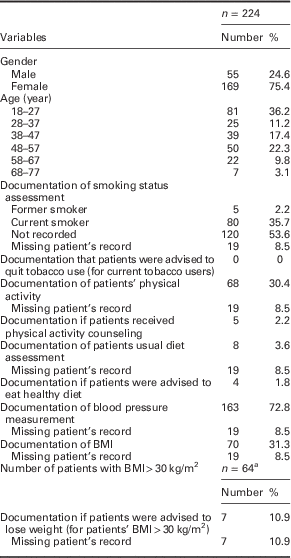
Respondents’ demographics and documentation of cardiovascular risk factors assessment are shown in Table 1. In all, 80 patients (35.7%) are current tobacco smokers and 0% documented to be advised to quit tobacco use. Physical activity was documented for 68 patients (30.4%) and diet assessment was documented for eight patients (3.6%).
Demographics and documentation of cardiovascular risk factors assessment

BMI=body mass index
a As reported by patients
Table 2 states cardiovascular risk factors assessment according to patients’ responses. Physical activity was assessed in 84 patients (37.5%) and diet was assessed in 68 patients (30.4%).
Cardiovascular risk factors assessment according to patients’ responses
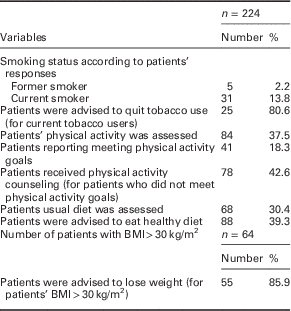
BMI=body mass index
Data concerning blood pressure control, blood lipid measurement, and blood lipid therapy and control are summarized in Table 3. The majority of hypertensive patients (95.9%) had a blood pressure reading at their most recent visit of ⩽140/90 or was prescribed ⩾2 antihypertensive medications.
Documentation of blood pressure control and fasting lipid profileFootnote a
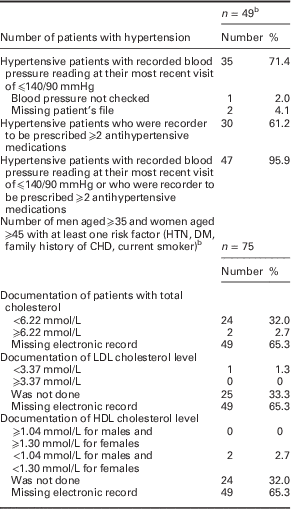
HTN=hypertension; DM=diabetes mellitus; CHD=congestive heart disease; LDL=low-density lipoprotein cholesterol; HDL=high-density lipoprotein cholesterol
a Fasting lipid profile is for men aged 35 and more and women aged 45 and over with at least one risk factor
b As reported by patients
Discussion
This study was first of its kind in Jordan to investigate the extent of documenting risk factors for primary prevention of CVDs. Identification of CVD risk factors is considered a crucial step in preventing CVDs. Initially, clinicians should assess presence of different risk factors through targeted medical history, physical examination and laboratory testing. In the second step, clinicians need to discuss such risk factors with patients and make pharmacological and non-pharmacological interventions in order to delay or prevent CVDs (Shah, Reference Shah2012). The results of this study showed a suboptimal documentation of CVD risk factors. However, when patients were asked if they were screened for risk factors such as smoking status, and other lifestyle issues such as diet and exercise, it was found that physicians did ask patients about them and in many instances educated patients about healthy lifestyle. It is fair to say that screening for CVD risk factors was done more than documented. This may be contributed to many factors such as work load, physicians’ beliefs of insignificance of documenting risk factors or physicians concentrating more on secondary prevention of CVDs.
In a similar study, electronic records of 1680 patients who attended primary care settings in New Zealand were analyzed. The study objective was to investigate the extent of primary care documentation of cardiovascular risk factors. The study found that the proportions of records with risk factors documented were as follows: blood pressure, 81.8%; cholesterol, 62.4%; and smoking status, 41.5% (Rafter et al., Reference Rafter, Wells, Stewart, Selak, Whittaker, Bramley, Roseman, Furness and Jackson2008). The results are similar to our study, where blood pressure documentation is the highest (72.8%).
Previously published studies showed that hypertension control in Jordan is below optimal level (Jaddou et al., Reference Jaddou, Bateiha and Ajlouni2000; Reference Jaddou, Batieha, Khader, Kanaan, El-Khateeb and Ajlouni2011). Interestingly, the majority of hypertensive patients in this study were controlled, this can be due to the high blood pressure assessment rate (72.8%). As discussed earlier, identification of risk factors will help eliminate or control risk factors. Other healthcare institutions in Jordan are encouraged to copy this healthcare facility experience, which is expected to improve blood pressure control. However, why blood pressure assessment was higher than smoking status and diet assessment is not clear. Physicians in this facility may be more competent in blood pressure measurement and treatment of high blood pressure compared with smoking cessation techniques and diet counseling.
The present study showed that level of physical activity, diet and weight assessment, and smoking cessation counseling provided was inadequate. Obesity, hypertension, hyperlipidemia and diabetes are major public health concerns in Jordan (Al-Nsour et al., Reference Al-Nsour, Zindah, Belbeisi, Hadaddin, Brown and Walke2012), which necessitates health authorities to encourage risk factor assessment, health promotion and disease prevention. Looking at other countries experiences can improve the current situation. For example, in the United Kingdom, an incentive program, ‘The Quality and Outcomes Framework,’ was applied to reward good practice through a scoring system. If similar incentive programs are applied in Jordan we expect quality of care to improve, which includes assessing and management of CVD risk factor (Lester and Campbell, Reference Lester and Campbell2010). In the United Kingdom also software that identifies individuals at risk of CVD was applied to data from a population aged 50 years and over. Similar software can be applied in primary care settings in Jordan, which can assist healthcare providers in assessing CVD risk factors (Holt et al., Reference Holt, Thorogood, Griffiths, Munday and Stables2008). Other example is the New Zealand cardiovascular risk initiatives, which focused on four areas to encourage systemic documentation of risk factors. First area concentrated on increasing patients’ awareness of cardiovascular risks. The second area focused on training healthcare providers to use computer software for risk factors documentation, whereas the third area focused on providing administrative tools that facilitates developing information culture. Finally, financial incentives for collecting and documenting risk factors were provided (Rafter et al., Reference Rafter, Wells, Stewart, Selak, Whittaker, Bramley, Roseman, Furness and Jackson2008). These four areas can be applied in Jordan in order to encourage risk factors assessment and documentation to promote primary prevention.
The results of the study should be considered within the context of its limitations. Limitations include incomplete documentation in patients’ records and recall bias in patients’ responses. Number of women was higher than men. In addition, the primary healthcare center where the study was conducted started electronic records documentation for laboratory findings, consequently and due to this transitional period 49 patients’ lipid profiles could not be found.
In conclusion, documentation of CVD risk factors assessment was suboptimal. However, blood pressure control was high. Healthcare providers should be encouraged to assess and document CVD risk factors and work in concordance with patients in order to control risk factors. Opportunities exist for health authorities to develop and implement information culture to improve documentation of risk factors and encourage the collaborative and continued effort between clinicians to prevent CVD.
Acknowledgments
The authors would like to thank Dr Nada A. Yasein for her assistance. All authors have read and approved submission of the manuscript.
Financial Support
This study was supported by a grant from the Deanship of Scientific Research, Jordan University of Science and Technology, Irbid, Jordan.
Conflicts of Interest
The authors report no conflicts of interest.