

On October 9, 1967, just before their departure from Beijing to Inner Mongolia, a group of ten students from the Beijing Number 25 High School congregated in front of a picture of Chairman Mao at Tian’anmen Square. Witnessed by a crowd of a thousand local residents, they swore allegiance to Mao, declaring,
For the great goal of spreading red Mao Zedong thought throughout the world, we would, if it were necessary, be willing to go up to the mountain of knives or down to the sea of fire. Following [Mao’s] great directive to integrate intellectuals with workers and peasants, we are taking the first step. We will go all the way on this revolutionary road and never look back.Footnote 1
This event, publicized through national radio stations and newspapers, generated enthusiasm throughout the country. By the end of 1967, official media reported that 4,000 high school graduates had left Beijing for the countryside, many more following the next spring.Footnote 2
In Shanghai, it was more than half a year later that idealistic students began to volunteer to go to the countryside. After several exploratory trips to Anhui and Heilongjiang in July 1968, the first delegation set off in August. “Farewell to the Huangpu River,” declared the Shanghai Jiefang ribao on August 12, 1968, announcing the departure of forty-five of “our city’s little soldiers” for remote mountain districts of China, where they would join village production teams. This contingent had secured the “glorious approval” of the Shanghai municipal government, which held a reception for them on the morning of their departure, praising them for their decision to go, and instructing them to closely study Chairman Mao’s works, learn from the poor and lower-middle peasants, and participate in both production and class struggle. As they prepared to board the train that evening, the station was brightly lit and adorned with red flags; drums beat as the “little soldiers” said goodbye to the 10 million citizens of Shanghai.Footnote 3
These voluntary departures of urban youth to the countryside took place in the context of the first years of the Cultural Revolution when, since its inception in summer 1966, student Red Guards in cities throughout China attacked educational, cultural, and administrative institutions, as well as individuals, including their own family members and teachers, whom they deemed to be counterrevolutionaries, or class enemies, or guilty of bourgeois thinking and habits. As with students from the Beijing Number 25 High School, Shanghai newspapers explained that the decision for urban youth to go to the countryside was a way of expressing their loyalty to Chairman Mao and the Chinese Communist Party as well as their commitment to revolutionary change.Footnote 4 The emergence of these volunteers culminated in the directive issued by Mao and publicized in the Renmin ribao on December 22, 1968, announcing, “It is necessary for educated youth to go to the countryside to receive re-education from the poor and lower-middle peasants,” and that “rural comrades throughout the country should welcome them.” This directive signified a turning point of the sent-down youth movement, shifting voluntary initiatives by a relatively few idealistic students to a state-led nationwide campaign.
Immediately after the announcement of Mao’s directive, the Shanghai municipal government announced its policy of “uniform redness” (yipianhong): all the 507,000 middle and high school graduates of 1968 and 1969, along with graduates of the previous two years who were still waiting for job assignments, would be sent to the countryside.Footnote 5 The practice of sending city youth to the countryside continued until 1978, some 1.1 million youth from Shanghai having been sent.Footnote 6 Over the course of the decade, these youth were assigned to village production brigades, state farms, or military farms. Persuading youth to go, transporting them, and settling them required an extensive mobilization campaign, as well as the creation of new administrative structures to manage the program.
This chapter focuses on the process of mobilizing Shanghai’s urban youth to go to the countryside, as well as responses to mobilization by youth themselves, their parents, and municipal government officials during the peak years of the movement in 1969 and 1970. During this time, the mobilization campaign aimed to achieve the goal of “uniform redness”: all the graduates were required to go to the countryside. Moreover, almost all were sent to production teams and state farms in places distant from Shanghai.
Mobilization
The mobilization of urban youth to go to the countryside had its origins in the mid-1950s, when a small number of idealistic and progressive youth volunteered to go to the countryside, and newspapers publicized model volunteers such as Dong Jiageng, Hou Jun, and Xing Yanzi.Footnote 7 Before the Cultural Revolution, the Shanghai government strongly encouraged “social youth” (shehui qingnian)—students who had not been admitted to high school or colleges and had not found employment—to go to the countryside.Footnote 8 By 1962, the central government formulated policies and established administrative offices for the resettlements. From 1955 to the beginning of the Cultural Revolution in 1966, the Shanghai government claimed that some 164,015 youth from the city were sent to the countryside.Footnote 9 In relation to the total Shanghai population, which was over six million in 1955 and nearly eleven million in 1966, this number, fewer than 15,000 per year, was small.Footnote 10 The effort to send youth to the countryside before the Cultural Revolution, therefore, affected a limited segment of Shanghai residents.
At the same time, however, this earlier phase of sending youth to the countryside is a significant backdrop to what took place during the movement’s reconfiguration and expansion during the Cultural Revolution. During the early months of the Cultural Revolution in 1966, a large contingent of youth sent to the countryside in the early 1960s returned to Shanghai and protested their assignment, demanding that the municipal government reinstate their urban residence permits. And in the unprecedented political opening afforded by the Cultural Revolution, many of the youth returning to the city formed their own rebel groups.Footnote 11 This meant that many sectors of the Shanghai population became well aware of the hardships endured by the earlier contingent of sent-down youth.
The sent-down youth movement of the Cultural Revolution, therefore, was not an entirely new phenomenon, even if it was instituted in a completely different context than the earlier movement. The dislocation of the first years of the Cultural Revolution, particularly the disruption to schools and factories, caused the problem of unemployment in Shanghai to reach an unprecedented level.Footnote 12 Red Guard attacks on schools resulted in the closure of all academic institutions above middle school. Students graduating from middle school, starting in 1966, could not be admitted to high schools; those graduating from high school could not go on to colleges or universities. There was also a scarcity of jobs for these school graduates, as most factories curtailed production during these early years of the Cultural Revolution when Shanghai worker rebels, endorsed by Mao, seized control of the municipal government and later occupied schools and government institutions.Footnote 13 This reduction in potential jobs became particularly acute in 1968 when, in order to restore classroom instruction, students in the middle and high school classes of 1966, 1967, and 1968, referred to as lao san jie (“three old classes”), would have to be graduated to make classroom space needed for new entering students.Footnote 14 The first policy to deal with these lao san jie, announced in April 1968, was to assign them jobs according to the “four directions”: to the countryside, frontier, factories, and mines.
Although most students hoped for urban factory jobs, a large number of them were sent to the countryside.Footnote 15 At this point the countryside to which most youth were sent consisted primarily of state farms near Shanghai (such as those in Chongming, Nanhui, and Fengxian) or more distant ones administered by Shanghai (such as Huangshan in Anhui and Dafeng in Jiangsu).Footnote 16 In early June 1968, the Shanghai Party Committee sponsored a mass rally in Hongkou Stadium to mobilize the 1966 high school and middle school graduates to go to the countryside.Footnote 17 A week later, the city established an office to oversee the mobilization.Footnote 18 Still, many students did not want to go to the state farms and instead chose to wait for the possibility of a preferable assignment.Footnote 19 Meanwhile, a small number of youth from Shanghai—following the example of their counterparts in Beijing—volunteered to go to distant production teams. In June, the Shanghai government dispatched two small teams to explore the possibilities for assigning youth to production teams in Anhui and Heilongjiang.Footnote 20
This is the context in which Mao issued his directive in December 1968. His directive added two new elements to the project of sending youth to the countryside. First, by the directive stating that it is “necessary” for educated youth to be re-educated by peasants, going to the countryside became a requirement, not one of several options. Second, it mandated that rural communities welcome the urban youth. The directive transformed what had been a relatively modest set of policies to deal with unemployed school graduates into a full-blown movement that required the participation of a far larger number of urban families.Footnote 21
Leaders of the Shanghai government announced that all students waiting for job assignments, along with the entire class of 1968 graduates, would be required to go to the countryside. Demonstrating loyalty to Mao and formulating policies that supported him was crucial for the personal and political survival of high-ranking government officials. Although the 1968 directive was not at all specific about how youth should be mobilized and where they should be settled, the Shanghai government, like that of Beijing and several other large cities, defined the countryside as remote rural regions. During these early years of the sent-down youth movement, the Shanghai government defined the countryside as remote production teams and state farms, excluding state farms administered by the municipal government that were in closer proximity to Shanghai.
Within several weeks, the Shanghai government arranged to send youth to state farms and villages in Heilongjiang, Jilin, Inner Mongolia, Anhui, Jiangxi, Yunnan, and Guizhou. This policy was strictly implemented for two years, and impacted 507,000 middle and high school graduates, including the entire 1968 and 1969 classes as well as the remaining 1966 and 1967 graduates who were still waiting for assignments by December 1968.Footnote 22
For the Shanghai government, the prospect of sending youth to the countryside offered a practical solution to some of its most vexing problems. As noted above, the curtailment of high school and college admissions since the beginning of the Cultural Revolution had prevented middle and high school students from graduating for two years. Until these students received job assignments and graduated, enrolling new students would be increasingly difficult. Mao’s sent-down youth directive might well have seemed a much-needed, even if temporary, solution to this problem.
Mao’s directive also offered a means of terminating the two years of urban violence and disorder that had erupted since the beginning of the Cultural Revolution, when Red Guards trashed neighborhoods and occupied schools and some private residences. In Shanghai disorder was not only a product of Red Guard activities, but also involved gangs of neighborhood youth labeled in government documents as hoodlums (liumang afei). The Cultural Revolution increased the ranks and activities of liumang, whom local newspapers accused of engaging in gang fights, theft, assaults on women, and killing people with knives.Footnote 23 By early 1969, some districts in Shanghai were arresting liumang (many identified as elementary and middle school students) and also organizing them into study groups; throughout that summer, city newspapers included numerous reports on efforts by the municipal government to crack down on them.Footnote 24 Exporting them to the countryside became one of the most effective ways in which the Shanghai government could deal with the problem. Commenting on the negotiation conducted by Shanghai authorities with Anhui Province to accept 10,000 liumang, one provincial official stated that the arrangement was “to relieve the pressure of these youth on the city.”Footnote 25 Whether such a sizeable number actually went and whether rural officials had any say about accepting these liumang remains unclear.
The Shanghai government launched a massive mobilization campaign to achieve “uniform redness.” Echoing the Renmin ribao, Shanghai newspapers did not refer to any of the practical rationales for launching the movement, but instead focused on its espoused revolutionary ideology and benefits: the virtues of hard labor in the countryside for urban youth, the opportunity the movement would provide them to learn about China’s social and economic problems, and the potential contributions to rural development they could make. It also glorified going to the countryside, depicting those who went as loyal followers of Mao willing to sacrifice the comfort of their urban homes for the cause of the revolution and presenting them as models of worthy revolutionary successors.Footnote 26
Mobilization consumed the city of Shanghai. Its streets were plastered with bright red posters proclaiming Mao’s directive about sent-down youth, depicting young students excitedly boarding trains bound for distant provinces. Newspapers published detailed accounts of mass rallies and parades celebrating those who agreed to go. The Jiefang ribao, for example, claimed that in early 1969 some 400,000 youth and their parents joined a parade to publicize their excitement about the movement.Footnote 27 Large assemblies took place every time groups of youth departed from the Shanghai train station, such as the 10,000 people who gathered to support the 4,000 urban youth leaving for Heilongjiang.Footnote 28 On a single occasion of 1,800 youth boarding a train for Anhui, the Zhabei district staged a sending-off parade with 200,000 participants, including both the “old and young” of the neighborhood.Footnote 29 The same district government also organized a “propaganda week” in May 1969, during which it commanded all work units to hang up banners and posters and stores to exhibit photos of and letters from sent-down youth in their windows. It also sent performing teams to schools, bus stations, major streets, and alleys to reach “every single family.”Footnote 30
In propagating the virtues of “going up to the mountains and down to the villages,” the media, particularly in the very early phases of the movement, made clear that the ideal version of going to the countryside was chadui luohu, joining village production teams and living like villagers in poor and remote areas.Footnote 31 The government had to confront large numbers of students who imagined they could comply with Mao’s directive by going to less impoverished areas or to state farms. One district report highlighted the problematic residents who asserted that “the worst thing is to be sent to chadui luohu,” and preferred to go to state farms instead.Footnote 32 Newspapers also boasted headlines such as “You Must Be Determined to Endure the Greatest Hardships!” “Take the Path to the Production Brigades!”Footnote 33 “Joining Production Brigades Is Forever Revolutionary!”Footnote 34 They praised youth accepting assignments to production teams, with headlines such as “Spring Thunder on the Banks of the Huangpu River: Waves of Youth Are Going Up to the Mountains and Down to the Villages.”Footnote 35
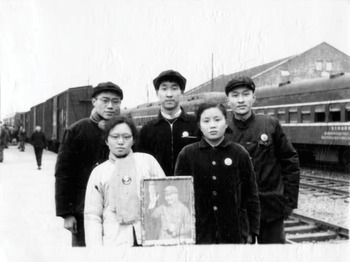
Holding a portrait of Chairman Mao, students from Shanghai’s Putuo district bid farewell to the Huangpu river.
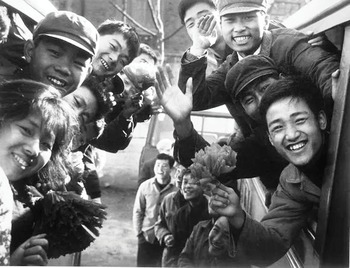
A photo released by the media featuring a happy departure of sent-down youth at the Shanghai train station. Xn-irro5qn0bv6c.com
To complement these calls to join production brigades, Shanghai newspapers published accounts, often culled and reprinted from provincial newspapers, of the enthusiastic welcome urban youth received from rural hosts. The Yunnan ribao (Yunnan Daily) declared, “We welcome you sent-down youth from Beijing and Shanghai!”Footnote 36 The Jilin ribao’s (Jilin Daily) bold-lettered welcoming of sent-down youth was followed by an account of the careful preparations being undertaken by villagers for the arrival of urban youth: making arrangements for food, housing, fuel, and furniture; preparing to provide political education; ordering Mao’s books as a welcome gift. According to one report, “Everything is in place” in the countryside: many villages had organized residents to repair old houses, build new stoves, and paint the walls; some villagers were saving vegetables for the sent-down youth, and some others happily vacated their rooms, decorating them as if for newlyweds.Footnote 37 Jiefang ribao also reported that Inner Mongolia had organized leadership committees and transportation teams to greet sent-down youth and would provide food for the youth during their journey to villages. Even local stores were reportedly prepared: they set up special counters to provide sent-down youth the commodities necessary for daily life in the region; some herdsmen made Mongolian gowns and leather boots for the arriving urban youth.Footnote 38 In Heilongjiang, local residents were said to have declared that their “great leader Chairman Mao” had bestowed upon them “this heavy responsibility to re-educate the educated youth … the greatest trust given to us peasants.” These villagers, the report said, wanted to assure urban parents that they would treat the students as if they were their “own sons and daughters.”Footnote 39
As soon as some Shanghai youth settled down in the countryside, newspapers began to publish accounts of their heroic accomplishments. A Shanghai youth sent to Jiayin, Heilongjiang, received lavish praise for having donated blood to save the life of a village woman who had lost consciousness during childbirth.Footnote 40 Other accounts described sent-down youth who provided medicines for villagers and who, as barefoot doctors, treated those who were seriously ill.Footnote 41
Negotiations
In spite of the relentless enthusiasm propagated by the national and local media, many urban residents were ambivalent about the call to go to the countryside. A cadre from Heilongjiang sent to Shanghai to receive potential sent-down youth described the “sea of noisy people” occupying the street in front of the prestigious Jinjiang Hotel where she and delegates from other provinces stayed. Hoping to obtain information about conditions in the countryside and potentially to negotiate the best possible assignments for their own children, people crowded the entrance to the hotel. At a high school gathering, this cadre found herself encircled by students desperately asking questions such as, “The winter must be cold. Will my ears freeze off?” “If I go out to pee, do I have to break the ice to make a hole with a stick?” “Are we getting guns? Is there going to be a war?” “Is there rice to eat?”Footnote 42
Despite their worries about rural conditions, the majority of urban students did join the movement. It is difficult to determine to what extent they did so voluntarily. Although newspapers relentlessly reported stories of young volunteers guided by revolutionary ideology, what might appear as voluntary participation sometimes turned out to be more complex. One early volunteer, a student from the high school affiliated with Shanghai Normal University, offered to go to Jiangxi before the movement became mandatory, hoping that this would enable his younger brother to have a factory job in Shanghai. This strategy to spare his brother from being assigned to the countryside failed. “Unfortunately,” he recalled, “the policy changed with Mao’s directive a month later, and my brother was sent to Jilin.”Footnote 43 Had he known in advance, he most likely would not have volunteered.
Once the government mandated that all graduates must go, many Shanghai residents tried to negotiate the best possible situation. One former sent-down youth explained her father’s efforts:
My younger sister and I were one year apart and in the same class of 1969. We were told there were four provinces where we could be sent: Heilongjiang, Jiangxi, Anhui, and Yunnan. My younger sister, who had some health issues, was assigned to Jiangxi, while I was assigned to the most distant location in Heilongjiang. I was upset and was informed that the Jiangxi slots were filled. Then my father, hearing that a work team from Jiangxi was staying at the Jinjiang Hotel, rode his bicycle there and met with the team leader. Fortunately, that person understood that if siblings were together they would be more secure and settled, and he promised to add me to the Jiangxi list. Did we resist? No! Everyone had to go and there was no alternative. And we were happy to have gotten the best possible assignment.Footnote 44
Although some Shanghai students expressed passion about going to the countryside, their passion was not always an expression of revolutionary zeal. One young woman explained her excitement as desire for independence from her family: “I was a little excited because I could finally escape the control of my parents and become my own boss. The sky is high so that birds can fly; the ocean is wide so that fish can jump.”Footnote 45 One student, a former Red Guard, explained the naivety of his enthusiasm:
At that time I was at an age when I didn’t really understand reality. I had no idea what kind of impact giving up my hukou would have on my future. I had no idea how precious a Shanghai hukou was. It took me only a few minutes to sign up.Footnote 46
Another attributed his enthusiasm to an effort to perform ideological correctness and compensate for the political problems of his deceased father that limited his future prospects. His family’s economic situation was also a factor: after his mother’s death, he lived with his aunt, who, regardless of her poor health, had to support a family of four on a monthly salary of sixty yuan. The aunt had tried to commit suicide because of poverty and her illness. His enlistment to go to the countryside represented a desire to relieve her burden.Footnote 47
To be sure, most youth did not readily volunteer or accept their assignment, and the mobilization campaign to persuade more than half a million students to go to the countryside required the involvement of the entire organizational infrastructure of the municipal government as well as extensive “ideological work” (sixiang gongzuo) on the youth and their family members. Schoolteachers and administrative officials, responsible for determining assignments for graduates, would try to persuade them by addressing their real or imagined objections: “‘You are afraid of going far away from home?’ they might ask,” as one sent-down youth recalled. “Then Anhui would be ideal: it is only a few hundred li from Shanghai and it would only take you one day to get home.”
You’re not used to eating wheat products? Then you can go to Jiangxi where they cultivate rice. If you are afraid of cold weather, then you can go to Yunnan where all four seasons are like spring and you can always wear a T-shirt and go barefoot. If you are worried about economic security, then you can go to a state farm where they pay you a salary every month.
Teachers and leaders insisted that these were one-time offers and that such choices would not be available for long.Footnote 48
Many students were still not persuaded. Some stayed away from school meetings, and others refused to accept their assignment. In these cases, neighbors organized to cajole them. Street committees, composed mostly of housewives, could be relentless: members took turns visiting homes and talking exhaustively, posting on people’s doors sheets of red paper on which Mao’s directives were printed. According to the cadre from Heilongjiang,
the street committee was more active than school officials. They would go to the homes of graduating students to engage their family members in ideological work. If the student disagreed or showed even slight resistance, those cadres would stay at their home every day from morning until night, until the student was actually persuaded to leave for the countryside.Footnote 49
Residents did not always appreciate these tactics, and in some instances vandalized the homes of street committee members.Footnote 50 If the strategies of schools and street committees were inadequate, parents of those who refused to leave were likely to be subjected to additional pressure from their work units, where they could be stigmatized and barred from privileges such as joining the CCP.Footnote 51
A number of parents, to avoid sending their children to remote regions, tried to arrange for their sons and daughters to go to villages in the relatively affluent areas of Zhejiang and Jiangsu near Shanghai. Although during the early years of the movement the government did not send students to these areas, many Shanghai residents had relatives in these two provinces who could accommodate their youth, a practice referred to as “finding one’s own road” (zixun chulu). From the perspective of parents, sending their youth to live in nearby areas under the care of relatives was far preferable to having them assigned to impoverished and faraway places, where they would be overseen by complete strangers. Although this could be understood as a way of nominally participating in the movement, the Shanghai government did not encourage this, and pressured residents to accept assignments to remote counties. The Jiefang ribao, for example, chastised such individuals, declaring, “if you do not go where you are assigned but instead go to where you have relatives, this is shameful!”Footnote 52
The stubborn resistance of some parents to having their children sent to the countryside proved to be a major problem, as reflected in the number of articles in major Shanghai newspapers addressing this subject. “There are some parents,” one reported,
who say, “The countryside is bitter and our children will not be able to adjust.” Actually, it is precisely the fact that they cannot adjust that proves how imperative it is for them to receive re-education by peasants … If billions of peasants can adjust to life in the countryside, then why in the world can’t educated youth adjust?Footnote 53
Another news report focused on parents at the Tobacco and Sugar Company in the Nanshi district of Shanghai. To persuade them to encourage their children to enlist for the sent-down youth movement, the company held more than 100 study sessions in summer 1969, with some 4,800 participants. Unfortunately, leaders found that although those attending expressed enthusiasm at the meetings, many still refused to send their children.Footnote 54
In spite of rallies, study sessions, and pressures on parents, a significant number of youth did not volunteer. In Putuo district, for example, 25,000 graduates were determined eligible to go to the countryside in 1969. After four months of intensive efforts to mobilize them, some 7,500 refused to comply. The district sent-down youth office developed a plan to improve its effectiveness: to provide training for the cadres from the schools, district, and neighborhood committee; to hold a large-scale rally with inspirational speeches; to organize an exhibition of photos featuring participants in the movement. The plan also called for special attention to Red Guards and their parents, and an analysis of the reasons for their lack of enthusiasm for the movement. In an effort to instill excitement among the district residents, the plan instructed cadres to “use every possible means” to publicize the movement. To this end, it proposed that broadcast speakers be installed in front of the district government office and at the intersections of the busiest commercial streets.Footnote 55
In addition to broadcasting the virtues of going to the countryside, the city government also began to publicize the consequences that would be faced by those who tried to undermine the movement. By fall 1969, public sentencing meetings began to take place. At one held in Putuo district, a woman found guilty of introducing prospective marriage partners to female youth so they could avoid being sent to remote regions was sentenced to twenty years in jail for having “tried to destroy the sent-down youth movement.”Footnote 56 In 1970, in response to a central government directive to crack down on those who subverted the movement, some thirty-seven individuals in Shanghai were identified as criminals guilty of undermining the movement. Beginning that year, 145 rallies were held to publicize these crimes, attended by 310,000 people (the largest had an audience of 5,000).Footnote 57
Looking more closely at the mobilization efforts in Shanghai, it becomes clear that their effectiveness was often shaped by the political, social, and economic status of individuals. Those labeled as members the “five black categories” (heiwulei)—landlords, rich farmers, antirevolutionary individuals, bad individuals, and rightists, as well as capitalists or anyone under scrutiny for historical or ideological problems—could not afford to resist having their sons or daughters participate in the movement, as it would likely intensify their already vulnerable position. For youth belonging to families with problematic backgrounds, complying with the policy could both protect their parents and express their determination to distinguish themselves from their inherited class identity. The majority of youth went to the countryside either because they believed it was the right thing to do or because they had no other choices. Ironically, it was most often residents of working-class neighborhoods, particularly those living in the city’s shack settlements, who defied the mobilization campaign.
Contradictions of Class
Class struggle dominated the media in Maoist China, particularly during the Cultural Revolution when the proletariat was valorized and the bourgeoisie condemned. This official discourse of class, however, obscured more popular notions of social status, which may not have used the vocabulary of class but manifested deep sensibilities about economic and social relationships. Most broadly, the residential registration system, which made urban residency a privilege inaccessible to rural people, marked the distinction between the agricultural and nonagricultural population, or between rural and urban status, particularly prominent. Residents of Shanghai were even more conscious of their city’s privileged status: they considered almost everyone else “outsiders” (waidi ren), a term commonly used interchangeably with xiangxia ren (“country bumpkins”). There were also popular perceptions of class identity within the city of Shanghai, based on employment, school, neighborhood, and place of origin. For example, Shanghai people identified some areas, such as neighborhoods in the former foreign concessions, as “upper quarters,” and the shantytowns and shack settlement districts where many of the so-called Jiangbei people lived as “lower quarters.”Footnote 58
Investigations of the mobilization campaign suggest that residents of the working class and shack settlement districts proved to be the most problematic, some openly challenging the government’s policy, and some ignoring it altogether. A report concerning the Shanghai Number 11 Textile Mill in Putuo district observed that in summer 1969, close to 20 percent of the youth in workers’ families who should have already gone to the countryside as members of the lao san jie remained at home in the city. One worker claimed that the family needed its child to perform household chores; another argued that his/her child had a high school education and was therefore “overqualified” to live in the countryside; another, having declared, “I do not believe there will be unemployment in a communist society,” was confident his child would obtain an urban job if they waited. The investigative team found a worker who cursed the unfairness of the policy every day, and expressed frustration that sometimes factory cadres sympathized with the needs and desires of individual workers to keep their children at home. Even some Party members set a bad example for others. According to the report, one Party member claimed that he had prepared all the materials his son would need in the countryside, but could do nothing more to force the unwilling child to go. Another used his old age as an excuse, saying that he needed his child to be home to take care of him. Citing the fact that a Party member appointed workshop head had not sent her own child to the countryside, some workers said they would send their children only if she sent hers.Footnote 59 Reports of other factories in Shanghai described similar problems. A certain Wang Zhengling, a CCP member who also served on the revolutionary committee of the Shanghai light bulb factory, was described in a special investigative report as a “typical case” of a leader who had not sent his children to the countryside.Footnote 60
The difficulties mobilizing factory workers to participate in the movement are also manifested in newspaper reports. Invariably providing a happy ending, these reports revealed problems that needed to be resolved. Leadership at the Number 9 Textile Factory, for example, called on all workers to make mobilization of the graduates in workers’ families a top priority. Visiting families and holding study groups to encourage enlistment for the countryside, factory cadres encountered an older worker, Tian Gendi, who adamantly protested sending her second son to the countryside. Master Wu, who belonged to her workshop, used his break time to talk to her. “We workers,” he reportedly instructed her, “need to listen to Chairman Mao. Have you thought about that? We came to the factory as teenagers. Do you remember conditions at that time and how much has improved? It is Chairman Mao who has brought us happiness and we cannot forget that.” Not only did Tian change her mind, but she also began to educate her coworkers. Half a year into the mobilization campaign, 1,500 of this factory’s 8,000 workers had agreed to send their children to the countryside. Although this report surely intended to convey success, it did indicate that many workers had expressed reluctance to send their children to the countryside.Footnote 61
There are several reasons why workers at these factories could brazenly complain about sending their youth to the countryside. As members of the politically privileged working class, they had far less at stake than intellectuals or people with problematic class backgrounds. Working for state enterprises, their work units could pressure or stigmatize them, or deny them Party membership, but most often their jobs were secure.
If government officials found it challenging to mobilize factory workers, they confronted even more frustrations in contending with residents who constituted a “sub-proletariat,” who had far less attachment or loyalty to the state. The critical role played by class in shaping responses to Mao’s directive on sent-down youth is particularly conspicuous in a detailed report on one of Shanghai’s best-known slum districts, Yaoshuilong. One of three major shantytown settlements in Shanghai, Yaoshuilong had its origins in the early twentieth century, when migrants from northern Jiangsu, Shandong, and Anhui came to the city to beg or engage in menial labor. The migrants made homes along the southern bank of Suzhou Creek in huts built of straw, bamboo poles, and broken wooden boards.Footnote 62 In the early 1950s, some one-fifth of Shanghai’s population lived in shantytowns, some of which, only in the latter part of the decade, were gradually replaced by brick housing compounds.Footnote 63 Running water and electricity (but not indoor plumbing) were also installed in these settlements. Although the Shanghai Institute of City Planning claimed that on the eve of the Cultural Revolution, many of the residences of Yaoshuilong had transformed from straw huts to simple dwellings with clay roofs, it nonetheless remained a slum with some of the worst housing conditions in Shanghai.Footnote 64
The authors of this 1969 report about mobilization in Yaoshuilong described it as Jiaozhou district’s most difficult neighborhood to organize. Reporting to the district government, the report described the slum neighborhood as a residential area of “the working class,” but this did not refer to members of the industrial proletariat. Instead, what emerges from the report is an account of a segment of the Shanghai population that to all intents and purposes was self-employed and engaged in private enterprises, albeit ones that were not particularly lucrative and offered no security and government benefits. As the report suggested, these residents earned a living doing jobs such as driving rickshaws; pulling carts; or working as carpenters, barbers, tailors, and street vendors.Footnote 65
The report about Yaoshuilong reveals that residents there were openly negative about the sent-down youth movement. Of the 239 youth graduating, only ninety-six had gone to the countryside and 140 had refused to go. According to the investigation, some cited physical disabilities or illness as their reason to remain in the city, while some 70 percent of the youth simply refused to go. One female student threatened to hang herself if forced to go to the countryside. Another, a male student about to marry a woman factory worker, was quoted as saying, “Even if you use a stick to break my leg, I will not go!” Parents shared their reluctance to leave the city. One parent said, “My child is young and let’s wait a few years.” Another reasoned that she had four daughters and only one son, upon whom she would be dependent in future and therefore she would not let him leave. One, who already had a daughter in the countryside, declared that she “would rather die” than let her son go. Described as suffering “ideological problems,” the report concluded that people from the slum “love the city and are scared of hardship and the countryside.”Footnote 66
The investigation also revealed residents of Yaoshuilong who avoided going to the distant countryside by negotiating marriages with people in nearby Jiangsu and Zhejiang provinces. A certain Wang Xiuying reputedly had connections with people in Huzhou, Zhejiang, and introduced young girls in the neighborhood to potential mates there. Eventually the investigative team of Yaoshuilong suggested that she be criticized and that her marriage arrangements be labeled a crime. She retorted that there was nothing wrong with her activities as she was actually helping “send people to the countryside.” Another Yaoshuilong resident reportedly had arranged a marriage for her son in Kunshan, just beyond the limits of Shanghai proper, in order to avoid him being sent to a remote and difficult place. One youth who married in a nearby county had a sixteen-table banquet at the wedding celebration.Footnote 67
In the context of these early years of the Cultural Revolution, when adherence to state policies was mandated of all citizens, the attitudes and activities of the Yaoshuilong residents may have concerned the investigators. They attributed the resistance to the fact that Yaoshuilong, although a “working-class” neighborhood, was populated by “enemies and bad influences.” The report went on to assert that “before Liberation it was a notorious place for bankrupted farmers, landlords, and gangsters.”Footnote 68 While some residents of Yaoshuilong may have been former landlords from Subei who fled to Shanghai during land reform, the majority could not obtain jobs in the system of state enterprises for which Shanghai was famed. Because they did not enjoy its benefits (such as secure employment in a state-owned enterprise, health insurance, and housing), they had less to lose by ignoring government efforts to mobilize them.
Another factor in Yaoshuilong residents’ resistance to the sent-down youth movement is that relocating youth to the countryside was not an entirely new phenomenon for them. Many of the “social youth” sent by the Shanghai government to the countryside from the mid-1950s to the mid-1960s came from districts like Yaoshuilong, where many residents had only temporary urban household registration permits and many youth had long ago dropped out of school and were not officially employed by the government. This meant that their families and neighbors were deeply familiar with the harsh conditions that sent-down youth would encounter. Families who had youth that had been sent to Xinjiang before the Cultural Revolution, for example, were most likely very reluctant to see their other children sent and resentful of those who came to mobilize them.Footnote 69 In one case, a youth named Wang Yugen, who had been sent to Jiangxi in 1963, adamantly opposed the prospect of his younger brother being sent to the countryside. He was back in Shanghai without a residence permit during the early years of the Cultural Revolution. When, in 1969, his brother received the notice assigning him to Heilongjiang, Wang tore it to shreds, and declared, “So long as I have porridge, he will have porridge! So long as there is food for me, he will not go hungry!”Footnote 70 Another youth who had returned from Jilin reportedly “told everyone how hard it was there, that they had to go out in the middle of the night to work, there was not enough food, and that wind and sand would get in your eyes.” A girl who had been in Heilongjiang informed neighbors and friends in Shanghai that “they were at war” and “life there is very hard.” “Lots of people were influenced by this and do not want to go,” the authors of the report lamented.Footnote 71
Residents of Yaoshuilong could refuse to go to the countryside for practical reasons as well. They knew how to survive without state-assigned jobs or government assistance, and were accustomed to finding ways of earning a living by providing services to local residents. Of the youth who refused to go to the countryside, one married a man who worked at the Xikang vegetable market and offered to buy a sewing machine so she could earn money as a tailor; several young women paid five yuan for sewing lessons, while several young men apprenticed a “master” carpenter, earning one yuan a day, a free lunch, and a packet of cigarettes. Others made a living by cutting hair or pulling bicycle carts.Footnote 72 One sold crickets for five cents each.Footnote 73 Authors of the report identified this as a “bad influence,” suggesting to neighborhood residents that one could ignore government directives and still make a living in the city. They described these self-employed people as “making a pretty good living.”Footnote 74
Among other things, the above account sheds light on the ways in which attitudes toward going to the countryside were sometimes shaped by the social and economic situation of individual families. The most disenfranchised, such as residents of Yaoshuilong, learned to survive outside the state employment system in ways unfamiliar to most Shanghai residents. More than the ability to make a living was at stake: anyone with occupational or political ambitions could not refuse government mobilization, as failure to comply would have closed doors for their future. People with such ambitions may have looked down on these Yaoshuilong types, but the petty laborers of neighborhoods such as Yaoshuilong saw themselves as far better off than their relatives in the countryside.Footnote 75
Conclusion
Mobilizing its city’s youth to go to the countryside was anything but straightforward for the Shanghai government. The widespread propagation of Mao’s directive that aimed to create widespread enthusiasm for the movement did not produce instant support and enlistment. Instead, municipal government officials had to mobilize all of their organizational resources to stage rallies and parades, as well as organize school administrators and teachers, neighborhood committees, and cadres in work units, to overcome the reluctance of students and often their parents to participate in the sent-down youth movement. With few choices available, the vast majority of middle and high school graduates from the 1968 and 1969 classes, and some of those from the previous two classes, participated in the movement and relocated to distant places. Some 615,517 Shanghai youth were sent to other provinces, of whom 401,147 went to production brigades and the rest to state or military farms.Footnote 76
Reports from Shanghai’s district offices of sent-down youth highlight two aspects of the mobilization effort that have not been previously observed. First, the most significant resistance to the government’s campaign was not staged by “class enemies,” but instead by factory workers and residents of the city’s shack settlements. Second, the reports suggest a dual role played by the city’s low-level cadres: on the one hand, they assumed responsibility for implementing Mao’s policy, but at the same time, their reports, even if not intended to do so, conveyed to their superiors some of what Elizabeth Perry refers to as the “fault lines” and “sites of potential rupture” in the political order.Footnote 77
One manifestation of the seriousness of these ruptures is that the idea of “uniform redness” in sending youth to remote provinces to live and work with peasants was relatively short-lived. Newspapers continued to glorify the project of sending youth to learn from peasants, suggesting that the policy was fully alive and that nothing had changed. Yet, by 1971, when the class of 1970 was to receive assignment, the meaning of being sent to the countryside had been transformed.
No matter whether youth in the late 1960s and early 1970s embarked for the countryside with enthusiasm or dread, idealism or cynicism, few who had grown up in Shanghai knew much about the rural areas where they were sent to settle. Nor did they know what this relocation would mean for their future: how long they would be required to stay in the countryside, whether they would ever have the chance for further schooling, whether they could someday return to Shanghai, and what impact time in the countryside would have on their lives.
Rural officials awaiting the arrival of sent-down youth harbored at least as many questions and concerns. If mobilizing youth to leave required the involvement of the entire administrative infrastructure in the city, then settling them in the countryside would require an even more extensive complex of rural management involving local residents and government officials at the village, commune, county, and provincial levels. As the next chapter shows, the difficulties for Shanghai youth to settle in remote villages of the countryside exceeded the imagination of both rural and urban government officials, compelling the Shanghai government to become involved in the supervision of its youth already in the countryside for years to come.


