

Consonants

Goizueta Basque has the consonantal inventory shown in the chart. For each consonantal phoneme, both its IPA symbol and its most common orthographic representation (inside grapheme brackets) are given. This is a typical, conservative, consonantal inventory for a Basque variety (see e.g. Hualde Reference Hualde, Hualde and de Urbina2003).Footnote 1
These consonant phonemes are exemplified in word-initial, intervocalic and word-final positions. Regarding the phonemic inventory, it must be said that, in the speech of the younger generations, the palatal lateral is in the process of being delateralized, becoming a palatal approximant. In Goizueta Basque, words are contrastively stressed on either the first or the second syllable and the stressed syllable is additionally specified to bear either a high (rising) or a low (falling) tone. Indicating the tone makes stress marks redundant, i.e. all syllables marked for tone are also stressed.Footnote 2
In the next subsections we comment on the phonetic realization and distribution of each class of consonantal phonemes separately.
Plosives
In utterance-initial position, the voiceless plosives /p t c k/ are realized as unaspirated (short positive VOT) and the voiced plosives /b d ɡ/ most frequently as prevoiced (negative VOT).
Although nowadays all Basque dialects have a firm phonological contrast between voiced and voiceless word-initial plosives, it appears that in earlier times the contrast between the two series tended to be neutralized in this position. In the native lexicon we find very few words starting with voiceless plosives and in the borrowed vocabulary a tendency to neutralize the contrast is also apparent. It seems that the original tendency was to adapt Latin (Lat.) word-initial voiceless plosives as voiced, e.g. Lat. corpus > gorputz ‘body’ (Michelena Reference Michelena1977: 238–239, Trask Reference Trask1997: 126). Nevertheless, we also find changes in the opposite direction and considerable variation is found among local dialects in the treatment of old borrowings from Latin and Romance (Michelena Reference Michelena1977: 241–242). In Goizueta Basque (GB), we find initial voiceless plosives in a number of words where variants with voiced consonants have been preferred in the standard language (St. Bq.) (Zubiri Reference Zubiri and Zuazo2000: 89): patáio ‘baptism’ (St. Bq. bataio < Lat. baptizare), pizár ‘beard’ (St. Bq. bizar), kolkó ‘bosom’ (St. Bq. golko), etc. An initial plosive has tended to assimilate to the voicing of a plosive on the onset of the next syllable. This has mostly resulted in the devoicing of the initial consonant, as in bukatu > GB bukátu ~ pukátu ‘finish’ and some of the other examples just cited, but sometimes in its voicing, as in Spanish (Sp.) cambio > GB kànbio ~ ganbìo ‘change’. In our data we have in fact found some cases of word-initial /b/ without prevoicing, as in the example berè [ eɾè] ‘his’ in the rendition of ‘The North Wind and the Sun’ that we are including with this article. Without context, these tokens are indeed perceptually ambiguous. The phonetic conditions for the occasional transfer between phonological categories are thus still present, at least for the labials.
As in Spanish, /b d ɡ/ are systematically realized without full occlusion (as approximants) after a vowel and in most postconsonantal contexts: alába /alába/ [alá a] ‘(the) daughter’, adarra /adára/ [a
 ára] ‘the branch’, garágarra /ɡaɾáɡara/ [ɡaɾá
 ara] ‘the barley’. (Since there in no contrast between voiced fricatives and approximants, in the remainder of the paper we will omit the ‘lowered’ subscript.)
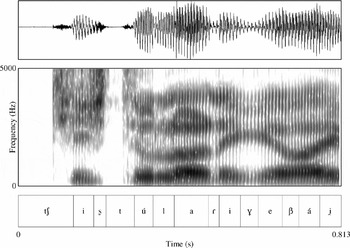
In addition, as noted by Salaburu (Reference Salaburu1984: 236) for the Baztan dialect, /p t k/ are sometimes realized as voiced approximants in intervocalic position (and some postconsonantal contexts) – see ta ólako kòntuk [taólaˠoˠòntuk] ‘and those things’ in figure 1, baràtzatikan e(r)e [baɾàt aðiˠane] ‘from the garden too’ in figure 2, and bóst kòtxe [ó
 ˠòt ʃe] ‘five cars’ in figure 3. Word-final /t/ and /k/, when followed by a vowel, may also be voiced and spirantized – see txistúlarik e(r)e bái [tʃi
 túlaɾ
túlaɾ ˠeβá] ‘the flutists too’ in figure 4. The optional weakening of intervocalic /p t k/ has also been reported for several Peninsular Spanish varieties (for Bilbao, see Lewis Reference Lewis2001). This weakening phenomenon may result in the surface neutralization of both series of plosives, although speakers are not aware of this neutralization, since the contrast is preserved in careful speech.
/ta ólako kòntuk/ ‘and those things’. Notice that both instances of intervocalic /k/ (the second one across a word boundary) are realized as voiced approximants.

/baɾátatikan e(ɾ)e/ ‘from the garden too’. In this example both intervocalic /t/ and intervocalic /k/ have been realized as voiced approximants.

/bót kòtʃe/ ‘five cars’. In this example, in the group /st-k/ word-final /t/ is deleted and word-initial /k/ is realized as a voiced approximant.

/tʃitúlaɾik e(ɾ)e bai/ ‘the flutists too’. In this example word-final intervocalic /k/ is realized as an approximant.
The voiced velar /ɡ/ is relatively rare in intervocalic position in Goizueta. As comparison with standard Basque shows, this is because /ɡ/ has undergone systematic deletion in the intervocalic context: ogi > /uí/ ‘bread’, egun > /eún/ ‘day’, egia > èia /èja/ ‘truth’, igitai > ìtti /ìci/ ‘scythe’, Sp. castigado > kastítu /katítu/ ‘punish’. Intervocalic /ɡ/ is found only in recent borrowings from either Spanish or standard Basque, including proper names. Intervocalic /d/ and /b/ have also been lost in some words: Lat. auditu > aditu *[aðícu] > *[aícu] > [ácu] /áicu/ ‘listen’, hilabete > /iʎáte/ ‘month’.
Word-finally, there is no contrast in voice in Basque. Very few words end in a plosive, although word-final /t/ and /k/ are common in discourse (often realized as voiced approximants, see figure 4), since they are found in some common items. Final /t/ is found only in a few but very high frequency items: bat ‘one’, zénbat [émbat] ~ [émat] ‘how much, how many’, and verbal forms ending in the first person singular agreement suffix /t/. There are no stems ending in /k/, but this is a common word-final segment, since it is found in the absolutive plural suffix /k/ (e.g. gizònak ‘the men’), ergative /k/ (e.g. gizónak ‘the man, erg.’, partitive /(ɾ)ik/ (e.g. gizónik ‘men, part’) and ablative /tik/ (e.g. mendítik ‘from the mountain’), as well as second person masculine singular agreement marker /k/ (e.g. duk ‘thou (male) hast it’). As for /p/, it is only found in onomatopoetic words and interjections: xurrúp /ʃurúp/, ttarráp /caráp/, both onomatopoeias of swallowing.
The distribution of the voiceless palatal stop requires further comment. Generally, the palatal voiceless stop /c/ has developed in Basque from /t/ in two contexts: (i) by conditioned palatalization after /i/, and (ii) in diminutive and affective forms. These are also the main historical origins of other palatal and prepalatal segments in Basque (see Michelena Reference Michelena1977: 179–202, Oñederra Reference Oñederra1990). Both sources of /c/ are found in Goizueta (see /ʃ/, /ɲ/ and /ʎ/ in the sections below):
(1) Historical sources of /c/
a. Historical palatalization of /t/ after /i/
/t/ > [c] / i____ (where /i/ may be a vowel [i] or a glide [
 ])
])Examples: ittó /icó/ ‘drown’, ittúrri /icúri/ ‘spring, fountain’, polítta /políca/ ‘pretty’, ermítta /ermíca/ ‘chapel’, geldíttu /geldícu/ ‘stay’ (and other participles in -ittu)
b. Affective/diminutive palatalization
Anttòn /ancòn/ ‘a proper name’, pattár /pacár/ (~ patár) ‘brandy’, ttíki /cíki/ ‘small’, pittíkot /picíkot/ ‘a little bit’
Given its historical origin in the palatalization of /t/, the status of /c/ as an independent phoneme or as an allophone of /t/ is not always clear in Basque varieties with this sound. In Goizueta, however, /c/ is clearly an independent phoneme, as it is found in phonemic contrast with /t/ (even leaving aside the phonological treatment of affective/diminutive palatalization). This is primarily so because two subsequent developments have rendered conditioned palatalization of /t/ after /i/ (vowel or glide) opaque. On the one hand, a glide [] has been absorbed into the following palatal consonant in some lexical items: átta /áca/ ‘father’ (< aita), mátte /máce/ ‘love’ (< maite), gótti /góci/ ‘up’ (< goiti), bátten /bácen/ ‘inside’ (< baitan), zérbette /érbece/ ‘something’ (< zerbait), eòtten /eòcen/ ‘be, stay, impf’ (< egoiten), emàtten /emàcen/ ‘give, impf’ (< emaiten), ebàtten /ebàcen/ (< ebagiten) ‘cut, impf’; on the other hand, palatalization has not applied in some cases where later contractions have placed /t/ in the palatalization context, as in abìtu /abìtu/ ‘depart’ (< abiatu), kanbítu ‘change’ (< kanbiatu), oblítu ‘oblige’ (< obligatu), kaníta ‘knife’ (< kanibeta), etc. In addition, in a couple of auxiliary verbs, deletion of a whole syllable has placed /c/ in word-initial position. In these items a palatal [c] that arose by the sound change in (1a) above is now found without the conditioning environment for the change: ditut > dittut > ttut /cut/ ‘I have them’ (vs. dut ‘I have it’). Unlike in some other Basque dialects with this process, the ablative suffix /tik/ does not undergo palatalization: mendítik ‘from the mountain’.
In a few examples, palatalization has affected an /nt/ sequence: mintegi > minttéi /mincéi/ ‘seedbed’. In a few words there is optional palatalization of /ld/ to [ʎ] bildots /bildót/ ~ /biʎót/ ‘lamb’, bildú /bildú/ ~ /biʎú/ ‘gather’ (Zubiri & Perurena Reference Zubiri and Perurena1998: 50), but this is not a systematic phenomenon.
Whereas in northern Bizkaian Basque and western Gipuzkoan areas, where palatalization of /t/ after /i/ has also been systematic, /c/ has merged or is merging with the affricate /t ʃ/ in the speech of the younger generations (the merger has been completed in Ondarroa and is ongoing in Lekeitio, Gernika, Eibar and other towns), in Goizueta /c/ is kept distinct from /t ʃ/ and there is no sign of merger as yet.
As for the phonetic realization of /c/, its articulation involves contact between a relatively large area of the predorsum and the hard palate (see Salaburu Reference Salaburu1984: 263–264). As in other languages with this phoneme, this consonant is realized with a certain amount of frication in the release of the occlusion, which explains its merger with /t ʃ/ in other dialects (and languages).
Fricatives and affricates
From a typological perspective, an interesting aspect of Basque phonology is the three-way place contrast among lamino-dental or lamino-alveolar //, apico-alveolar // and post-alveolar /ʃ/ and the corresponding affricates /t/, /t/ and /t ʃ/. (For a different proposal for the transcription of these segments, see Yárnoz Yaben Reference Yárnoz Yaben2001.) This contrast has been simplified further west (in many Gipuzkoan and all Bizkaian varieties), through various neutralizations. In Goizueta, however, the contrast is fully stable.
The post-alveolar fricative /ʃ/ is the ‘affective/diminutive’ correlate of the other two sibilant fricatives. Thus, for instance, xakúr /ʃakúr/ ‘little dog’ is a diminutive of zakúr /akúr/ ‘dog’ and Xubìri /ʃubìɾi/ is an affective form of the surname Zubiri. However, some words with /ʃ/, such as xáu /ʃáu/ ‘mouse’, xérra /ʃéra/ ‘steak’, do not have a variant without /ʃ/.
The velar fricative /x/ is found almost exclusively in borrowings from Spanish. Only a small handful of native words contain this phoneme, all in word-initial position: jatór /xatór/ ‘authentic’, /xáun/ ~ /jáun/ ‘lord, sir’. This is in striking contrast with local varieties immediately to the west. The few native words containing /x/ in Goizueta are the result of interdialectal borrowing. See section ‘Central approximant’ below.
As in many other Basque dialects, the contrast between fricatives and affricates is neutralized after a nasal or liquid, in favor of the affricate. This can be seen in the adaptation of borrowings: Sp. ensalada > GB entsálada /entálada/ ‘salad’, Sp. ansia > GB ántsi /ánti/ ‘anxiety’, Sp. calza > GB gáltza /ɡálta/ ‘pants’, Sp. verso > GB bèrtso /bèrto/ ‘poem’. In Goizueta the affrication of fricatives after liquids and glides remains fully productive in the adaptation of recent borrowings, unlike in other Basque dialects that have been studied in this respect (Hualde & Bilbao Reference Hualde and Bilbao1992: 5; Hualde, Elordieta & Elordieta Reference Hualde, Elordieta and Elordieta1994: 16). A synchronic alternation is found in participle + verb combinations, where auxiliaries starting with a fricative undergo affrication after /n/ and /l/: ikási zun [(i)káiun] ‘s/he learned’, esán tzun [(e)ántun] ‘s/he said’. Word-initial fricatives are not affricated in other syntactic contexts: éun zuló [é nuló] ‘a hundred holes’.
Nasals
The three nasal phonemes contrast only in syllable-initial position.
The palatal nasal has its historical origin in the palatalization of /n/ (see above for /c/). As in some other Basque dialects, in Goizueta, /n/ has palatalized after the vowel /i/ and the palatal glide: irina > /iɾíɲa/ ‘the flour’, arin > /aɾíɲ/ ‘fast’. When the trigger was a glide, it has been almost always absorbed: laino > /laɲó/ ‘cloud’, zain > /áɲ/ ‘vein’ (with a few exceptions: erein > /eɾéiɲ/ ‘sow’), so that /n/ and /ɲ/ are found in phonological contrast in the postvocalic environment. Even after /i/ there is a contrast, since a few recent borrowings have not undergone palatalization; cf. mìna /mìna/ ‘(the) mine’ (< Sp.) vs. míña /míɲa/ ‘the pain’. Word-initially, the palatal nasal /ɲ/ is rare, but it is found in a few examples such as ñáñu /ɲáɲu/ ~ ñàño ‘dwarf’, ñiñí /ɲiɲí/ ‘baby’.
Before a consonant, nasals undergo place assimilation. In other Basque dialects, the three nasal phonemes are neutralized in /n/ word-finally either before a vowel or before pause (Trask Reference Trask1978: 78). In Goizueta, however, the palatal nasal is also found word-finally as a consequence of historical palatalization, as we have just mentioned.
Laterals
Word-initially the palatal lateral is only found in a few borrowings from Spanish. On the other hand, /l/ has palatalized in the same contexts as /n/: mila > /míʎa/ ‘a thousand’, zail > /áʎ/ ‘difficult’. Like elsewhere in the Basque Country, and coinciding with the same development in Spanish, the palatal lateral /ʎ/ is in the process of becoming delateralized in the speech of young speakers, becoming neutralized with the palatal approximant [j]: mílla /míja/ ‘a thousand’, makìlla /makìja/ ‘stick’.
Rhotics
As in Spanish, the contrast between rhotic tap and trill is only made in word-internal intervocalic position. Elsewhere the distinction is neutralized. Unlike in Spanish, this neutralization in Basque is generally in favor of the trill. Neither rhotic is found in word-initial position in the native lexicon, although the trill is found in a few recent borrowings from Spanish, e.g. ràdio ‘radio’. Notice also roéri /roéɾi/ ‘drugstore’ < Sp. droguería. Phonetically (also as in Spanish), rhotics are often realized without full contact, as approximants or fricatives.
Central approximant
The syllable-initial central approximant [j] of yábe [jáβe] ‘owner’, yón [jón] ‘go’, yénde [jénde] ‘people’ is probably best analyzed as an independent phoneme rather than as an allophone of the high front vowel /i/ in syllable-initial, prevocalic position, since it contrasts with [ie], [ia] in hiatus in words such as [iél] ‘frog’ (St. Bq. igel), [iéri] ‘notice’(St. Bq. igerri), [iár] ‘thin’(St. Bq. ihar ‘dry’). (As can be seen from the standard Basque cognates, hiatus is found in items where an intervocalic consonant has been lost by historical change.)Footnote 3
The degree of constriction of this consonant is variable. For very constricted realizations, the symbol [ʝ] would seem appropriate, as in aió /ajó/ [aʝó] ‘bye’. In utterance-initial and postconsonantal contexts it can be optionally realized as a voiced palatal (affricated) stop [ɟ]: yábe [jáβe] ~ [ɟáβe] ([ ]) ‘owner’.
In Gipuzkoan Basque and even in the neighboring Navarrese village of Arano, just a few kilometers to the west of Goizueta, word-initial /j/ has systematically become /x/ by a historical change that mirrors the evolution of this sound in Spanish. One finds a systematic isogloss between Goizueta and Arano separating word-initial /j/ from /x/ in a large number of words (e.g. Goizueta /ján/ ‘eat’, /jó/ ‘hit’, Arano /xán/, /xó/).
In some items, /j/ is the result of affective/diminutive palatalization of /d/, as in jántza /jánta/ ‘dance’ (< dantza), aió /ajó/ ‘bye’(< adio). The delateralization of /ʎ/ has considerably increased the frequency of [j] in the speech of the younger generations, e.g. older generation màlla [màʎa] (St. Bq. maila), younger generation [màja] ‘level’, which may become homophonous with màia ‘table’ (St. Bq. mahaia) for young speakers.
Vowels and glides
Like most other Basque dialects, Goizueta Basque has five vowel phonemes.
(2) Vowel phonemes
The formant values in figure 5 are average values in stressed position for two male speakers. Values in unstressed syllables are very similar. A total of 482 tokens extracted from words in a carrier phrase were analyzed. These formant values are very similar to those reported for Castilian Spanish in Martínez-Celdrán, Fernández-Planas & Carrera-Sabaté (Reference Martínez-Celdrán, Fernández-Planas and Carrera-Sabaté2003), the only noticeable difference occurring in F2 for /u/. Notice that /u/ is not more retracted than /o/ in our data. We may point out in this respect that word-final /u/ has become /o/ in some words, e.g. du > do ‘s/he has it’.
Vowel triangle (average in stressed position for two male speakers).

Sequences where a high vocoid immediately follows another vowel are generally syllabified as diphthongs. The diphthongs in (3) are common.
(3) Falling diphthongs
A hiatus is nevertheless exceptionally found in some words where an intervocalic consonant has been lost, as in mintegi > /mincei/ [miɲcéi] ‘seedbed’, xagu > [ʃaú] ~ [ʃá] ‘mouse’. This is especially the case when stress falls on the high vocoid (with variation among speakers), egur > /eúr/ ‘wood’ (~ /éur/ [ér]), egun > /eún/ ‘day’ (~ /éun/ [én]). The vowel sequence created after intervocalic consonant deletion has, however, been reduced to a diphthong in other examples, such as eguerdi > /éurdi/ [érði] ‘midday’, lagun > /láun/ [lán] ‘friend’, seguru > /éuɾu/ [éɾu] ‘sure’ (possibly with historical displacement of the stress to the more open vocoid in some of these cases).
Sequences of rising sonority, on the other hand, are most usually realized as hiatus, as are sequences of two high vocoids. (Hiatus sequences may be reduced to diphthongs in fast speech. Etymological intervocalic consonants that have been lost in Goizueta are given in (4) in parentheses.)
(4) Hiatus sequences of rising sonority
Exceptions are relatively recent borrowings from Spanish such as soziálismo ‘socialism’, guártzibilla ‘Civil Guard’, fiésta ‘holiday’, siésta ‘siesta’, kuàrto ‘room’, suérte ‘luck’, fuèrte ‘strong’, etc., which maintain the diphthong of the source language.
Given the existence of lexical exceptions to the general rule of syllabifying sequences of falling sonority as diphthongs and sequences of rising sonority as hiatus, the status of glides as allophones of the high vowels or as independent phonemes is not straightforward.
Sequences of three ‘underlying’ vocoids commonly arise in inflected forms of nouns and adjectives ending in a diphthong. In such sequences, the high vocoid is resyllabified as a syllable-initial approximant consonant: [bé] ‘cow’, [béja] ‘the cow’; [balkó] ‘balcony’, [balkója] ‘the balcony’; [ɡá] ‘night’, [ɡáwa] ‘the night’. Such sequences are also found morpheme-internally: oihú [ojú] ‘shout’, maiátz [maját] ‘May’, Oihana [ojàna] ‘a woman's name’.
Word stress and word tone
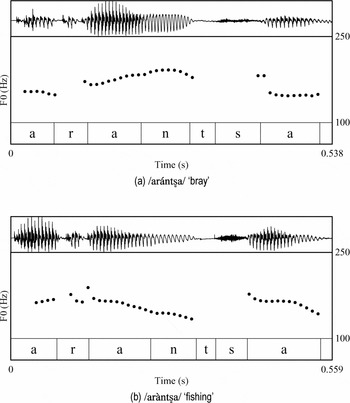
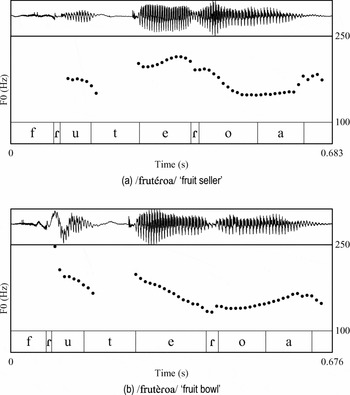
In Goizueta both the position of the stress and the tonal contour or pitch-accent associated with the stressed syllable are lexically contrastive. This is perhaps the most remarkable feature of this Basque dialect. As already mentioned, stress may fall either on the first or on the second syllable and the stressed syllable bears one of two lexically specified accents: Accent 1, which is a rise over the stressed vowel (a high tone), or Accent 2, which is falling contour (a low tone) (Hualde, Lujanbio & Torreira Reference Hualde, Lujanbio and Torreira2008). Vowels in stressed syllables are significantly longer than adjacent unstressed vowels. Historically, unstressed vowels have been lost in some words. The vowel bearing a tone mark in our transcriptions is the nucleus of the stressed syllable. In figure 6a, b and figure 7a, b we illustrate the tonal contrast with two minimal pairs: arrántza ‘bray’ vs. arràntza ‘fishing’ and frutéroa ‘the fruitseller’ vs. frutèroa ‘the fruitbowl’. This contrast plays a crucial role in inflectional morphology, as in the pair offered in figure 8, mendíri ‘to the mountain, dative’ vs. mendìri ‘to the mountains, dative’ (for more details see Hualde et al. Reference Hualde, Lujanbio and Torreira2008).
Tonal contrast /á/ ~ /à/.
Tonal contrast /é/ ~ /è/.
/mendíɾi/ ‘to the mountain, dative’ vs. /mendìɾi/ ‘to the mountains, dative’ (= Hualde et al. Reference Hualde, Lujanbio and Torreira2008, figure 9).

The North Wind and the Sun
We offer four versions of the text. The first is the text that the speaker read. It is a phonemic transcription using Basque orthography but reflecting the phonology of the dialect. The second version is essentially a transliteration using IPA conventions. The only phonetic detail that it adds is that semivowels are distinguished from vowels. The third text is a relatively narrow phonetic transcription of the acoustic signal that was recorded. Finally, a literal rendition of the text in standard Basque is also provided. This last version might be useful as a point of comparison as it offers a clear picture of the reductions that have taken place in Goizueta. It should also prove useful to those who want to check the meaning of specific forms by consulting a Basque dictionary.
Orthographic transcription (phonemic, in Basque orthography adapted to the dialect)
Ipàr aizéa ta Èuzkia
Ipàr aizéa ta Èuzkia, indàrtsuna zèin tzen éspan ài ziála, ibíltari bat pasátu zen kàpa lodì báten bildúa. Erábaki zutén indàrtsuna izáin tzela ibíltariri kàpa aurréna kendùzitzen tzína. Órdun Ipàr aizék berè íñal guzìkin yó zun, biño zénbat eta fuérteo yó, ibíltarik órdun ta estúo èusten tzin beré kàpari; azkénen, Ipàr aizék, etsìta, utzì ín tzun berè aléiña. Géro, Èuzkia fuèrte beròtzen así zen, ta ibíltarik bélexe kendú zun beré kàpa. Ta óla, Ipàr aizék attòrtu bear izan tzún Èuzkia zéla bìetan indàrtsuna.
Phonemic/broad phonetic transcription in IPA
Narrow phonetic transcription of recorded text
Adaptation in standard Basque
Ipar haizea eta Eguzkia
Ipar haizea eta Eguzkia, indartsuena zein zen espan ari zirela, ibiltari bat pasatu zen kapa lodi batean bildua. Erabaki zuten indartsuena izanen zela ibiltariari kapa aurrena kenduarazten ziona. Orduan, Ipar haizeak bere eginahal guztiekin jo zuen, baina zenbat eta fuerteago jo, ibiltariak orduan eta estuago eusten zion bere kapari; azkenean, Ipar haizeak, etsita, utzi egin zuen bere ahalegina. Gero Eguzkia fuerte berotzen hasi zen, eta ibiltariak berehalaxe kendu zuen bere kapa. Eta hola, Ipar haizeak aitortu behar izan zuen Eguzkia zela bietan indartsuena.
Acknowledgements
We want to thank all the speakers of Goizueta Basque who have assisted us in the fieldwork on which this paper is based. We are also grateful to three anonymous reviewers for this journal for their comments.



