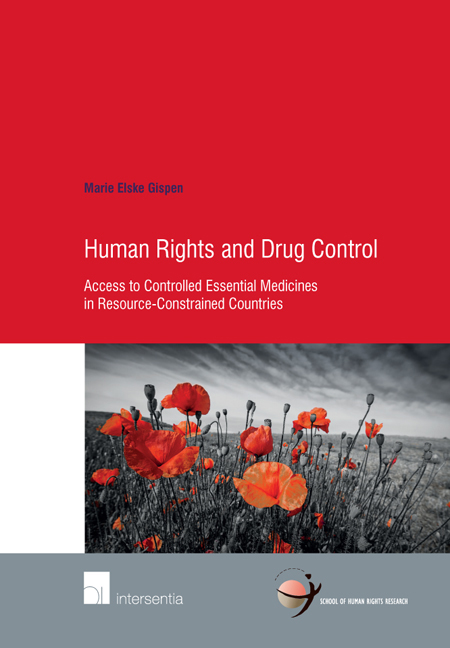
Human Rights and Drug Control

-
Select format
-
- Publisher:
- Intersentia
- Publication date:
- 27 September 2018
- 27 January 2017
- ISBN:
- 9781780687179
- 9781780684543
- Dimensions:
- Weight & Pages:
- Dimensions:
- Weight & Pages:
- Subjects:
- Law, Human Rights
- Series:
- Human Rights Research Series
You may already have access via personal or institutional login- Subjects:
- Law, Human Rights
- Series:
- Human Rights Research Series
Volume 80
Show more authors 
You may already have access via personal or institutional login
Book description
Globally, millions of people suffer health and socio-economic related problems due to the unavailability of controlled essential medicines such as morphine for pain treatment, which leaves them in disabling and sometimes degrading situations. Controlled essential medicines are medicines included in the World Health Organization's List of Essential Medicines, and whose active substance is listed under the international drug-control treaties. Their availability and accessibility therefore fall within the remit of both human rights and international drug-control law. Even though the unavailability of controlled essential medicines is generally caused by a multifaceted and complex interplay of factors, the current international drug-control framework paradoxically hinders rather than fosters the access to medicines.Human Rights and Drug Control analyses a human rights interpretation of the international drug-control framework with an emphasis on advancing the access to controlled essential medicines in resource-constrained countries. Its approach goes beyond the more conventional legal analysis and includes an ethical analysis as well as two case studies in Uganda and Latvia. It first aims to identify a human rights foundation of drug control by examining how human rights norms would balance the underlying tension: some controlled substances have a clear, evidence-based medical benefit, yet also have the potential to be misused, which may lead to dependency disorders. This makes it evident that States should regulate this delicate equilibrium, the challenge being how they can do so legitimately in light of human rights norms.Having explored this premise in the context of human rights law and theory, this book then applies these findings to Uganda and Latvia, - two 'best practice' countries - when it comes to improving the accessibility of morphine for pain treatment. Relying on qualitative research methods, the study explores whether the human rights basis of drug-control regulation may be adequately integrated into the structures of the present international drug-control system. It specifically deals with various technical, administrative and procedural obligations relating to the import/export and retail trade of controlled medicines. The book concludes with a proposal on how a human rights approach to drug-control may be advanced, specifically highlighting the importance of reconciling international obligations with the local reality in which these obligations come into play.
Contents
Contents
Metrics
Altmetric attention score
Full text views
Full text views helpTotal number of HTML views: 0
Total number of PDF views: 0 *
 Loading metrics...
* Views captured on Cambridge Core between #date#. This data will be updated every 24 hours.
Usage data cannot currently be displayed.
Accessibility standard: Unknown
Why this information is here
This section outlines the accessibility features of this content - including support for screen readers, full keyboard navigation and high-contrast display options. This may not be relevant for you.
Accessibility Information
Accessibility compliance for the PDF of this book is currently unknown and may be updated in the future.