


The Andaman Islands occupy a contradictory place within the national imagination of India. Frequently excluded from popular representations of Indian territory, such as weather maps, they nevertheless play a key role within nationalist narratives as the feared “Kalapani” (black waters) where freedom fighters were banished to a life of exile. In this narrative, which is a gross simplification of the complex history of the transportation of convicts to the Andaman Islands that began in 1858, the Andaman Islands are refigured as a sacred and redemptive space for Indian nationalism.Footnote 1 Today, there is considerable state investment in propagating a standardized, nationalist narrative of the Andaman's past. In 1979, President Morarji Desai declared the ruins of the cellular jail at Port Blair to be a national monument, which paved the way for the creation of a museum.Footnote 2 Tourists visiting the Island can enjoy Son-et-Lumieres within the jail compound that narrates “the saga of the heroic freedom struggle.”Footnote 3 The website on tourism run by the Andaman and Nicobar administration informs us that the jail is “now a place of pilgrimage for all freedom-loving people.”Footnote 4 Its description of other must-see “heritage” sites in the Andaman Islands also evokes a nationalist past. For example, the Netaji Flag Hoisting Memorial commemorates the place where Netaji Subhash Chandra Bose “hoisted the Tricolor on 30th December, 1943 for the first time on free Indian soil, much before India attained Independence.”Footnote 5 This narrative, despite its nationalist trappings, is a colonizer's history. It reduces the Andaman Islands' past to moments of imbrication in the master narrative of the emergence of the Indian nation. The islands gain relevance through the periodic presence of nationalists from mainland India, whether as prisoners or as liberators. What it ignores is a complex process of marginalization of the islands' indigenous population, which began with British occupation in the middle of the nineteenth centuryFootnote 6 and developed into full-blown settler-colonialism after the islands gained formal independence.
This article explores this anomalous emergence of settler-colonial governmentality within a postcolony, that is, India. I argue that this cannot be seen merely as a continuation of colonial policies. Colonial epistemology had actively produced the Andaman Islands as “no-ones land”—devoid of rule of law, agriculture, and any notion of sovereignty or ownership of land. This refusal to recognize indigenous rights to land set the Andaman Islands apart from mainland India, where customary tribal laws, including customary land rights, had been formally recognized since the nineteenth century.Footnote 7 Yet, during the colonial period, there was no systematic attempt to settle the islands. This pattern of governance shifted radically with India's independence. The nationalist elite combined inherited colonial discourses, which refused to acknowledge indigenous rights to land, with a new postcolonial zeal to transform these “backward” islands through planned development. The result was a state-led project of agricultural expansion drawing settlers from the mainland of India. It reduced indigenous communities to embattled and endangered minorities, “protected” in designated “reserves.” This article maps this violent history and demonstrates how legal regimes promising protection to indigenous communities actually normalized their displacement and disenfranchisement.
I argue that the key to understanding indigenous marginalization in the Andaman Islands is to make visible the surreptitious or sly operation of a logic of terra nullius. Footnote 8 Broadly understood as the imperial tendency to treat tribal or indigenous land as “no-one's land,” terra nullius has long been seen as the defining feature of settler-colonialism in Australia.Footnote 9 While the actual incidence of this legal doctrine in Australian history and its relevance in current jurisprudence is richly debated, I suggest a different approach toward understanding the temporal and geographical scope of terra nullius through a study of the colonization of the Andaman Islands. In the Andamans, the doctrine of terra nullius was never operationalized in the sphere of law.Footnote 10 Instead, it worked powerfully at a discursive level, informing policy and structuring patterns of governance. It marked as “empty” lands inhabited by indigenous communities. The de facto operation of the doctrine of terra nullius not only enabled colonial occupation, but also fostered postcolonial fantasies of rapid development of “empty” and “backward” lands. Paradoxically, the discourse of terra nullius gained momentum in the postcolonial period. In order to explain this particular trajectory, I begin with an exploration of how the twinned discourses of savagery and emptiness shaped the colonial history of the Andaman Islands. I move on to map changes and continuities in the postcolonial period when discourses of development were grafted to colonial constructions of “primitive” tribes. This generated a peculiar pattern of settler-colonialism that masqueraded as development of backward land and protection of aboriginal tribes.Footnote 11
NO-ONE'S ISLAND: SAVAGERY, EMPTINESS, AND COLONIZATION OF THE ANDAMAN ISLANDS
The first occupation of the Andaman Islands, by the English East India Company, dates to 1789 and lasted less than a decade. However, the fascination with “savagery” in the Andamans predated this.Footnote 12 The islands entered the annals of European explorers as the wild habitat of equally wild anthropophagi. In the earliest accounts, the inhabitants were mythical, fantastic creatures, frequently depicted with animal heads and tails.Footnote 13 In the late eighteenth century, with the Indian Ocean increasingly becoming a British sea, the Andaman Islands were mapped into imperial geographies of domination. A series of surveys and reports paved the way for actual occupation. The survey reports prepared by Ritchie, Alexander Kyd, and Archibald Blair in the last decades of the eighteenth century definitely established the inhabitants of the islands to be humans, albeit savages.Footnote 14 These reports were steeped in Enlightenment notions of savagery and property, especially Lockian ideas of ownership of land through improvement.
Kyd contended that in their manners the “savages” of the Andaman Islands ranked amongst the “lowest yet discovered on the scale of civilization, in a word Man in the rudest state of nature.”Footnote 15 Their “degraded” state was linked to the tropical climate of the islands, which sustained a rudimentary life devoid of clothing or shelter. “Ignorant in the arts of husbandry and cultivation, they derive their subsistence from the spontaneous productions of the earth.…”Footnote 16 Kyd's description was steeped in a conjectural notion of history, in which cultivation of land represented the first “stage” of civilization.Footnote 17 The aboriginal inhabitants of the islands were marked as particularly backward, even amongst “primitive” tribes encountered by colonial explorers, since they did not cultivate land. This particular lack could pave the way for the denial of indigenous rights to land. In Enlightenment thought, ownership of land was linked to man's ability to “improve it for the benefit of Life.”Footnote 18 For Locke, the injunction to improve land was a divine one, and, “He that in obedience of this Command of God, subdued, tilled and sowed any part of it thereby annexed to it something that was his Property.”Footnote 19 Following this logic, it could be argued that the Andaman Islands belonged to nobody, that they were terra nullius and open to occupation and improvement by the British. This was the implicit logic that rationalized the occupation of the Andamans by the English East India Company in 1789.
The East India Company mainly wanted to create a naval harbor and was not particularly interested in building settlements.Footnote 20 Nevertheless, the expedition's leader, Lieutenant Blair, was given explicit instructions to obtain the consent of the local inhabitants.Footnote 21 It is evident from Blair's notes that despite frequent encounters with the indigenous population, ranging from friendly attempts at conversations to violent skirmishes, he never tried to obtain consent for settlement. The colonizers not only occupied and cleared Chatham Island, the chosen site for the harbor, but also claimed and cleared a strip of forested land around Phoenix Bay, in South Andaman Island. A newly-built road stood in for the unilaterally imposed frontier between “native” and East India Company territory, and the firepower of muskets and the ship's guns stood in for indigenous consent. By March 1792, Blair had the satisfaction of commenting on how the “natives have been perfectly inoffensive for a long time.”Footnote 22 A similar pattern of occupation was repeated in Port Cornwallis, to which the settlement was shifted the following year. That settlement was abandoned in 1796, partly on account of ill-health amongst the settlers and partly because it had outlived its utility as a safe harbor.Footnote 23 However, it set the precedence of laying claim to the Andaman Islands without any need to acknowledge indigenous sovereignty or property rights. It is likely that this de facto practice of terra nullius was enabled by the assertion that the indigenous inhabitants of the Andamans, much like the population Cook encountered in New South Wales, represented men at the lowest rung in the “ladder of civilization.”Footnote 24
The second attempt to occupy the Andaman Islands, launched in 1858, also derived from the imperial and strategic needs of the British Empire. However, the rebellion of 1857 had sealed the fate of the islands to become a penal colony, designed to house a burgeoning population of convicts from the Indian mainland.Footnote 25 The occupation was preceded by a survey conducted by a committee of experts consisting of Dr. F. J. Mouat, Dr. G. R. Playfair, and Lt. J. S. Heathcoat, which was followed by Mouat's reports on the Andamans.Footnote 26 Once more, the savagery of the Andaman Islanders was mobilized to justify occupation. The report chronicled, in some detail, all existing reports of occasional shipwrecks there, which were “accompanied by circumstances of unusual barbarity.”Footnote 27 He presents this largely as an explanation of what prompted this second occupation. Yet for Mouat the proof of the inhabitants' “savagery” did not derive from their hostility toward shipwrecks alone. To him, they were one of “the most savage races on the face of the earth, whom civilization has yet found it impossible to tame, or even almost to approach.”Footnote 28 They acknowledged “no law to restrain and guide them” and had no knowledge of “a supreme Being” or agriculture.Footnote 29 In other words, since the inhabitants lacked a form of political or social organization recognizable to Eurocentric frameworks, colonial surveys represented the islands as a land devoid of law. This made British occupation not just desirable, but almost inevitable, given the Andamans' proximity to vital trading routes.
This second British occupation did not explicitly evoke the doctrine of terra nullius, nor did it profess any explicit intent of settling the islands. Yet, the discursive emptying out of the Andaman Islands—of law, religion, and social and economic organization—preceded its occupation. Unlike mainland India, no treaties of conquest were ever signed there. Neither was land purchased from “natives,” as was common practice in North America. Still, as the penal colony expanded, so did the piecemeal settlements of land, driven by convicts and ex-convicts. This dynamic can be characterized as the de facto operation of the colonizing logic of terra nullius.
In sum, the history of colonial occupations of the Andaman Islands followed a pattern in which actual occupation was preceded by a flurry of reports and surveys that argued for the exceptionally primitive nature of the indigenous population. This discourse of savagery and emptiness enabled the creeping appropriation of indigenous land in and around the expanding penal settlement of Port Blair. The actual pace and scale of agricultural colonization was severely constrained by the remote location of the islands and the difficulty of recruiting willing settlers. Still, the full potential of the logic of terra nullius to facilitate indigenous dispossession was realized only in the postcolonial period. Far from posing incommensurability with democratic self-rule, colonial discourses around savagery and emptiness proved amenable to re-articulations within a self-consciously nationalist context. Accompanying this re-articulation was a series of new policies that claimed to develop the Andamans and protect its aboriginal population, but actually served to entrench a settler-colonial governmentality.Footnote 30
EXPANDING SETTLEMENTS AND “DYING” ABORIGINALS: DEVELOPMENT IN THE ANDAMANS
The transfer of power brought little change in the administrative structure of the Andaman and Nicobar Islands. As a type D province, the islands continued to be directly ruled by Delhi through a chief commissioner selected from the ranks of the erstwhile Indian Civil Service, now renamed the Indian Administrative Service. The only difference was that the chief commissioner was now appointed by the president of India instead of by the British Viceroy, and he reported to the Ministry of Home Affairs. In the absence of a local legislative body, he was the highest judicial and executive authority in the islands, while the president was empowered to provide regulations for governance, which would have the same force as an Act of Parliament.Footnote 31 Picking up exactly where the British government had left off, the government of India imagined the Andaman Islands in terms of multiple lacks. It was seen as backward, underpopulated, and underdeveloped. This apparent continuity in governmental structures and attitudes was disrupted by a heightened nationalist awareness. The government in Delhi was determined to outdo its colonial predecessor in developing the islands and in integrating them, socially and politically, with the Indian mainland. The latter goal had never been entertained by the British administration of the Andamans.
Development had also been conceived narrowly. The colonial administration concentrated on extracting and profiting from the islands' natural resources, particularly timber. With independence, the Andaman Islands began to be mapped into an emerging geography of national planning. The postcolonial state distinguished itself from its colonial predecessor by seeing itself as the harbinger of comprehensive economic and social development.Footnote 32 The Andamans, being a directly administered territory, felt the full force of the developmental state. The new rulers of the islands were quick to envision comprehensive plans to expand agriculture and rapidly increase the population, and ambitious projects to achieve self-sufficiency in food.Footnote 33 All of these schemes were designed to be driven forward by settlers from the mainland of India. In other words, national development arrived in the Andamans as an out and out colonizing discourse that sought to radically transform the entire islands. This vision reduced the indigenous population to impediments in the path of the juggernaut of planned development.
This framing of indigenous islanders as problems for the administration was not new. Through much of the colonial period, the Anadamanese Islanders had been subjected to a two-pronged policy that sought to discipline and civilize the “friendly” aboriginals while punishing the “hostile” ones through punitive expeditions. The combined onslaught of displacement and epidemics had decimated the population of the Great Andamanese tribes and thrust them into irreversible decline, thus creating yet another type: the “dying savage.”Footnote 34 It was this complex conglomeration of “hostile,” “friendly,” and “dying” aboriginals that the Government of India took over in 1947. Officially recognized as aboriginal tribes in the 1950s, they were reclassified as primitive tribal groups, or PTGs, in the 1970s.Footnote 35 This period of official recognition was also the period when the authorities in Delhi set out to transform these “backward” islands through planned development, leading to a precipitous decline in the space afforded to indigenous life.
When Indian authorities took over the administration of the Andaman Islands the indigenous population consisted of four distinct groups: the Great Andamanese, the Jarawas, the Onges, and the Sentinelese. Each of these “tribes” was the product of histories of pacification and colonial ethnography, albeit in different ways.Footnote 36 The “friendly” Great Andamanese who lived around the settlement of Port Blair were a conglomeration of the survivors of the ten tribes that had once inhabited the Great Andamans archipelago. The Onges of Little Andaman Island and the Jarawas who inhabited the western regions of South and Middle Andaman Islands had both been treated as a threat and subjected to years of expeditions designed to “tame” them. While the Onges had been declared tamed by 1885 and thus appeared as a “friendly” tribe in 1947, the Jarawas remained “hostile” and unapproachable.Footnote 37 The Sentinelese, who live on the North Sentinel Island, have been largely spared incursions of outsiders due to their distant location. The Jarawas, by contrast, bore the brunt of British punitive expeditions that began in the 1860s. The interwar years witnessed significant expansions of forestry and the penal settlement in the South Andamans and Middle Andamans. This led to a rise in violent encounters between the Jarawas and settlers and punitive expeditions against the former.Footnote 38 Nationalist planners inherited this colonial “problem” of the “hostile” Jarawas.
While the new rulers were determined to develop and colonize the islands, they lost the primary means of doing so: unfree convict labor.Footnote 39 Preliminary surveys concluded that “extensive colonization is not only possible but desirable to make the islands self-supporting in food and labor requirements. It will only be with an increased population and increased communications that the resources (including forests) of these islands can be exploited fully in the interests of the country as a whole.”Footnote 40 Yet the administration struggled to find settlers willing to travel to the dreaded and isolated Kalapani. A solution was found in exploiting India's post-partition refugee crisis. In the aftermath of partition, thousands of unwanted refugees from East Pakistan languished in camps strewn across West Bengal. Unlike their Punjabi counterparts, the displaced Bengalis had no hope of obtaining land or monetary compensation.Footnote 41 Unsurprisingly, the national government found “willing” settlers for the Andaman Islands in these overcrowded and disease-ridden camps, with enthusiastic help from the Government of West Bengal.Footnote 42 Between April 1949 and August 1951, the Ministry of Home Affairs sanctioned five separate schemes that resettled displaced families in the Andamans.Footnote 43 In 1952, these gave way to an integrated “Colonisation and Development Plan,” which constituted the core of the first and second five-year plans for the Andaman Islands. During that decade over three thousand refugee families were resettled there.Footnote 44 This was a small fraction of the estimated six to eight million refugees who sought shelter in West Bengal, but for the Andamans the consequences were far-reaching. Its population more than doubled, from 18,962 in 1951 to 48,985 in 1961.Footnote 45 Thus, in a decade of independent rule the scale of colonization of the Andaman Islands dwarfed what British rule had achieved in nearly a century. This state-led demographic onslaught was continued in subsequent decades, through an “Accelerated Development Programme” that began in 1964. The patterns of development of the Andaman Islands were guided by two major reports commissioned by the Government of India, in 1949 and 1965. A closer look at these reports reveals that the decline and disappearance of the indigenous communities of the Andaman and Nicobar Islands was not an unforeseen consequence of developmental projects, and indeed the discourse of development there presupposed the eventual disappearance of aboriginal tribes.
The Report on the Possibilities of Colonization and Development of the Andaman and Nicobar Islands (1949) was produced by a team of bureaucrats drawn from the Forest, Agricultural, Public Works, and Home Affairs departments of the central government. Though the team was purportedly meant to explore whether colonization of the Andamans group was desirable or not, in effect the eventual colonization of the islands using refugees from East Bengal was already a settled fact.Footnote 46 This is evident from the questions this survey team was expected to answer. They left Delhi with detailed questionnaires prepared by the Ministry of Home Affairs. Questionnaire I consisted of twenty-eight separate questions, which prompted the team to comment on diverse means of developing the islands that included building a dry dock, developing sugar-cane plantations and tourism, and settling refugees. Tellingly, question number twenty-seven, “What are the possibilities of settling refugees in the islands?” had an entire supplementary questionnaire attached to it that raised detailed queries on every aspect of the future resettlement of refugees. The “aborigines” featured in only two questions in the first questionnaire, which asked for information regarding the areas they occupied and possible means for their “protection and welfare.”Footnote 47 The report's author, H. R. Shivdasani, chose to respond only regarding issues of land occupation and was silent on questions of welfare.
The team was unable to visit the Nicobar Islands and recommended that they be left out of colonization projects for the time being since the resident population of Nicobarese, though found to be a “peaceful and simple race” and “primitive in their beliefs,” were by no means “jungli” (wild) or “dying out.”Footnote 48 The word jungli evokes not just savagery or wildness, but also the fact of living in a jungle and relying on hunting as a primary means of subsistence.Footnote 49 Thus the evolutionary schema of colonial anthropology, which read lack of agriculture as evidence of primitivism, continued to play a critical role within postcolonial administrative discourse. If not being jungli could exempt indigenous groups from colonization, then being perceived as jungli could enable the appropriation of indigenous land, and as we will see in the case of the Jarawas and Onges, did so. The logic of terra nullius, which linked together the absence of agricultural practices with not only savagery but also a lack of any recognizable rights to land, had lost none of its force in the postcolonial period.
Shivdasani divided the aboriginal population of the Andaman Islands into the “friendly” Great Andamanese, who were “definitely dying out rapidly,” and the wild or hostile tribes, namely the Onges of Little Andamans, the Sentinelese of North Sentinel Islands, and the Jarawas of the unexplored western coast forest of the Great Andamans. The report recommended that those areas already thought to be occupied by aboriginals be left out of schemes of colonization. There was as yet no proposal to set up a formal reservation for the Jarawas. However, Shivdasani's report in many ways anticipated the later carving out of a bounded space as the Jarawa Reserve by arguing that the indigenous population was “confined to specified areas.”Footnote 50 It reframed the territory of the Andaman Islands within a binary framework that consisted of two kinds of lands: specific territories that needed to be reserved for the indigenous population—that is, not encroached upon—and everywhere else, where no such consideration was necessary.
This was a temporary reprieve based on inadequate information and did not amount to any acknowledgement of indigenous rights to land. It envisioned that the area reserved for the Jarawas could be “decreased in course of time after better contact has been made with them and their proper number ascertained.”Footnote 51 The unstated assumption here is that the Jarawas, in 1949, occupied more land than they needed. This is a familiar settler-colonial logic, which resonates with eighteenth-century justifications for the colonization of North America, in which the Native Americans were seen to occupy more land than they needed, thus validating the colonial “restriction” of “savages within narrower bounds” and the occupation of parts of their territory.Footnote 52 Much like the eighteenth-century jurists, Shivdasani's report seemed to express a case for coexistence of settlers and indigenous people. However, by arguing that the amount of territory to be reserved for the Jarawas was to be determined by their numbers alone, it advocated a pattern of development in which their very survival was pitted against the hunger for more land amongst settlers. What Shivdasani's report envisioned was not just a one-off plan of colonization of uninhabited lands in the Andamans, but a profound re-imagination of the entire territory of the Andaman and Nicobar Islands as national lands, and therefore as lands awaiting development. In recommending that colonization should be, in the preliminary stages, confined to uninhabited stretches of South, Middle, and North Andaman Islands, Shivdasani attached the caveat that “the rest of the Islands can be tackled later.”Footnote 53 Thus, independence unleashed in the Andamans a logic of development that needed indigenous land, but had no use for indigenous people. Henceforth, all that the Andaman's aboriginal tribes had to do to get in the way of developmental projects was to stay at home and continue a pattern of subsistence that relied on access to land and its resources. Thus, a settler-colonial “logic of elimination”Footnote 54 arrived in the Andaman Islands masquerading as national development.
Growth Rate of Population in the Andaman District of Andaman and Nicobar Islands. Source: Directorate of Economics and Statistics, Andaman and Nicobar Administration, Economic Survey of Andaman and Nicobar Islands, 2007–2008, Dec. 2008.

The 1960s saw a renewed emphasis on the colonization of the Andaman and Nicobar Islands, which was linked to a renewed refugee crisis. In 1964, when the Indian Ministry of Rehabilitation was reconstituted, it was also made responsible for development of “such special areas as may be indicated by the Prime Minister from time to time.”Footnote 55 These “special areas” were defined as those areas of the country in which, for climactic, geographical, or other reasons, economic and social development had been retarded and which, though sparsely populated, were richly endowed with natural resources. The first “special area” to be notified was the Andaman and Nicobar Islands. The quality of “backwardness” that had originally been attributed to the people inhabiting the Andaman Islands was now shifted to describe the land itself. The islands, already geographically remote, were now marked as temporally out of sync with the rest of India. They were perceived as lagging behind in the telos of national development and this state of affairs was pathologized using medical language. By the 1960s the Andamans was no longer a remedial space where the segments of society marked as refuse or waste, such as convicts and refugees, could be recycled. The space itself was now marked as retarded and in need of active intervention. The project of “development” of the Andaman Islands thus shifted from an instrumental use of its perceived emptiness to a desire to reconfigure the space entirely, in the image of the Indian mainland.
The report prepared by an inter-departmental team in 1965 visualized manpower as the starting point of all development. It argued that the Andaman and Nicobar Islands were underpopulated since the estimated population density was 22.5 per square mile, against the all-India average of 392. Based on high annual rainfall and the presence of thick tropical forests, the Andamans were deemed suitable for agriculture. The report declared that the “land if properly and fully exploited can support a much larger population.”Footnote 56 It proceeded to set ambitious targets of rapid colonization that envisioned doubling the population in five years and raising the total to 250,000 by 1979. The future development of the islands was to be “so designed as to generate employment adequate to support this additional population.”Footnote 57 In other words, postcolonial development of the Andaman Islands envisioned settlers from the mainland as both the agents and beneficiaries of development. Indigenous communities had no active role within this future-oriented discourse. But neither could they be left alone. The burgeoning population of settlers needed land and much of the land deemed suitable for settlement had been classified as tribal reserves in 1957.Footnote 58
This did not deter the inter-departmental team from advocating settlement in these areas. The list of areas deemed suitable for rapid reclamation as plantations or paddy fields included 6,000 acres in Rutland Island, 60,000 in the Little Andaman Island, 10,000 in the middle of Katchal Island, and the entire Great Nicobar Island.Footnote 59 All of these areas had been classified as tribal reserves in 1957.Footnote 60 It also recommended the colonization of 3,000 acres in the Betapur catchment area of the Middle Andamans. It is unclear whether this latter constituted an incursion into the Jarawa Reserves or an expansion of settlement in contiguous areas. In either case, it would certainly increase the zone of contact and conflict between settlers and Jarawas. Predictably, the report also advocated a complete overhaul of the existing policy toward the indigenous population of the Andaman Islands. It argued that government policy of minimizing interference with the way of life of the tribal population in hopes that they would adjust gradually to the changing world had failed to achieve results. The team asserted that a “drastic reconsideration” of government policy was essential—the current policy, if it continued, was “likely to achieve the gradual extinction of these people.”Footnote 61 Strangely, the report remained silent on the Andaman and Nicobar Protection of Aboriginal Tribes Regulation of 1956, despite blatantly ignoring its provisions.
This purported concern for the survival of indigenous communities seems disingenuous since the report in effect recommended an onslaught on indigenous land, particularly that occupied by Onges in Little Andaman Island, the Nicobarese in Katchal Island, and the Shompens in Great Nicobar Island. In recommending a massive reduction of indigenous access to land and a rapid influx of settlers, the team, which lacked any anthropologists, chose to ignore all existing evidence pointing to the detrimental impact of loss of land upon indigenous communities. Echoing the 1949 report, the section dealing with policy toward aboriginals mobilized entrenched tropes of primitivism to completely devalue indigenous life. For example, the team declared that it was “difficult to conceive of a more primitive way of life” than that of the Onges, since they were “quite naked,” spent their life in “hunting pigs, catching fish in primitive canoes and eating roots,” and were “incapable of hard work.” However, unlike Shivdasani's report, the later document represents both the “friendly” Onges and the “hostile” Jarawa as dying out. According to this report, while the precipitous decline in numbers of the Great Andamanese could be attributed to “contact with the unsympathetic early colonists” the Onge were rapidly becoming extinct despite being “practically isolated from the rest of the population.”Footnote 62 The report's claim that the Onge were isolated had no basis in facts. The postcolonial government had continued the British policy of encouraging them to visit Port Blair and call upon the chief commissioner, in return for gifts of tobacco, tea, and sugar.Footnote 63 Nevertheless, the inter-departmental team not only attributed the impending extinction of the Onge to the supposed policy of non-intervention adopted toward them, but also declared that it was “too late” to stop their inevitable extinction.Footnote 64
By contrast, the possibility of the Jarawas “dying out” was represented as a tragedy and not yet an inevitability. If the delegation of the Onges to the scrapheap of history seemed premature, the speculation regarding the extinction of the Jarawas defied explanation. While the report lamented their continuing hostility, it imagined them as a “spirited” people with a strong presence. Half of Middle Andamans was “infested” by them, while the expansion of colonization and road construction into the forests had created a situation where “friction has become more frequent and no month passes without a case of attack.”Footnote 65 This is hardly the image of a people in irreversible decline. Yet, the planners of the Andaman's future were already contemplating what a tragedy it would be “if they have to die out.” By contrast, the inter-departmental team advocated that the Sentinelese could be left in isolation for another generation, since the island they occupied was “small and far away from the existing colonies.”Footnote 66 Despite their being the most isolated of all the Andamanese people, the report neither recommended intervention nor predicted decline and extinction for the Sentinelese people. Reading between the lines of this report, it is easy to ascertain the actual reasons for the refusal to leave the Onges and the Jarawas alone: they occupied large areas deemed fit for colonization.
In less than two decades of independence, then, within the bureaucratic imagination imminent or eventual extinction had become the generalized fate of the indigenous people. It would be more accurate to read this concern that Onges and Jarawas might “die out” as a settler-colonial desire for ideal conditions to enable further development. Within the biopolitics of settler-led development of the Andamans, the management of territory in general and tribal lands in particular had become inextricably linked to population, in ways that evoked the notion of living space, or lebensraum. This was especially relevant in 1960s India, where overpopulation was privileged as the most intractable problem for economic growth and development.Footnote 67 According to the 1966 report, while unutilized manpower was the nightmare of planners on the mainland, in the Andaman Islands planners faced the reverse problem of scarcity of labor. The planners saw the Andamans as a vast reserve of underutilized land that could provide an outlet for land-hungry agriculturists from mainland India. Within this context, to raise fears of the extinction of a tribal population actually provided the justification for their displacement on the grounds that they no longer needed the land reserved for them. In this sense, the 1966 report was the logical extension of Shivdasani's report, despite their radically different policy recommendations when it came to land inhabited by aboriginal groups. For the Onge, being labeled as group that was “rapidly becoming extinct” opened the floodgates for a series of policies that cleared forests and resettled refugees from East Pakistan in Little Andaman Island. Sita Venkateswar has described this systematic marginalizing the Onge, which led to their eventual resettlement and decline in numbers, as ethnocide.Footnote 68 For administrators determined to “fully exploit” the land of the Andamans, the ideal aboriginal was a dying aboriginal.
The desirability of the dying aboriginal, over and above the “friendly” one, drew upon the legacy of colonial attempts to engage the Great Andamanese in productive labor, which had established the vulnerability of the “savage” body to external contact as well as their unsuitability to modern regimes of productive labor.Footnote 69 Thus, even when administrators encountered a growing population of aboriginals, as in the case of the Nicobarese, and could admit their need for more living space, they were loath to allot land deemed suitable for other productive economic activity, such as plantations, to aboriginals. A plan to establish a plantation in Katchal Island using migrant Tamil labor was pushed forward despite full knowledge that the Nicobarese would view a settlement of outsiders as an unwarranted incursion into their domain. Even the local administration advised against any colonization by outsiders, arguing that instead Nicobarese from Car Nicobar Island should be allowed to settle there. The planners from Delhi conceded that the density of population amongst Nicobarese in Car Nicobar Island was high, and readily admitted that the “Car Nicobarese do need ‘lebensraum’ for their growing needs.”Footnote 70 Yet, they pushed forward with the plans to build a plantation at Katchal.
This example, though not directly dealing with the Andaman Islands, illustrates the nature of the marginalization of indigenous communities of the Andaman and Nicobar Islands. Their exclusion from projects of development did not derive from any specific attributes, such as declining numbers. Perceived as “primitive” and relics of a past era, indigenous life and culture was by definition at odds with future-oriented plans of development that increasingly sought to expand forestry, agriculture, and plantations into lands deemed underused. Unlike the colonial era, there were no punitive campaigns launched against “hostile” Jarawas. Still, the postcolonial state's hunger for converting ever more land into productive economic activity that excluded “primitive” tribes could not but threaten them, since access to land and its resources is the first and most basic requirement for indigenous survival.
Embedded here within postcolonial discourses of development we encounter a settler-colonialism that does not use racial difference as its organizing principle, but is no less motivated by the desire to acquire and transform indigenous land while excluding the people. In other words, development in the Andamans was driven by what Wolfe has characterized as the settler-colonial “logic of elimination.”Footnote 71 Within an independent and formally democratic polity that is invested in marking its difference from the erstwhile colonial rulers, the most effective means of acquiring indigenous land—the actual elimination of the people—was politically impossible. The colonizer's desire for this forbidden possibility leaks into discourses of governance as a readiness to grieve, lament, or speculate on the inevitability of the Jarawas and the Onges “dying out.” Nonetheless, to further the project of development, the administrators of the Andaman Islands had to find mechanisms of extending control over indigenous land that would preserve indigenous life, but on the colonizer's terms. The various policies authored by India's independent government toward the Andamanese tribes—befriending “hostile” tribes, containing them in reserves, decreasing the territory of “dying” tribes, and resettling “tamed” ones—can be read as positive aspects of a settler-colonial logic of elimination since they were designed to undermine indigenous life in the interest of colonization. Once located within this history, it is possible to read the Andaman and Nicobar Protection of Aboriginal Tribes Regulation as the legal framework for the settler-colonial management of indigenous life in the Andamans.
A FRAMEWORK FOR SUBJUGATION: LIMITS AND POSSIBILITIES OF ABORIGINAL PROTECTION
In June 1956, the President of India promulgated the Andaman and Nicobar Islands Protection of Aboriginal Tribes Regulations (henceforth ANPATR). This act empowered the chief commissioner of the islands to declare specific areas inhabited by aboriginal tribes as reserved for tribal use alone. It also conferred added responsibilities of preventing alienation of tribal land and controlling or stopping the incursion of “non-tribals” into notified tribal territory.Footnote 72 The chief commissioner was quick to act upon his newfound authority and on 2 April 1957 designated specific areas of the Andaman and Nicobar group of islands as reserved for tribal groups (see Map 1).Footnote 73 Received wisdom reads the promulgation of the ANPATR positively, arguing that “the regulation guaranteed the protection of tribal culture by law”Footnote 74 and recognized large tracts of land as “exclusive tribal territory.”Footnote 75 This is an overly optimistic reading that takes the regulation at face value. It ignores the immediate context of agricultural colonization that informed the government's understanding of tribal territory. Moreover, the actual text of the regulation and the manner of its subsequent implementation suggests that, far from offering protection to aboriginal tribes, it laid down the legal framework for their subjugation and dispossession. In this sense, the protection of aboriginal tribes in the Andamans needs to be located within the long history of excluding “primitive” tribes and the “backward tribal areas” from all forms of self-government in colonial India, which found an afterlife in independent India in special provisions made for “schedule areas.”Footnote 76 Through a contextualized reading of the ANPATR and its mobilizations in the Andaman Islands between 1956 and 1979, I will suggest that this act of legal protection was designed to turn tribes perceived as primitive and lawless into subjects of law, and not right-bearing citizens.
Protected Areas and Tribal Reserves, Andaman Islands. Source: Pankaj Sekhsaria and Vishvajit Pandya, eds., The Jarawa Tribal Reserve Dossier: Cultural & Biological Diversities in the Andaman Islands (Paris, UNESCO, 2010). Map data drawn from the Andaman and Nicobar Protection of Aboriginal Tribes Regulation (ANPATR), 1956; and the World Database on Protected Areas, 2006.

By the time the Government of India promulgated the ANPATR in 1956, colonization of the Andaman Islands using settlers from the mainland was well underway. The protection offered by the government was not in response to any particular demands by the affected tribes or civil society activists, who in more recent years have played a crucial role in framing government policy towards the Jarawas.Footnote 77 This unilateral “protection” offered to aboriginal tribes, though antithetical to the local context of rapid and expanding colonization, made sense in the contemporary national context of the territorial reorganization of the Indian Union, brought about through the State Reorganisation Act of 1956. The Andaman and Nicobar Islands was reclassified as a Union Territory. At this moment of territorial stock-taking and administrative reform, the Andaman Islands was already divided into settled areas, where the state had a presence, and forested regions, perceived to be occupied or inhabited by “hostile” or merely “primitive” aboriginals. The forests, though frequented by Forest Department employees extracting timber, had no permanent state presence. Even the tramlines used for extraction were “pulled up immediately” after work in a particular region was completed.Footnote 78 Therefore, the chief commissioner's 1957 notification of certain areas as tribal reserves acknowledged the situation as it was on the ground. Marking the limits of “tribal territory” did not involve any consultation with the tribes in question regarding their historical patterns of land use and habitation. The regulation merely gave legal form to existing frontiers of settlements and colonization, which were maintained through violent policing.
This was particularly true of the Jarawa Tribal Reserve in Middle and South Andamans. These areas had emerged as zones of containment of the “hostile” Jarawas before the notification was issued. The reserve's frontiers were marked by bush police camps designed to protect settlers. These settlements, and therefore the frontiers of tribal land, were of very recent provenance owing their origins to the Government of India's schemes to settle refugees in “empty” lands. Take, for example, the Tirur region in South Andamans, which was settled between 1949 and 1952.Footnote 79 Here, the borders of the cultivated fields blend into the hills, which are assumed to be Jarawa territory. The villages enjoyed the protection of four bush police camps that demarcated “their” territory from that of the settlers.Footnote 80 The first five-year plan to settle displaced persons from eastern Pakistan was inaugurated in 1952. Along with the establishment of new villages in Middle Andamans, the plan also recommended the establishment of a bush police force of forty-five men to prevent attacks from Jarawas.Footnote 81 The new villages of Kalsi, Santanu, and Uttara, established in the Rangat and Kadamtala regions of Middle Andamans between 1952 and 1956, effectively marked the intrusion of settled agriculture into forested regions (see Map 2). How far these forests were “empty” before this, that is, uninhabited by the Jarawas, is questionable, especially since from then on an expanding force of bush policemen was necessary to keep the Jarawas at bay. By 1957, a string of fourteen Bush Police posts with 140 men was maintained along the eastern border of Jarawa territory to prevent their incursion into the colonization area.Footnote 82
Middle Andaman Islands Settlement Villages and Jarawa Camp Sites. Source: Pankaj Sekhsaria and Vishvajit Pandya, eds., The Jarawa Tribal Reserve Dossier: Cultural & Biological Diversities in the Andaman Islands (Paris, UNESCO, 2010). Map data drawn from Anthropological, Zoological and Botanical Surveys of India as reported in the 2003 Expert Committee Report submitted to the Kolkata High Court.
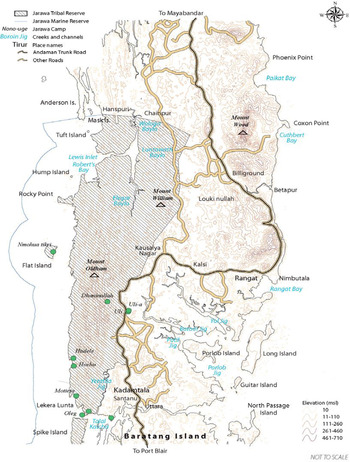
In administrative parlance, these regions became territories “frequented” by the Jarawas, but paradoxically, were never described as regions occupied or inhabited by them. When the refugees settled on these lands narrate their role as pioneers, they are often less circumspect about the consequences of their presence for the Jarawas. When I interviewed him in 2007, Shukharanjan Mridha, a settler of Kalsi said, “There were no settlements here. The entirety, the jungle was theirs…. Now, the settlement was built in their areas, we were brought over and settled.”Footnote 83 This violent and recent history of refugee resettlement and indigenous displacement required regularization, and the ANPATR provided the legal framework for it. On 2 April 1957, when the chief commissioner declared particular areas of the Andaman and Nicobar Islands to be “reserved” areas, it undoubtedly generated “a discourse of power, obedience and authority” through unilateral imposition of a bounded territory on the indigenous communities.Footnote 84 But more importantly, he was also using law, as a technology of rule, to legalize the recent and violent history of marginalization of the Jarawas. Seen in its proper context, the ANPATR is a legal manifestation of the settler-colonial dynamic that molds the postcolonial history of the Andaman Islands.
A closer analysis of the ANPATR text supports this reading of it as a colonizing tool and its mobilization as acts of “lawfare”—an assault on indigenous life conducted through the language and idiom of law.Footnote 85 The eleven clauses of the ANPATR deal with issues of occupation or ownership of tribal land and its management. These include legal limitations on sale and transfer of land, on non-tribal ownership or use of tribal land, and set limitations on the presence and commercial activities of non-aboriginals within the reserve areas. There was no mention whatsoever of the need to preserve tribal culture or autonomy. Neither did it recognize any kind of indigenous title or autonomous right to land. Instead, what this regulation achieved was to extend the absolute sovereignty of the Indian state over every aspect of the delineation and management of land occupied by tribes in the Andaman and Nicobar Islands. The chief commissioner was empowered to not only set the limits of the tribal reserve, but also to revise it, as and when he saw fit, without consultation or appeal. Similarly, clause four of the Act, which disallowed the allotment of reserved land for agricultural purposes to anyone who was not a member of an aboriginal tribe, came with a caveat that empowered the chief commissioner to make an exception to this rule. He merely needed to be satisfied that the land was “not required” by aboriginals, or that, in his opinion, such allotment was “in the public interest.”Footnote 86 The sale of reserved land to non-aboriginals was forbidden unless sanctioned by the chief commissioner, as was mobility or commercial activities by non-tribal people within the reserve areas. These sanctions and permissions, rather than being granted in exceptional situations, became routine acts of governance. By April 1957, the Andaman and Nicobar administration had created specific rules and procedures by which settlers could apply for passes to enter the reserve areas and obtain licenses for trading in specific products such as coconuts and betel nuts. The rates of exchange were fixed, as were the fees to be collected.Footnote 87
Moreover, an amendment enacted in 1960 exempted all government servants “while proceeding on duty to a reserved area” from applying for a pass to enter the reserves.Footnote 88 While this can be seen as a measure to reduce unnecessary bureaucracy, the same amendment inexplicably also exempted every single family member of such government servants from applying for a pass. “Family” was defined in the widest possible terms, to include not just children and spouse, but also parents and brothers and sisters. This effectively created the conditions for the abuse of power by ground-level employees, especially forest workers and bush policemen, and their family members. As the few permitted outsiders within the tribal reserves, they had a unique opportunity to exploit the land and the people for profit. Thus, conditions conducive for poaching, for illegal expansion of settlements into tribal areas, and for the infamous Jarawa “safaris,” on which tourists gawk at, photograph, or film and throw food at near-naked Jarawas, were the unintended consequences of the ANPATR.Footnote 89 It is significant that a disproportionately large number of illegal “encroachments” into the Jarawa Tribal Reserve are authored by Ranchiwallas or laborers recruited from Oraon, Munda, and Kharia tribes of the Chotonagpur region, who are brought over by the Forest Department or the Department of Public Works on short-term contracts.Footnote 90 Equally significant is the fact that in a recent video that exposed the crudeness of the Jarawa safaris to the world, the voice commanding Jarawa girls to dance in exchange for food belonged to a man variously identified as belonging to the local police or the Indian army; that is, a government employee.Footnote 91
The ANPATR provided no mechanism for the Jarawa or the Onge to exercise any kind of political or economic right. In this sense, it continued the colonial legal framework of offering protection in lieu of self-representation to those groups designated as “tribes” in India.Footnote 92 This protection took the form of a series of legal interventions, beginning with the Scheduled Districts Act of 1874 and extending right up to the Government of India Act of 1935, which created and maintained a different idiom of rule for the tribal areas, variously classified as “non-regulation tracts,” “scheduled districts,” “backward areas,” and “excluded areas.”Footnote 93 At the core of these regulations was the assertion that tribal inhabitants of these areas were too backward or primitive to be capable of political self-representation, and were vulnerable to exploitation by surrounding caste Hindus. Its main impact was to perpetuate direct colonial rule and bar all forms of representative politics in tribal areas in the name of “protection.” The Constitution of India, through its fifth and sixth schedules, reaffirmed this legal pluralism that denied full political agency to tribes. Scheduled and tribal areas were created as special zones of legal exceptionalism within the states of India. For example, Article 244 (1) of the Fifth Schedule of the Constitution of India, which dealt with the administration of tribal areas in all of India excepting the North East, enabled the governor of a particular state to limit the sway of existing laws, or impose specially designed regulations as he saw fit, on the scheduled area within his jurisdiction.Footnote 94 The ANPATR extended to the Andaman Islands this practice of promoting tribal welfare and protection through neocolonial benevolent despotism. In the Andamans, it fell upon the chief commissioner to don the mantle of the benevolent despot. However, unlike the rest of India, where the governor was obliged to consult with a Tribes Advisory Council,Footnote 95 in the Andaman Islands the chief commissioner could legislate on tribal welfare unfettered by any obligation to consult, or even inform, the aboriginal tribes. Given the dominant impetus to promote settler-led development of the Andaman Islands, it should come as no surprise that the alterations effected by the chief commissioner of the tribal reserves evoking the ANPATR were, in all but one instance, summary reductions of reserved areas to accommodate new settlements.
In 1959, the eastern boundary of the Jarawa Tribal Reserve in the Middle Andamans was adjusted through a notification that basically empowered the Forest Department to determine where the new “imaginary line” should fall. The language of the notification suggests that this gave the Forest Department a carte blanche to eat into the Jarawa reserve, provided “sufficient land” was “left” to “provide enough hunting ground to Jarawas while they are on the move.” The needs of the Jarawas were, however, to be balanced out against “the suitability of such alignment, from the point of view of water and terrain, as a patrol path.”Footnote 96 In the 1970s, a spate of notifications modified the boundaries of the tribal reserves. In 1972, a significant area on the eastern coast of Little Andaman Island was carved out of the reserve areasFootnote 97 and Rutland Island was de-notified in 1973.Footnote 98 In 1979, the entire section of the Jarawa Tribal Reserve lying to the east of the newly constructed Andaman Trunk Road in the South Andaman Island, which had been built right through the tribal reserve area, was de-notified.Footnote 99 Each of these adjustments were post facto legalizations of encroachment into tribal areas that were part and parcel of the plans for “accelerated development” of the Andamans, envisioned in 1965, and implemented by the very authorities responsible for “protecting” the indigenous population.
Herein lies the paradox of the “protection” the Government of India offered to the aboriginal tribes of the Andamans. It created a series of special powers, routine functions, and roles for outsiders who were designated as protectors. Given that local administrators had little or no knowledge of the Jarawa language, the Jarawas were most certainly not informed of the terms of their own protection, such as the boundaries of the Jarawa Tribal Reserve.Footnote 100 Condescension toward tribal culture was rampant within administrative circles in India during the 1950s, when public debates around policy for the welfare of tribes reiterated colonial stereotypes of backwardness. It is unsurprising that protectors steeped in such prejudice could, and did, turn into exploiters. However, to focus on the “degenerate notions about the indigenous tribes in the Andamans” amongst “continually changing administrators”Footnote 101 is to miss the structural causes behind the marginalization of the indigenous people. There was an organic link between laws offering so-called protection to tribes and the construction of tribes as backward people incapable of self-determination. The ANPATR, far from ensuring tribal autonomy, illustrates the bankruptcy of legal protectionism. In the Andamans, it provided the legal framework of tribal dispossession.
CONCLUSION
This article has mapped the history of the Indian state's management of indigeneity in the Andaman Islands, with a particular focus on the immediate aftermath of independence. Received wisdom about the Andamans has long suggested that the encounter between the colonial state and indigenous communities there has constituted a significant departure from the general pattern of governance of tribes in mainland India.Footnote 102 The scholarship on tribes in colonial India explores the wide variety in the nature of internal organization of the tribes and their long history of interaction with larger polities and economies.Footnote 103 Their encounter with colonial modernity has been complex and variable. Received wisdom in the field suggests that a common feature underlying this diversity is the absence of settler-colonialism in the Indian context. This consensus feeds a related claim, put forward by both the Indian state and some anthropologists, that the concept of indigenous rights is inapplicable to the Indian context.Footnote 104 Kaushik Ghosh makes the link between the absence of settler-colonialism and the denial of indigeneity explicit when he argues for two kinds of indigeneity. According to Ghosh, “indigeneity in the postcolony” functions through the recognition of ethnicity as opposed to a recognition of priority,Footnote 105 which, he says, is a defining feature of indigeneity in settler colonies.Footnote 106 The unresolved debate over the applicability of the concept of indigeneity in India has been to a large extent prompted by the recent global movement for the rights of indigenous people, which has been enthusiastically embraced by tribal activists in India.Footnote 107 The colonial encounter in the Andaman Islands and its subsequent history does not fit this pattern.
In the Andaman Islands, it is important to use the term “indigenous” to distinguish the original inhabitants of these islands from later settlers from mainland India, some of whom were recruits from tribal communities. Moreover, the evocation of settler-colonialism to understand the history of the Andaman Islands does not derive from current debates regarding the applicability of indigeneity in the Indian context. Historians have drawn upon the pattern of racialization of the Andamanese Islanders and the construction of the islands as an imperial frontier to argue that the penal colony established there was a settler colony.Footnote 108 In a recent multidisciplinary attempt to author an integrated history of seemingly diverse, yet co-constitutive framings of the Andaman Islands—as an imperial outpost, a penal colony, and a postcolonial site for settlement and development—the islands are frequently described as a settler colony.Footnote 109 There is thus a broad consensus that the history of the Andamans constitutes a clear divergence from the general pattern of governance of tribal areas in colonial India, where large-scale and state-led agricultural settlement was never an option.
This consensus regarding the exceptional status of the Andaman Islands as a settler colony raises more questions than it answers. Within existing scholarship, the legal and governmental apparatus that enabled settler-colonialism in the Andaman Islands is left largely unexplained. The present article has addressed this lacuna by demonstrating how the discursive framing of the Andaman Islands as empty land and the de facto operation of a logic of terra nullius enabled occupation and justified settlements. The concept of de facto terra nullius is useful for understanding instances of state-led appropriation of tribal land that is enabled by an implicit denial of indigenous land rights or ownership. This process is distinct from an explicit denial of property rights to any particular tribe or community within legal jurisprudence. It operates through a refusal to recognize indigeneity/aboriginality or name even the possibility of tribal/aboriginal ownership of land. Thus, such acts of colonization will invariably fail the test of explicit legal evocation. Instead of law, de facto terra nullius manifests itself in the sphere of governance. Its operation can be traced in the actual appropriation of land for state-led settlement that takes place without recourse to purchase or conquest. It relies on the conjoined discourses of emptiness and primitivism to naturalize such appropriations and erase the violence they involve. Understanding how de facto terra nullius was operationalized allows us to do the critical work of making the naturalized and therefore invisible violence of settlement visible.
As the history of the Andaman Islands illustrates so clearly, de facto terra nullius does not necessarily lead to large-scale settler-colonialism. During the colonial period, settlement there remained limited to piecemeal schemes, dictated by the needs of the penal colony of Port Blair. The colonial administrators had neither the political will nor the resources to pursue large-scale agrarian colonization. The postcolonial ambition of eradicating “backwardness” from the national geography dramatically increased the resources allotted to the project of developing the Andaman Islands. However, only by grasping the colonial legacy of de facto terra nullius can we explain how national development took the form of state-led settlement of “empty” land, using settlers from mainland India. The discourse of national development could unleash an extreme form of settler-colonialism upon the Andaman Islands because it was already imagined in terms of multiple lacks.
Herein lies the greatest significance of the specific history of the Andaman Islands: it illustrates how postcolonial development can take the form of settler-colonialism within an avowedly nationalist context.Footnote 110 De facto terra nullius is a particularly valuable concept for understanding this dynamic. It is an inherently contradictory concept in that it is constituted by colonial discourses around primitivism and yet refuses to explicitly acknowledge indigeneity and the radical alterity between the settler and the colonized. This distinguishes it from the legal fiction of terra nullius, which relies on the explicit evocation of racial difference between the settler and the native, where the native is seen or portrayed as inherently incapable of conceptualizing or exercising ownership over land. By contrast, de facto terra nullius, given its refusal to acknowledge indigenous difference in law, is perfectly compatible with the discourses of “self-rule” that avoid racialized categories of difference.
The first two decades of independence revealed how the governance of indigeneity in postcolonial Andamans displayed both continuities with and radical departures from colonial practices. The marginalization of the Andamanese Islanders during the colonial period derived from the complete denial of indigenous rights. The postcolonial period ushered in an era of official recognition of the indigenous population of the islands, albeit in ways that purposefully prioritized notions of backwardness and primitivism over any notion of rights. The Andamanese Islanders were recognized as “aboriginals” when they were promised a legal regime of protectionism in 1956 under the Andaman and Nicobar Protection of Aboriginal Tribes Regulation. This recognition was unilaterally offered by the postcolonial state and not prompted by any demand articulated by the indigenous communities. The legal recognition of aboriginality was effectively a colonizing move. On one hand, it denied “primitive tribes” political agency, while on the other it normalized absolute and unilateral state control over the limits of their territory. The “protection” offered to the indigenous population, through an elaborate series of regulations that included the creation of reserve areas, was actually designed to rationalize and enable settler-colonialism. Unlike during the colonial era, in the postcolonial period settler-colonialism functioned through a sly politics of recognition that deliberately focused on the primitive nature of the indigenous population while studiously ignoring the question of rights that might derive from prior habitation. This particular relationship between colonization and recognition echoes Povinelli's critique of the limits of liberal recognition in promoting indigenous rights or welfare.Footnote 111 It is crucial for understanding both the possibilities and limits of contemporary debates about the welfare and survival of Jarawas in the Andaman Islands. Once placed in a historical context, the current activist focus on safeguarding the sanctity of the Jarawa Tribal Reserve and ensuring minimal contact between the Jarawas and outsiders can be read as advocating the continuation of a settler-colonial governmentality peculiar to the postcolonial state.
The specific history of postcolonial development in the Andaman Islands also interrogates the conventional binary between the settler colony and the postcolony, and India's location within the latter category. The Andamans were not unique within the emerging geography of underdevelopment in independent India. They were merely the first of several regions classified as “backwards” and in need of “accelerated development” during the fourth plan period.Footnote 112 The history of that nation-wide project of interventionist development is yet to be written. Given that the Government of India also reclassified tribes with declining populations and pre-agricultural technologies as “Primitive Tribal Groups” immediately after that, during the fifth plan period, it is likely that the imagined geographies of “backwardness” and “primitivism” overlapped. Discomfort with a category of governance that marked specific groups as primitive began to be expressed in the 1990s,Footnote 113 but not until 2006 was that category replaced by the more palatable “Particularly Vulnerable Tribal Group,” or PVTG. In other words, the exigencies of planned development in India simultaneously marked some areas as “backward” and some people as “primitive.” The conjuncture of discourses of tribal backwardness and state-led development unleashed settler-colonialism in the Andaman Islands. It follows that any exploration of the regions where the presence of “primitive tribes” coincided with “economic backwardness” must question received wisdom regarding the nature of the state-society relationship in India and how far it was qualitatively different from that in settler colonies.



