

Introduction
This article aims to take stock of and reconceptualise the scale of changes observable in ‘social policy’, especially with respect to labour market policy and income-support schemes implemented since the 1980s. This period of change coincides with the rise of ‘neoliberalism’ (cf. Plant, Reference Plant2012), which has entailed the problematisation of ‘the welfare state’ in advanced democracies, and not just liberal ones. The arc stretches from Reagan to Thatcher to Blair, with other countries such as Denmark and the Netherlands in the Global North affected along the way (Lodemel and Moreira, Reference Lodemel and Moreira2014), as well as low- and middle-income countries in the Global South (Deeming, Reference Deeming2013). However, the central theme is the triumph of various forms of illiberalism in social policy, with punitive or compulsory ‘workfare’ (work-for-the-dole), paternalist specification of obligations, and a general championing of duties over rights in policies seeking to address social and economic exclusion (Mead, Reference Mead1997).
As we show, this form of governing involves a high degree of governmental self-formation, as authorities and agencies seek to direct the conduct of citizens towards predefined goals (Jones et al., Reference Jones, Pykett and Whitehead2013). Implicated here is the complex array of governmental practices that are constantly monitored and evaluated by agencies and authorities, both within and beyond the boundaries of the state. In this article we elaborate on the Australian policy context. Australia provides an ideal case to highlight and contest some of the excesses of ‘neoliberal’ (cf. Higgins, Reference Higgins2014) rule, and the policies affecting advanced democracies more generally. We are particularly concerned with the ends and means of the policy instruments and the active ethical issues arising from their use.
Active social policies and political platforms
There is a growing international trend towards active social policy and learning (Hall, Reference Hall1993), associated with the rise of the behavioural sciences and the experimental ‘problem-solving’ approach to policymaking now dominating the intellectual landscape of the advanced liberal democracies. In the 1980s and 1990s, political theory encompassing new principles of reciprocity helped to reformulate the nature of the social contract between citizen and state, as Mead and Beem (Reference Mead and Beem2005) observe. Subsequently, government has become much more active in pursuing the health, wealth and well-being of their populations, using social policy instruments and forms of welfare conditionality. Although much of this thinking on the ‘common obligations of citizenship’ was originally associated with the New Right and free-market neoliberal ideology (Mead, Reference Mead1986, Reference Mead1997), it also gained credence from communitarians and labour-based political parties in power (cf. Gilbert, Reference Gilbert2004). Policymakers in the neoliberal state now saw that citizens had obligations to themselves and the communities that supported them, as well as to society more generally (White, Reference White2003). Welfare-reform rhetoric thus moved away from a discussion of entitlements and rights and focused on the principle of reciprocity and, increasingly, on the need to act on the conduct of citizens receiving assistance from the state in order to address perceived ‘social problems’ and achieve desired social goals.
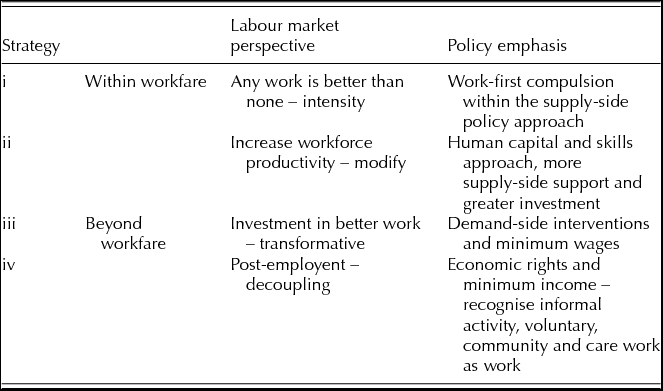
The different forms that incentive-based approaches and behaviour-changing policies can take mean that the new and emerging terrain of ‘active’ social policy is functionally diverse, if not conceptually ambiguous. The ‘active social policy paradigm’ (cf. Bonoli, Reference Bonoli2013) may be said to include the interventions associated with ‘nudge’ and ‘libertarian paternalism’ (Thaler and Sunstein, Reference Thaler and Sunstein2009), and behavioural economics more generally (Oliver, Reference Oliver2013), but also covers the range of active labour market policies (ALMPs) and social programmes concerned with investment in human capital (cf. OECD, 2005, 2013a). At a broad analytical level, we can distinguish between different economic and social policy strategies, as depicted in Table 1. Here we focus on the policies that support neoliberal market norms, examining the new regulatory workfare instruments in Australia (OECD, 2013b), and some of the new coercive programmes that have been introduced to govern the conduct of Australian citizens (Australian Government, 2008). As Table 1 suggests, labour market attachment (LMA) policies and the ‘Work-First’ approach in the liberal market economy (LME) place minimal investment in human capital and privilege immediate and intensive job-search and quick labour-market reintegration on the basis that any job is better than inactivity (Peck and Theodore, Reference Peck and Theodore2000); the ‘Work-First’ approach may be distinguished from social policies promoting sustainable labour-market participation and investment in human capital development and skills (Human Resource Development (HRD)) in the coordinated market economies (CMEs) of Europe (Deeming and Smyth, Reference Deeming and Smyth2105). However, there are also more transformative strategies to consider, beyond workfare in Table 1, that call for the recognition of social and economic rights within market liberal society.
Economic and social policy strategies within and beyond workfare
Source: Adapted from Carpenter et al. (Reference Carpenter, Speeden, Griffin, Walters, Carpenter, Belinda and Speeden2007: 162).
Activating unemployed citizens
Work has long been regarded as the best way to secure welfare for Australian families. In Australia, for much of the twentieth century, there was little political appetite for an expanded system of welfare paid out of general taxation because wage control was the means for securing needs-based welfare. Policymakers have sought to maximise employment by securing acceptable conditions of work, including legislative measures to ensure a fair minimum wage for workers. Being out of work and claiming benefits from the state have increasingly been defined by political programmers as being problematic; dependency is not only detrimental to the moral character of the claimant, but, it is claimed, it also erodes the moral life of society more generally. Unemployed workers are said to be making claims on society's scarce resources, while contributing little, if anything, back to society. As a consequence, work conditionality and regulatory welfare measures that ensure individuals seek work if they claim welfare from the state have found a new level of legitimacy in Australian society.
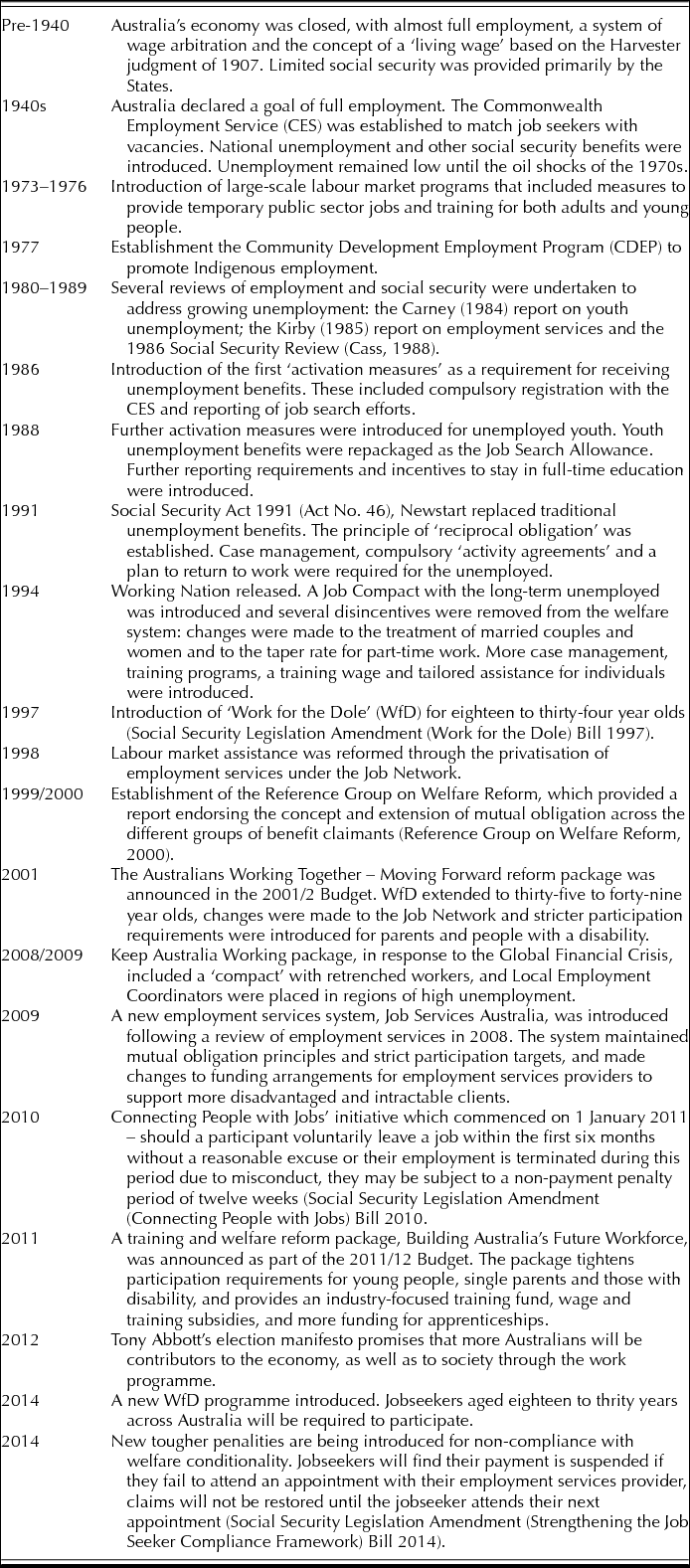
Australian activation measures originated in the social security reforms of the 1980s and 1990s, shown in Table 2. From 1989, Australian citizens claiming out-of-work benefits faced an ‘activity test’, a form of conditionality whereby social security beneficiaries were required to fulfil a variety of obligations and work-oriented activities, such as job-search and job-preparation activities in order to address barriers to work and remain eligible for social assistance (see King, Reference King1995a, for a discussion of the ‘activity test’ in the British and US contexts).Footnote 1 Further labour market reforms, set out in Labor's White Paper, Working Nation (Australian Government, 1994), promoted ‘competition’ in public services and Prime Minister Keating's notion of ‘reciprocal obligation’. Comparable with ‘Third Way’ thinking in Britain, the Keating government created a quasi-market of employment services and introduced ‘case management’ of unemployed people. Thus, the means of governing the unemployed citizen was now embedded in a complex system of state bodies, businesses, employers and community organisations in order to fulfil political objectives.
Welfare reform in Australia
Source: Adapted from Herscovitch and Stanton (Reference Herscovitch and Stanton2008: 53–7) and Cooper (Reference Cooper2011: 12–13).
The Liberal-led coalition government, elected in 1996 under John Howard, strengthened the market system by privatising employment services and allowing providers to compete with each other. ‘Centrelink’, the benefit administration body (introduced in 1997) and the ‘Job Network’ (introduced in 1998), of for-profit and non-profit agencies, now replace the government-operated labour exchange.Footnote 2 The reforms localised the government of unemployed workers and gave ‘personal advisers’ a defining role in the implementation of the new activation strategy. The rights and responsibilities of the unemployed worker were now articulated and mediated in a relationship between the ‘case manager’ and his or her unemployed ‘client’. Thus, ‘case management’ became key in governing the problem of unemployment in Australian society (McDonald and Marston, Reference McDonald and Marston2005). At the same time, ‘Work for the Dole’ (WfD) legislation removed the provisions that prevented unemployed workers from being required to work for the dole. Hence, the problem of unemployment in Australian society was reconstituted by political programmers as the ability to access state benefits without being required to contribute ‘work’ back to society. Originally, policymakers saw the ‘work ethic’ of young people as the root of the problem (Bessant, Reference Bessant2000). Following a trial programme, all jobseekers aged eighteen to thirty-four who had been claiming benefits for six months or longer were required to join the work programme. From 2001, WfD was extended to those aged thirty-five and over. More claimants now faced the prospect of mandatory work and work-related activity requirements. The policy, known as ‘Mutual Obligation’ (Saunders, Reference Saunders2002), argued that the long-term unemployed had an obligation to society. Unemployed individuals could meet their obligation through WfD schemes, voluntary work, training or part-time employment. In the process, the behaviour of unemployed citizens came under close scrutiny as new forms of surveillance were used to gather information in order to ensure compliance with the expectations of political programmers (Parker and Fopp, Reference Parker and Fopp2005).
In 1999, the government established a working group to consider welfare reform. The ‘Reference Group’ recommended increasing mutual obligation requirements on the unemployed, sole parents and disability claimants in order to address ‘welfare dependency’, which now constituted a growing political problem in Australia (Reference Group on Welfare Reform, 2000). Further reforms to activate recipients of benefits, that were previously not conditional on availability for work, followed. In 2003, for the first time, parents, whether lone or partnered, were required to engage in work-related activities in order to remain eligible for income-support payments. This marked a significant new departure in Australian social policy; previously, parents on benefits could elect to care for their children full-time until their child reached sixteen years. By 2006, anyone who was deemed long-term unemployed (seeking work for twelve months or more) faced mandatory work. More surprisingly perhaps, and against fierce opposition from the trade unions, the Labor government (2007‒13) maintained the principles of mutual obligation. Although WfD was no longer mandatory under Labor, all unemployed Australians were actively encouraged to participate in the scheme. With the election of the Liberal-National coalition government in 2013 however, community work programmes are being revived and expanded once again along with a new sanctions regime (Table 2). As Prime Minister Tony Abbott (Reference Abbott2012: 9) declared in his election manifesto: ‘more people will be contributors to our economy as well as to our society through work for the dole and other measures to keep people in the workforce’.
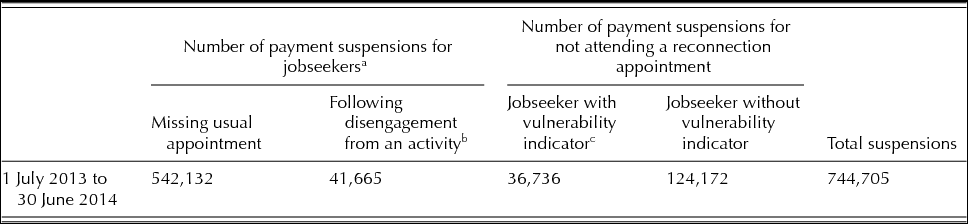
The ‘quasi-market’ arrangements for the reintegration of jobseekers in the Australian labour market now reward ‘outcomes’; thus, market forces ensure that only high-performing providers remain in the market (Struyven and Steurs, Reference Struyven and Steurs2005). With ‘unemployment’ defined and represented by policymakers as ‘the problem’ for policymaking to solve however, ‘jobseekers’ have become a particular category of the population whose conduct is now managed and governed through such ‘problematisations’ (cf. Bacchi (Reference Bacchi2009) for a detailed discussion of the systems of knowledge and regimes of practices that render ‘problems’ reality). State administrative practices have been intensified and forms of work conditionality increased. Social security claimants must now document their job-seeking efforts and activities, which are then scrutinised by welfare bureaucrats at work-focused interviews (Brodkin and Marston, Reference Brodkin and Marston2013). Thus, the coercive powers of the state are encountered during the compulsory interview. Anyone who refuses to accept the new conditions set by policymakers is now likely to lose their right to claim benefits under Australia's new punitive workfare regime. We return to the ethicality of this programme after we consider active social policies targeting Indigenous Australians. For instance, recent figures released by government officials show total payment suspensions to be over 700,000 across all employment services programmes between 1 July 2013 to 30 June 2014 (Table 3). Over 500,000 payment sanctions were given to jobseekers missing appointments, some 42,000 suspensions were made for jobseekers failing to attend specified work or education activities and around 37,000 sanctions were given to vulnerable jobseekers. We return to the ethicality of this programme after we consider active social policies targeting Indigenous Australians.
Income support payment suspensions for non-attendance at appointments/activities

Source: Australian Government (2014: 4).
Notes: aThis table includes all participation payment suspensions in Australia applied to activity-tested jobseekers across all employment services programmes. Jobseekers are required to give prior notice of their inability to attend an appointment or activity if, for example, the jobseeker is unwell and gives prior notice of their inability to attend, then a failure would not be applied.
bFailure to attend an ‘activity’ means failure to attend an activity such as work or education activity specified in an employment pathway plan.
c‘Vulnerability’ means that a jobseeker has a diagnosed condition or personal circumstance (for example, homelessness, mental illness) that may impact on their capacity to comply with participation requirements, although it does not exempt a jobseeker from these requirements. Vulnerable jobseekers do not usually have their income-support payment suspended in the first instance but payment can be suspended for missing the reconnection appointment, as shown in the table.
Activating Indigenous citizens
Indigenous governance in Australia has had a troubled and complex history as the country moved towards decolonisation (cf. O’Malley, Reference O’Malley, Dean and Hindess1998). In 2007, the Howard-led coalition government launched a new and controversial conditional cash transfer (CCT) programme that deserves some elaboration as it helps to illustrate further the increasingly interventionist nature of the neoliberal state. The policy was constituted as a national emergency response to protect Aboriginal children in the Northern Territory (following an inquiry into child abuse by the Northern Territory Government, cf. Wild and Anderson, Reference Wild and Anderson2007). The ‘Northern Territory Emergency Response’ programme, which simply became known as the ‘Intervention’, has been mired in controversy since its launch, and continues to be called into question for raising prejudice and discrimination because of the apparent racial bias, as Proudfoot and Habibis (Reference Proudfoot and Habibis2013) observe. Parallels may be drawn with the segregated pattern of race relations in the US and the experience of African-Americans (cf. King, Reference King1995b).
The policy package targeted Aboriginal communities in the Northern Territory. To enable the necessary legislation to pass into law, the federal government was forced to suspend the 1975 Racial Discrimination Act. The Intervention represented a complex set of measures governing land tenure, policing, law and order, health, housing, education, employment and welfare conditionality. A new programme of ‘Income Management’ was also introduced. Indigenous Australian citizens receiving welfare benefits, including unemployment benefits, disability and single-parenting payments, now found themselves subject to new restrictions on their spending. Political programmers had prohibited the purchase of services and goods such as alcohol, tobacco and gambling products (FaHCSIA, 2010). Welfare ‘quarantining’, as it became known, meant income-support payments and allowances could be used only for purchases ‘approved’ by policymakers. Other conditions were imposed for families with children, largely relating to school attendance and the use of health services (such as compulsory child health checks).
Many of the Emergency Response measures implemented are still in force; others were modified or discontinued with the election of the Labor government in 2007. In 2010, for example, Labor introduced ‘New Income Management’ (NIM). Social security recipients (especially long-term claimants) found themselves subject to the compulsory NIM programme measures, while a new voluntary scheme was established for anyone who wished to opt into the NIM programme. By 2012, over 16,000 citizens in the Northern Territory were subject to the NIM measures; more than 90 per cent of participants were Indigenous Australians. The extension of Income Management across the entire Northern Territory effectively allowed the Labor government to claim that the previously race-based measures were now ‘non-discriminatory’. Further legislation passed in 2012 committed the Australian government to the political programme NIM (renamed ‘Stronger Futures’) for another ten years.
While the policy rhetoric surrounding NIM and the Intervention was grounded in ‘evidence-based’ policymaking (Australian Government, 2008), many critics openly disputed this claim (for example, Altman, Reference Altman2008; Cox, Reference Cox2011). Altman, for example, accused the government of ill-conceived policy ‘ad hocery’ and selectively ‘cherry-picking’ evidence from a vast array of contradictory findings while, at the same time, ignoring or dismissing instances where the evidence discredited or contradicted the official position. Others critics, such as Behrendt (Reference Behrendt, Davis and Lyons2010), maintained that the Intervention and NIM ran contrary to what is known about ‘what works’ in Indigenous policy. As we shall see in the next section, the issues at stake here go well beyond methodological concerns and programme outcomes. It is notable, however, that two major evaluations (one by the Australian government, AIHW, 2010) and another independent evaluation (Bray et al., Reference Bray, Gray, Hand, Bradbury, Eastman and Katz2012) found little evidence to suggest improved outcomes on key measures (for example, financial management, child health, alcohol abuse, violence and parenting) attributable to the political programme.
Active ethical policy dilemmas and tensions
The two case studies, on social security reform and income management practices elaborated under the rubric of ‘active’ social policy in advanced liberal society highlight a number of competing tensions and complex interrelated issues that require further elaboration. Here we are particularly interested in the following: how ‘social problems’ are constructed and the ways in which ‘evidence’ is represented by political programmers in the policy processes; what this says about state power and the nature of rule in the advanced liberal democracies; and the complex ethical issues arising from these coercive social programmes.
Problematisations and narratives about evidence
As justifications of policy, expert knowledge and ideational claims are indispensable, as citizens value coherent explanations for policy choices. The whole ‘evidence-based’ approach to policymaking has become ideologically driven, however, as Packwood (Reference Packwood2002) argues. Conditional social policies increasingly support particular beliefs and values compatible with neoliberal thinking that increasingly defines how people and society should function in the twenty-first century. In the Australian context, we find commonality in the rhetoric and language employed by the federal government and its critics in the debates over the findings emerging from the instruments targeting Indigenous citizens. Both sides of the argument make strong claims and appeals to the evidence and ‘what works’ (Nutley et al., Reference Nutley, Walter, Davies and Argyrous2009). Of course, such positioning may be expected, as it is a reflection of the current dominance of the social learning approach to policymaking. At best, however, evaluations suggest that NIM has had a set of diverse impacts. For some citizens, it has been positive; for others, it has been negative; for many, it appears to have had little effect (Bray et al., Reference Bray, Gray, Hand, Bradbury, Eastman and Katz2012). Faced with a deluge of inconclusive information however, policymakers have been moved to create persuasive policy stories and ‘evidence-based’ narratives to help justify their interventions and social programmes, as Cox (Reference Cox2011) argues. In doing so, they have ignored possibly more ‘enlightened’ ways of helping people to learn to manage their own affairs than the coercive social programmes would suggest (Rowson, Reference Rowson2011).
State surveillance systems that are required for social programmes like NIM infringe on people's privacy and place great burdens on members of society (which need to be balanced against concern for public safety and health according to communitarian thinking, see Etzioni, Reference Etzioni1999). In 2011, for example, the Australian government allocated some $117 million from the federal budget simply to administer NIM and the necessary system of state surveillance. The government was forced to introduce a new type of EFTPOS debit card in order to monitor all forms of consumption. This new debit card could be used only at approved and participating shops and outlets. Thus, it was necessary for policymakers to enlist hundreds of retailers across the Northern Territory in government-led practices, all deemed necessary to monitor consumption and programme objectives. Clearly, the means and rationalities of active social policy programmes do not only incorporate the institutions, state bodies, agencies and programme administrators (necessary for the governance of activation, cf. van Berkel and Borghi, Reference van Berkel and Borghi2008), they also include a wide network of experts, professionals and practitioners drawn from diverse fields of health, welfare and education and beyond, who play a key role in fulfilling the political objectives of social policy. In this context, however, it is far from clear that NIM has achieved any of the benefits that may justify this sort of intervention, at least according to strands of communitarian thinking (cf. Etzioni, Reference Etzioni1999).
The work programme for unemployed workers is equally contentious. Policymakers in Australia have struggled to weigh up the ‘costs’ and ‘benefits’ of this programme (Productivity Commission, 2002). Despite it having been in place for nearly two decades, little is known for certain about its effectiveness (Belchamber, Reference Belchamber, Smyth and Buchanan2013). If welfare deterrence remains the implicit objective of workfare, this may not matter much.Footnote 3 Activation instruments have been designed to move claimants off benefits and back into employment as quickly as possible, usually into the growing numbers of low-paid and insecure roles that involve poor-quality work in LMEs. With the turn to activation policies that problematise individual agency (with a particular focus on the lower classes and disadvantaged sections of society), however, policymakers appear to have lost sight of important structural and economic constraints and inequalities. In the process, politicians are failing to engage actively with the public on important issues of social policy: about social investment to address the problem of persistent ‘structural unemployment’, the lack of jobs, particularly in some areas, and inequalities in the labour market and society more generally. Some groups face higher unemployment rates than others. Political programmers have clearly misunderstood the complex structural causes of youth unemployment and unemployment among citizens of Aboriginal origin (but may not care if the object here is to extend state compulsion on citizens regardless of individual circumstances). Youth unemployment is now at record levels in Australia, 28 per cent of eighteen to twenty-four-year-olds are currently jobless, and the unemployment rate for Australian citizens of Aboriginal and Torres Strait Islander origin, at over 20 per cent, has reached three times the national average (Brotherhood of St Laurence, 2014).
Policymakers continue to assume that ‘unemployment’ (the ‘problem’) is voluntary, resulting from poor motivation. Equally, however, the ‘problem’ of unemployment could be reconceptualised as the lack of ‘decent work’, which is not just about ‘paid employment’, in society (Dean, Reference Dean, Keune and Serrano2014). One of the main objections to the state stepping in to create work, as the employer of last resort, is whether it is economically sustainable to do so. The political Right's view, traditionally, is that only jobs created by the private sector can be considered real productive jobs in LMEs; the situation is quite different in the CMEs where job-creation strategies have long found favour in ALMPs and firms have been more enthusiastic about implementing the programmes (Martin, Reference Martin2004). Under coercive workfare programmes, however, the neoliberal state is increasingly prepared to create and subsidise poor-quality work and unrewarding roles in order to discipline unemployed workers (Wacquant, Reference Wacquant2010). Thus, punitive ‘workfarist’ regimes are designed not only to deter citizens from making welfare claims but also to act as a regulatory labour market push factor, forcing low-skilled workers to accept low-waged jobs with little choice. In contrast, little attention is paid to work incentives. However, it may be more prudent for policymakers to invest more in HRD, training and rewarding roles for unemployed workers, and the government-sponsored Job Guarantee (JG) approach for promoting full employment in society (cf. Murray and Forstater, Reference Murray and Forstater2013). Historically, public expenditure on ALMPs in LMEs (including initiatives in Australia) has been relatively low, at around 0.3 per cent of GDP in recent times (OECD, 2013c). Labour market pull factors (such as decent work that meets living wage requirements) can help to move the model of employability in the advanced liberal democracies beyond workfare: broadly equivalent to the third economic and social policy strategy illustrated in Table 1 above (although the extent to which CMEs may now be moving toward duties over rights in ALMPs is currently the subject of growing debate, cf. Lodemel and Moreira, Reference Lodemel and Moreira2014).
Governance, power and rule
Unquestionably, policymakers respond to voters and in recent years there has been a distinct hardening of social attitudes towards social security, and behavioural regulation has acquired a new level of moral acceptability in LMEs (Dean and Rogers, Reference Dean, Rogers and Dean2004; Wilson, Reference Wilson2013; Deeming, Reference Deeming2014). The views of policymakers and voters now appear to converge on the political imperative, ‘workfare’. It has been suggested that the principle of reciprocity may serve to legitimise welfare functions and social security payments with middle-class voters (Standing, Reference Standing2014), but social policies are also purposeful programmes associated with political ideologies, as exemplified in Table 1. Neoliberal activation policy generates new legitimacy for an essentially unjust system of production and distribution as Hawkesworth (Reference Hawkesworth and Schaff2001) argues, and reinforces entrenched inequalities within society, thereby preserving existing social structures and power relations. Policymakers seem to believe that disadvantaged citizens (who already struggle to make ends meet) must be increasingly controlled and coerced. However, this form of policy constitutes disadvantaged citizens as governed subjects engaged in a power struggle for resources, recognition and respect. Recent scholarship, therefore, attempts to move us on from fairly constrained debates about the efficacy of policies to much more basic concerns regarding the structures of power involved in the government of society and the nature of the ongoing power struggles between dominant elites and marginalised populations. In other words, the coercive policies are instruments that support particular beliefs and values which are compatible with neoliberal thought and market norms, as Higgins (Reference Higgins2014) observes.
Citizens in the advanced liberal democracies may be accustomed to the neoliberal political discourse, and may even now accept punitive welfare policies, but what about the views of Australians subjected to sanctions and conditionality? The data here remain patchy and perceived benefits are not altogether clear. Trial data from the NIM programme, for example, appeared to suggest strong support amongst the participants (FaHCSIA, 2010). Some 70‒80 per cent of participants reported positive benefits for themselves and their families. Such findings were used by policymakers to help justify escalating the programme to the national level in 2012. However, even if conditionality in operational policy improves levels of living for some Australian families in ways that they approve, it is highly questionable whether these same families would accept or consider appropriate the sanctions imposed when conditions are not met, particularly if their child's health and well-being were at stake. The Australian government, for example, originally claimed that ideas about withholding benefits (benefit sanctions) and fining parents if children fail to attend school arose from consultations with Aboriginal communities. However, more recent work with Aboriginal families casts considerable doubt on the official government line. Extensive consultations in Aboriginal communities reveals considerable disquiet over the coercive social programmes that are in place (Concerned Australians, 2011). This offers a further reminder, if any were needed, that social surveys are not always ‘value-free’ instruments, but may be designed to serve political ends, as Goerres and Prinzen (Reference Goerres and Prinzen2012) argue.
Ethics and human rights
The new activation strategies raise profound ethical issues, particularly the differential treatment of Aboriginal people, which is the core issue of illiberal social policy, as defined by King (Reference King1999), and the ongoing experimentation with the lives of more disadvantaged citizens and marginalised populations (Elizabeth and Larner, Reference Elizabeth and Larner2009). Experiments with social security and assistance, by their very nature, often target the most vulnerable members of society. There is a real danger, therefore, that conditionality is undermining efforts to promote social inclusion or, worse still, conditionality is reinforcing existing prejudices, thus heightening social stigma and ‘othering’ (not-me) of more marginalised members of the community. For this reason, the Roman Catholic Church in Australia has a principled objection to the inclusion of Indigenous families in divisive political programmes such as the Intervention and NIM (Quinlan, Reference Quinlan2010). Behavioural programmes can also be a burden to citizens and families who find themselves subject to the new forms of conditionality. The cost of compliance may be significant for families and welfare beneficiaries, often such costs are not fully accounted for by policymakers in their evaluations. For instance, NIM incurs costs such as having to access approved stores or the cost of not being able to access cheaper shopping outlets not included in the programme. Under these conditions, many people found the NIM scheme embarrassing, humiliating and de-motivating.
Rights are being eroded by the new economic policies that emphasise duties; at the same time, poverty, inequality and insecurity across the advanced liberal democracies has been increasing, particularly among young people, carers and citizens who cannot find work in the open labour market (Standing, Reference Standing2014). The issues at stake here are less about the ‘evidence’ than the moral arguments; conditionality may be effective in changing behaviour in certain circumstances, as we heard above. The problem, however, according to some observers, is that conditionality undermines or narrows people's rights. Coercive state programmes are divisive, in that they create and sustain social divisions within society. More marginalised sections of society, low-income families living in poverty or Indigenous Australians, for example, are treated differently from other citizens. This approach has major implications: basic human rights are violated by the coercive state programmes. International instruments, such as the UN Universal Declaration on Human Rights, for example, affirm that every human being has the unconditional right to social security (Article 22).Footnote 4 If social security is transferred only on condition, basic human rights are surely undermined and this is likely to consolidate injustice on society's most disadvantaged citizens, as White (Reference White2003) argues. And, while the right to work remains a human right (Article 23), it is not a citizenship right in the advanced liberal democracies.Footnote 4 Therefore, a broader conception of work (and not simply labour), which recognises voluntary, community and care work as work, may now be required to guarantee freedom and equality based on social and economic citizenship rights: the fourth social and economic strategy depicted in Table 1 which, broadly speaking, guarantees the right to share in society's economic resources.
Discussion
Activation programmes and forms of welfare conditionality are now shaping the lives of millions of people in contemporary liberal-democratic capitalist states. In Australia, coercive social programmes are increasingly being used for the social engineering of Australian society: for the better it is claimed. However, neither the emerging evidence nor moral claims really support this contention. The new behavioural policies are failing to stem the growing levels of inequality and insecurity generated in the economy; instead, they serve to reinforce deep social divisions within society. Worryingly, the Abbott-led Liberal-National coalition government is now asserting greater social control in Australia than previous administrations. The state is becoming more interventionist and behaviour is increasingly conditioned. In the process, new government surveillance systems have been established and strengthened at untold costs.
Not all scholars would accept the charge of illiberalism (applied to paternalistic interventions and welfare conditionality) in a productivist society like Australia, where everyone is expected to contribute (White, Reference White2003). However, there is clearly a dark side to the forms of neoliberal ‘activation’ unfolding here that would cause discomfort to many readers of this journal. At the same time, it is perfectly possible to argue that many ‘active’ social policies that entail coercive social programmes have too much ‘legitimacy’ in contemporary liberal democracies. This is what makes their implications irreducible to issues of whether they are efficacious or not. It is also what makes the characterisation of such practices as illiberal persuasive (cf. King, Reference King1999). It is perfectly possible, then, to argue that dangerous neoliberal practices and rationalities have emerged in the name of liberalism and in defence of its values. These abhorrent forms of policy, increasingly identified as ‘social policies’, continue to provoke reactions from the social policy community, for it is only by calling into question this divisive neoliberal turn and subjecting the social issues discussed here to alternative ‘regimes of truth’ (Clarke, Reference Clarke2004) that we may hope to end such intolerable political strategy in the hope of achieving social and economic security for all (Panel Discussion with Robert A. Dahl, Claus Offe and Alain Touraine, 1987).
Acknowledgements
I am grateful to both referees for helpful comments on an earlier version of the manuscript and to the Editors who guided the manuscript through the review process. The writing of this article was supported by a three-year research council fellowship (UK Economic and Social Research Council award ES/K001353/1 ‘New Cultural Contradictions in Advanced Liberal Democracies’) and completed during my appointment as Visiting Associate at Macquarie University, Australia, during 2015.



 Open access

