




1. Introduction
Advances in interstellar probe technology, biotechnology and the study of exoplanets have made it possible to discuss interstellar directed panspermia in a more serious tone.Footnote 1 Directed panspermia, or planetary seeding, is the deliberate transmission of microorganisms to a lifeless planet with the aim of seeding it with life. In practice, robotic interstellar life-seeding missions could be carried out by accelerating lightweight space probes with light sails to high speeds using a phased array of lasers.Footnote 2 Once at the target, the interstellar probe could be decelerated using magnetic or electric sails.Footnote 3 After deceleration, the lifeless planet could be seeded with microbes carried by the probe. The technology for launching a nanocraft to a nearby star is currently being developed for scientific purposes; and the first interstellar flight could possibly be carried out within the next generation.Footnote 4 Thus, we soon could attempt to seed exoplanets with life.
Technological progress often results in new ethical questions and challenges. Genetically modified plants, autonomous vehicles, cloning and facial recognition are just a few examples of novel technologies that raise ethical questions for philosophers. Similarly, the foreseeable possibility of directed panspermia demonstrates that, as humanity's ability to operate in outer space increases, we will face more ethical questions about space. Space agencies are actively discussing plans to settle the Moon and Mars; soon humans will crew missions to Mars, and recently two billionaires visited space with their own spacecrafts. Technological progress in space requires ethical reflection which the emergent field of space ethics provides. One of the field's central debates concerns the ethical dimensions of colonising space, in particular the future of humanity, planetary protection and our moral constraints beyond Earth.Footnote 5 Similar questions are relevant to directed panspermia. Yet we must also discuss planetary seeding because, in addition to these general questions, it raises unique questions. Moreover, the technology for directed panspermia could be viable before large-scale space settlement projects; planetary seeding does not have to deal with the difficulties of maintaining human life in hostile space environments. In other words, directed panspermia has two practical benefits: it can be carried out autonomously with unmanned probes over long time scales and, consequently, is relatively cheap. So, we ought to reflect about the ethics of directed panspermia now rather than later.
For simplicity, I will assume that, in this century, humanity could develop the capability to seed lifeless exoplanets with simple life forms (i.e. various microorganisms and even plant seeds).Footnote 6 Hence, I focus on the normative question: should we do so if we could do so? In section 2, I outline what I call the favourable case, according to which spreading lifeFootnote 7 to other solar systems would be an extremely good thing and, therefore, something humanity should strive for. By doing this, I explain what is at stake ethically with directed panspermia and emphasise the importance of this inquiry. In section 3, I identify two variables – the frequency of life in the universe and theories of environmental value – from the favourable case that affect the desirability of planetary seeding and formulate conditions under which we should disseminate life to space. In section 4, I discuss two objections that undermine the desirability of planetary seeding. The first objection maintains that directed panspermia should be avoided because it could harm local life, if it exists, at the target planet. The second objection claims that spreading life to space might multiply suffering in our galaxy. A technical solution could be developed that would address the risk of interfering with life indigenous to other planets. The second objection, however, poses a more serious threat for the ethical justification of planetary seeding. If the objection is correct, spreading life to outer space might be an extremely bad thing. As a result, we face a knotty dilemma with stakes so high that the question of planetary seeding is fundamental: planetary seeding could be supremely good or it could be supremely bad.Footnote 8
2. The favourable case
Earth will remain habitable for about 1 to 3.5 billion years more. After that, the Sun will become too hot, which will increase Earth's temperature and eventually trigger a runaway greenhouse effect. Life on Earth will cease and our planet will become sterile. Yet, our galaxy can sustain life for an immensely longer time. New stars continue to form in the Milky Way. Some of these could sustain life for a very long time – at least another six billion years or so if the star is similar to ours. And if life finds a foothold on a red dwarf planet, life could exist for much longer because some red dwarf stars can shine for trillions of years.Footnote 9
If we assume that humanity could send probes packed with payloads of microorganisms to other solar systems, particularly those that could sustain life for a very long time, humanity has the possibility to do something potentially extraordinary. If we can propagate life elsewhere and grant life a long-lasting existence in the galaxy, should we not do so?
I formulate the first premise of the favourable case as:
1. Earth can sustain life for 1 to 3.5 billion years more. However, life could continue to exist in our galaxy for a much longer time if it exists in a new solar system.
To safeguard life, we should regard life as worth preserving in itself. Sending microbes to other solar systems will not do much good for humanity since those solar systems would be (at least for now) out of our reach. Therefore, the relevant moral motivation for sending organic payloads to distant exoplanets is related to moral reasoning that is not directly tied to the aim of benefitting humans. This is a probable moral standpoint because, for the favourable case to succeed, it requires the simple belief that it is better that life (or certain types of life) exists in our galaxy for a longer period of time than not. A modified version of Richard Routley's famous Last Man Example captures this underlying intuition.Footnote 10 Imagine a world in which only a single person exists. This person knows that for some reason after her death every living thing on Earth will die out (painlessly). She also knows that she could save fragments of life by committing a fair bit of her resources and effort. Suppose that the last person decides not to commit these resources and not save pieces of life. Eventually, the last person dies and so too all life. From an anthropocentric point of view, this omission appears to be permissible because there was no one left whom this omission could harm. Nevertheless, for most of us, what the last person did was wrong. This thought experiment shows how one might believe that a world with life is better than a lifeless world. As such, it implies that life or a certain type of life has value independent of humans.
The second premise can be formulated as:
2. Life is valuable in itself. Or, it is better that life exists than not.
Until now, we have only considered Earth's life. Planetary seeding would be more significant if life is rare in our galaxy. Otherwise, life would be likely to survive for a long time if life emerges at a relatively high rate in suitable conditions or if life exists independently in various places. In such circumstances, directed panspermia would not significantly contribute to the valuable end state of having a galaxy in which life exists after terrestrial life has become extinct. The universe is old; thus, life would have had plenty of time to emerge and evolve independently in multiple locations. Also, scientists have demonstrated that planets in the circumstellar habitable zone are common. Despite this, so far, humanity has not yet found any indications of extraterrestrial life. Consequently, in our galaxy, Earth's life could be special. Even if the probability that life on Earth is unique is small, we might have good reasons for planetary seeding. The reason for this is that the potential gain is so great – life would continue its journey for billions of years. Under expected utility theory, we should disseminate life to other planets even if the chance that we are alone is small.Footnote 11 Of course, the probability should not be trivially small, and the costs of the enterprise should not be excessive. The underlying idea is that, for the expected value of directed panspermia to be enormous, we do not need a large probability for the rareness of life because securing the existence of life in our galaxy is purportedly extremely valuable. Current scientific understanding is consistent with this since we are not highly confident that life is common in our galaxy.Footnote 12 Given the present state of knowledge, we cannot say whether the probability of abiogenesis is high or low on Earth-like planets. From what we know, abiogenesis could be extremely rare.
The third premise is:
3. Life is possibly rare in our galaxy.
Because Earth can maintain life for at least another billion years, a reasonable response to what I have outlined above would be a wait-and-see approach. One might say that a billion years is a shockingly long time – why the rush? This sounds like a reasonable response but only at a first sight. Currently, humanity faces many serious existential risks.Footnote 13 According to Nick Bostrom: ‘An existential risk is one that threatens the premature extinction of Earth-originating intelligent life or the permanent and drastic destruction of its potential for desirable future development.’Footnote 14 If an existential catastrophe were to occur, it would mean that no one would be left to send life to other solar systems.
The premature destruction of humanity could have various causes, including engineered pandemics, nuclear war, unaligned artificial intelligence, global warming, super-volcanic eruptions, and asteroid or comet impacts. Even a small risk of an existential catastrophe might justify committing to directed panspermia within the next hundred years. But, according to many experts, the total existential risk is not as small as one might think. For example, Bostrom claims that setting the total existential risk probability lower than 25% would be wrong.Footnote 15 Martin Rees predicts a 50% chance that humanity will dodge a global collapse of civilisation during the twenty-first century.Footnote 16 Toby Ord argues that humanity has a 1/6 chance of not surviving the next century.Footnote 17 Of course, estimating the exact probability for a future event that has never before occurred is extremely hard. Nonetheless, these estimates cannot be ignored, especially because researchers who have studied existential risks arduously claim that they are a serious threat. The threat is non-trivial and, therefore, warrants our attention.
Michael N. Mautner and Gregory L. Matloff, proponents of planetary seeding, refer to the possibility of anthropogenic global catastrophes and note that ‘in our own civilization the emergence of the technological level which makes panspermia possible generates, simultaneously, a threat that may also make directed panspermia desirable’.Footnote 18 The threat of existential catastrophes means that, on a cosmic timescale, humanity may have a short period of time in which it could disseminate life to other planets. Moreover, we are currently the only terrestrial species capable of sending life to other planets. So, if humans are wiped out of existence, it is unlikely that another species would evolve to fill this gap. There are at least three reasons for this. First, it is uncertain whether another species as intelligent as humans would evolve on Earth. Very special selection pressures are needed for natural selection to favour intelligent individuals. Human-level intelligence requires a lot of resources and, from an evolutionary perspective, it is unclear whether this level of cognitive capabilities is an efficient solution. Second, even if another intelligent species evolved, it is nowhere certain that they would form societies that would also enable the development of technology required for interstellar travel. Third, it is unclear that even if such a species did evolve, they would consider planetary seeding valuable and worth pursuing. Thus, the question of directed panspermia is more acute than one might first think.
The final premise may be introduced:
4. Existential risks threaten the future of humanity, and hence, the possibility of directed panspermia.
Currently, scholars discuss existential risks together with an ethical view called longtermism. Longtermism is a recent view that takes seriously the vast size of the future and claims that if one aims to do the most good one can do, one should aim to impact the long-term future.Footnote 19 It is a useful perspective for this article. Longtermism is based on two assumptions, one of which is empirical and the other evaluative.Footnote 20 The empirical assumption claims that the size of the future is immense. As already mentioned, humanity and life more generally could survive on Earth for at least another billion years and, if humans or life expand to other worlds, this future trajectory could be vastly longer. This empirical assumption relates to premise 1 above. The evaluative assumption claims that all consequences matter equally. That is, it does not matter whether a good or a bad thing happens now or in the future: both are axiologically (ceteris paribus) equally good or bad. These two assumptions lead to the conclusion that an event that has very long-lasting consequences has the possibility of creating an enormous amount of value or disvalue. So, we should be especially concerned with the impacts that our actions have on the distant future.
Propagating life on distant exoplanets leverages the size of the future and, therefore, enables us to do something extraordinary in terms of the value that it creates if life is rare in the universe and if the continuity of life is valuable. It is hard for a human mind to grasp the quantity of how much good there would be if we granted life billions of additional years of existence.Footnote 21 It would be safe to say that the expected value is tremendous. Besides, if existential risks are a serious threat to humanity, then we wish to secure life a long-lasting future sooner rather than later.
One could argue that the gain in value of planetary seeding is not monumental because one holds that preserving life is not morally important. Instead, taking care of existing life is what is valuable. This view might take some argumentative force from the favourable case, but does not tip the scale against it. The reason for this is that, on this view, one is also committed to the idea that a world in which life ends in 6,000 years is just as good as a world in which life ends in 6 billion years. For many, I assume, this is counter-intuitive.
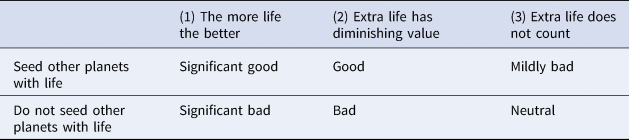
Moreover, views that do not support creating and engendering new life do not argue that it is bad to bring life into existence (ceteris paribus). Assuming that someone regards life as valuable, she might be committed to one of three positions regarding additional units of life. Either she believes that (1) the more life, the better; or that (2) additional life has diminishing value; or (3) additional life neither makes outcomes better nor worse.Footnote 22 If she is uncertain about which view is correct, she faces moral uncertainty. This moral uncertainty suggests that she has rational reasons to support planetary seeding, given that no reasonable view prohibits creating new life (ceteris paribus). If she assigns some credence to views (1), (2) and (3), her decision is simplified as illustrated in Table 1. The option ‘Seed other planets with life’ yields more positive value across the different views and yields a negative value only in the case of (3) – extra life does not count – because there are only costs for the society from wasting resources on planetary seeding. One could argue, though, that even the true costs would not be so high because the research for and development of directed panspermia would probably advance science and technology in ways that would benefit humans elsewhere.
Decision situations in which the agent is uncertain about the value of extra life
One could still press the issue and argue that the preservation of life motivates people only because humans have endangered the natural world. On this view, we have a special obligation to protect and preserve nature but not necessarily an obligation otherwise to protect and preserve living things. This argument may seem appealing, but we can test its intuitiveness by imagining a case in which rare flora and fauna inhabit an island that will soon be covered with lava as a result of a violent volcanic eruption. Even though the species will face a non-human danger, I maintain that many people would be eager to save some of the individual flora and fauna to protect and preserve their species.Footnote 23 By analogy, I argue that, knowing the empirical fact that life on Earth will one day end, we have similar reasons to protect and preserve life by planetary seeding. The only differences in the two cases are the temporal and spatial scales, which, I claim, are not morally relevant enough to affect the reasoning.
Moving organisms to another location for preservation purposes is not novel. Humans have already done so. For instance, in the US, Florida torreya (Torreya taxifolia) have been relocated as a measure against climate change.Footnote 24 This kind of practice is often referred to as assisted colonisation, assisted migration or managed relocation. Footnote 25 While some people are confused by the different terms and definitions regarding intentionally relocating organisms as a part of a conservation approach, the International Union for Conservation of Nature defines assisted colonisation as ‘the intentional movement and release of an organism outside its indigenous range to avoid extinction of populations of the focal species’.Footnote 26 According to this definition directed panspermia is a form of assisted colonisation. Of course, the length of migration typically associated with assisted colonisation is measured in hundreds of kilometres, whereas that of planetary seeding would be measured in astronomical units, light years or parsecs. Additionally, the focus would be on the preservation of life in general, rather than a particular species. Otherwise, there is not much difference according to the definition above.Footnote 27
To recapitulate, the argument of the favourable case goes as follows. By combining the premises:
(1) Earth can sustain life for 1 to 3.5 billion years more. However, life could continue to exist in our galaxy for a much longer time if it exists in a new solar system.
(2) Life is valuable in itself. Or, it is better that life exists than not.
(3) Life is possibly rare in our galaxy.
(4) Existential risks threaten the future of humanity, and hence, the possibility of directed panspermia,
we can conclude that:
Conclusion: humanity has a prima facie duty to spread life to other solar systems.
The argument for the favourable case depends heavily on premises 2 and 3. Therefore, a more fine-grained analysis is needed. Premise 2 is not a universal truth but an axiological view. Depending on what value theory people consider correct, there are many opposing views in environmental ethics. Premise 3 is based on the empirical possibility that life is rare in the universe. This might not be the case. Space is filled with a staggering number of stars and planets. So, the universe could be rich in life. As of May 2021, scientists have confirmed over 4,700 exoplanets and new discoveries are constantly being confirmed.Footnote 28 On Earth, organisms, namely extremophiles, have been found to survive in various extreme conditions and environments normally considered hostile for life. Hence, life could survive elsewhere, even on an exoplanet with conditions that are typically unfavourable for life. As the search for extraterrestrial life continues, we may eventually discover that terrestrial life is not alone. Moreover, life could be common throughout the universe, though less complex than on earth. Perhaps the Great Filter is at an early stage making it improbable for complex life to emerge.Footnote 29 If so, then Earth's life would be unique insofar as it is more complex than most life in our galaxy. In this case, one could design a life-propagating mission such that life would have an evolutionary head start at a target planet and propel its evolution.Footnote 30 In the next section, I analyse under what conditions our prima facie duty to spread life to the cosmos holds; I also sketch out a more detailed account of the question at hand.
3. Framework for evaluating interplanetary life-seeding
In the previous section, I outlined an argument for the claim that we should seed other worlds with life. This argument for the favourable case leans heavily on two assumptions: that the existence of life is valuable and that life is possibly rare in our galaxy. One may challenge either assumption.
In what follows, I analyse how the desirability of an interstellar life-seeding mission depends on two variables (premises 2 and 3 of the favourable case). I will articulate three different possibilities of each variable. First, what is the correct value theory in environmental ethics: anthropocentrism, strong biocentrism or weak biocentrism? Anthropocentrism assigns intrinsic value solely to human beings and, therefore, is only interested in promoting human interests or well-being. If non-human living things have moral value, it is merely instrumental for some human value. Strong biocentrism claims that all living things have intrinsic value.Footnote 31 By contrast, weak biocentrism offers a moderate position between strong biocentrism and anthropocentrism. This means that here I postulate weak biocentrism to represent a cluster of views that are exclusive compared to strong biocentrism and positions somewhere between anthropocentrism and strong biocentrism. A proponent of weak biocentrism could claim that only complex life forms, for example sentient life or life forms with a certain level of biological complexity, are intrinsically valuable. Hence, more simple life forms would be outside the realm of moral consideration. Initially, I will focus more at an individual level, but later in the section I will discuss holistic theories of environmental value.
The second issue that determines the desirability of an interstellar life-seeding mission is the empirical question about how common life is in our local universe: is life rare or is the universe full of life (that we have not yet found)? The third and intermediate option is that, across the galaxy, primitive life (e.g. bacteria) is quite common but more complex life is rare. With these possibilities in mind, we can start mapping the conditions under which planetary seeding might be desirable (Table 2).
A framework for defining the desirability of directed panspermia
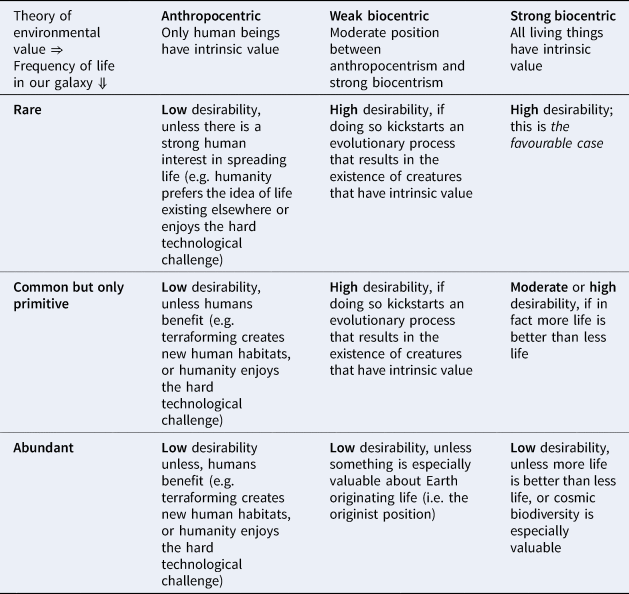
Anthropocentrism offers a rather low value for the desirability of directed panspermia regardless of the status of life in our part of the universe because it is unlikely that disseminating life will benefit humans greatly. Nevertheless, under anthropocentrism, humanity might wish to spread life if people have a strong interest to do so. This interest might stem from enthusiasm to take up a difficult challenge just for its own sake or from an interest to ease cosmic loneliness.Footnote 32 The desirability of directed panspermia, from an anthropocentric perspective, is contingent because humanity's values may change over time. We might find shared meaning and a sense of purpose in planetary seeding; it would then have significant value for humanity. The strongest, anthropocentric reason for directed panspermia would be to terraform a planet so that humanity could eventually then settle it. Currently, this reason would justify using simple life to terraform planets in our solar system. However, it would not justify a robotic seeding mission beyond our solar system because, until crewed interstellar spaceflights are practical, humans could not reach the terraformed planet. Altogether, in my estimation, anthropocentrism does not provide strong support for directed panspermia. It may even advise against it insofar as it could be wrong to allocate substantial resources to a project that would not contribute to the well-being of humanity. If we consider existential risks, the conclusion becomes stronger. In an anthropocentric framework, a top priority is the reduction of existential risks because they threaten the most valuable things – humans.Footnote 33 The anthropocentrist could argue that given current existential risks, planetary seeding would be a waste of resources.Footnote 34
If we adopt weak biocentrism as our guiding axiology, a life-seeding mission presents itself as desirable, especially if life is rare in our part of the universe or if only primitive life is common. Furthermore, the aim of the life-spreading mission should be to kickstart an evolutionary process that creates life that weak biocentrism considers valuable. Depending on the strength of the weak biocentrism to which one is committed, this can be anything from eukaryotes to sentient beings to sufficiently intelligent beings.
In the case that our galaxy is full of life, weak biocentrism weights the desirability of directed panspermia low unless there is special value about life originating from earth. This position is called originism: that life forms that share a common origin with us – the same biological lineage – possess something (morally) important.Footnote 35 Whether the originist position is justifiable cannot be addressed here.Footnote 36 Instead, I will settle for showing that, even if life is abundant in the universe, we could still find reasons to transmit earthly microorganisms to exoplanets. Some version of an originist position might motivate us to save terrestrial life out of kinship, given that all life on Earth came from a single source. Originism would provide an ethical justification for promoting especially terrestrial life regardless of the status of extraterrestrial life.
Strong biocentrism is incompatible with any originist position insofar as strong biocentrism is universal: all living things are (equally) valuable independent of humans.Footnote 37 It is slightly unclear what view on planetary seeding a strong biocentrist would accept if the universe is full of life. A strong biocentrist could claim that directed panspermia is futile because all life is valuable and our galaxy is already full of these value-carrying entities. What, then, is the point of adding more life to the cosmos? Or, a strong biocentrist could maintain that, insofar as all life is valuable, more life is better than less life (ceteris paribus) and directed panspermia is desirable because it creates an enormous amount of new life.
On the other hand, a strong biocentrist could claim that she is not interested in maximising life per se but instead finds biodiversity valuable. Then, planetary seeding could be seen desirable if it fosters cosmic biodiversity.Footnote 38 This would especially be the case if only simple life is common in the universe because we could seed exoplanets with the aim of bringing forth complex beings and further increase diversity. However, valuing biodiversity does not necessarily require that we should artificially increase it. Perhaps artificially created biodiversity does not possess the value we traditionally assign to (natural) biodiversity.Footnote 39 It should be noted that from a biodiversity perspective directed panspermia runs the risk of preventing potential life from emerging at the target planet. This potential life may be totally different from life on Earth, and if we value diversity, this potential extraterrestrial life would be more valuable than life originating from Earth. This concern, though, depends on the rate at which abiogenesis occurs on habitable planets and this risk can be minimised by targeting planets that are habitable but sterile. Claudius Gros has suggested that habitable M-dwarf oxygen planets might be environments in which life cannot emerge (because of primordial oxygen) but could otherwise thrive.Footnote 40 Such exoplanets would be ideal targets for directed panspermia.
Finally, on the strong biocentric case if life happens to be rare we essentially get the favourable case. We also would have extremely strong reasons for seeding other planets with life.
So far, I have only focused on individualistic theories of environmental value. So, a brief discussion of holistic views is needed. Holistic theories of environmental value, rather than focus on individuals, emphasise the value of ecological wholes. If applied straightforwardly, directed panspermia would be desirable insofar as planetary seeding would create whole new biotic communities that support life. This, without a doubt, might rely on a simplistic understanding of holistic views and directed panspermia. This is because, according to J. Baird Callicot and Charles S. Cockell, holistic theories, such as Aldo Leopold's land ethic, can be Earth-centred and tribal in nature.Footnote 41 Therefore, a land-ethical holism would not necessarily see much value in extraterrestrial biotic communities. Also, if a holistic view is understood more broadly, one can also respect inanimate objects, such as rivers and mountains. This respect could then be extended to exoplanets. Holmes Rolston III has argued that nature's ‘projects’ that have formed integrity are valuable and, thereby, deserve our respect. Rolston argues:
Analogously to the way in which it is arrogant anthropocentrism for humans to value themselves and disvalue jumping spiders, it is Earth chauvinism for Earthlings to value Earth and disvalue Jupiter. Both the jumping spider and Jupiter are formed in the wonderland of projective nature. There are disanalogies with which we must deal: a jumping spider has organic integrity; Jupiter has site integrity. But both are projects with their glory.Footnote 42
Respect for nature's projective value might render planetary seeding unethical because doing so would fail to respect the natural value of the target planets. Then again, we could argue that planets with life are more valuable than lifeless planets, even though we agree that we should also respect lifeless planets for themselves. Cockell argues in this way by deploying thought experiments to draw out readers’ intuitions. Suppose you must choose between creating a life-bearing world or a lifeless world. Which one would you create? Or, suppose you must destroy a planet with life or one without. Which one would you destroy? According to Cockell, most of us would prefer creating a world with life and destroying one without, so ‘[t]hese thought experiments suggest that life-bearing extrasolar planets are more valuable than lifeless ones’.Footnote 43 If this conclusion is reasonable, then the value of directed panspermia depends on whether the genesis of life on a planet affects the value of the planet's biotic community. I suspect it could go either way. For example, Robert Elliot has criticised the idea that environmental engineering can restore the value of nature.Footnote 44 Possibly origin matters and the same would apply to world-creation via planetary seeding.Footnote 45 On the other hand, if we were to discover that life did not spontaneously emerge on Earth but instead primordial life was sent to Earth by an early extraterrestrial civilisation, would we have any reasons to value our biosphere less?Footnote 46 Answering the question affirmatively would, at the very least, be a surprising conclusion. Therefore, holistic views of environmental values both support and oppose planetary seeding.
We may not have any assurance on the status of life in our galaxy for quite some time. We may never know whether we are alone. Moreover, we lack consensus about axiological questions related to life and its different forms. However, in this section we explored cases (in addition to the favourable case) in which we could achieve a lot of good if we propagate life outside our solar system. At the same time, the future of humanity is uncertain. Under this current epistemic and moral uncertainty, we should spread life to outer space because otherwise we might fail to generate an enormous amount of good. Then again, by spreading life – in the worst case presented in this section – we add life to a cosmos already full of life and the harms are mainly the resource costs associated with the dissemination missions.
Next, I consider two ethical objections for planetary seeding. I argue that these objections tip the scale (at least for now) against directed panspermia. The objections, however, are not definitive, so further research is required.
4. Ethical objections to directed panspermia
In the previous section, I outlined a framework for evaluating the desirability of seeding other planets with life. The desirability depends on which theory of environmental value we adopt and on how common life is in our corner of the universe. Accordingly, there are at least three cases in which seeding other worlds with life seems desirable. Because the expected value in these cases is so tremendous, we ought to favour directed panspermia. The cases that do not support disseminating life, though, do not strongly forbid it. Hence, in our current epistemic and morally uncertain situation, spreading life to other solar systems seems desirable. Nonetheless, we ought to evaluate planetary seeding critically. Interstellar seeding would be a massive project with potential consequences lasting for aeons. The repercussions could be extremely bad if things go wrong.Footnote 47 Hence, naive techno-optimism cannot ground such a major effort. The burden of proof is simply too high. Next, I consider two ethical objections that put brakes on humanity's cosmic preservationism.
4.1 Interfering with local biota
Thus far, the most critique directed panspermia has received focuses on the possibility of interfering with local biota.Footnote 48 This shows that this debate relates to the larger discussion about human activity more locally in space. Planetary protection protocols exist partly because we worry that, while exploring celestial objects in our solar system, we might interfere with indigenous life elsewhere. The Outer Space Treaty stipulates that harmful contamination of space and celestial bodies should be avoided. The primary strategy to avoid harmful contamination (i.e. accidentally spreading life) is to carefully clean and sterilise hardware and spacecrafts that operate in situ. Directed panspermia involves a risk of harming possible indigenous life to an even greater degree. If our motivation for directed panspermia is grounded in either assigning moral value to life or protecting life in general, then life-seeding missions could turn catastrophic especially if they obliterate life on other planets. Those who hold a strong originist position will not necessary be persuaded that this is a problem. Otherwise, we need to account for this serious ethical issue.
Contaminating other planets with terrestrial life might result in enormous amounts of harm. Moreover, if the local lifeforms are sentient, the results might involve immense amounts of suffering. Terrestrial life might infect indigenous life or compete with it for the same ecological niche. We know too well what invasive species can do when introduced to new environments. Consider for instance the many invasive species that damage the ecology of Australia, such as the European rabbit (Oryctolagus cuniculus) and red fox (Vulpes vulpes). Nevertheless, a technical solution might address this objection. We could minimise the chance of a disaster by targeting newly formed planets because local life would not have had time to emerge. Or, as Gros has suggested, we could target habitable but sterile oxygen planets.Footnote 49 We may even equip probes with technology that could after arriving closer to the target planet identify (to a certain level of accuracy) whether there are traits of life and decide accordingly whether to proceed or abort the mission.Footnote 50
Tony Milligan has argued that planetary seeding would be justified if minimal constraints are met. These minimal constraints are primarily technological and epistemic, which he summarises as: ‘[w]e would need to know that the bacteria we send do not constitute a significant threat’.Footnote 51 Nonetheless, such constraints may be challenging to satisfy considering that it is not easy to determine whether a planet is lifeless. But at least Milligan does not completely rule out directed panspermia. He also notes that his constraint is a matter of degree because our situation may change. For example, if the level of existential risks were to rise, the degree to which the constraint should be met would change as well. What can be concluded is that, if we could overcome (to a satisfying degree) the challenges related to ensuring that directed panspermia would not constitute a significant threat, then transferring fragments of life to other planets is something humanity should consider.
4.2 The risk of suffering
The second ethical objection raises an even more vexing problem. Its proponents maintain that we should not send life to other planets because doing so increases the net suffering in our galaxy immensely.Footnote 52 This objection relates to recent discussions about wild animal suffering and claims that if wild animals on Earth suffer in great measure, the same would probably occur on exoplanets and, thereby, multiply the suffering in our galaxy.Footnote 53 This argument depends on the claim that microorganisms that seed life on exoplanets could in the long run evolve into sentient beings whose lives – similar to sentient wildlife on Earth – could contain more suffering than happiness.
This objection challenges a commonly held but idealistic view of terrestrial nature. Nature is often thought to be valuable either intrinsically or instrumentally. Additionally, when we think about animals in the wild, we tend to think about big vertebrates living happy lives. But, as Oscar Horta has argued, ‘Most animals are not big vertebrates, most of them never reach adulthood, and, in most cases, their lives contain little more than suffering.’Footnote 54 This suffering occurs because of predation, starvation, disease and other things that typically cause suffering and death in wild animals. Moreover, the most common reproductive strategy in nature is r-selection. R-selection species give birth to many offspring with a short life. They compensate for the short survival rate of individuals by creating a lot of individuals so that genes are transmitted successfully. For example, trout (Salmo trutta) lays on average 200–6,000 eggs and bullfrog (Rana catesbeiana) 6,000–20,000 eggs per reproductive season.Footnote 55 Only a handful reach adulthood. Although many never develop sentience, the number of eggs that do is still very high. And most that become sentient will either starve or be killed by other animals and so are likely to have painful deaths. Consequently, for a vast majority of individuals their lives contain a lot of suffering, making the lives of these animals net negative by large.Footnote 56 Since there are so many of these animals in the wild, the balance between value and disvalue in terrestrial nature seems to skew towards there being far more suffering than happiness.
This view also challenges biocentric views because it assigns moral value or disvalue to states of welfare – pleasure, pain, happiness, suffering, and so on – rather than to individuals. Hence, only life that experiences positive net welfare is good. As I see it, this view does not directly challenge anthropocentrism because I believe human lives are on average net positive, contra some anti-natalist views. The risk of suffering objection is especially devastating for suffering-focused ethics, which maintains that our moral priority is to reduce suffering. Furthermore, symmetrical value theories (e.g. classical utilitarianism) also face this objection if nature overwhelmingly involves suffering. Earlier I pointed out that, given the vast scope of the future, it is possible to create an enormous amount of value. However, this length of time also entails the possibility of enormous disvalue. The risk of suffering objection illustrates this quite well. An action that affects the far future in a way that, instead of creating value, creates disvalue leads to a terrible conclusion naturally. Therefore, when our actions affect the course of history for a long time, we need to be particularly sure that our actions have good consequences.
In response to the risk of suffering objection, one could argue that a galaxy with life is better than one without life precisely because of this feature. According to this line of thought, a galaxy with life would be better as a whole simply because there is life, even if there were more suffering than happiness. However, this response fails to convince those who are worried about suffering, to begin with, unless one is a value pluralist and assigns a very significant and high value to life's existence.
Whether suffering dominates terrestrial life is, of course, still debated.Footnote 57 Furthermore, it is uncertain that a similar evolutionary trajectory would occur on an exoplanet seeded by terrestrial microorganisms. Perhaps, consciousness or the dynamics of suffering on Earth are an unfortunate anomaly. However, its occurrence on Earth suggests that it could happen elsewhere. More research is required to explain whether (a) suffering prevails in terrestrial nature, and (b) if so, whether suffering would dominate life on an exoplanet following directed panspermia.Footnote 58 And, research should determine (c) whether could we seed planets in such a way that minimises the risk of suffering.
After considering these two ethical objections, the case against planetary seeding seems compelling enough to warrant a strong degree of caution. But these objections are not definitive, and the possible benefits are so high that a total rejection is not warranted. Ensuring, to a satisfying degree, that planetary seeding does not constitute a significant threat to local life elsewhere involves technological and epistemic issues that may be resolved. The problem about suffering may be more difficult to address, and current research cannot resolve it: nature may not be mostly suffering or, perhaps, we could find a way to minimise the risk of suffering. For the time being – until further research settles some of the empirical questions – we should set aside our mantle as cosmic stewards. Still, directed panspermia could be an extremely good thing, especially if life is valuable and rare in our galaxy. Therefore, I urge further research on these questions. I am hesitant to draw a stronger conclusion about planetary seeding because there are many empirical questions in play to which philosophical research cannot give answers. Nonetheless, if we were sufficiently confident that life is rare in our galaxy, that directed panspermia would not pose a significant threat to life elsewhere and that suffering would likely not dominate on the target planets, then we would have a robust case for directed panspermia.
5. Conclusion
Sending life to distant exoplanets via probes packed with a biological payload, a payload selected and designed to maximise its survival in the target environment, may sound like science fiction. Yet, no good theoretical reasons prevent it from becoming a reality in the future. Because it is a real possibility, we ought to explore whether humanity should strive for such a future, especially given that existential risks cast a shadow on humanity's prospects.
I have argued that planetary seeding would produce an astonishing amount of good if the continuity of life (or a certain type of life) is valuable, and if life is rare or only simple life is common in our corner of the universe. At the same time, directed panspermia faces two major ethical challenges: the potential of interfering with life indigenous to the exoplanets and the risk of creating a considerable amount of suffering. I argued that, in theory, the risk of harming local biota can be reduced through technological and scientific innovations, so this objection is not devastating for the permissibility of directed panspermia. However, the risk of suffering objection constitutes a serious ethical problem – planetary seeding may be extremely good or it might be a moral disaster – depending on one's moral theory. Until we have identified a satisfying resolution of this predicament, humanity should abstain from any acts of cosmic preservation. We need more research on animal welfare and the value of life in the universe.Footnote 59
Competing interests
The author declares none.


 Open access

