


INTRODUCTION
Once introduced, pneumonic plague typically spreads quickly in an urban environment. While such outbreaks continue to occur in developing countries, they are not often observed in developed countries. Although the risk to developed countries has apparently increased due to bioterrorist threats, the lack of experience with such outbreaks in non-endemic areas may delay detection. The World Health Organization (WHO) [1] estimated that an aerosol of Yersinia pestis (Y. pestis) released outdoors over a city of 5 million people could result in the deaths of 36 000 people. Stenseth et al. [Reference Stenseth2] have emphasized that because little remains known about plague dynamics in its natural reservoirs, and climate changes may increase risk in both endemic and new regions, there should be concern about increased risk to humans.
The purpose of this paper is to summarize disease information from the literature on pneumonic plague infection with an emphasis on the earliest possible clues for detection, prior to laboratory confirmation, of a pneumonic plague outbreak or bioterrorist attack. Syndromic surveillance systems [Reference Lombardo3] use sophisticated algorithms to look for unexpected changes in this prodromic or pre-diagnostic information available in electronic health data from a variety of sources, with the premise that such pre-diagnostic information may provide earlier indications of a disease outbreak rather than waiting for a confirmed diagnosis. The name syndromic comes from the fact that the early versions of these systems organized these data by grouping records with similar symptoms into so-called syndromes. The syndrome definitions used by such systems may have significant impact on the positive predictive value and sensitivity of such systems [Reference Guasticchi4]. For example, use of an influenza-like illness case-definition has been shown to miss cases of confirmed influenza in hospitalized patients [Reference Van der Hoeven5, Reference Babcock6]. To help mitigate these limitations, new syndromic surveillance systems have been developed in which the user can query for specific combinations of pre-diagnostic data, so that they are no longer limited to a hardwired syndrome definition [Reference Hashemian7]. These queries can be saved and reused as needed. New syndromic surveillance systems [Reference Buckeridge8, Reference Mnatsakanyan9] are also beginning to take advantage of electronic medical records (EMRs) that contain laboratory and radiology requests. Even before the results of these requests are known, the fact that the health records show that the physician has made such requests of various types may be an early indicator of greater severity of the illness being observed [Reference Mnatsakanyan9, Reference Babin10]. Syndromic surveillance systems continue to advance and incorporate new and disparate sources of data. While such systems do not replace traditional surveillance, they may enhance decision-making by epidemiologists by providing them with access to a means of scanning vast amounts of data for statistical anomalies.
First, general background information will be briefly presented on plague and its bacterial agent Y. pestis. Then the Methods used to determine the symptoms and signs of pneumonic plague during the course of the disease will be presented. Because of the relatively small number of reports of human cases of the pneumonic form and because of the potential use of animal data in some syndromic surveillance systems [Reference Babin11, Reference Maciejewski12], relevant information from animal studies will be presented. Following the animal studies, the progression of disease signs and symptoms of pneumonic plague in humans will be described, with an emphasis on providing pre-diagnostic clues useful for syndromic surveillance [Reference Lombardo3].
GENERAL BACKGROUND ON PLAGUE
Y. pestis typically reproduces in the proventriculus of the flea, resulting in a fibrinoid mass that prevents blood from entering the flea's stomach. The hungry flea sucks more blood but, when it tries to swallow the blood, its proventriculus recoils, regurgitating as many as 24 000 bacilli into the victim's skin, and temporarily clearing its oesophagus to allow nutrition [Reference McGovern, Friedlander, Sidell, Takafuji and Franz13]. While badgers, pigs, mule deer, chipmunks, and tree squirrels may occasionally become infected [Reference McGovern, Friedlander, Sidell, Takafuji and Franz13], plague is enzootic in rats, prairie dogs, ground squirrels, gophers, mice, marmots, and voles [Reference Johnson, Thorn, Adams, Braunwald, Isselbacher and Petersdorf14]. Enzootic infection refers to a relatively disease-resistant host that maintains long-term survival of the bacilli. When the disease is in its enzootic state, the fleas are content with their primary hosts and usually do not seek other food sources. Epizootic infection occurs when large numbers of these primary hosts die of the disease, forcing the hungry fleas to seek other hosts. Epizootic plague activity shows a peak during or just after a multi-year period with cooler than normal temperatures and heavier than normal rainfall [15]. A recent study suggests that natural plague outbreaks may become increasingly more common as a result of climate change [Reference Stenseth16]. The majority of human plague cases in the USA are seen during April–September. Off-season increases in human plague infection are often seen during the hare- and rabbit-hunting season of October–February [17].
Human plague infections most commonly occur following the bite of an infected flea. Typically, this is preceded by large die-offs of rats followed by the movement of the fleas from their dead hosts to humans, with subsequent outbreaks of the disease in humans. The 1994 pneumonic plague outbreak in India was preceded by a large urban rat die-off occurring a few weeks earlier than the first reported human case [18, Reference John19]. The most common form of plague acquired from rat fleas is bubonic plague, although a small number of people develop primary septicaemic plague. Bubonic plague is distinguished by the early development of greatly enlarged lymph nodes, primarily in the inguinal and femoral regions because these drain the most common location of the flea bite. Sometimes, usually in children, enlarged lymph nodes occur in the cervical or axillary regions because their flea-bite locations may be more superiorly located than in adults. The area of enlargement is called a bubo and consists of a firm matted group of lymph nodes measuring 2–5 cm in diameter, although it may be even larger. The primary septicaemic form of plague is actually a variant of the bubonic form in which sepsis occurs before lymphadenopathy [Reference Johnson, Thorn, Adams, Braunwald, Isselbacher and Petersdorf14]. McGovern & Friedlander [Reference McGovern, Friedlander, Sidell, Takafuji and Franz13] report that the only symptom that appeared more frequently in septicaemic than in bubonic plague was abdominal pain, which occurred in about 40% of patients with septicaemic plague. Neither bubonic nor septicaemic plague spreads from person to person. Around 5–15% of people with bubonic or septicaemic plague develop pneumonic plague [Reference McGovern, Friedlander, Sidell, Takafuji and Franz13], in which fulminant pneumonia eventually predominates. Unlike the other forms of plague, pneumonic plague can be spread person-to-person by respiratory droplets and is considered very contagious. The degree of secondary spread is a function of living conditions (e.g. sanitation, crowding) and is typically limited to close contacts (those that spend some time unprotected within 2 m of the victim).
METHODS
A detailed search of PubMed, WHO, and Centers for Disease Control and Prevention (CDC) publications (originally in or translated into English language) over the last 100 years was performed to identify reports about the clinical course and epidemiology of pneumonic plague. The primary search term was ‘pneumonic plague’ although the articles were further confined to those involving the clinical presentation and progression and to the epidemiology of confirmed outbreaks of pneumonic plague. Because syndromic surveillance systems primarily use pre-diagnostic data, selection criteria for relevant articles included an emphasis on the earliest signs and symptoms and their progression in time. This approach has the additional benefit of providing the clinician with clues for early recognition of this typically fatal disease in their patients. Information relevant to the early clinical course and presentation of pneumonic plague was derived from this literature review and is summarized in the Results section. Because of the scarcity of human pneumonic plague reports available and because syndromic surveillance systems may use animal data as sentinels, animal studies were also examined.
RESULTS
Pneumonic plague: animal studies
The results of studies that exposed rodents and primates to Y. pestis via the oral, intradermal, subcutaneous, and intravenous routes showed that as few as 1–10 bacilli were sufficient to cause infection. For the respiratory route, studies in non-human primates suggest an infective dose varying from 100 to 20 000 bacilli [Reference McGovern, Friedlander, Sidell, Takafuji and Franz13]. Speck & Wolochow [Reference Speck and Wolochow20] exposed 182 Macacus rhesus monkeys to varying dosages of plague bacilli in aerosol form via an atomizer. They determined that, while an occasional animal was resistant to enormous bacilli doses for unknown reasons, the LD50 (single dose that is lethal for 50% of a sample population) for Macacus rhesus exposed to infectious plague aerosols was 20 000 inhaled bacilli. It should be borne in mind that the LD50 is not equivalent to the minimum infective dose.
Meyer [Reference Meyer21] described work by Martini [Reference Martini22, Reference Martini23] and Strong et al. [Reference Strong, Crowell and Teague24] in exposing guinea pigs to sprays of suspended plague bacilli. At necropsy, over one quarter of the guinea pigs had pneumonia while the remaining 75% had cervical lymphadenitis and tracheobronchitis followed by fatal septicaemia. While Martini [Reference Martini22, Reference Martini23] and Strong et al. [Reference Strong, Crowell and Teague24] could not fully explain the lack of pneumonia in their results, later studies showed that it was largely due to the size of the aerosol particles and the anatomy of the guinea pig. Particles smaller than 1 μm resulted in pneumonia, while larger particles adhered to the upper respiratory epithelium and led to cervical lymphadenitis. Interestingly, the cervical lymphadenitis resulted in septicaemia sooner than the pneumonia. The guinea pig is a nose-breathing animal whose respiratory tract prevents particles larger than 4 μm from reaching the lungs.
Studies of pneumonic plague in mice [Reference Meyer21] produced results similar to those in guinea pigs. Studies of marmots exposed to sprays of Y. pestis suspended in saline produced a mortality rate of 100%. However, only 5 out of 13 had primary pneumonic plague while the remainder had primary septicaemia. Meyer [Reference Meyer21] noted that this was similar to the 1920–1921 Manchurian pneumonic plague outbreak in humans, with tracheobronchial lymph node involvement but few lung lesions. Secondary transmission from marmots with primary pneumonic plague to healthy marmots resulted in septicaemic as well as pneumonic plague.
There have been many cases of humans developing plague from exposure to domestic cats and, of these, almost one third were primary pneumonic plague [15]. Cats appear to be unique among carnivores in that they develop bubonic, pneumonic and septicaemic plague [Reference Watson25]. The signs of plague in domestic cats are similar to those in humans [Reference Werner26, Reference Eidson27]. Because of their high susceptibility and an incubation period slightly shorter than that in humans, cats may make good sentinels for the disease.
Pneumonic plague: humans
Eitzen et al. [Reference Eitzen28] reported a human incubation period of 1–21 days with an average of 3–5 days. Johnson [Reference Johnson, Thorn, Adams, Braunwald, Isselbacher and Petersdorf14] reported an incubation period of 1–12 days and typically 2–4 days. As with any disease, the actual incubation period depends upon the dose of organisms, the route of infection, and the susceptibility of the host. Inhalation or intradermal injection of only ten Y. pestis bacilli can cause human infection [Reference Radostits, Blood and Gay29]. However, Franz et al. [Reference Franz30] report that the human infective dose is 100–500 bacilli in aerosol form via the respiratory route. Asymptomatic oropharyngeal carriers of plague have been identified, but whether they are capable of transmitting the disease has not yet been determined [Reference Johnson, Thorn, Adams, Braunwald, Isselbacher and Petersdorf14].
The largest outbreaks of pneumonic plague in humans in the last 100 years occurred in 1910–1911 and in 1920–1921 in Manchuria. Because China solicited international help in fighting these outbreaks, they were intensively studied by a variety of international experts, were well documented, and were confirmed to be pneumonic plague [Reference Wu31, Reference Chernin32]. Wu [Reference Wu31] published perhaps the most detailed review of pneumonic plague, reviewing all known cases until that time. In addition, Dr Wu actively participated in treating victims of the 1910–1911 outbreak and was thus able to draw upon his own clinical experiences.
Wu [Reference Wu31] divides the symptomatic period, following the incubation period, into a first stage and a second stage. In the first stage, disease onset is almost always sudden. This stage is often marked by rigor (i.e. chills or shivering fits). It is noteworthy that this stage is characterized by general signs only, with few, if any, respiratory signs and this finding has been repeatedly corroborated by other authors studying subsequent pneumonic plague outbreaks. Indeed, cough is most often absent in this stage and, when present, is usually dry and slight. The primary respiratory symptom is increased respiration rate although it is often within normal limits. Temperature is only slightly elevated initially but continues a steady and slow rise that is considered characteristic. The prominent symptoms during the first stage are severe headache, nausea, vomiting, vertigo, and general malaise. Wu concluded that the nausea and vomiting were primarily of central nervous system origin (presumably from bacterial toxins) because of the general lack of actual gastrointestinal inflammation found post-mortem. Appetite is decreased and thirst is greatly increased. Wu notes that the seriousness of the infection is seldom evident at this early stage. The duration of this first stage is variable, although Wu states it was most often around 24 h in his patients.
The beginning of the second stage described by Wu [Reference Wu31] is demonstrated by the presence of cough. Even at this stage, it is often dry at first but soon brings up sputum. The expectoration is initially scanty and often results in chest pain. Sputum production increases and haemoptysis appears later in the course. Based on experiments with agar and animals, as well as clinical experience, coughing is considered the primary means of transmitting pneumonic plague to others. Once coughing appears, the patient should be considered infectious. The temperature, which has increased steadily from onset, tends to plateau during the second stage (often around 39·4°C/103 F). Respiration continues to increase in frequency and dyspnoea develops. One finding was so common that it was considered characteristic of pneumonic plague: the dyspnoea in the second stage appeared much worse than was reflected by the lung signs determined by auscultation or palpation. A report on 34 autopsies of these victims revealed nine cases in which no pneumonic lesions of any sort were found [Reference Meyer21]. As this second stage continues, the cough worsens and becomes bloodier, dyspnoea becomes more marked, and cyanosis develops. According to Wu's account, death most often was due to heart failure. Death typically occurred so suddenly that it appeared to be painless, as corpses were found in a variety of strange positions.
It is very interesting to note that Wu [Reference Wu31] states that the one acute disease most easily mistaken for pneumonic plague or vice versa was influenza. He cites instances in the late 1800s and early 1900s in which outbreaks thought originally to be influenza were later determined to be pneumonic plague. One distinction that Wu noted was that influenza usually included rhinitis while pneumonic plague rarely did. Moreover, haemoptysis is more common in pneumonic plague than in influenza although, as mentioned above, this is a relatively late sign in the course of the disease. The presence of haemoptysis often leads the clinician to think of tuberculosis before considering pneumonic plague, with the distinction being that the general condition of the patient is more serious than in tuberculosis. In contrast to the more common varieties of pneumonia such as pneumococcal, pneumonic plague is characterized by the marked disproportion between the slight lung findings and the serious general condition of the patient [Reference Wu31]. Localized respiratory symptoms develop much sooner in non-plague pneumonia than in pneumonic plague. Therefore, obvious and more severe lung signs early in the course of the disease should lead the diagnosis away from pneumonic plague and towards more common forms of pneumonia.
The last pneumonic plague epidemic in the USA occurred in Los Angeles during 1924–1925 [Reference McGovern, Friedlander, Sidell, Takafuji and Franz13]. The first victim became ill on 1 October 1924, and presented with a femoral bubo that was diagnosed as venereal disease. He recovered, but his daughter and several neighbours became ill and died. By 28 October 15 people were infected and all died within 3 days. The chief complaints of these patients included stupor, high fever and chills, headaches, and large swellings in the armpit, neck, and groin. By the end of the epidemic in 1925, there had been 33 cases, of which 31 had died [Reference Kohn33]. Interestingly, there were 114 people identified as close contacts of these patients who did not get the disease [Reference Viseltear34]. While this was considered a pneumonic plague epidemic, the presenting signs of nearly half the victims were non-respiratory. Meyer [Reference Meyer21] reported that three of the nine autopsies failed to show any pulmonary consolidation but did show haemorrhagic oedematous lesions of the tonsils, epiglottis and larynx.
According to Eitzen et al. [Reference Eitzen28], symptoms of pneumonic plague include high fever, chills, headache, and malaise, followed by cough, often with haemoptysis. As with many diseases, the ‘classic’ symptomatology is often neither seen in all patients with the disease nor necessarily in the earliest stages. This axiom is illustrated in the following case report [35]. On 22 August 1992 a young man had onset of abdominal cramps. On 23 August he had onset of fever (39·6°C/103 F), nausea, vomiting, severe diarrhoea and cough. On 24 August he presented to his physician with the chief complaints of diarrhoea and vomiting. No abnormal chest sounds were heard and there was no lymphadenopathy. He was treated for gastroenteritis. On 25 August he was hospitalized with cyanosis, septic shock, and lobar pneumonia. He died 24 h later. Ante-mortem blood and urine cultures were culture negative. After the patient had died, an ante mortem sputum sample was examined by a rapid microbiological test, which identified the organism as Yersinia pseudotuberculosis. However, 1 week later, biochemical tests of the same sample identified the organism as Y. pestis, which was confirmed by the CDC. Investigation by county public health officials determined that the patient had become infected on 19 August through respiratory exposure to an infected domestic cat that the patient had removed from a crawlspace of a friend's house. The cat had submandibular and oral lesions consistent with feline plague and died on 19 August. A dead chipmunk found nearby tested positive for Y. pestis. A nearby rodent die-off was also evident. It should be noted that while this patient had respiratory symptoms, his chief complaints were gastrointestinal. A similar presentation of primary pneumonic plague with prominent gastrointestinal symptoms (nausea, vomiting, abdominal pain and diarrhoea) occurred in California [Reference Werner26].
Therefore, while pneumonic plague typically includes respiratory symptoms such as cough and dyspnoea, these appear relatively late in the course of the disease and, even then, clear-cut pulmonary signs are often not found during auscultation [Reference Johnson, Thorn, Adams, Braunwald, Isselbacher and Petersdorf14]. Chest radiographs of pneumonic plague victims are highly variable and abnormal findings frequently non-existent, although bilateral alveolar infiltrates appear to be most common [Reference Alsofrom, Mettler and Mann36].
DISCUSSION
Based on a review of case reports and epidemiological studies described above, a likely progression of a pneumonic plague outbreak is shown in Table 1. After an incubation period of about 2–5 days, the first stage of the disease presents with mostly gastrointestinal symptoms. As noted above, plague has been diagnostically confused with gastroenteritis, influenza, muscular injury, and venereal disease. Pulmonary signs are initially non-existent, except for a slight increase in respiration. Inglesby et al. [Reference Inglesby37] indicate that prominent gastrointestinal symptoms, in addition to the typical respiratory symptoms, should be expected in an aerosol attack. Studies of aerosol exposure in animals described earlier in this paper illustrate that such exposure may result in plague presentations other than just the pneumonic form.
Order of appearance of key signs and symptoms of pneumonic plague

After about 24 h, the second stage begins with the development of a dry cough. During this stage, respiratory signs become increasingly prominent. However, respiratory discomfort appears out of proportion to the minimal respiratory signs, and the condition of the patient deteriorates rapidly after coughing develops, leading to dyspnoea, haemoptysis, cyanosis, and sudden death. By the time significant respiratory signs have arisen, the patient's condition would rapidly deteriorate.
There are several ways in which the above information can be used in syndromic surveillance systems. If the system utilizes pre-diagnostic hospital emergency department (ED) data, then combinations of the chief complaints listed in Table 1 could be queried. If the syndromic surveillance system uses EMR data, then associations may be found between these chief complaint combinations and increases in physician requests for laboratory tests and chest radiographs. Note that detecting an increase in laboratory and radiograph requests above expected levels does not require waiting for the test results. If the system uses animal data in addition to human data, then the presence of unusual numbers of sick or dead animals of certain species (e.g. cats, chipmunks) would be an additional clue [Reference Babin11, Reference Maciejewski12] (see Table 2).
Database queries and corroborating evidence that may be useful in early detection of pneumonic plague
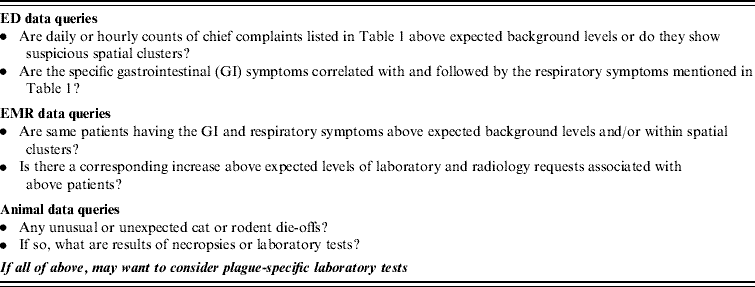
Note that queries for text data may use synonyms and wild cards to account for different ways of stating the same pattern of symptoms.
It should also be noted that a deliberate aerosol release may infect the rodent population and thereby their fleas, which may lead to the emergence of human bubonic and septicaemic plague alongside the pneumonic form. There have been cases of bubonic plague in which the typical buboes were absent, but pulmonary and gastrointestinal symptoms were present. In several case reports of bubonic plague, the patients were initially diagnosed with muscular injuries and treated with anti-inflammatory drugs [38]. When buboes were present, they were sometimes mistaken for venereal disease (although the same antibiotic, tetracycline, may be effective for both). It is also interesting to note that, in both cultures and other laboratory tests, Y. pestis is frequently confused with Y. pseudotuberculosis and both organisms are capable of causing human disease. Y. pseudotuberculosis is closely related to Y. pestis and a recent study suggests that Y. pestis evolved from it [Reference Chain39]. In contrast to Y. pestis, Y. pseudotuberculosis causes nausea, vomiting, and diarrhoea from direct gastrointestinal inflammation rather than central nervous system effects.
CONCLUSIONS
In untreated cases, the mortality rate for pneumonic plague may be as high as 95–100% [Reference Wu31]. However, the spread of the disease is primarily among close contacts during the coughing stage of the victim. Dependent on how crowded, damp, and lacking in sunlight the conditions are, the infectivity may be as high as 70%. In addition, the presence of immunocompromised individuals in the population may increase the infectivity and subsequent spread of the disease.
The purpose of this report is to review the available literature on pneumonic plague in order to determine the earliest diagnostic clues to a possible pneumonic plague outbreak. These clues may then be used in syndromic surveillance of pre-diagnostic data and by clinicians. While the name implies that pneumonic plague must emphasize respiratory signs and symptoms, most case reports suggest that gastrointestinal symptoms dominate early in many people with pneumonic plague, presumably from its effects on the central nervous system rather than any direct gastrointestinal inflammation. When respiratory symptoms do develop, they are characteristically much worse than the respiratory signs would indicate. Therefore, syndromic surveillance systems may contain the earliest indicators of this disease in the gastrointestinal, rather than the respiratory, syndrome category. One way of utilizing this knowledge would be to query the database [Reference Hashemian7] for patients appearing with the specific gastrointestinal symptoms followed by the particular respiratory symptoms noted in Table 1. Because new versions of syndromic surveillance systems are utilizing EMRs [Reference Buckeridge8, Reference Mnatsakanyan9], the presence of an increase in laboratory and radiograph requests in these patients may raise the suspicion further that something unusual, such as pneumonic plague, could be occurring [Reference Mnatsakanyan9, Reference Babin10]. Syndromic surveillance systems that use animal data [Reference Babin11, Reference Maciejewski12] may provide further corroboration if there have been unexpected increases in cat or rodent deaths [35]. By thus examining all these pieces of evidence available from syndromic surveillance systems and elsewhere, the epidemiologist may consider whether to make the recommendation of specific laboratory tests for confirmation or refutation of their suspicion of pneumonic plague.
ACKNOWLEDGEMENTS
The views and conclusions contained in this document are those of the author and should not be interpreted as necessarily representing the official policies, either expressed or implied, of the United States Government.
DECLARATION OF INTEREST
None.



