


Pippard and Ellam (Reference Pippard and Ellam1981) conducted a national survey of the use of electroconvulsive therapy (ECT) in Britain in 1980 and two similar, more limited surveys were conducted in 1991 and 1995 (Reference BenbowBenbow, 1991; Reference Benbow, Tench and DarvillBenbow et al, 1998). Benbow concluded that in Britain there had been little change in practice since the 1980 survey. In 1995 the Royal College of Psychiatrists published The ECT Handbook (Royal College of Psychiatrists, 1995). The clinical practice of ECT by New Zealand psychiatrists in 1999 was surveyed by questionnaire.
The study
New Zealand has a total population of 3.6 million and a slightly larger land area than the UK. The vast majority of psychiatrists work wholly or partly in the public system, with only a handful working solely in private practice. The intention was to survey all psychiatrists in New Zealand. Included were Medical Officers of Special Scale (MOSS), who are doctors working in psychiatry often with lengthy experience but without a specialist qualification. Postal questionnaires were distributed through the Directors of Area Mental Health Services (DAMHS), who are statutory appointees under mental health legislation representing the entire public system of 22 Health and Hospital Services (HHS). The DAMHS from 19 HHSs responded. Questionnaires were also sent to the few psychiatrists who could be identified as working fully privately.
Questions addressed current attitudes to, range of experience of and practice of ECT. Of the 307 questionnaires distributed 184 were returned, giving a response rate of 60%. In one question respondents were asked to rate (often, sometimes, rarely or never) how appropriate they considered ECT to be for a number of psychiatric conditions. The analysis used the same method as both Pippard & Ellam and Benbow et al.
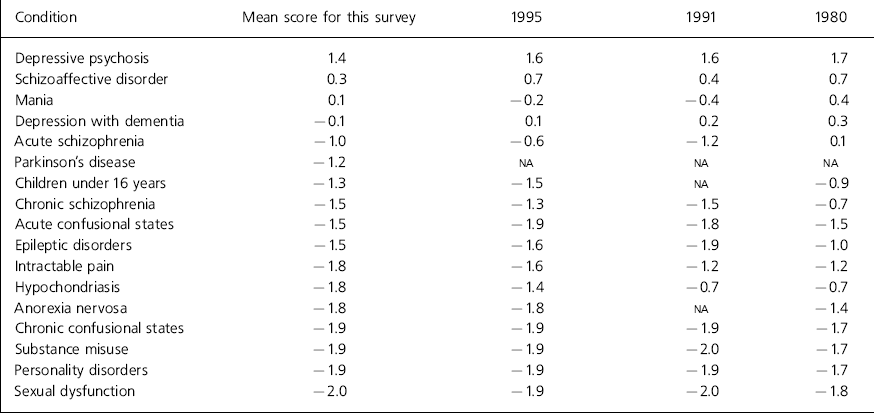
The responses were treated as if they were an arithmetic series, assigning +2 to often, +1 to sometimes, -1 to rarely and -2 to never. A value of 0 was given to any ambiguous or undecided responses. The deviation from 0 was calculated for each condition. A deviation of +2.0 would indicate that all respondents had chosen often and a value of -2.0 would indicate all had chosen never (see Table 1).
Opinions of New Zealand psychiatrists on the appropriateness of electroconvulsive therapy in various conditions, compared with results from surveys conducted in 1995 (Reference Benbow, Tench and DarvillBenbow et al, 1998), 1991 (Reference BenbowBenbow, 1991) and 1980 (Reference Pippard and EllamPippard & Ellam, 1981).
| Condition | Mean score for this survey | 1995 | 1991 | 1980 |
|---|---|---|---|---|
| Depressive psychosis | 1.4 | 1.6 | 1.6 | 1.7 |
| Schizoaffective disorder | 0.3 | 0.7 | 0.4 | 0.7 |
| Mania | 0.1 | -0.2 | -0.4 | 0.4 |
| Depression with dementia | -0.1 | 0.1 | 0.2 | 0.3 |
| Acute schizophrenia | -1.0 | -0.6 | -1.2 | 0.1 |
| Parkinson's disease | -1.2 | NA | NA | NA |
| Children under 16 years | -1.3 | -1.5 | NA | -0.9 |
| Chronic schizophrenia | -1.5 | -1.3 | -1.5 | -0.7 |
| Acute confusional states | -1.5 | -1.9 | -1.8 | -1.5 |
| Epileptic disorders | -1.5 | -1.6 | -1.9 | -1.0 |
| Intractable pain | -1.8 | -1.6 | -1.2 | -1.2 |
| Hypochondriasis | -1.8 | -1.4 | -0.7 | -0.7 |
| Anorexia nervosa | -1.8 | -1.8 | NA | -1.4 |
| Chronic confusional states | -1.9 | -1.9 | -1.9 | -1.7 |
| Substance misuse | -1.9 | -1.9 | -2.0 | -1.7 |
| Personality disorders | -1.9 | -1.9 | -1.9 | -1.7 |
| Sexual dysfunction | -2.0 | -1.9 | -2.0 | -1.8 |
Findings
Of the 184 respondents, 164 were specialists (consultants), 18 were MOSS and two did not specify.
Principal specialities were as follows: general psychiatry (111), child and adolescent psychiatry (20), psychiatry of the elderly (19), forensic psychiatry (18), consultation liaison psychiatry (6), and drug and alcohol dependency, psychotherapy, maternal mental health, rehabilitation, community crisis and intellectual disability (12). Eighty respondents trained primarily in New Zealand, 53 primarily in the UK, 19 in the USA, 15 in South Africa, 6 in Australia and 7 in Canada, India, Sweden or Ireland. Professional affiliations were as follows: Fellow of the Royal Australian and New Zealand College of Psychiatrists (FRANZCP; 99), Fellow/Member of the Royal College of Psychiatrists (F/MRCPsych; 58), United States Board Eligible/Certified (17), South African qualification (9), other (4) or none (17). Twenty had joint affiliation.
ECT guidelines
Eighty-seven per cent of respondents were aware of guidelines to ECT practice and many cited more than one source, these being: Royal College of Psychiatrists (86), Royal Australian and New Zealand College of Psychiatrists (51), American Psychiatric Association (21), local guidelines/protocols (24) and Canadian Psychiatric Association (Reference Enns and ReissEnns & Reiss, 1992) (2).
Attitude to, and prescription of, ECT
Ninety (49%) respondents were strong advocates of ECT, 82 (45%) were generally in favour, 10 (5%) were generally opposed but would use it as a last resort and one respondent said ECT should never be used. No respondent declined an opinion. One hundred and ten (60%) had prescribed ECT in their current post. One hundred and fourteen (62%) could identify a consultant responsible for their ECT service and 63 (34%) could not. Fourteen respondents always administered the ECT they prescribed, 78 sometimes and 80 never. Seventy per cent would give ECT to an unwilling patient.
Routine investigations and information provided before ECT
Routine investigations before ECT were reported as follows: physical examination (100%), urea and electrolytes (92%), haemoglobin (91%), electrocardiograph (77%), chest X-ray (62%), syphilis serology (18%), computed tomography brain scan (10%) and skull X-ray (8%). Ninety per cent routinely gave written information on ECT to the patient and 66% to the family of the patient. Others nominated to receive written information included caregivers, judges, retirement home staff, support workers, ward and community mental health staff, guardians and close friends.
ECT technique and practice
Sixty-five per cent of respondents reported having a brief pulse machine, 2% a sine wave machine and 33% did not know. Fifty per cent would initially use bilateral ECT, 13% right unilateral, 20% unilateral depending on handedness and 17% expressed no preference. Twice weekly treatment was preferred by 50%, thrice weekly by 45% and 5% favoured other regimes. Eighty-eight per cent consider maintenance ECT favourably and 50% had used it. There were several comments about how rarely this had occurred.
Contraindications, morbidity and mortality
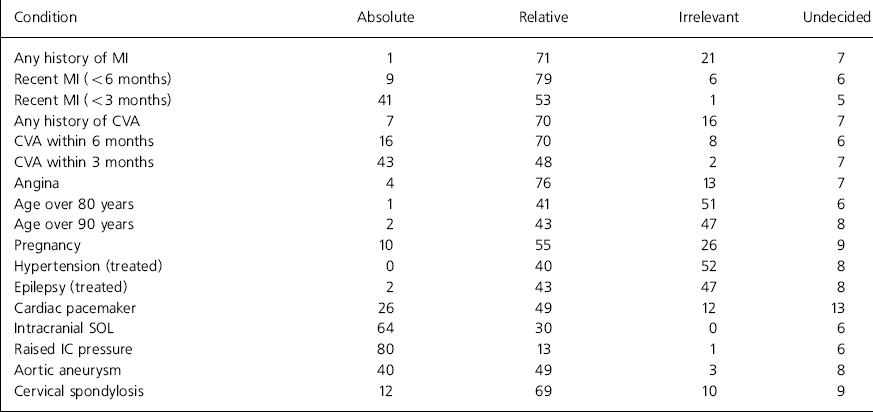
Respondents rated 17 medical conditions as absolute or relative contraindications, or as irrelevant (see Table 2). Three deaths attributed to ECT were reported in the combined experience of the 184 respondents. They were a ruptured cardiac aneurysm, extension of a cerebrovascular accident and presumed ventricular fibrillation during treatment where a defibrillator was not available. Seventeen per cent of respondents had experience of what they considered a major medical complication occurring during ECT. Seven respondents had personal experience of a defibrillator being used. Twenty-three per cent reported difficulty at some time getting an anaesthetic for medically ill people.
Respondents' opinions on contraindications to electroconvulsive therapy (%)
| Condition | Absolute | Relative | Irrelevant | Undecided |
|---|---|---|---|---|
| Any history of MI | 1 | 71 | 21 | 7 |
| Recent MI (<6 months) | 9 | 79 | 6 | 6 |
| Recent MI (<3 months) | 41 | 53 | 1 | 5 |
| Any history of CVA | 7 | 70 | 16 | 7 |
| CVA within 6 months | 16 | 70 | 8 | 6 |
| CVA within 3 months | 43 | 48 | 2 | 7 |
| Angina | 4 | 76 | 13 | 7 |
| Age over 80 years | 1 | 41 | 51 | 6 |
| Age over 90 years | 2 | 43 | 47 | 8 |
| Pregnancy | 10 | 55 | 26 | 9 |
| Hypertension (treated) | 0 | 40 | 52 | 8 |
| Epilepsy (treated) | 2 | 43 | 47 | 8 |
| Cardiac pacemaker | 26 | 49 | 12 | 13 |
| Intracranial SOL | 64 | 30 | 0 | 6 |
| Raised IC pressure | 80 | 13 | 1 | 6 |
| Aortic aneurysm | 40 | 49 | 3 | 8 |
| Cervical spondylosis | 12 | 69 | 10 | 9 |
Medications
The majority of respondents would always or preferably reduce or stop benzodiazepines (81%), anti-convulsants (75%) and monoamine oxidase inhibitors (MAOIs) (69%) and half would stop lithium (50%). Fewer would stop tricyclics (44%), neuroleptics (41%) and selective serotonin reuptake inhibitors (SSRIs) (41%). Eighty per cent routinely used antidepressants as prophylaxis after ECT.
Comment
The large majority (93%) of respondents strongly advocated, or were generally in favour of, ECT for appropriate patients. This corresponds with a 1995 finding of 93% (Reference Benbow, Tench and DarvillBenbow et al, 1998) and is higher than a 1980 figure of 83% (Reference Pippard and EllamPippard & Ellam, 1981). The majority (74%) were affiliated to the Australasian College, the British College or both. The ECT Handbook (Royal College of Psychiatrists, 1995) was the most nominated set of guidelines despite the majority of psychiatrists being New Zealand trained. Only 60% had prescribed ECT in their current post. This is significantly lower than the 83% of Benbow et al's survey (Reference Benbow, Tench and Darvill1998) and probably reflects the more transient nature of part of the New Zealand workforce. Over the past 10 years the shortage of psychiatrists in New Zealand has been addressed by recruiting psychiatrists on short-term contracts, of 1-2 years, mainly from the US and Britain. There has also been the immigration of many South African psychiatrists. The apparent lower overall usage of ECT in New Zealand may reflect attitudinal differences evidenced by comments such as “ECT is underused in our service” (Old age psychiatrist, FRANZCP), “ECT seems less acceptable to New Zealand patients compared to the UK” (MRCPsych) and “Docs [doctors] here need increased education and training in this modality” (US psychiatrist). Sixteen of the 19 (84%) HHSs had a modern brief pulse machine as recommended by The ECT Handbook, compared with 59% of ECT clinics in England and Wales in 1995-1996 (Reference Duffett and LelliotDuffett & Lelliot, 1998). Bilateral treatment would be favoured by fewer New Zealand psychiatrists (50%) than those of north-west England (57%) (Reference Benbow, Tench and DarvillBenbow et al, 1998), with unilateral treatment being more popular (37% v. 22%). New Zealand psychiatrists were markedly less inclined to use a twice weekly regime (50% v. 88%), with 45% preferring the thrice weekly regime favoured in the US.
Table 1 compares the appropriateness rating for the use of ECT in four populations; a 1980 national survey in the UK (Reference Pippard and EllamPippard & Ellam, 1981), old age psychiatrists in the UK in 1991 (Reference BenbowBenbow, 1991), north-west England psychiatrists in 1995 (Reference Benbow, Tench and DarvillBenbow et al, 1998) and New Zealand psychiatrists in 1999. Most ratings were similar, although the generally less negative ratings in 1980 suggest that ECT was used then for a wider range of disorders. The positive score for depression with dementia in both of Benbow et al's surveys is matched by a score of +0.2 for the 19 New Zealand old age psychiatrists. For acute confusional states the score of -1.5 was the same as that of Pippard and Ellam, and higher than the -1.9 and -1.8 of Benbow. ECT is not indicated for general cases of delirium, but repeated reports of its effectiveness have led the American Psychiatric Association Task Force on ECT (1990) to acknowledge delirium as an indication. Higher scoring may represent greater recognition that ECT can be effective in neuroleptic malignant syndrome (Reference Velamoor, Swamy and ParmarVelamoor et al, 1995).
A detailed medical history and full physical examination was the generally acknowledged minimum pre-ECT evaluation. The Royal College of Psychiatrists' guidelines (1995) include a full blood count and urinalysis for blood, glucose or protein. The Royal Australian and New Zealand College of Psychiatrists' guidelines (1999) specify fundoscopy but state that no laboratory investigations are specific for ECT. However, the majority of respondents felt that urea, electrolytes, haemoglobin, chest X-ray and electrocardiograph should be routine, probably reflecting local anaesthetic department practice. The assessment of risk associated with the listed medical conditions (see Table 2) was remarkably similar to that of Benbow (Reference Benbow1991). Differences included New Zealand psychiatrists being more cautious about older age and less so about hypertension. The American Psychiatric Association (1999) and the Royal College of Psychiatrists (1995) guidelines propose that there are no absolute contraindications to ECT. The Royal Australian and New Zealand College guidelines (1999) nominate only raised intracranial pressure. Nevertheless, most respondents indicated many conditions to be absolute contraindications.
New Zealand psychiatrists were notably more in favour of reducing or stopping all classes of psychotropic medication during ECT as compared with psychiatrists in north-west England (Reference Benbow, Tench and DarvillBenbow et al, 1998). The ECT Handbook, however, suggests continuation of an established tricyclic if no change is intended, not stopping an SSRI prior to starting a course of ECT unless a full washout can be achieved, that discontinuing MAOIs is unnecessary and that no special precautions are needed for neuroleptics. Given that ECT is used primarily for depression it is of concern that 20% of psychiatrists would not routinely put a patient on an antidepressant post ECT.
In conclusion, the above findings suggest that guidelines are having insufficient impact on practice.
Acknowledgements
I thank Susan Benbow for allowing me to use her questionnaire, amended to be suitable for New Zealand, and Leanne Finlay for her invaluable secretarial assistance.


 Open access


eLetters
No eLetters have been published for this article.