


Plumes From Leads
Leads and polynyas are regions of open water or thin, newly formed ice that occur in the pack ice of the Arctic Ocean in response to wind and currents. They are climatologically important because in winter heat passes through leads from the relatively warm ocean to the cold atmosphere two orders of magnitude faster than it does through the ubiquitous ice (Reference BadgleyBadgley, 1966; Reference MaykutMaykut, 1978; Reference Andreas, Paulson, Williams, Lindsay and BusingerAndreas and others, 1979).
Several experiments over narrow leads and polynyas (Reference BadgleyBadgley, 1966; Reference Andreas, Paulson, Williams, Lindsay and BusingerAndreas and others, 1979, Reference Andreas, Williams and Paulson1981; Reference Smith, Anderson, Hartog, Topham and PerkinSmith and others, 1983) did not dispel the notion that the heat and moisture lost from open water in winter remains within the atmospheric boundary layer, trapped by the prevalent Arctic inversion. But we have recently documented high-rising plumes of water droplets or ice crystals that clearly originated from major leads north of Ellesmere Island (Reference SchnellSchnell and others, 1989). Some of these plumes reached an altitude of 4 km, while others extended down-wind from their surface source over 200 km. They were massive. Such leads and their associated plumes may produce basin-wide climatological effects.
To continue toward our ultimate goal of understanding how much lead-derived heat and moisture reaches an arbitrary level in the atmosphere, we here estimate particle concentrations in two of these massive plumes. The plumes were observed with an airborne, downward-looking, 1.06 μm lidar; we convert the Rayleigh (backscatter) ratio measured by the lidar into plots of particle concentrations within the plumes.
The Lidar Equation
A lidar experiencing backscattering obeys (Reference Collis and RussellCollis and Russell, 1976)

Here, Pr is the instantaneous received power; Ρ0 , the transmitted power; R, the range to the scatterer; G, a calibration constant; c, the speed of light; τ, the lidar pulse duration; R′, position along the propagation path; βπ and α, respectively, the volume backscattering coefficient and the volume extinction coefficient of the atmosphere; and A, the receiver area.
The extinction α results from two effects, molecular scattering and absorption (αa) and aerosol scattering and absorption (αa) (Reference Collis and RussellCollis and Russell, 1976); thus

The backscattering coefficient, likewise, is the sum of molecular (β πm) and aerosol (β πa) backscattering,

From the lidar observations, we computed the so-called Rayleigh ratio B, the ratio backscattered power from an aerosol cloud to backscattered power from clear air, where this clear-air backscatter value came from flight segments through clear air. From Equations (1)–(3), the Rayleigh ratio is
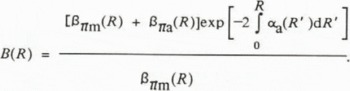
Because the aerosol backscattering coefficient depends on the number of aerosol particles present through
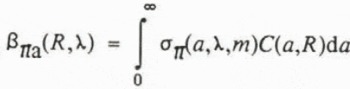
where λ is the lidar wavelength, σπ is the backscattering cross-section, and C is the number concentration of particles with radius a and complex refractive index m, we have a means of estimating particle concentrations from the Rayleigh ratio.
A few simplifying assumptions are, however, necessary. Reference Andreas, Williams and PaulsonAndreas and others (1981) concluded that the vapour escaping from wintertime leads condensed into droplets having a fairly narrow size distribution with a mode radius of about 5 μm. Such small droplets can persist supercooled even at Arctic temperatures (Reference SchaeferSchaefer, 1962; Reference Andreas, Williams and PaulsonAndreas and others, 1981; Reference Heymsfield and SabinHeymsfield and Sabin, 1989). Sampling at higher altitudes, Reference Ohtake, Jayaweera and SakuraiOhtake and others (1982) found that the particles over Arctic leads were ice crystals with a mode radius more like 40 μm But because they were unable to sample particles with radii smaller than 10 μm, 40 μm is probably an upper limit for the mode radius of these crystals. For our calculations, we henceforth assume that a lead plume is a mono-dispersive aerosol consisting either of supercooled, spherical water droplets of radius 5 μm, or spherical ice crystals of radius 40 μm.
The backscattering cross-section in Equation (5) is usually expressed in terms of a dimensionless back-scattering efficiency factor Q π (x,m),

where x = 2πa/λ is a size parameter. Because we assume that the plume consists of particles of a single size, Equation (5) thus becomes

We computed Qπ using the Mie theory computer program given by Reference Bohren and HuffmanBohren and Huffman (1983: 477–82), with values for the refractive index of water (Reference Irvine and PollackIrvine and Pollack, 1968) and of ice (Reference WarrenWarren, 1984) at 1.06 μm. For 5 μm water droplets, x = 30 and Qπ = 0.23; for 40 μm ice spheres, x = 240 and Qπ = 0.36.
The aerosol extinction coefficient, αa, in Equation (4) is also related to a cross-section, the extinction cross-section σex(a,λ,m), as in Equation (5). and this cross-section, in turn, is usually expressed in terms of the extinction efficiency factor Qex(x,m), in analogy with Equation (6). Thus, for a monodispersive aerosol, αa can be modeled as β πa in Equation (7), αa(R,λ) = πa2Qex(x,m)C(a,R), where from our Mie calculations Qex ≃ 2. From Reference McClatchey, Fenn, Selby and VolzMcClatchey and others (1972), we estimate that αa is in the range 6 × 10⁻⁵ to 2.6 × 10 m−1; from Reference Collis and RussellCollis and Russell (1976), 1–5 × 10 −4 m−1. For the droplet concentrations that Reference Andreas, Williams and PaulsonAndreas and others (1981) measured over leads, we estimate that dg is roughly 1.9 × 10⁻⁴ m−1; from the conditions observed by Reference Ohtake, Jayaweera and SakuraiOhtake and others (1982), we estimate 2.0 × 10 −4 m−1. Because of the limited range in these estimates, for our subsequent calculations we assume that αa= 2.0 × 10⁻⁴ m−1.
Finally, we can compute the molecular backscattering coefficient, β πm, in Equation (4) from a relation given by Reference PenndorfPenndorf (1957) and Reference McCartneyMcCartney (1976),

Here βm(θ) is the molecular scattering coefficient at angle θ, Ν is the number density of air molecules, and pn (= 0.035) is the depolarization factor. For backscatter, θ = 180°; thus, β πm ≡ βm(180 °). Ν derives simply from N = ρN a/M a where ρ is the air density, Na is Avogadro’s number, and Ma is the molecular weight of air. For n, the real part of the refractive index of air, we use Reference OwensOwens’ (1967) relation.
With Equation (7), with the relation for molecular backscatter [Inline 16] (Equation (8)), and with the other simplifications that we have been discussing, we can derive from Equation (4) a prediction equation for the particle concentration within lead plumes,
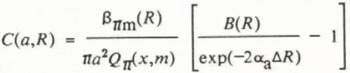
where ΔR is the range increment for which the lidar beam was within the plume.
Because the B(R) term within the square brackets in Equation (9) is generally much larger than 1, C is almost directly proportional to Β and inversely proportional to exp(αa), to exp(ΔR), and to Qπ. Our Mie computations showed that Qπ is very sensitive to particle size; uncertainty in the particle radius, therefore, probably introduces a factor-of-five uncertainty in our concentration estimates through the a2 and Qπ terms in Equation (9).
Particle Concentrations in the Plumes
We here consider the lidar data collected on 27 January 1984 during the Arctic Gas and Aerosol Sampling Program (AGASP) (Reference SchnellSchnell, 1984). Figure 1 shows the flight track north from Thule, over Alert, and then out over the frozen Arctic Ocean (Reference Kent, Poole and McCormickKent and others, 1986). Nominal flight altitude was 5800 m. In the figure we also show major leads visible in Defense Meteorological Satellite Program (DMSP) infrared images from the time of the flight. At least two of these leads, as marked in the figure, were open and produced major plumes that we have documented elsewhere (Reference SchnellSchnell and others, 1989). We derive particle concentrations in these two plumes.

The flaw lead north of Ellesmere Island produced an enormous plume that reached an altitude of 3 km and extended down-wind (northward) over 200 km (Fig. 2). Although we do not have information on the width of this lead, the surface droplet concentrations in Figure 2 and near-concurrent satellite imagery suggest that it may have been at least 20 km wide.
Concentrations of 5 μm water droplets computed for the plume observed between 16.35 and 17.05 Ζ that originated in the flaw lead north of Ellesmere Island. If the plume particles were 40 μm ice spheres, instead of water droplets, concentrations would be just 100 times less. The origin of the abscissa is arbitrarily located.
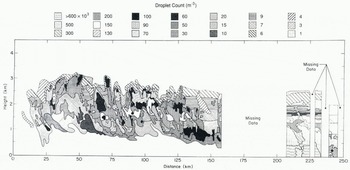
The second plume (Fig. 3) originated in a lead at about 85°N, well into the interior of the Arctic ice pack. This plume reached an altitude of almost 4 km. Although again we have no direct observations of the width of this lead, given the meteorological conditions measured by the 12.00 Ζ Alert radiosounding on 27 January, we estimated that a lead would have to be roughly 10 km wide to provide the thermal energy necessary for a plume to reach 4 km (Reference SchnellSchnell and others, 1989). Satellite imagery and the maximum in calculated surface droplet concentration shown in Figure 3 corroborate that the lead was roughly 10 km wide.
As in Figure 2, except this is the plume observed between 16.25 and 16.30 Z.
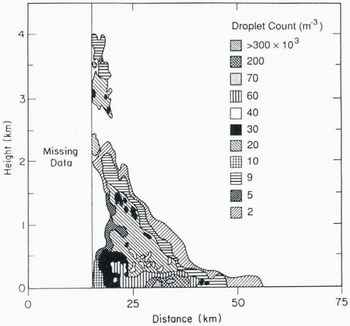
Figures 2 and 3 show the concentrations of droplets with radius 5 μm. For ice crystals with radius 40 μm, the concentrations are just 100 times less. The figures generally give droplet concentrations to only one significant figure to indicate the uncertainty in our calculations. In taking αa to be a constant of 2 × 10⁻⁴ m−1, in effect, we are assuming that plumes of 5 μm droplets have a uniform concentration of 130 × 104 droplets m−3 or plumes of 40 μm ice spheres have a concentration of 2 × 10⁴ crystals m−3. Consequently, Equation (9) overestimates the particle concentration in regions for which the overlying plume has concentrations greater than 130 × 104 droplets m3 (or 2 × 10⁴ crystals m−3), which is everywhere within both plumes. Therefore, considering the uncertainties discussed earlier, we feel that the concentrations in Figures 2 and 3 are accurate to within an order of magnitude.
The 5 μm droplet concentrations are somewhat smaller than those observed by Reference Andreas, Williams and PaulsonAndreas and others (1981) within a meter of the surface of narrow leads. They found maximum condensate concentrations of 1–20 × 107 droplets m−3. But because the lidar has a vertical resolution of about 30 m, it cannot measure as near the surface as Andreas and others did; as a result, it yields maximum concentrations somewhat less than they found.
Except in the immediate vicinity of their source, these plumes have particle concentrations lower than those measured in most clouds (Reference Carrier, Cato and EssenCarrier and others, 1967). The bulk of a plume is therefore not visible. In fact, plume particle concentrations are typical of subvisible cirrus clouds (Reference Braham and Spyers-DuranBraham and Spyers-Duran, 1967; Reference HoffHoff, 1988; Reference Sassen, Griffin and DoddSassen and others, 1989). In light of the computed concentrations, knowing that the ambient air temperature was near −30°C in the lower 4 km, and realizing that the relative humidity needs to be only about 75% for air to be saturated with respect to ice at −30°C, we conclude that the bulk of the observed plumes consist of ice crystals.
The 12.00 Ζ Alert radiosounding on 27 January showed a main inversion at 600–700 m and an overall drop in potential temperature of 25°C between the surface and 1500 m. Yet such atmospheric stability was clearly unable to constrain the plumes near the surface. With lead-derived heat and moisture, thus, capable of reaching the mid-troposphere, wide leads have the potential to influence the climate not just locally but basin-wide.
Though invisible, the plumes may also affect the climate radiatively. Assuming ice crystal concentrations of 1–100 × 104 m−3, Reference Curry, Radke, Brock and EbertCurry and others (1989) computed infrared radiative cooling rates in- the Arctic atmosphere that were about 2°C d−1 greater than for clear air. This atmospheric radiation loss would, in turn, warm the sea-ice surface and have significant influence on the surface energy budget. The plumes shown in Figures 2 and 3 both have particle concentrations similar to those used in the calculations by Curry and others. Thus, the Ellesmere Island flaw lead (Fig. 2) has, in effect, thrown a warming blanket of condensate particles over the sea ice for more than 200 km down-wind. Similar leads that occur in the marginal seas north of Siberia probably produce like effects in that area.
Acknowledgements
We would like to thank G. Koh, J.A. Curry, K.C. Jezek, S.G. Warren, and an anonymous reviewer for comments on the manuscript. Discussions with A.W. Hogan were very helpful. L.F. Radke, C.A. Brock, M.P. McCormick, and J.L. Moore provided technical help with the data collection and processing. The U.S. Office of Naval Research supported this work with contracts N0001486K0695, N0001488WM22012, and N0001489WM22006.



