

Introduction
In 2011, Chilean university students began to mobilize massively against the country’s neoliberal education system. Students occupied schools, colleges, and universities for months in the country’s most important protests in decades. The movement caused the resignation of two and the impeachment of one of President Sebastián Piñera’s education ministers, and led his government to unexpectedly pursue more statist education policies than his progressive predecessors in terms of government oversight, funding, and governance of higher education (Reference Kubal and FisherKubal and Fisher 2016, 231). In 2014, President Michelle Bachelet began undertaking a comprehensive reform of the country’s education system, the scope and direction of which would have been unimaginable without the mobilizations. Moreover, four former student leaders were elected to the Chamber of Deputies in 2013 thanks to the protests.
The Chilean student protests are not an unprecedented or isolated case. Scholars have long recognized students as a force for reform in the region (Reference PortantieroPortantiero 1978). Moreover, similar protests have occurred in Mexico, Colombia, and Argentina, among other countries (Reference VommaroVommaro 2013, 127).
Scholars have paid little attention to student movements in the region since the 1980s, when it was argued that mass access to higher education and the emergence of private institutions had led to the decline of student activism (Reference LevyLevy 1991). Experts claimed that college students mobilized for maximalist demands, inspired by ideology to change their countries’ political systems (Reference Levy and AltbachLevy 1989, 315, 318). According to these scholars, mass access diversified student bodies while private institutions discouraged participation, and the combined effect undermined the student movements. This claim resonates with the more general argument that, in the long run, neoliberalism quells mobilization (Reference Gans-Morse and NichterGans-Morse and Nichter 2007). Strong movements for sectorial causes in some of the higher education systems with the highest enrollment ratios (like those of Argentina and Uruguay), and in some of the most privatized ones (such as Chile’s and Colombia’s) seem to contradict this argument, but we lack a systematic explanation for the resurgence of student mobilization.
This article seeks to explain individual student participation in Chile, a country that in recent decades has experienced both the adoption of market policies in the social sector, including education, and the reintroduction of competitive party politics. This study maintains that liberalization of higher education does not eliminate protest but rather creates financial grievances by expanding the number of students attending college while also increasing educational costs. It argues that when students and their families are unable to bear the financial burden of college on their own, they are more likely to mobilize. It also claims that students from disadvantaged backgrounds are more likely to mobilize for their education than their more privileged peers. In addition, I suggest that close linkages between students and ruling parties make students less likely to mobilize, both because they trust the government to advance their demands institutionally, and because the government can use these connections to co-opt students and nip mobilization in the bud.
This article uses a mixed-methods research design. The hypotheses proposed below are first illustrated through a case study of the evolution of higher education policy, student-party linkages, and student protests in Chile from 1990 to 2011. This section draws evidence from primary and secondary sources, including more than forty semistructured elite interviews carried out by the author between June 2014 and March 2015 in Washington, DC, Santiago, and Valparaíso. The hypotheses are then tested statistically at the individual level using a sample of college students from a 2012 Chilean survey.
Chile is a useful case to analyze in part because it has had variation on the dependent as well as the independent variables. In recent years, Chile has experienced varying levels of student protests, including major mobilizations in 2006 and 2011. The country has adopted neoliberal higher education reforms that have increased enrollment as well as educational costs for students (Reference BrunnerBrunner 2009). Chilean students’ closeness to government political parties has also changed over time (Reference Bülow and Pontevon Bülow and Bidegain Ponte 2015). Finally, as the region has tended to follow the Chilean example of increasing enrollment through neoliberal policies (Reference López Segrera and SantosLópez Segrera 2011, 212–218), many countries may experience similar mobilizations.
Incomplete Explanations for Student Mobilization
The causes of current student movements in Latin America are undertheorized. Worldwide student demonstrations in the 1960s triggered an unprecedented number of studies about student politics and movements, but academic interest waned when the demonstrations declined or were suppressed (Reference Altbach, Forest and AltbachAltbach 2006). Although some of these early studies (Reference LipsetLipset 1993, Reference Lipset and Lipset1967) offer theoretically grounded explanations, they are outdated because they focus on the smaller, more exclusive student bodies of the time.
In the case of Latin America and other developing regions, these studies analyzed “elite” (Reference TrowTrow 1973) higher education, in which a reduced share of the college-age population is enrolled, access is understood more as a privilege than as a right, and most students come from the ruling classes. By contrast, Latin America currently trends toward general and even universal systems, which are not only for the elites. Moreover, the connection between student and party politics has eroded in many countries of the region.
Researchers have paid little attention to student movements since the 1980s. Some important exceptions to this lack of interest focus on a single case like Chile (Reference SommaSomma 2012; Reference CummingsCummings 2015; Reference Kubal and FisherKubal and Fisher 2016; Reference Palacios-ValladaresPalacios-Valladares 2016; Reference Bülow and Pontevon Bülow and Bidegain Ponte 2015; Reference Salinas and FraserSalinas and Fraser 2012), or are edited works that study several countries in the region (Reference González Marín and Sánchez SáenzGonzález Marín and Sánchez Sáenz 2011). These studies make important empirical contributions to our understanding of the cases they examine. Unfortunately, they tend to limit themselves to exploring the applicability of the existing theories rather than presenting novel theoretical contributions.
There is a growing body of literature that explains mobilizations against neoliberal reforms in Latin America (Reference SilvaSilva 2009; Reference YasharYashar 2005). This literature, however, has largely excluded student movements from analysis. One exception is Almeida (Reference Almeida2007, 129), who finds that students were involved in 17.5 percent of all anti-neoliberal protest campaigns between 1995 and 2001 in the region. More research on student involvement seems justified since, according to Almeida, other well-studied groups, such as indigenous and women’s movements, participated in fewer protests.
A Theory of Mobilization: Reconciling Grievances and Opportunities
The most fruitful way to understand individual participation in student movements is as a case of mobilization against neoliberal reforms caused by grievances (Reference UseemUseem 1998) associated with neoliberalism. Scholars have long argued that subjecting social services to market logic can generate popular resistance (Reference PolanyiPolanyi 1944), and Latin America has been no exception (Reference SilvaSilva 2009). Scholars of mobilization have suggested, however, that the levels of grievances are constantly high among some groups, and therefore cannot explain variation in levels of contention over time (Reference GoodwinGoodwin 2001; Reference McAdamMcAdam 1982, 11). I argue, by contrast, that changes in education finance and enrollment policies increased both the level of grievances and the size of the student population, leading to the resurgence of student mobilization.
Latin American higher education has gone from being limited, public, and free to becoming massive, increasingly private, and paid for by students (Reference BernasconiBernasconi 2008). Under the auspices of the World Bank, many Latin American countries adopted market-oriented higher education regulations in the 1980s and 1990s (Reference Mollis, Forest and AltbachMollis 2006, 504). Neoliberal education reforms cut funds to public universities, which have transferred part of their costs to students by increasing fees. Neoliberal reforms also led to the proliferation of private institutions, which fund themselves almost exclusively through tuition (Reference Castro and LevyCastro and Levy 2000, 102; Reference Holm-Nielsen, Thorn, Brunner, Balán, de Wit, Jaramillo, Gacel-Ávila and KnightHolm-Nielsen et al. 2005, 44). Some countries (like Argentina and Uruguay) have preserved the public and free character of higher education more than others (like Colombia and Peru), but the general trend since the advent of the Washington Consensus has been toward increased costs for students. As a result, Latin American students experience a new grievance: the high cost of education.
At the same time, enrollment in higher education has also expanded dramatically in the region. Although part of this expansion can be attributed to improved primary and secondary school attendance, neoliberal reforms also contributed to increased enrollments, making college education more accessible to the middle and working classes (Reference Holm-Nielsen, Thorn, Brunner, Balán, de Wit, Jaramillo, Gacel-Ávila and KnightHolm-Nielsen et al. 2005, 40). Many of these students, however, cannot easily afford tuition increases and have resisted efforts to saddle them with the growing costs of education. Rising costs combined with increased access to education have thus promoted mobilization.
The consequences of these national policy changes are evident at the individual level. Today in Latin America students and their families have more trouble paying for their studies than in the past. The chronic shortage of grants and scholarships (Reference Holm-Nielsen, Thorn, Brunner, Balán, de Wit, Jaramillo, Gacel-Ávila and KnightHolm-Nielsen et al. 2005, 53) makes the situation of the poorest students even more precarious. The retreat of public support is a problem not only for the working class, however. Many middle-class students must also take out loans to pay for their education so they too have incentives to protest the high cost of education.
Hypothesis 1: Students who incur debt are more likely to mobilize than those who do not.
There are also grievances that are more intense for working-class, first-generation students—the main beneficiaries of the policies aimed at increasing access. In many instances, the services provided by institutions have not kept up with the enlargement and diversification of their student bodies. Housing, meals, libraries, and facilities are often still designed to cater to people who do not have to work and who are expected to have adequate access to books and study spaces in their homes. More important, higher education institutions in Latin America seldom provide resources such as tutoring and remedial courses to promote the retention and success of economically disadvantaged students (Reference Sverdlick, Ferrari and JaimovichSverdlick, Ferrari, and Jaimovich 2005, 107–108). These institutional deficiencies tend to be particularly widespread among the new, low-quality private institutions, which have also absorbed the lion’s share of increases in enrollment. These class-specific, unmet needs are likely to lead working-class students to mobilize:
Hypothesis 2: Working-class students are more likely to mobilize than their middle- and upper-class counterparts.
Although grievances may be the immediate cause for mobilization (Reference McAdam, Tarrow and TillyMcAdam, Tarrow, and Tilly 2001), some have existed for a while and thus cannot independently explain why social actors mobilize under certain circumstances but fail to do so in others. Political opportunities (Reference McAdamMcAdam 1982; Reference TillyTilly 1978), may help to explain the emergence and timing of protests. A vast array of different political factors could be considered to open up the political system for mobilization, but this study emphasizes the role of linkages between students and political parties.
As Kitschelt (Reference Kitschelt2000) argues, linkages between citizens and parties may take a variety of forms, including programmatic, personalistic, and organizational linkages.Footnote 1 In Chile, programmatic linkages—that is, the alignment between citizens’ personal policy preferences and the party’s platform—tend to be strong, especially relative to other Latin American countries (Reference Luna and AltmanLuna and Altman 2011, 9). Scholars have previously argued that linkages with opposition parties can promote mobilization and policy changes (Reference Almeida, Van Dyke and McCammonAlmeida 2010; Reference Stearns and AlmeidaStearns and Almeida 2004; Reference SuSu 2015). Strong oppositions can also promote mobilization to destabilize the government (Reference Morgenstern, Negri and Pérez-LiñánMorgenstern, Negri, and Pérez-Liñán 2008, 183). The resources and policy-making influence of opposition parties vary considerably, however. Some may be organizationally powerful and control numerous municipal and congressional posts, while others may hold no offices and have few resources. It is difficult, therefore, to make generalizations about the capacity of all opposition parties to influence student mobilization.
By contrast, ruling parties wield greater influence than opposition parties, and connections between them and social movements will typically decrease mobilization. Ruling parties may want to discourage their supporters from mobilizing to facilitate governance. Likewise, supporters may want to dampen protest to avoid calling the regime’s legitimacy into question. In the case of unions, experts have found that connections with ruling parties reduced their ability to mobilize and to resist market reforms (Reference MadridMadrid 2003; Reference MurilloMurillo 2001). In Latin America, ties between social movements and ruling elites in the post-transition period resulted in the subjugation of the logic “directed toward securing concrete claims” to the political logic of democratic consolidation (Reference GarretónGarretón 2003, 85). Indeed, the goal of elite participation in mobilization may be to eventually curb it (Reference McAdamMcAdam 1982, 62). For example, the 1968 Italian student movement only emerged after students escaped “the narrow logic of party control” (Reference TarrowTarrow 1989, 156).
Government linkages may prevent the emergence of student mobilization in at least two ways. First, if the government opposes students’ demands, it can co-opt them by offering side benefits. Second, if they respond to their grievances, ruling parties can channel them institutionally, rendering mobilization unnecessary. Following the terminology of McAdam, Tarrow, and Tilly (Reference McAdam, Tarrow and Tilly2001, 12) linkages with government parties put students closer to becoming “polity members” with routine access to policy-making; conversely, when linkages with the government are weak they are more likely to become “challengers”:
Hypothesis 3: Students with weak ties to ruling parties are more likely to mobilize than better-connected students.
Student protests, therefore, have been more likely to break out when students use credit, when they come from working-class families, and when they have weak linkages with ruling parties. In the following section, I explore how this came to pass in Chile.
Student Mobilization in Chile: A Case Study
Higher education in Chile was free and funded by the state until the reforms enacted in 1981 by the military regime. The 1981 law created new independent institutions out of existing universities’ regional branches, progressively eliminated direct funding, and permitted the creation of new private institutions. Indirect public funding took the form of state-backed loans, which were only available to students attending pre-reform universities and their offshoots (called “traditional” universities).
Increased enrollment after the return to democracy in 1990 enlarged the mass of students from lower-income families who were the most vulnerable to neoliberal policies (Reference BrunnerBrunner 2009, 318–319). Linkages between student organizations and political parties also played an important role in the transformation of the grievances into mobilization. Ties to the center-left Concertación governments were initially strong but began to deteriorate in the decade of the 2000s. Then, when the center-right government of Piñera was elected, linkages with ruling parties became too weak to prevent mobilization. Massive student protests broke out. These mobilizations had ambitious goals geared toward changing the whole educational system.Footnote 2 Although the students ended up embracing large-scale demands such as the nationalization of the copper mining industry and constitutional reform in 2011, the protests began with, and had at their core, discontent about education finance (Reference SommaSomma 2012, 300).
The 1990s, by contrast, experienced low levels of student mobilization (Reference CummingsCummings 2015, 54). Once student federations achieved their main goal—the return to democracy—they lost their mobilizing capacity.Footnote 3 In the second half of the decade, protests were small and circumscribed to public institutions. Students mobilized—unsuccessfully—for income-based tuition rates (arancel diferenciado)Footnote 4 and the reestablishment of student participation in higher education governance (Reference Muñoz TamayoMuñoz Tamayo 2011, 125).
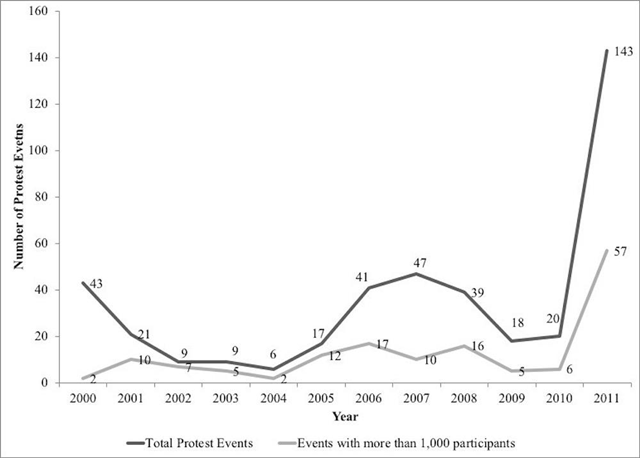
In the first decade of the 2000s, college students followed the lead of secondary school students twice: in the 2001 Mochilazo protest to reduce student fares in public transportation, and in the 2006 Revolución Pingüina (Reference DonosoDonoso 2013). Before 2011, the most important college student-led mobilization happened in 2005, when traditional university students mobilized against the imposition of a state-endorsed private loan program, which was nevertheless applied to students attending other institutions.Footnote 5 Figure 1, constructed using reports by the Latin American Social Observatory (OSAL 2012) of protests between 2000 and 2011, shows that Chilean college students’ involvement in protests clearly peaks in 2011, both in terms of the total number of protests as well as the frequency of very large events.Footnote 6 As I will argue below, protests became frequent and massive when enrollment and debt grew and government linkages weakened.
Number of protest events with higher education student participants in Chile, 2000–2011.
Source: Author’s elaboration based on OSAL (2012) conflict briefs.
The protests responded in large part to neoliberal education policies. The return to democracy under the Concertación coalition governments (1990–2010) did not reverse but rather built on the neoliberal legacy in higher education. Although some important reforms were carried out, none of them addressed the finance issues. The new regime established stricter monitoring and rules for the creation of new private institutions, emphasized access and the quality of academic programs, and improved the information available to current and prospective students.Footnote 7 However, the Concertación upheld the private sector’s ability to establish new schools, the administrative autonomy of colleges, the market’s self-regulation and, most importantly, students’ responsibility for financing their education (Reference BrunnerBrunner 2009, 294).
Public expenditures did not keep up with the expanded coverage. In 2003, for example, public and private sources both spent an average of about $1,415 per student at public universities. By contrast, in private universities, the Chilean state spent slightly more than $62 while private sources spent more than $2,174 per student on average (Reference Marcel and TokmanMarcel and Tokman 2005, 40).Footnote 8 Household expenditures represented 83 percent of the country’s total expenditures in higher education in 2004 (Reference BrunnerBrunner 2009, 381). Moreover, by 2007, tuition in public universities accounted for 28 percent of the gross national income per capita—higher than in any OECD country—while tuition in private universities represented 32 percent (OECD and World Bank 2009, 247).
By the time protests erupted under Piñera in 2011, the OECD (2011, 232) found that 85 percent of spending on higher education in the country came from households, as opposed to the OECD average of 69 percent. For this reason, politicians, activists, and the media dubbed the country’s higher education system “the most expensive in the world” (The Economist 2011).
Aggrieved students enter the system
Why did it take two decades for students to mobilize massively for financial reasons? In some cases, the implementation of the new financial system generated an immediate yet short-lived backlash. For example, in 1990, when the collection of tuition was handed over to a private bank, students at the Metropolitan University of Education Sciences protested by burning payment stubs in front of the rector’s office.Footnote 9 Nevertheless, major protests did not break out until much later.
The reason is that it took years for a sizable mass of students to be affected by the high cost of education. Chile went from having a predominantly urban, elite, young, and male student population to one with increasing gender, age, geographic, and socioeconomic diversity (Reference Orellana, de la Jara and RojasOrellana 2011, 87). Two factors made the increasingly diverse student population possible: growth in the number of institutions, and increased access to credit. Successive governments deregulated the education system and permitted it to expand rapidly. The number of recognized higher education institutions went from just 8 in 1980 to a maximum of 302 in 1990, and then declined to 229 in 2003 and 165 in 2014 (CNED 2014).
Increasing access to credit also played a vital role in the massification of higher education, especially in the second half of the 2000s. State-endorsed student loans have subsidized the demand for higher education. In 2005, President Ricardo Lagos’s administration created the State-Endorsed Loan (Crédito con Aval del Estado, CAE). A majority of the students who benefited from the CAE in 2010 belonged to the lowest income brackets, and most attended nonuniversity institutions and the less selective post-reform universities (Reference Durán, Jorquera, Pey, Riesco and MendozaDurán et al. 2011, 46–47). These students had difficulty adapting to the costs (tuition but also others like transportation and meals) associated with higher education.Footnote 10
The result of these market-based, government-subsidized policies was that coverage increased steadily. Initially, the policies promoting access primarily benefited the segments of the upper and upper-middle classes that still had not entered the system. Then, in the late 1990s, these upper classes reached a saturation point at about 55 percent of the college-age population, and more students from middle- and lower-middle-class backgrounds began to attend college for the first time. Finally, in the mid-2000s, when the percentage of middle-class college students reached 25 to 35 percent of the college-age population, the percentage of working-class students also began to increase substantially (Reference Orellana, de la Jara and RojasOrellana 2011, 89).
Household survey data (Centro de Estudios MINEDUC 2012, 16) illustrates the changes in the higher education net enrollment ratio (NER)Footnote 11 between 1990 and 2011 by income decile in Chile. The richest decile increased its NER from 40.3 in 1990 to 62.9 in 2011. However, the most dramatic changes are found in the NER of the two poorest deciles. Indeed, college-age youths in these groups increased their participation in higher education by six and seven times between 1990 and 2011, respectively. As a result, the poorest decile had a NER of 21.8 in 2011, the same as the third richest decile in 1990. While the poorest two deciles comprised 3 and 2 percent of higher education students in 1990, by 2011 their share had increased to 5 and 7 percent, respectively. By contrast, the share of the college student population accounted for by the two highest income deciles decreased from 17 and 23 percent in 1990 to 14 percent each in 2011 (Ministerio de Desarrollo Social 2015a, 2015b).
The meager public support offered for higher education was not enough to keep up with the dizzying pace of enrollment of poorer students. Olavarría Gambi et al. (Reference Olavarría Gambi, González, Sepúlveda and Albornoz2010) and Durán et al. (Reference Durán, Jorquera, Pey, Riesco and Mendoza2011) find that, both nationwide and in the Santiago Metropolitan region, lower income students are less afraid of incurring debt, and are more likely to take loans to pay for college. Increased availability of credit, therefore, has had a direct effect on college enrollment.
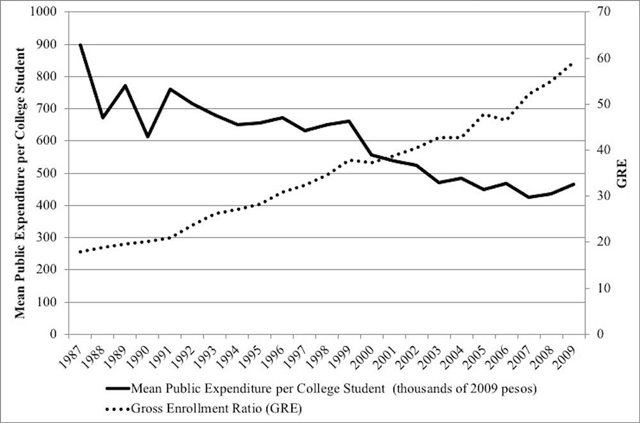
Figure 2 shows the decline in mean public expenditure per college student between 1989 and 2009 (Reference ArellanoArellano 2011, 24), a period in which enrollment increased considerably. While the lowest amount was in 2007 (424,000 pesos), the amount spent per student in 2009 (437,000) when the gross enrollment ratio (GER)Footnote 12 reached 59 percent, was less than half the amount spent in 1987 (897,000), when the GER was about 18 percent. Thus, it was not until after 2005 that financial grievances affected a large segment of the college population. A former Communist Youth member, Iván Mlynarz, recounts that, in the mid-1990s, when he proposed free education, a University of Chile student replied, “The free education that you’re proposing would be financed by the state, and those resources are given by all Chileans, and that would mean that there would be a transfer of resources from the poorest to high-income people, who are the majority of those who study here” (Reference Muñoz TamayoMuñoz Tamayo 2011, 125).
Government expenditures per student and gross enrollment ratio, Chile, 1987–2009.
Sources: Arellano (Reference Arellano2011, 24); World Bank Databank Education Statistics (data interpolated for the years 1989, 1991, and 2001).
The situation had drastically changed fifteen years later. As one student leader puts it, students from less selective institutions became “proletarianized” as their socioeconomic background diversified, and they began demanding system-wide changes to get more public support.Footnote 13 As Deputy Giorgio Jackson explains, the neoliberal policies carried out in the country “generated an illusion” that “exploded” in 2011, leading to widespread protests by working- and middle-class students.Footnote 14 By contrast, upper-class students—who had already accessed higher education and attended selective universities—did not have to take loans to pay for their studies. They did not experience a financial discontent and, therefore, mobilized much less.Footnote 15 Thus, although protests had been common for years, they only became very frequent and massive in 2011, when college became highly accessible yet financially onerous for students.
Government linkages: Erosion under the Left, absence under the Right
The relationship between ruling parties and college student organizations also helps explain the timing of mobilizations. The ruling parties’ linkages with students were strong in the first years of the Concertación governments, but they subsequently eroded (Reference GarretónGarretón 2005, 393). The right-wing Alianza coalition has always had a weaker presence in student politics, which explains why students mobilized in 2011 after the election of a president supported by this coalition.
The Concertación began its rule with strong ties to students who participated in the mobilizations against the Pinochet regime. Beginning in 1990, the factions that competed in student politics tended to represent the national-level political parties.Footnote 16 In the early years after the return to democracy, the Concertación “downplayed mass mobilization in favor of elite-negotiated social and political pacts to mitigate the fears of conservative sectors” (Reference RobertsRoberts 1998, 141). This meant that student organizations linked to the Concertación were discouraged from pressing financial demands, which put their student supporters in an awkward situation between their classmates’ demands and their parties’ directives. As one student leader observed, “Working as a Concertación leader was very unpleasant because you really had a conviction as a student leader about the state of education in Chile, so you were in the middle because you had to respond to your bases, to other leaders who were critical of the government … but you couldn’t push too far in the opposite direction … you couldn’t push too far because in a way it was also your government. If I demonstrate all week long I’ll harm the government.”Footnote 17
Special envoys from the parties also impeded student efforts to organize mobilizations. These envoys, former student leaders themselves, acted as “strikebreakers.”Footnote 18 Some interviewees described how the presence of these brokers—who might linger outside of the meeting rooms where the student organization CONFECH (Confederación de Estudiantes de Chile) convened—influenced the decisions made by the Concertación-controlled student unions.Footnote 19
Another prominent example of parties demobilizing protests occurred with the 2006 Revolución Pingüina. The government was unable to thwart its emergence because the leaders of the secondary student organizations that spearheaded the protests represented far-left and center-right opposition parties as well as the ruling Concertación (Reference DonosoDonoso 2013, 9). During the protests, however, the ruling Socialist and Radical Parties managed to get their members elected to the presidencies of several student federations.Footnote 20 This helped bring an end to the demonstrations after the creation of a Presidential Advisory Council that incorporated students and other social actors.
As time passed, linkages between the ruling Concertación and the students began to erode. In the 2000s, the ruling parties had a weak presence in the universities. This does not mean, however, that students became depoliticized: the Communist Party (PC), for example, maintained strong linkages. Student organizations that were hostile to or had no connections with the government gained influence. It was students from the PC and new organizations such as SurDA,Footnote 21 New University Left (Nueva Izquierda Universitaria), and Autonomous Left (Izquierda Autónoma, IA), who provided resources and organized many of the mobilizations in the first decade of the 2000s. Indeed, several interviewees noted the gradual disappearance of the Concertación from the college scene and the subsequent political activation of students, this time without party affiliations.Footnote 22
Finally, when Sebastián Piñera was elected, the government lost virtually all connections to the major student organizations. As a student leader of the conservative Gremialista movement put it, the administration lacked the usual ties to students that could have prevented or curtailed protests.Footnote 23 The groups still linked to the Concertación also had the opportunity to coalesce and in some cases lead the mobilizations against the government. Such was the case in the elite Catholic University (Pontificia Universidad Católica de Chile), where New University Action (Nueva Acción Universitaria), a center-left organization, led the student federation and played a key role in the 2011 mobilizations. However, the people who turned the 2011 protests into a massive, unprecedented phenomenon were the “new” nonelite and unaffiliated students.Footnote 24
Weak linkages help explain the outbreak of student protests in 2011. The majority of students were politically distant from Piñera. According to right-wing congressman Jaime Bellolio, the government tried to identify “the people who needed to be convinced and approached to seek a legislative or policy exit” to student demands.Footnote 25 However, as former education minister and longtime Concertación leader Sergio Bitar explains, “we’ve always had people coming from the social movements; party leaders are connected to social leaders; by contrast, the Right doesn’t have any capacity to dialogue. … Therefore, [grievances] exacerbate with the Right.”Footnote 26
Unlike more isolated episodes in the past, the student movement in 2011 had widespread support both in the traditional and newer universities. The latter have a higher proportion of students who come from lower-income families and have fewer connections to political parties.(Reference Palacios-ValladaresPalacios-Valladares 2016, 16). In light of these factors, it is easy to understand why the 2011 movement began with a strike at Central University (Universidad Central de Chile),Footnote 27 a private, post-reform institution whose students are mostly first generation (Reference Fleet and Guzmán-ConchaFleet and Guzmán-Concha 2016, 13; Reference Kubal and FisherKubal and Fisher 2016, 230).
A Quantitative Test of Student Mobilization
I test the hypotheses presented above using data from the 2012 National Youth Survey (Encuesta Nacional de la Juventud, ENJ) by the Chilean National Youth Institute (Instituto Nacional de la Juventud, INJUV 2015). INJUV is the public organization in charge of youth policy, and it has conducted a nationwide survey of youths every three years since 1994. The 2012 ENJ provides a snapshot of a time when there were relatively high levels of student mobilization. It was conducted between June and August 2012, the target population being fifteen- to twenty-nine-year-olds. The sample was obtained through a multistage probabilistic procedure.
The following analysis uses data from college student respondents. Three items in the survey—enrollment in higher education (23.22 percent), enrollment in specific types of higher education institutions (22.65 percent), and the respondent’s level of education—can be used to define this subset. Unfortunately, not all respondents answered consistently across these questions. My solution was classifying respondents as students if they responded simultaneously that they were enrolled in higher education; attended university, vocational, or technical college; and that their current level of education was incomplete college. This was done to exclude respondents who had already completed a college degree. The size of this subsample is 1,501 students. The survey’s sampling weights make the sample representative of the Chilean fifteen- to twenty-nine-year-old population so they are not appropriate for the subsample, and are not used.
Dependent variable: Protest participation index
Participation in protests was measured in the ENJ by asking about participation during the past twelve months in demonstrations (38.8 percent of positive responses), strikes (31.5 percent), and sit-ins (17.8 percent). All “yes” answers were summed to create an index ranging from a value of zero (no participation) to three (participation in all protest types).Footnote 28 The subsample size decreases by only ten respondents once those who did not answer any of the protest participation questions are excluded: 805 reported not participating in any protest; 280 participated in one type; 189 in two types; and 218 said they participated in all types.Footnote 29 Although the ENJ did not ask specifically about protest participation for education causes, it asked about protesting during a time of high education-related mobilization, which reduces the potential bias caused by participation for other causes.
Socioeconomic sector
The ENJ includes a measure of the respondent’s socioeconomic sector (SES). This measure, which is widely used in Chile, classifies respondents based on their head of household’s education and employment status. For example, higher education levels and more lucrative occupations denote higher incomes and therefore a higher SES. The SES categories are ABC1 (highest), C2, C3, D, and E (lowest).
Higher education funding
The survey asked students about their sources of funding. The options were grouped into four different, not mutually exclusive variables: scholarships, loans, self-funding, and other sources. Each of these four variables can take three values (“yes,” “no,” “doesn’t know”). The “loans” variable directly tests H1, while the other items are included to control for the effect of using other funding sources.
Party linkages
The ENJ does not include a variable that directly captures party linkages.Footnote 30 The alternative used in the regressions is identification with what the survey calls “political sectors.” The categories are “Right,” “Center-Right, “Center,” “Center-Left,” “Left,” “None,” and “Don’t know.” Ideology is a reasonable, albeit incomplete, indicator of distance from the governing parties: students who identified with the Center, Center-Left, Left, or no political sector when Piñera was president should have weaker government linkages than those who identified with the Right or Center-Right. I associate both the Center-Right and the Right with the Piñera administration because his government included both center-right politicians (such as Piñera and other RN members) and right-wing politicians: members of the right-wing Independent Democratic Union (Unión Demócrata Independiente, UDI) filled several key cabinet positions, including that of education minister. Although studies have shown that leftist ideology is an important predictor of protest participation (Reference Dalton, Van Sickle and WeldonDalton, Van Sickle, and Weldon 2009, 60), I would expect the main distinction not to be between leftist students and everyone else, but rather to be between government supporters and everyone else, including students who identify with no sector. The trichotomous government identification variable used has, therefore, the following values: Stronger (Right, Center-Right), Weaker (Center, Center-Left, Left, None), and Don’t know.
Nevertheless, it is difficult to know whether this variable is measuring the impact of ideology or party linkages or both. Variance in the ideology of the executive would be necessary to properly disentangle the effect of ideology from party linkages, but unfortunately the ENJ was only carried out during the Piñera administration. Additionally, the survey does not measure students’ organizational resources or capture the organizational aspects of mobilization.Footnote 31 These are important limitations of this study that future research may be able to resolve.
Control variables
Educational affiliation should also shape participation. The type of college that students attend is important because of the role resources play in mobilization (Reference Verba, Schlozman and BradyVerba, Schlozman, and Brady 1995). Arguably, the starkest differences are between university and nonuniversity (professional institute and technical school) students.Footnote 32 The former have, in many cases, well-organized unions, which provide resources that facilitate mobilization; the latter, by contrast, are less organized because their institutions often discourage and even persecute their efforts to organize (Reference LevyLevy 1991, 150). A university/nonuniversity variable is included to assess this effect.
Participation in social organizations is assessed because these groups also provide students with resources to mobilize. The survey asked about participation in twelve types of groups. A participation/no participation variable is added. The availability of symbolic resources and strategies in the capital, Santiago, has also been emphasized in the literature (Reference Marín NaritelliMarín Naritelli 2014) so a Metropolitan Region dummy is also included.
Recent studies have argued that social media use has an independent effect on mobilization (Reference Lin and SuLin and Su 2015). To evaluate this effect, a variable was created based on a question about frequency of Facebook and Twitter use. The categories are “Never,” “Almost never,” “At least once a month,” “At least once a week,” “Every day,” and “Doesn’t know.” Finally, gender and age are also included as controls.
Results and robustness tests
The dependent variable is assumed to be an ordinal scale so the hypotheses were tested using ordinal logistic regression models. The ordinal logistic model provides a better fit for the data when its distribution is limited and takes few values (Reference Cameron and TrivediCameron and Trivedi 2013, 99). Table 1 presents two ordinal logistic models: model 1 includes only the variables of interest, and model 2 is the full model, which adds the control variables.Footnote 33 Brant tests show that model 2 does not violate the parallel regression assumption and hence is appropriate. The significance level and direction of the effect of most of the explanatory variables in model 1 remain unchanged after adding the controls in model 2. Important exceptions are all but one of the socioeconomic group categories (compared to group E), which become statistically significant after adding the controls. The rest of this discussion focuses on model 2.
Ordered logistic regressions predicting protest behavior.

Standard errors in parentheses *** p < 0.01; ** p < 0.05; * p < 0.1.
As expected (H2), there is an important association between protesting and SES. Compared to group E (the poorest group), all other groups, except C2, are significantly less likely to mobilize. For example, compared to the poorest group, students in the richest segment (ABC1) have about 62 percent lower odds of mobilizing. Comparisons between other socioeconomic groups (e.g., between C1 and C2) do not usually achieve statistical significance, nor do when SES is dichotomized or trichotomized (not shown). This suggests that the most important distinction is between poor students, who are more likely to protest, and everyone else.
It was also hypothesized that students who incur debt are more likely to mobilize than those who can (H1). Indeed, having loans increases the odds of mobilizing by approximately 52 percent. Interestingly, having scholarships also increases the odds of protesting by about 51 percent, and declining to respond to this item increases it by 2.2 times. It may be that many respondents who declined to answer actually had scholarships but preferred not to mention it due to social desirability bias. Students with scholarships may be more likely to protest because they fear that neoliberal education reforms might eliminate them. Using other funding sources is also positively associated with participating in protests. This was an open-ended question, which often included other loans and scholarships not listed in the ENJ.
The hypothesis about linkages with ruling parties (H3) is also supported. Compared to students with weaker government identification, government supporters have almost 59 percent lower odds of protesting.Footnote 34
University students, compared to those attending other higher education institutions, had about 117 percent higher odds of mobilizing. This finding supports the argument, made by scholars in the 1980s and 1990s (Reference LevyLevy 1991), that institutional diversification deters mobilization.
Other control variables also had a significant effect. Participating in social organizations is positively associated with protesting. By contrast, being female and older are negatively associated with mobilization. Against expectations, living in the Metropolitan Region is negatively associated with protesting.
Contrary to other studies of social media and student protest in Chile (Reference Scherman, Arriagada and ValenzuelaScherman, Arriagada, and Valenzuela 2015), the analysis finds no significant association between the regularity of Facebook and Twitter use and protesting. Dichotomizing social media use (everyday use/less than everyday use) does not change the significance level of this variable (not shown).
In Table 2, I use logistic regressions to examine how these same variables affect participation in the different protest categories (strikes, demonstrations, and sit-ins). For the most part, the size, direction, and significance level of the effects of the independent variables are similar. Important exceptions are the SES variable, which is statistically significant for participating in demonstrations and sit-ins but not in strikes; also, using loans is significantly associated with participating in strikes and demonstrations but not with participating in sit-ins. The results of the logistic models hence support the hypotheses that SES, indebtedness, and party linkages shape protest participation but suggest that their effects vary by tactic. The different levels of personal costs required to participate in each protest type may explain the variation. For example, participating in a sit-in, which involves occupying the school under threat of eviction, is rare except among the most ideologically driven student activists.
Logistic regressions predicting protest behavior by protest type.
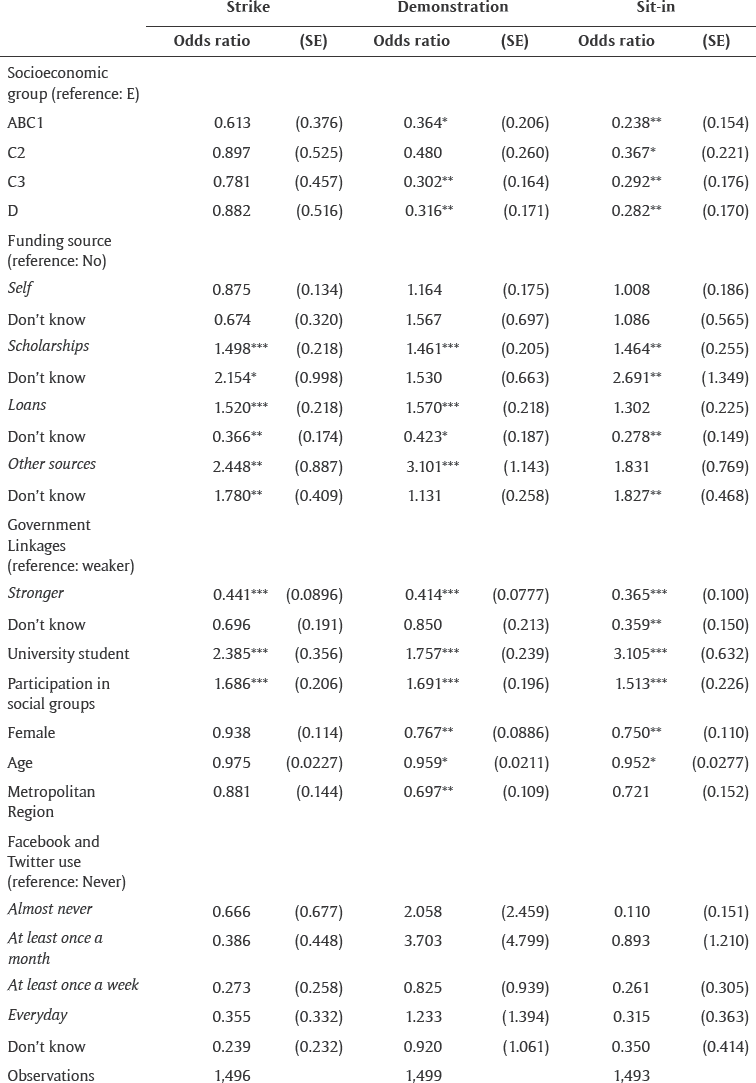
Standard errors in parentheses *** p < 0.01; ** p < 0.05; * p < 0.1
Conclusion
This article shows how differences in social class, funding, and linkages to governing parties lead to different levels of protest participation among college Chilean students. Previous studies using survey data have shown that education is a key factor in protest participation (Reference Dalton, Van Sickle and WeldonDalton, Van Sickle, and Weldon 2009). This article contributes to this line of research by showing how education shapes mobilization. The quantitative analyses demonstrate that a working-class background, taking education loans, and having weak programmatic connections to governing parties increase the likelihood of mobilization. Qualitative evidence sheds light on the ways these factors lead to student mobilization. Over time, neoliberal reforms caused cost increases while also expanding the number of working-class students who could not afford the rising fees. Moreover, in 2011 a right-wing coalition with weak organizational student linkages came to power, so it could not co-opt them or channel their demands. Neoliberal education policies were, therefore, responsible for both generating a grievance and increasing the population affected by it, while ruling party linkages were behind the timing of the mobilizations caused by the financial discontent.
The results from this study have several important implications. First of all, they emphasize the role that discontent in general and economic grievances in particular play in mobilization. More specifically, they suggest that neoliberal policies do not necessarily decrease mobilization in the long run, as some scholars have suggested (Reference WeylandWeyland 2004). Rather, as Silva (Reference Silva2009, 3) argues, neoliberal policies may actually provide “the motive for mobilization.” They engendered protests by creating “significant economic and political exclusion among urban and rural labor and even middle classes” (Reference SilvaSilva 2009, 4). In the case of the college student population, neoliberal policies caused discontent by cutting public education expenditures. Moreover, by expanding access, neoliberal policies increased the size of the population that shared this discontent. This study thus shows that neoliberal policies can affect both the acuteness of grievances and the size of the populations affected. The existence of discontent is an insufficient but necessary cause for mobilization.Footnote 35 Future explanations of changes in mobilization would benefit from studying both of these causal channels.
High levels of grievances shared by a large population are more likely to increase mobilization. Like Chile, the United Kingdom experienced student protests in 2010 and 2014 because tuition increases affected a large population (Reference Brown, Dowling, Harvie and MilburnBrown et al. 2013, 81; Reference CammaertsCammaerts 2013, 531). Other student protests occurred for similar reasons in Canada and the Netherlands (Reference RatcliffeRatcliffe 2015). The United States’ sizable student population has accumulated massive levels of loan debt so it seems plausible that it might experience comparable mobilizations. Indeed, student financial grievances were expressed during the Occupy Wall Street movement, when hundreds of local protests were organized against tuition hikes, student debt, and for public education (Reference McCarthyMcCarthy 2012). Whether these same issues will result in nationwide student protests during the presidency of Donald Trump is an open question. Not all countries that have boosted tuition and expanded access to education have experienced widespread protests, however. In Peru, for example, there have been relatively fewer student mobilizations (Reference ChávezChávez 2015) despite an explosion in the number of private, for-profit institutions, because public colleges still cover tuition and private ones offer income-based tuition rates. Thus, although college students have multiplied, financial grievances have not proliferated.
This study also describes the contradictory relationship between political parties and social movements, emphasizing that ruling party linkages have an important effect on mobilization. While the current literature has emphasized the effect of the opposition (Reference Almeida, Van Dyke and McCammonAlmeida 2010; Reference ArceArce 2010), this article suggests that ruling party linkages have a major demobilizing effect. In Chile, strong ties to small opposition parties in the 1990s and 2000s were not enough to counter the demobilizing effect of linkages to the ruling Concertación. Moreover, after Bachelet’s reelection in 2014, the government used its student connections to prevent mobilization (Reference SegoviaSegovia 2014), leading to a “crisis” in the movement (Reference Danton, Guzmán and HillmanDanton, Guzmán, and Hillman 2016). One report found that in 2015, college students participated in 42 events (Observatorio de Medios y Movimientos Sociales 2015, 22), a sharp drop from the peak of 143 in 2011.
Variance in ruling party linkages helps explain other episodes of mobilization and should be the object of future research. In Venezuela, middle- and high-income students have protested more against Presidents Hugo Chávez and Nicolás Maduro than their peers attending newer institutions with closer government ties (Reference IvanchevaIvancheva 2016). Similarly, students with stronger ties to the opposition protested in 2007 against the President Evo Morales’s Constituent Assembly (La Nación 2007). Students protesting against tuition hikes in the United Kingdom in 2010 had also weak linkages to the Conservative-Liberal Democratic government (Reference IbrahimIbrahim 2011). More generally in Latin America, party linkages also explain the waning of labor (Reference Levitsky and WayLevitsky and Way 1998) and the rise of ethnic movements (Reference RiceRice 2012; Reference Van CottVan Cott 2005; Reference AnriaAnria 2013). It is clear, therefore, that changes in the intensity and extension of grievances, as well as in political opportunities, must be considered to explain individual protest participation.
Additional Files
The additional files for this article can be found as follows:
• Appendix 1. Descriptive statistics of dependent and independent variables. DOI: https://doi.org/10.25222/larr.395.s1
• Appendix 2. Predicted probabilities of protest participation by selected combinations of socioeconomic sector, funding structures, and government identification. DOI: https://doi.org/10.25222/larr.395.s2


 Open access

