

4.1 Introduction
Around one million species of animals and plants are threatened with extinction. It is increasingly clear that this tragedy can only be avoided through transformative change (IPBES, 2019). This chapter aims to understand why the current state of biodiversity is so fragile, despite over half a century of global conservation efforts, and develop insights for more effective ways forward. We argue that past efforts have failed in part because they are based on an “ill-fit for purpose” problem analysis, and that reconfiguring problem conceptions shows promising directions for identifying novel strategies for triggering transformative change.
The chapter develops this argument by: (a) bringing together literatures on how to govern transformative change, transformations and transitions; (b) distinguishing their insights against a problem typology that identifies different perspectives on how to conceive of, and address, sustainability challenges and, as a result, (c) providing new insights for transformative governance.
The chapter is organized as follows. In the next section, we discuss and integrate different contributions to the literatures on transformative change, transformations, transitions and their governance, in order to better understand and govern transformative change. We then apply the four problem conceptions that Reference CashoreCashore (2019) has developed with colleagues (Reference Cashore and BernsteinCashore and Bernstein, 2022; Reference Cashore, Bernstein, Humphreys, Visseren-Hamakers and RietigCashore et al., 2019; Reference Humphreys, Cashore and Visseren-HamakersHumphreys et al., 2017) to assess how different schools of applied sustainability scholarship have shaped how to conceive of, and address, environmental challenges. Sections 4.4 and 4.5 then discuss the implications for transformative governance, including the need for much greater thinking about the contribution of scientific knowledge. Finally, we identify key conclusions that, together, offer a novel contribution to the academic and practitioner debates on transformative change and governance.
4.2 Transformations and Transitions: Integration and Reflection
It is clear that the dominant sustainability strategies to date have failed to “bend the curve” (Reference Mace, Barrett and BurgessMace et al., 2018) of biodiversity loss. A consensus is now emerging that a fundamentally different approach to how governance and science address the biodiversity challenge – through a focus on transformative change – is needed. Such fundamental change is called for since current structures often inhibit sustainable development and actually represent the underlying societal causes of biodiversity loss. To accomplish such transformative change, attention must not only be placed on the apparent direct drivers of ecological degradation (the physical causes of biodiversity loss, including land-use change, climate change, overfishing and pollution) that have guided so much of environmental and biodiversity policy analysis, design and implementation to date (IPBES, 2019; also see Chapter 1), but especially on the underlying societal causes, or indirect drivers, of biodiversity loss. But what exactly do these concepts of (governing) transformative change, transformations and transitions entail, and how do they relate to one another?
Over the past decades, new governance approaches have been developed under the headers of transformation and transition. Coming from different scientific disciplines and methodological traditions, these approaches share a recognition of the need for fundamental change, as well as a focus on the complexity, patterns and dynamics of structural and systemic change and the broader societal agency and governance that do, or do not, accelerate and guide such change. However, there is a distinction. The differentiation by Reference Linnér and WibeckLinnér and Wibeck (2019) is useful here, with macrotransformations referring to transformations that have spanned across entire civilizations, while particular transformations (or transitions) refer to transformations within subsystems of society, such as parts of specific socioecological systems (e.g. the food, mobility or energy transition).
We here provide a brief overview of the literatures on transformative change, transformations, transformative governance, transitions, and transition management and governance, which have all contributed to the thinking on fundamental societal change. We focus on governance, governance instruments and mixes of governance instruments (instead of governmental policy only) in order to recognize the role of different societal actors, including governments, market actors, civil society and researchers, in transformative change.
4.2.1 Transformations, Transformative Change and Their Governance
Reference Linnér and WibeckLinnér and Wibeck (2019: 4) define transformations as “profound and enduring non-linear systemic changes, typically involving social, cultural, technological, political and/or environmental processes.” Approaches that deal with problems on a global socioecological scale, such as approaches in resilience thinking (Reference Olsson, Galaz and BoonstraOlsson et al., 2014; Reference Westley, Tjornbo and SchultzWestley et al., 2013) and transformative adaptation (Reference O’BrienO’Brien, 2012), use the notion of “transformation” to refer to the essential and rudimentary shifts in nature–culture interactions and feedbacks. According to Reference O’Brien and SygnaO’Brien and Sygna (2013), transformations consist of three spheres, the practical, political and personal sphere, which all need to be addressed to enable societal transformations. Based on the IPBES Global Assessment (GA), Chapter 1 defines transformative change in a similar manner, namely as “a fundamental, society-wide reorganization across technological, economic and social factors and structures, including paradigms, goals and values.”
The GA operationalizes transformative change in terms of pathways, and levers and leverage points (IPBES, 2019). Because of the transformative change required, existing unsustainable development pathways and vested interests and existing structures should make space for new and more sustainable pathways (Reference Loorbach, Frantzeskaki and AvelinoLoorbach et al., 2017; Reference Sharpe, Hodgson, Leicester, Lyon and FazeySharpe et al., 2016). Part of this departure may occur by deepening and accelerating existing processes of change. The IPBES GA suggests that these outcomes can be achieved through complementary top-down and bottom-up action on eight key points of intervention, or “leverage points” (Reference Abson, Fischer and LeventonAbson et al., 2017; Reference MeadowsMeadows, 2008), and five types of “levers,” or management or governance interventions to effect the transformative change.
Reference Visseren-Hamakers, Razzaque and McElweeVisseren-Hamakers et al. (2021: 400) have defined transformative governance as “the formal and informal (public and private) rules, rule-making systems and actor-networks at all levels of human society (from the local to global) that enable transformative change, in our case, toward biodiversity conservation and sustainable development more broadly.” Building on the IPBES GA and Reference Visseren-Hamakers, Razzaque and McElweeVisseren-Hamakers et al. (2021), Chapter 1 of this volume further operationalizes the concept of transformative governance as including five approaches (integrative, inclusive, adaptive, transdisciplinary and anticipatory) which should be: (a) focused on addressing indirect drivers underlying sustainability issues; (b) implemented in conjunction and (c) operationalized in specific manners.
Similarly, Reference Linnér and WibeckLinnér and Wibeck (2019) stress the importance of integrative and inclusive governance through developing smart governance mixes, involving nonstate actors and the general public, and developing transformative capacity to be adaptive, creative and innovative, and to be able to deal with uncertainty. The authors highlight the need for transformative governance to aim at achieving different sustainability goals in an integrative manner instead of focusing on particular transitions.
An alternative approach to governing transformations is to think in terms of principles that might provide guidance to realize transformative change (Reference Bulkeley, Kok and van DijkBulkeley et al., 2020). The process of transformation itself is then one through which new solutions are generated, thus requiring a pragmatic and adaptive approach.
4.2.2 Conceptualizing Transitions and Their Governance
According to Reference Hölscher, Wittmayer and LoorbachHölscher (2018), a societal “transition” refers to a fundamental, systemic shift in the structure, culture and practices of sociotechnical, socioeconomic or socioinstitutional processes. Basic concepts in sustainability transitions research include regimes, landscapes and niches, with regime referring to an ecosystem, sector, technological system, area or organization that develops toward an optimum by gradually reducing diversity and optimizing efficiency (see e.g. Reference GeelsGeels, 2002). The societal context (or landscape), however, changes autonomously (the climate, demographic change, or political, economic or technological developments). From a certain point in time, adapting the regime to this changing context becomes harder and tensions start to build. At the same time, alternatives (niches) start to develop (new technologies, practices or models), which can become more competitive over time, especially when the regime is disrupted (through e.g. economic crisis, technological breakthroughs, forest fires or social revolution). In most disciplines the concept of transitions is used analytically (e.g. in ecology and literature on resilience) or descriptively (historical transition studies). However, transition governance uses this idea prescriptively: If persistent sustainability problems are rooted in existing regimes then existing knowledge frames and political strategies that deal with them are inherently part of perpetuating a development pathway that causes the “symptoms” of unsustainability. The transition premise is that this pathway will inevitably be disrupted by external pressures, internal crises and emerging alternatives. Transition management literature thus conceptualizes systemic change as a nonlinear process that takes us from one dynamic equilibrium to another as a result of destabilization of the status quo and breakthrough of alternatives (Reference Grin, Rotmans, Schot, Geels and LoorbachGrin et al., 2010).
Over time, the dynamics of transitions evolve, together with the types of agency that drive it. To initiate transitions and go against a very stable societal regime typically requires strong vision, radical voices, experimentation and leadership. As more people become aware of the need for transitions, alternatives become more attractive and mainstream. New combinations and collaborations between niche-actors and regime-actors can start to develop. Contrary to these bottom-up changes, spaces for rapid institutional change occur typically in a more top-down manner. Transition governance is then the strategy that combines this actor perspective and the dynamics of transitions with action-oriented instruments (see Reference De Haan and Rotmansde Haan and Rotmans, 2018).
By necessity, transition governance is multi-actor, multilevel and multidomain in its analysis and selective when it comes to participation by only involving actors already committed to transformative change to achieve common goals. It is also by definition based on co-construction, backcasting and reflexivity, as it acknowledges structural uncertainties while trying to use the mechanisms of social construction and social learning. Experimentation is also an important aspect in transition management, based on learning-by-doing. These principles have been translated in a number of instruments and tools, such as transition arenas, scenarios and experiments, with the idea of bringing transformative thinking – critical toward the status quo in order to improve it, assuming disruptive systemic change ahead and assuming positive futures are already emerging somewhere – into contexts and networks where people implicitly or actively work on sustainable alternatives to the regime.
4.2.3 Integrating Transformations and Transitions through Transformative Governance
The literatures on sustainability transformations and transitions share many similarities. They both recognize the need for fundamental change and the roles of different actors in governing such change, and they share a normative starting point, aiming to contribute to transforming our societies to become sustainable, equitable and just.
Interestingly, they emphasize different aspects of fundamental change, with transformations by definition focused on changing societal structures, or the underlying societal causes of unsustainable practices, and transition approaches often zooming in on change in specific systems or regimes (while recognizing the interrelationship between these regimes and broader societal structures).
We propose here that transformative change encompasses both transformations and transitions, and is thereby focused on both the generic societal underlying causes and those specific to certain regimes. So transformative change includes a focus on enabling change in what is referred to in the transitions literature as the “landscape.” It also (implicitly) assumes more agency to actually directly enable change in these societal structures, instead of only through niches and regime change, for example by promoting alternatives to paradigms of globalization, neoliberalism, economic growth or current discourses on relationships between humans and nonhumans.
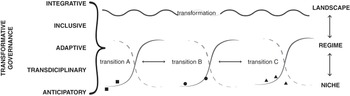
The transformation and transition literatures can be integrated by positioning transitions in a broader societal context of transformations: from the transitions perspective seeing transformation as a “family of transitions” (Reference LoorbachLoorbach, 2014), or from the transformation perspective approaching transformative change to include multiple specific transitions (e.g. the transitions on energy, mobility, animal-free innovation, food), that also influence one another. Some of the change takes place in specific regimes or sectors, and some of the change is inherent in multiple regimes. More importantly, some of the societal causes underlying our current inherently unsustainable societies are generic (e.g. values, paradigms and goals; economic structures; generic institutions; ways of governing), and thus influence all specific transitions. Together, the stronger focus on generic societal change of the transformations literature, combined with the detailed focus on specific transitions, represents an important new avenue for understanding transformative change and its governance. With this, transformative governance entails agency at the niche, regime and landscape level, and governance mixes need to include instruments meant to enable transformative change both within specific regimes, among regimes and in society more broadly (Figure 4.1).
Integrating transformations and transitions through transformative governance
Transformative governance enables transformative change through governance mixes that include instruments focused on niches, transitions (and their interactions) and transformations. Transformative change encompasses both transformations and transitions, and is thereby focused on both the generic societal underlying causes and those specific to certain regimes.
While both literatures highlight the need for adaptive, anticipatory and transdisciplinary governance, the transformation literature is more explicit about the need for integrative governance. Also, some authors from both literatures agree on the need to strategically think about participatory processes, highlighting the crucial role of those actors with transformative ambitions and the danger of including actors with vested interests in the old regime too early on in the process. However, many authors, especially from the transformative change literature, see inclusive governance in terms of its representativeness of different views, and promote pluralist approaches. We here follow the former, more strategic approach, also in light of the “problem-solving through prioritization” approach we are proposing, as elaborated below.
4.3 Four Sustainability Problem Conceptions, Not One
The role of cognitive frames in shaping policy and governance in general (Reference Douglas and WildavskyDouglas and Wildavsky, 1982; Reference StoneStone, 1997) and on the environment in particular (Reference BernsteinBernstein, 2001) has long been recognized by a range of scholars within public policy, transnational governance and global environmental politics (e.g. Reference HaasHaas, 2002). Cashore and colleagues contributed to this literature by reflecting on the types of problems that confronted environmental and sustainability challenges. Doing so led to three observations. First, practitioners and applied scholars were involved, often unwittingly, in a narrowing of attention to environmental problems to those that, when solved, created “win-win” outcomes with economic goals. Second, the championing of “evidence-based” science often narrowed data collection that reinforced, rather than confronted, this bias (Reference CashoreCashore, 2019). Third, widespread emphasis among the private sector and international agencies on sustainable development tended to drift toward ameliorating economic sustainability challenges that, ironically, contributed to environmental degradation (Reference Cashore and BernsteinCashore and Bernstein, 2020). Overcoming this drift required consciously identifying a “learning protocol” among scientists and stakeholders through which four different types of sustainability problem conceptions, and corresponding evidence, would be rendered explicit (Reference Cashore, Bernstein, Humphreys, Visseren-Hamakers and RietigCashore et al., 2019). Such exercises, they argued, can lead to innovating insights for ameliorating environmental and social problems (Reference Humphreys, Cashore and Visseren-HamakersHumphreys et al., 2017) rather than “drifting” away from them (Reference Cashore and BernsteinCashore and Bernstein, 2022).
This quest to help ameliorate the environmental (and social) problems that were usually caused by championing economic goals led Cashore and colleagues to offer a three-part framework that is relevant to, and helps frame, the literature on transformative governance.
First, they identified two ways to disentangle four types of approaching sustainability issues: those that champion economic utility as the goal versus those that do not; and those that justify their approach to applied policy analysis based on the particular features of a problem in question versus those that offer universalistic frameworks (Reference Cashore, Bernstein, Humphreys, Visseren-Hamakers and RietigCashore et al., 2019). The corresponding four types (Table 4.1) are innovative in that they simultaneously capture (subjective) constructed notions of particular problems but also point researchers to collect (seemingly objective) empirical evidence that narrows “lessons learned” to those that reinforce particular problem conceptions over others (Reference Cashore and BernsteinCashore and Bernstein, 2022).
| Rationale | ||||
|---|---|---|---|---|
| Do economic or utility rationales dominate the underlying moral philosophy? | ||||
| Yes | No | |||
| Problem orientation | Analysis justified based on features of a specific kind of problem? | Yes | Type 1: Commons | Type 4: Prioritization |
| No | Type 2: Economic optimization | Type 3: Compromise | ||
Second, they found that four different sustainability schools tended to reinforce each type.
The Type 1 reinforcing commons school captures those sustainability scholars who target overuse of resources (Reference AraralAraral, 2014; Reference OstromOstrom, 1990) commonly referred to as “tragedies of the commons.” This orientation, which dominates schools of resource and agricultural economics, leads experts to focus on developing policies and institutions that limit the extraction of any resource to the same level as they reproduce. This approach also shows up in biodiversity cases when viewing them as a global tragedy of the commons that stems from a failure or absence of collective action that produces suboptimal economic results.
The Type 2 reinforcing economic optimization school shares Type 1 conceptions advancing overall economic utility or welfare. However, it is guided by a moral philosophy that evaluates solutions to any problem on whether they enhance economic welfare in society as a whole. It finds economically optimal solutions through cost–benefit analyses in which a range of environmental, social and economic outcomes are all granted some type of utility decreasing or increasing value, which then allows comparison across all outcomes (Reference Arrow, Cropper and EadsArrow et al., 1996). Environmental goals are often converted into economic values through willingness to pay by consumers. Only those solutions that are deemed to enhance, rather than reduce, economic utility are considered rationally appropriate (Reference Sinden, Kysar and DriesenSinden et al., 2009). The economic optimization school has dominated the vast majority of environmental governance over the last thirty years (Reference Hepburn and SternHepburn and Stern, 2008; Reference Nordhaus and EstyNordhaus, 2019). It explains why Reference Nordhaus and EstyNordhaus (2019) has found that limiting carbon emissions to a 3.1 degree world is the rational approach, even though environmental scientists have found that maintaining 1.5 degrees is required to avert catastrophic ecological outcomes.
The Type 3 reinforcing compromise school emerged out of a critique of the economic optimization school and advances a moral philosophy championed by many applied political scientists and sociologists who seek balance and compromise across different values. Also disconnected from problem structure, it advances multistakeholderism and “multigoal” policy analysis as the appropriate and legitimate way to understand and manage trade-offs that seek some type of balance among competing perspectives (Reference EckersleyEckersley, 2019; Reference Weimer and ViningWeimer and Vining, 1999). This school has dominated many global processes over the past thirty years, including the United Nations Sustainable Development Goals (SDGs) (Reference Bebbington and UnermanBebbington and Unerman, 2018). This school and its Type 3 reinforcing approach also tends to dominate high-level global reports on sustainability challenges (Reference Cashore and NathanCashore and Nathan, 2020; IPBES, 2019; IPCC, 2019). Moreover, the formal goals of the Convention on Biological Diversity (CBD) actually include three main pillars, namely conservation, sustainable use and the equitable sharing of the benefits of the use. Such a problem conception can also be considered a Type 3 typology.
In contrast, Type 4 reinforcing prioritization conceptions identify those problems that, for either moral or scientific reasons, cannot, by definition, be ameliorated by subjecting them to Type 3, 2 or 1 schools. Cashore and Bernstein refer to antislavery as an undisputed example of a moral argument for prioritization. Adjudicating whether society should be against allowing humans to own other humans based on optimality or compromise calculations to permit some types of slavery is considered abhorrent and absurd by almost every country and citizen across the world (although modern slavery still exists). Since the nineteenth century, antislavery is considered a universal norm, which means that it cannot be addressed by a universal framework meant to apply to any class of problems.
A second kind of Type 4 conception emerges from scientific evidence about the problem at hand, for example about what type of conservation efforts must be in place to ensure addressing an irreversible problem like extinction. Disciplines that tend to treat problems as Type 4 include scientists who study biodiversity loss, as well as philosophers and social scientists who focus on ways in which universally shared norms emerge and permeate societal attitudes. Their general agreement is based on science: The rate of biodiversity loss is real, alarming and caused by human activity.
This Type 4 school, for instrumental reasons, turns to “lexical” or sequential policy analysis in which policy solutions are adjudicated against a particular problem at hand, and then, once resolved, it turns to second and third order challenges – but only in ways that do not undermine the higher level problems. Long ago, Reference Cashore and BernsteinCashore and Bernstein (2022) point out, Tribe made this point when referring to species extinction (Reference TribeTribe, 1972). Put succinctly, he posited that since extinctions are irreversible and often caused by championing economic utility, the only way to address them is to grant them lexical status. The point here is that the underlying moral philosophy of the universalism of the compromise school or economic optimization school usually works against solving Type 4 problems, when, tragically, in today’s world they are often offered as transformative solutions for doing so. While Type 4 conceptions were prevalent in global and domestic environmental governance in the 1970s (Reference BernsteinBernstein, 2001; Reference YaffeeYaffee, 1994), this thinking has been marginalized owing to the dominance of Type 2 and 3 frames. Recently, however, Type 4 conceptions are again gaining increasing salience (Reference GeelsGeels, 2020; Reference Lockwood, Kuzemko, Mitchell and HoggettLockwood et al., 2017).
Third, they offered that “fit for purpose” governance requires explicit and continuous attention to problem conception, instead of applying “ill-fit for purpose” policy analyses and solutions. This contributes to the literature on transformative governance as it reinforces the need to be very clear about what actual problems, and corresponding outcomes, are being advocated when the literature makes conclusions about how to foster transformations. Put another way, proposed solutions that seek to value the environment through its economic values and that pose no threat to economic growth will look fundamentally different to those that champion the environment and justice. We therefore argue that if governments and scholars seek to address the environment then they must begin, and end, with attention to the problem at hand, rather than narrowing it to those cases that appear synergistic with other problems.
The question then becomes how we can accelerate such a norm shift from Type 2 or 3 conceptions to Type 4 for biodiversity conservation, as part of transformative change in terms of goals, values and paradigms (see Section 4.2 for the definition of transformative change used in this volume). Reference Cashore and BernsteinCashore and Bernstein (2022) argue that doing so requires greater interrogation of disciplines and literatures that have tended to maintain Type 4 conceptions in the midst of so much drift over the last thirty years to Types 1, 2 and 3. These tend to include critical and discursive political scientists, legal scholars and some strands of philosophy – the very disciplines that have been undermined in the shift toward a “data driven,” “evidence-based” and artificial intelligence (AI) world – while their general agreement is based on science: The rate of biodiversity loss is real, alarming and caused by human activity.
However, one of the complications of academic debates on biodiversity loss is not only that scholars do not conceptualize biodiversity-related issues as Type 4 problems, but that different scholars actually prioritize different biodiversity-related issues, and therefore also propose different solutions, as shown in the different chapters in this volume (see Chapter 2 for an overview of different perspectives). A first group (e.g. Reference Dinerstein, Vynne and SalaDinerstein et al., 2019 and Chapter 11) places biodiversity conservation at the top of the lexical ordering, and, as a result, proposes to protect large areas of land and ocean to halt biodiversity loss. A second group prioritizes improving the lives and livelihoods of local communities living in biodiversity-rich landscapes, which often leads them to oppose formal protection. Yet another, third, group prioritizes moving away from the human–nature dichotomy, and promotes addressing the indirect drivers of biodiversity loss and integrating multiple land uses, and thereby are also often against formal protection (see e.g. Chapter 12). A fourth prioritizes rights of nature, animal rights, antispeciesism, or posthumanism, thereby also moving beyond the human–nature dichotomy but in a different manner, criticizing positioning human wellbeing as more important than that of animals or nature (see Chapter 9). And even when prioritizing biodiversity conservation, scientists often disagree on what types of biodiversity can be best conserved and how, for example ecosystem approaches, focused approaches for specific species, or ex-situ approaches (Reference Cashore and BernsteinCashore and Bernstein, 2020).
So, while the scientific evidence for the fragile state of global biodiversity is clear, academic conceptualizations of the problem and solutions that should be prioritized differ among different groups of scholars. Many scholars would therefore actually disagree with framing the problem as “how to save a million species” – the title of this chapter. Obviously, these groups overlap, as the boundaries are not set in stone, and views evolve over time. Also, different arguments are used by different groups for the prioritization, with the first and fourth groups mainly recognizing the intrinsic value and rights of nature and animals, the second group mainly arguing for biodiversity conservation because humans depend on it, based on instrumental values, and the third group mostly representing relational values. Interestingly, academics representing the different schools of prioritization often collaborate without being explicit about these problem conceptions (see Reference Pascual, Adams and DíazPascual et al., 2021). So not only in policymaking in general, but also within Type 4 problem analysis, more explicit attention to problem conception is needed.
Integrating explicit attention to problem typologies in biodiversity governance requires that actors first ask how they conceptualize the problem at hand. If they have determined that they conceive of the problem as akin to antislavery norms, or in line with scientific knowledge of ecological tragedies, then they also need to be careful not to inadvertently undertake policy options in ways that are based on or strengthen Type 1, 2 or 3 rationales. Following Cashore and Bernstein, we argue that only Type 4 is “fit for purpose” to ameliorate the problem of global biodiversity loss that threatens one million species with extinction, since it’s the only one that addresses the problem as an ecological catastrophe or moral obligation. This does not mean that governance instruments identified by other schools have become obsolete, but that they need to be converted in service of ameliorating Type 4 problems, as elaborated below.
4.4 Implications for Transformative Biodiversity Governance
4.4.1 Prioritizing Biodiversity
What does all of this mean for halting biodiversity loss, or in other words, saving one million species? As shown, among others, in Chapter 6, most biodiversity policies have recently been based on Type 2 and Type 3 thinking, with local initiatives sometimes based on Type 1. Perhaps some protected areas (PAs) could be considered as fitting a Type 4 conception, although the trend in PAs is moving from strict protection to combining land uses, so moving toward Type 3 thinking. Also, PA policy, including deciding where to realize PAs, is often based on Type 2 or 3 thinking. Perhaps the emerging rights-based approaches (see Chapters 2 and 9) could be considered as representing Type 4 thinking. But overall, we have to conclude that most biodiversity policies and initiatives have not been based on Type 4 thinking – biodiversity loss is not treated as a priority in biodiversity governance.
When integrating problem-type analysis into the debate on transformative change and governance, we can conclude that defining biodiversity loss as a Type 4 problem in essence represents an integral part of transformative change: a change in terms of values, goals and paradigms. This would mean transforming biodiversity governance – this volume’s title – would mean prioritizing biodiversity concerns.
Interestingly, the transformation and transition literatures are not explicit about how they conceptualize sustainability problems. In general, sustainability transitions research (Reference Loorbach, Frantzeskaki and AvelinoLoorbach et al., 2017; Reference Rotmans, Kemp and Van AsseltRotmans et al., 2001) acknowledges the importance of problem framings and implicitly makes the case for transition governance that supports the shift from Type 2 and 3 thinking to Type 4. Also, by highlighting the need for fundamental change, the transformative change literature implicitly tries to address the fact that existing institutions and governance systems do not prioritize biodiversity or sustainability concerns, so could be seen as Type 4 thinking. However, the dominance of pluralist approaches in the transformative change literature and (science) policy debates, as discussed in the above, reflect Type 3 typologies.
Incorporating the focus on Type 4 problems thus provides a goal to transformative change, for example the goal of saving one million species. So, while we agree with the often-heard argument that different actors have different perspectives on the envisioned goal of transformative change and the ways to achieve these, we suggest another way forward. Instead of trying to accommodate all of these different views in the proposed solutions (which in essence reflects Type 2 or 3 thinking), we propose to explicitly discuss these different perspectives in order to come to a clearer understanding of what the problem is that needs to be prioritized and what types of solutions would be appropriate. Being aware of the differentiation between the four problem types thus makes governance more problem-focused.
In other words, explicitly prioritizing biodiversity conservation, and transforming to a truly sustainable society in order to avoid biodiversity loss, has consequences for the types of governance instruments that are required – and perhaps more importantly, those that are less relevant. Taking such a starting point would thereby radically change the way governance would be implemented, since the prioritization would be the basis for strategies and interventions, as discussed in more detail below.
4.4.2 Toward Ecocentric, Compassionate and Just Sustainable Development
Integrating problem-type thinking into transformative governance has consequences for the latter concept, defined in Chapter 1 as “the formal and informal (public and private) rules, rule-making systems and actor-networks at all levels of human society (from local to global) that enable transformative change, in our case, toward biodiversity conservation and sustainable development more broadly.” Especially the reference to the concept of sustainable development, currently operationalized around the world through the SDGs, needs further thought (see Chapter 1 for an overview of the SDGs). With the currently dominant Type 2 and 3 thinking, implementing the SDGs quickly becomes a matter of optimizing, or compromising between, the different goals.
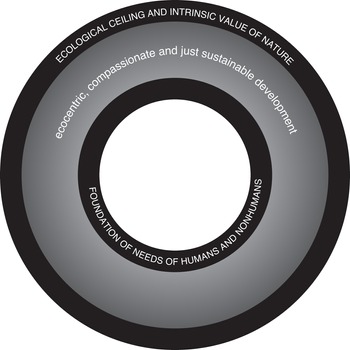
Instead, approaches such as Raworth’s doughnut economy prioritize the ecological and social SDGs to inform how to operationalize the economic ones to create a “safe and just space for humanity” (Reference RaworthRaworth, 2017: 218). However, Raworth’s doughnut mainly focuses on human justice, since the planetary boundaries are based on an instrumental perspective, and not necessarily on the intrinsic value of nature. Two important omissions of the doughnut include: (a) attention to the interests of the individual animal – it does not address speciesism, and (b) the intrinsic value and rights of nature. Therefore, we propose to include nonhuman animals and nature in the consideration of the safe and just space – so an ecocentric, compassionate (Reference BekoffBekoff, 2013) and just doughnut economy (see Burgerboerderijen, 2021 and The Vegan Society, 2021) (Figure 4.2). In line with the proposal by Reference Visseren-HamakersVisseren-Hamakers (2020) for an eighteenth SDG on animal health, welfare and rights, this would represent a transformation of the definition of sustainable development, from “meeting the needs of current generations without compromising the ability of future [human] generations to meet their own needs” (Reference Brundtland, Khalid, Agnelli, Al-Athel and ChidzeroBrundtland et al., 1987), a rather anthropocentric definition, to a definition that includes more ecocentric approaches: “meeting the needs of humans and nonhumans, while respecting the constraints of the planetary boundaries and the intrinsic value of nature.” This implies a prioritization of People and Planet over Profit, instead of regarding the three Ps as equal, while also recognizing animal interests (see Chapter 9). So, integrating Type 4 thinking into the definition of transformative governance changes the interpretation of the concept of sustainable development. Redefining sustainable development thus also represents an integral part of transformative change – a change in terms of values, goals and paradigms. This would mean transforming biodiversity governance would not only mean prioritizing biodiversity concerns, but prioritizing ecological, justice and equity concerns over economic ones more broadly, with a view to enabling ecocentric, compassionate and just sustainable development (Reference Elder and OlsenElder and Olsen, 2019; Reference GerickeGericke, 2021; Stockholm Resilience Centre, 2016; United Nations Environment Programme, 2021).
The ecocentric, compassionate and just doughnut economy
4.4.3 Further Operationalizing Transformative Governance
So how can governance support and accelerate this change in problem definition from optimization or compromise to prioritization? As previously stated, transformative governance, as operationalized in Chapter 1 (focused on the indirect drivers, and operationalizing integrative, inclusive, adaptive, transdisciplinary and anticipatory governance in a specific manner), implicitly already starts from Type 4 problem-solving. However, the concept can be further specified to enable prioritization approaches in the following manners.
This focus of transformative governance on the indirect drivers should include addressing those institutions, modes of governance and characteristics of our economic structures that do not prioritize ecocentric, compassionate and just sustainable development, since these actually represent an integral part of the indirect drivers (or underlying societal causes) of biodiversity loss. With this, addressing the indirect drivers becomes focused on enabling the prioritization of ecological and social societal goals.
The definitions of integrative, inclusive and anticipatory governance already implicitly reflect Type 4 thinking, with integrative governance (working through governance mixes) basically aimed at ensuring that biodiversity conservation (and ecocentric, compassionate and just sustainable development more broadly) is a priority across sectors, issues, levels of governance and places, and inclusive governance, operationalized in a manner that emancipates those stakeholders who prioritize biodiversity conservation (and ecocentric, compassionate and just sustainable development). With this, transformative inclusive governance could strengthen, support, emancipate and empower those parts of society and the economy where biodiversity loss and its associated negative impacts are already perceived and treated as a Type 4 problem. Anticipatory governance ensures prioritization in contexts of uncertainty by applying the precautionary approach. Adaptive governance then becomes focused on reflecting on whether governance still reflects Type 4 thinking, or whether the process is “drifting” (Reference Cashore and BernsteinCashore and Bernstein, 2022) toward optimization or compromise approaches. Stakeholders can together reflect on the extent to which governance is becoming and remains transformative. When integrating priority type thinking, transdisciplinary governance becomes focused on ensuring the needed types of knowledge are available and applied, as elaborated in Section 4.5. Through the iterative process of governance that combines these five approaches in this manner, over time, governance becomes increasingly transformative and thereby able to address indirect drivers (see Reference Visseren-Hamakers, Razzaque and McElweeVisseren-Hamakers et al., 2021).
Type 4 problem-solving thereby has significant consequences for governance mixes (combinations of public, private and hybrid governance instruments): as they become more transformative over time, they will increasingly include Type 4 solutions, with the aim of becoming fully focused on the prioritized objective. The question then becomes what types of governance instruments enable Type 4 solutions. Clear examples include prohibiting biodiversity-unfriendly practices, or conservation on the ground through well-placed, strictly protected and effectively managed PAs or other conservation measures. During the evolution of governance becoming increasingly transformative, Type 1 self-governing, Type 2 market-based, cost–benefit solutions and Type 3 deliberative or synergies-oriented approaches can play a role in the governance mix, applied in ways that contribute to Type 4 problem-solving and with this mix changing over time.
Reference Diercks, Loorbach and Van der SteenDiercks et al. (2020) discuss four governance roles and four processes in transitions. We here apply these in reflecting on transformative governance, as operationalized in the above to include both transitions and transformations. The four governance roles include:
Regulating,
Collaborating,
Stimulating and
Facilitating.
The four processes, which take place in parallel, include:
Emergence (developing new ways of thinking, working and organizing),
Changing (changing existing elements for new applications or a new context),
Institutionalization (becoming the norm),
Phasing out (of ways of thinking, working and organizing).
When combining these governance roles and processes with the four problem conceptions and the main governance instruments based on their logics, the following contributions to transformative governance emerge (see Table 4.2).
| Problem conception | Main governance roles | Main processes | Main governance instruments | Contributions to transformative governance |
|---|---|---|---|---|
| Type 1 self-govern | Collaborating, regulating | Institutionalization | Informal local rules |
|
| Type 2 optimize | Stimulating | Phasing out, changing, institutionalization | Market-based, financial instruments | - Decreasing role as transformation evolves |
| Type 3 compromise | Collaborating, facilitating | Changing, emergence, institutionalization | Deliberative, synergies-oriented instruments |
|
| Type 4 prioritize | Regulating | Phasing out, institutionalization | Formal rules | - Increasing role as norms change |
Type 1 self-governing solutions have a role to play throughout the transformation, in specific contexts in which local communities informally regulate natural resource use in a collaborative manner. These processes, however, need to be aligned with generic societal priorities. Type 2 market-based and financial solutions (e.g. subsidies, taxation, certifications schemes) can support actors (companies, consumers) during the transformation toward a fully sustainable economy by making sustainable options more competitive. They can especially play a role in phasing out, changing and institutionalization processes, and represent stimulating governance roles. Type 3 deliberative, synergies-oriented solutions (multistakeholder processes, partnerships) can facilitate discussing the perspectives of different stakeholders on what priorities should be. They can especially play a role in changing, emergence and institutionalization processes, and represent collaborating and facilitating governance roles. They have a role to play throughout the transformation to avoid “drifting” to nonprioritizing solutions, and to find synergies among different Type 4 problems within the context of ecocentric, compassionate and just sustainable development. Type 4 solutions, including formal rules that enable prioritization, have a regulating role and mainly play a role in phasing out nonsustainable practices and the institutionalization of sustainable ones.
Transformative governance thus evolves over time. As the indirect drivers become increasingly addressed over time, the governance mix can become more focused on Type 4 solutions, since economic structures and institutions, and societal values, paradigms and goals, are evolving to become more sustainable, making Type 4 solutions more feasible. Also, as a Type 4 understanding of the issue of biodiversity loss (and ecocentric, compassionate and just sustainable development more generally) gains prominence in society, Type 1, 2 and 3 policy approaches can be revisited in the light of the emerging transformations. Type 2 policy analysis starts to change, as can be seen with the Stern review and the Dasgupta review (Reference DasguptaDasgupta, 2021; Reference SternStern, 2007), and there will be gradually growing attention for concerns beyond gross domestic product (GDP) and post-growth approaches. In order to accelerate the process, different actors can reflect on the most appropriate governance mix in different phases of the transformation, through the transformative governance approach discussed in the above.
Some interesting questions remain. What does Type 4 thinking mean for trade-offs between different sustainability or societal concerns, for example climate change mitigation and biodiversity conservation, or biodiversity conservation and local livelihoods, or biodiversity conservation and animal rights? In other words – what should be done if two Type 4 problems meet? In essence, most transformative solutions address multiple sustainability concerns simultaneously, since the same societal structures cause various sustainability issues, as discussed above, so in theory Type 4 governance mixes to address biodiversity loss would simultaneously help mitigate climate change, and vice versa. However, sometimes trade-offs are unavoidable, for example in the case of Invasive Alien Species (IAS). We could have avoided, and still can prevent, IAS through preventative measures (less trade and travel), but the damage in some cases has already been done. The rights of which animal then has priority in a situation where they cannot coexist – the one considered local or the one considered invasive? In such cases, the only way forward would be for actors to explicitly discuss what the priority should be.
4.5 Implications for the Role of Science in Transformative Governance
What is the role of science in transformative governance focused on prioritizing biodiversity conservation? It is important to realize that knowledge, science and the scientific community can be considered part of the problem, or perhaps more gently, not part of the solution; (parts of) our knowledge systems may be part of the indirect drivers of biodiversity loss, including our perception of the problem, how we relate to nature and how we understand what nature is (Reference StengersStengers, 2011).
As discussed in Section 4.3, parts of the scientific community represent Type 4 thinking but prioritize different biodiversity-related problems, while other parts of the scientific community represent other problem types. The main social scientific theories also represent different problem conceptions. While recognizing many possible exceptions, one could say that rational choice scholars mostly represent Types 1 and 2; different institutionalist approaches cover Types 1–3; discursive theories are mainly aimed at understanding different perspectives, thereby best matching Type 3; and critical theory is clearly focused on a Type 4 problem conception.
Moreover, there are significant epistemological differences between the natural sciences promoting prioritizing biodiversity conservation and those social sciences and humanities also representing Type 4 problem conceptions. So, while their problem conceptions converge, their scientific practices differ to the extent that collaboration becomes difficult. Instead, and as a result, ecologists tend to gravitate toward Type 2 environmental economists, with whom they share similar methods, but who reinforce moral philosophies representing “rational” approaches to addressing ecological catastrophes.
The consequence is that the message in science–policy interfaces is diffuse. While there is academic consensus that biodiversity loss is a problem, scientists characterize the problem and its solutions in many different ways. Moreover, because most current policy processes actually represent Type 2 and 3 conceptions, Type 4 messages on prioritizing biodiversity conservation do not match policy practices and are not integrated in governance efforts. What can we learn from different scientific schools of thought in addressing these dilemmas?
Research on uncertainties (Reference Van Asselt, Beusen and Hilderinkvan Asselt et al., 1996) postulates the idea that reductionist and logical empiricist or positivist knowledge approaches are not able to effectively address the most wicked or unstructured problems. In these approaches, “scientific evidence” is used as a basis for policymaking aimed at tackling the complexity of sustainability problems. However, this evidence is never neutral, as is also stressed in literature about political epistemology: Its nuances and uncertainties will be used to misinterpret, modify or motivate interventions in line with powerful interests or dominant perspectives. The objective position of the research(ers) related to policy and, in general, the science–policy interface has already been the subject of debate for decades (e.g. Reference Hoppe and HisschemollerHoppe and Hisschemoller, 1996; Reference WildavskyWildavsky, 1979), but has been revived in the context of sustainable development and biodiversity loss.
While the unstructured nature of complexity points at a need for the involvement of diverse knowledge systems and sources in science for policy, given the inherent uncertainties and values in policy-related science, we need to critically reflect on the “contributions” of academia to noneffective approaches or reinforcing certain typologies, including the synergies norm of Type 3 thinking.
Examples include sustainability science (Reference Clark and DicksonClark and Dickson, 2003) and integrated assessment (Reference Rotmans and Van AsseltRotmans and Van Asselt, 1996), developed as integrated sciences to deal with unstructured “sustainability problems.” The core idea, for example, is that the future effects of biodiversity loss are unknown and will also be interpreted and perceived in different ways depending on context. Integrated assessment, transdisciplinarity, co-creation and participatory research engage different types of scientific and practitioner knowledge to create shared analyses and consensus about complex problems as a basis for solutions. However, while we agree that such processes of sense-making and problem-structuring (Reference RosenheadRosenhead, 2006) are critical in order to explore why persistent and unstructured problems are seemingly unsolvable, the danger of “drifting” to Type 2 and 3 solutions is tremendous. So, transformative change and governance need a realist ontology: Problems are real but our way of understanding them differs. Therefore, regular deliberation on what exactly are the priorities is vital.
Disciplinary knowledge remains important. Political theory, for example, showcases how vested interests may be reinforced within current regimes, by analyzing processes through which dominant regime-actors (within policy and markets) are able to influence innovation, thereby maintaining their influential position. In other words, these dominant regime-actors make sure that their interests flow into the mainstream debate and policy discourse. This helps them to improve their position and work against potential emerging disruptors (Reference SterlingSterling, 2001). This tendency is also elaborated in institutional theory, which points at the inertia and incremental nature of policymaking and change, and also addresses how powerful actors seek to reinforce and maintain their position. More broadly, institutional theory addresses how organizational structures keep cultural norms and behavioral routines intact in order to stabilize societal systems.
In order for science–policy interfaces to be able to contribute to transformative governance, stakeholders and academics can together codesign governance approaches focused on Type 4 problem-solving. The role of researchers within a Type 4 conception also changes: they are not simply knowledge providers or “experts that resolve needs” (Reference IllichIllich, 1977: 11), but they also act as change agents to establish the much-needed modes of thinking, participation and dialogue for the purpose of transformative change (Reference Fazey, Schäpke and CanigliaFazey et al., 2018; Reference Wittmayer and SchäpkeWittmayer and Schäpke, 2014).
Natural science can continue providing scientific evidence for biodiversity loss, through which biophysical nature – one millions species – gains a voice through the scientists’ activities and their instruments (Reference LatourLatour, 2020). In biodiversity governance, this marks the role of the natural sciences: They provide species with a voice, and as biodiversity declines, this voice also increasingly demands political representation. Social sciences that are especially needed in transformative governance include knowledge on institutional change and stability, path dependency, economics that moves beyond the economic growth paradigm, and governance focused on changing values, paradigms and goals. Reference CashoreCashore (2019) proposes an emphasis on qualitative disciplines in history, philosophy, law, historical sociology, political science, sociology and some strands of geography in order to address the nature of Type 4 problems properly.
Transformative governance perhaps also includes a more fundamental reflection of the institutional structures of academia, and in our case the science–policy interfaces around biodiversity. These are in many ways intimately linked to the dominant discourses in science (disciplinary, descriptive, objective) and policy (solution-oriented, formal, power-based) rather than around the transformative governance principles (integrative, inclusive, transdisciplinary, adaptive and anticipatory). If we take these as design principles for transformative science–policy interfaces, it would mean a completely different way of bringing together knowledge perspectives and societal governance. It would mean facilitating communities of stakeholders that work on transformative change in practice, and working with them to identify the institutional principles and conditions needed to mainstream their practices (e.g. regenerative agriculture, biodiversity conservation, cooperative models, de-growth economies, circular economic models and social enterprises). In other words, such a new institutional design would provide mechanisms for transforming biodiversity governance by actually prioritizing the new practices of governance that prioritize biodiversity governance. Together, practitioners and academics could reflect on the main bottlenecks in the transformation, and address them together, whether they be at the landscape, regime or niche level, and whether they would be relevant for only one transition or for sustainability transformations more generally.
4.6 Conclusions
In this chapter we have combined various literatures in order to provide answers to the question of how to save one million species. We have combined the literatures on transformative change, transformations, transitions, transformative governance and problem typologies, which has allowed us to develop the following unique insights.
Bringing together the literature on (governing) transformations and transitions combines the strengths of both bodies of knowledge. The combined perspective allows more focused attention to the generic societal underlying causes of sustainability issues than the transition literature has done so far. These indirect drivers are now better represented as not only influencing transitions in regimes, but also as objects to be changed through transformative governance. The renewed perspective also allows sustainability transformations scholars to operationalize the transformation to – in essence – sustainable societies as “a family of transitions,” thereby enabling integrative governance (Reference Visseren-HamakersVisseren-Hamakers, 2015; Reference Visseren-Hamakers2018) of transitions, focused on the interrelationships between different transitions and the underlying causes they have in common. It’s perhaps through this enhanced attention to the underlying causes of sustainability problems in multiple transitions that both the transitions and the transformations they are embedded in can be accelerated.
Integrating problem-type thinking (Reference Cashore and BernsteinCashore and Bernstein, 2020) into the transformative change and governance literature has contributed to furthering the conceptualization and operationalization of the concept of transformative governance in the following ways.
First, through the development of this chapter, we have come to realize that most biodiversity policies and initiatives have (purposefully or inadvertently) not been based on Type 4 thinking: Biodiversity loss is not considered as a priority, but instead often regarded as part of problems of optimization or compromise. Based on this analysis, we conclude that defining biodiversity loss as a Type 4 problem in essence represents an integral part of transformative change: a change in terms of values, goals and paradigms. Transforming biodiversity governance would then mean prioritizing biodiversity concerns. Incorporating the focus on Type 4 problems thus provides a goal to transformative change, in our case the goal of saving one million species.
Integrating problem-type thinking also has consequences for the reference to the concept of sustainable development in the definition of transformative governance, as introduced in Chapter 1. Transforming biodiversity governance would then mean prioritizing ecological, justice and equity concerns over economic ones to come to mean ecocentric, compassionate and just sustainable development, which can be defined as meeting the needs of humans and nonhumans, while respecting the constraints of the planetary boundaries and the intrinsic value of nature.
Transformative governance then becomes focused on the role of current institutions, modes of governance or characteristics of our economic structures that do not prioritize ecocentric, compassionate and just sustainable development as part of addressing the indirect drivers (or underlying societal causes) of biodiversity loss.
Type 4 problem-solving also radically changes governance. Governance mixes will need to increasingly include Type 4 solutions with the aim of becoming fully focused on prioritization. During the evolution of governance becoming increasingly transformative, Type 1 self-governing, Type 2 market-based, cost–benefit solutions and Type 3 deliberative or synergies-oriented approaches can play a role in the governance mix, adjusted and applied in such ways that they contribute to Type 4 problem-solving, and with this mix changing over time. Through adaptive governance, actors can reflect on whether governance mixes are focused enough on Type 4 problem-solving, or whether implemented solutions are “drifting” toward optimization or compromise solutions. Only if we treat the threat of losing one million species as a priority will we succeed in avoiding this potentially historic loss of life.


 Open access