


Introduction
In human-dominated landscapes where protected areas border farmlands, crop use by wildlife is common (Ravenelle & Nyhus, Reference Ravenelle and Nyhus2016). Such crop damage typically has negative financial and non-financial impacts on farmers, and thus may generate negative attitudes towards wildlife and lead to retaliation measures (Decker & Chase, Reference Decker and Chase1997; Treves, Reference Treves, Manfredo, Vaske, Brown, Decker and Duke2009). To reduce these negative human–wildlife interactions, conservation scientists have been studying the drivers of crop damage, its consequences, and potential solutions (Reiter et al., Reference Reiter, Brunson and Schmidt1999; Treves et al., Reference Treves, Wallace, Naughton-Treves and Morales2006), often assessing the type and severity of impacts on individual farmers (Ravenelle & Nyhus, Reference Ravenelle and Nyhus2016). Although in some areas there is a tendency for low-income communities to settle near protected areas (Treves, Reference Treves, Manfredo, Vaske, Brown, Decker and Duke2009), few studies have considered the relative economic status of affected farmers, or the potential of wildlife-caused damage to increase social inequality. However, it is essential to understand whether poor farmers experience more wildlife damage, and the underlying causes of this relationship, to recognize potential negative effects of wildlife conservation actions, and to implement effective mitigation measures.
Damage caused by elephants is of particular conservation interest because typically it is both frequent and severe (Osborn & Parker, Reference Osborn and Parker2003). As flagship species, elephants are important to conservation, but both African Loxodonta africana (e.g. Naughton-Treves, Reference Naughton-Treves1997; Haore, Reference Haore2000) and Asian Elephas maximus elephants (e.g. Wilson et al., Reference Wilson, Davies, Hazarika and Zimmermann2015; Neupane, Reference Neupane, Johnson and Risch2017) regularly feed on crops, damage houses and cause human injuries and sometimes fatalities. To the farmers living in areas where crop use by elephants occurs, the protection of their crops, homes and families from such damage is part of daily life (Saif et al., Reference Saif, Kansky, Palash, Kidd and Knight2019). Apart from the often considerable indirect and emotional cost (Barua et al., Reference Barua, Bhagwat and Jadhav2013; Gogoi, Reference Gogoi2018), the financial cost of such damage is typically substantial. Because of their large body size, foraging and trampling elephants cause severe crop losses. Damage to buildings and other farm structures, for example to obtain access to stored food resources, causes further economic losses to farmers. Earlier studies have shown that the risk of damage is higher in close proximity to a protected area than further away from it, and suggested that people living near protected areas have less capacity to deal with damage caused by elephants (Wilson et al., Reference Wilson, Davies, Hazarika and Zimmermann2015). In addition, the perception of elephant-caused damage varies within communities, with poorer farmers being more fearful of elephants than their wealthier counterparts (Sarker & Røskaft, Reference Sarker and Røskaft2014). However, to our knowledge, there has been no study of the economic status of farmers in relation to the risk of damage by elephants.
Here, we examined the spatio-temporal distribution of wealth and elephant-caused damage in the western buffer zone of Bardiya National Park, Nepal, in relation to the farmers’ economic status. We were particularly interested in farmers living on the edge of the cultivated area, as they were ostensibly closest to the elephants’ habitat and therefore disadvantaged. We wondered if next to being literally marginal (living on borderland), these farmers were also marginal in terms of their economic status. We therefore examined (1) the socio-economic organization of the farmers, in particular in relation to distance to the wilderness, (2) the frequency and spatial distribution of elephant impact, and (3) the financial consequences of elephant-caused damage for individual farmers and the community as a whole. We also estimated the farmers’ willingness to pay for an insurance scheme (Ravenelle & Nyhus, Reference Ravenelle and Nyhus2016), to assess the capacity of farmers to forecast damage. By combining these research questions, we aimed to determine the severity and spatial and social distribution of human–elephant conflict across the community.
Study area
Bardiya National Park is located in the Terai of south-western Nepal (Fig. 1), the low-lying landscape that covers much of the northern Gangetic Plain, between the foothills of the Himalayas and the Ganges River. Most of the present-day landscape is composed of a mosaic of small (c. 0.04 ha) agricultural fields that are dotted with houses built along a network of tar and unmade roads. Historically, the main inhabitants of the Terai plain were members of the Tharu community, but since the 1950s people from other ethnic groups (e.g. Pahani) have moved in from the hills and the neighbouring Gangetic Plain of India. The Tharu people have an effective genetic resistance against malaria (Terrenato et al., Reference Terrenato, Shrestha, Dixit, Luzzatto, Modiano, Morpurgo and Arese1988; Modiano et al., Reference Modiano, Morpurgo, Terrenato, Novelletto, Di Rienzo and Colombo1991), but the local eradication of malaria in the Terai (Brydon et al., Reference Brydon, Joshi and Pradhan1961; Dahal, Reference Dahal2008) enabled large-scale settlement of non-malaria resistant people in the area.
Bardiya National Park, Nepal, and the study area where we assessed damage caused by Asian elephants Elephas maximus. The study area (the territories of the Village Development Committees Patabhar and Gola) is located in the buffer zone west of the Park, in between the river arms.

The local economy is almost completely based on farming, with extensive irrigation systems. In recent years, embankments have been built to prevent rivers from flooding the area. There are typically three growing seasons per year: rice is produced during the monsoon (June–August), mustard is grown predominantly from September to December, and wheat during the winter (January–April). Farmers make abundant use of fertilizers and pesticides, as is common in South Asia (Prins & Tsewang, Reference Prins and Namgail2017). Although motorization of agriculture is starting to develop, most farmers use traditional methods, with water buffalo and draught cattle still playing an essential role. In the study area, farmers are at severe risk (45%) of undernourishment, based on a minimum requirement of dietary energy consumption of 1,810 kcal/person/day (Joshi et al., Reference Joshi, Maharjan and Luni2010). Human population density is high in much of the Terai (about 400 persons/km2), and land is a scarce commodity (Population Education & Health Research Centre, 2016). The wealth of farmers is thus largely defined by their land possessions. The mean landholding size in Nepal is 0.58 ha per household, and 45.5% of the households are small farms (< 0.5 ha). Farmers with small farms are subject to high food insecurity (Maharjan & Khatri-Chhetri, Reference Maharjan and Khatri-Chhetri2006).
The 970 km2 Bardiya National Park is one of the few remaining areas in the Terai where wildlife is protected. The Park provides shelter to the Asian elephant, the greater one-horned rhinoceros Rhinoceros unicornis, the Bengal tiger Panthera tigris, the leopard Panthera pardus and various species of deer. Although the core area of the Park is strictly protected, much of the buffer zone has been converted to agricultural land and settlements. Cessation of the Nepal Civil War (1996–2006; e.g. Sharma, Reference Sharma2006) led to further pressure on the land. During this war, the local rhinoceros population was severely reduced in numbers (WWF, 2007) and possibly became locally extinct (N. Subedi, pers. comm., 2017). Similarly, Bardiya's elephant population was nearly exterminated. Surviving elephants migrated across the international boundary with India where they took refuge in the neighbouring Katarniaghat Wildlife Sanctuary (Baral & Heinen, Reference Baral and Heinen2005). Rhinoceroses were reintroduced (Thapa et al., Reference Thapa, Nepal, Thapa, Bhatta and Wikramanayake2013) and around 1994 elephants recolonized Bardiya National Park (Velde, Reference Velde2017).The current elephant population is c. 80 individuals (Pradhan et al., Reference Pradhan, Williams and Dhakal2011). Increasingly, wild animals leave the core protected area and enter the buffer zone, where they frequently come into conflict with people. There are several causes of this. Firstly, there is increased safety: deployment of armed forces in Nepal's national parks reduced poaching (Achary, Reference Acharya2016; Aryal et al., Reference Aryal, Acharya, Shrestha, Dhakal, Raubenhiemer and Wright2017). Secondly, with the removal of cattle from the protected area in the 1970s, and the resettlement of local people out of the Park and the associated cessation of logging, grazing and cutting largely ceased and the vegetation composition consequently changed, with unpalatable Sal trees Shorea robusta now dominating and displacing grassy vegetation to a large extent (Dinerstein, Reference Dinerstein1979a,Reference Dinersteinb; Dinerstein, Reference Dinerstein1980; van Lunenburg et al., Reference van Lunenburg, Kral and van Alphen2017). The main types of human–wildlife interactions in the buffer zone of the Park are (1) occasional killing of people by elephants (multiple casualties each year), (2) crop use by large herbivores, particularly elephants but also by rhinoceroses, deer and wild boar Sus scrofa, and (3) livestock depredation by carnivores (primarily leopards; Thapa, Reference Thapa2010). Financial compensation for any human casualties is granted fairly efficiently and quickly by the authorities, but the process for compensation of damage to crops and property is slow and perceived as inadequate by the local people (K. Khadka, pers. comm., 2016). At the time of our study, people aimed to protect their crops and properties with night patrols, but there was no insurance or other collective scheme of damage compensation by the government, except for human injuries or fatalities.
We interviewed people in the Village Development Committees of Patabhar and Gola on the northern tip of the peninsula between the two branches of the Karnali River (Fig. 1), in the Bheri Zone of the Bardiya District of western Nepal. Village Development Committees are subdivided into wards, which are subdivided into settlements, which are clusters of homesteads. At the homesteads, farmers traditionally store much of their harvest in large clay containers. These hold 500–1,000 kg of rice or wheat and are typically built either next to or inside the house, with a maximum height of c. 2 m. Some farmers also brew and distil their own rice toddy and store it in their houses. Both the clay food stores and stored rice toddy are attractive to elephants.
To understand the risk of elephants causing damage to crops and properties, we examined the distance of fields and houses to the boundary between the anthropogenic matrix and the wilderness area. We defined the anthropogenic matrix as the area containing houses, house yards, agricultural fields and infrastructure (but not forest roads). We did not include community forests (where cattle grazing and extraction of wood are permitted) in the anthropogenic matrix, because elephants are known to inhabit these forests in the study area. As such, the border was typically either the river levee (which demarcates the floodplain from the anthropogenic matrix) or the edge of community forests (Supplementary Fig. 1).
Methods
To investigate damage caused by elephants in the Village Development Committees, we conducted semi-structured interviews at two societal levels, with settlement leaders and subsistence farmers. To obtain an overview of the damage across the study area, we first interviewed settlement leaders, which resulted in delineated high-risk areas, where we subsequently interviewed 10 farmers in each settlement. We asked settlement leaders general questions to indicate the proportion of households affected by elephants in the past year. Questions for farmers were more specific and asked about their economic status (in particular, the size of their landholdings) and the amount and spatio-temporal dynamics of damage caused by elephants. We also explained the concept of insurance and asked farmers to estimate the amount they would be willing to pay annually for such an insurance, assuming that reimbursement would be comprehensive and fast. We obtained informed consent from settlement leaders and farmers prior to the interviews.
The interviewers were employed by the National Trust for Nature Conservation (a quango) and had intricate knowledge of the area and its people. During 22–24 November 2016, we instructed the interviewers on site. The survey was conducted during December 2016–February 2017 and included 31 settlement leaders and 240 farmers. Most settlements in the area have a linear structure, with houses located next to an unmade road. To maximize spatial coverage and minimize the risk of bias towards farmers who experienced elephant-related damage, interviewers started the interview at one edge of the settlement and from there selected every 10th homestead they encountered, on either side of the road. Interviews with farmers comprised two parts: one focused on the homestead itself (i.e. damage to and near the house, in the yard), and the second focused on the agricultural field belonging to the same farmer (i.e. damage to the standing crop). By including fields, we increased the spatial coverage of our survey, because fields were more dispersed than the linearly aligned houses.
Interviewers recorded locations of the homesteads of the selected settlement leaders and farmers, and of agricultural fields, using a GPS. To record field locations, farmers were asked to walk to the field with the interviewer. When farmers had fields at separate locations, we asked them to walk to the nearest field and to answer questions regarding elephant damage only for that field. In 24 out of 239 cases, the closest field was > 250 m away from the house. Farmers often reported damage specifically either to the field or at the yard, thus recording locations for the homestead and field of each farmer separately increased the spatial accuracy of the damage estimation.
In the discussions concerning the amount of damage and willingness to pay for an insurance scheme, we used NPR, the local currency, and later converted to EUR (1 EUR = 115 NPR). We asked farmers to estimate the amount of damage per incident and per year. We estimated central tendencies of damage costs and willingness to pay with the median, to avoid the large influence of high, potentially overestimated values (hence, the reported estimated damage costs and willingness to pay are conservative estimates). Field size data were collected in katha (the local unit of land size; 1 katha = 380 m2 or 0.038 ha).
We performed statistical analysis in R 3.6.1, using base functions (R Core Team, 2019). Variables with boolean values (damage occurrence: yes or no) were analysed using a logistic regression, and count data (relating to frequency of damage events) with a Poisson regression. Estimation of harvest and insurance amount for various distance or income classes were, even after transformation, not normally distributed and therefore analysed with a Kruskal–Wallis test. Subsequent post hoc analyses were done by the Nemenyi test, as implemented in the R package PMCMR (Pohlert, Reference Pohlert2014).
Results
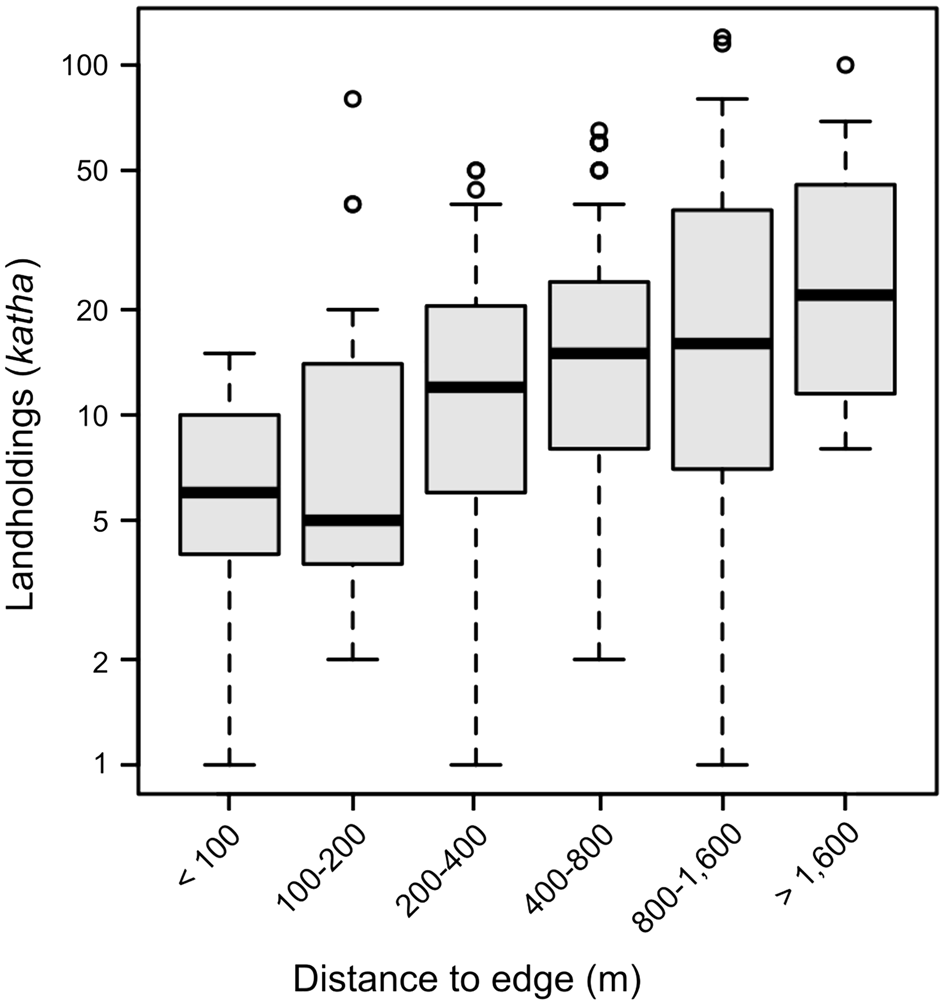
We found considerable economic inequality in the study area. Most landholdings were 0.15–1.90 ha (10th–90th percentile), with a median of 0.57 ha. Most farmers with small landholdings did not produce sufficient rice to sell a surplus (> 81% for landholdings < 0.15 ha vs < 16% for landholdings > 1.90 ha; logistic regression: constant = −0.006, Wald = −2.628, P = 0.009). There was a negative relationship between the size of landholdings and their proximity to the boundary with the wilderness area (Fig. 2; Kruskal–Wallis rank sum test, χ 2 = 17.187, d.f. = 5, P = 0.004). The median size of fields located within 200 m of the boundary was 0.19 ha, compared to 0.76 ha at distances > 1,600 m from the boundary.
Boxplots showing the size of farmer's landholdings in relation to distance to the edge of the wilderness area (1 katha = 380 m2). Statistics: Kruskal–Wallis rank sum test, χ 2 = 17.187, d.f. = 5, P = 0.004.
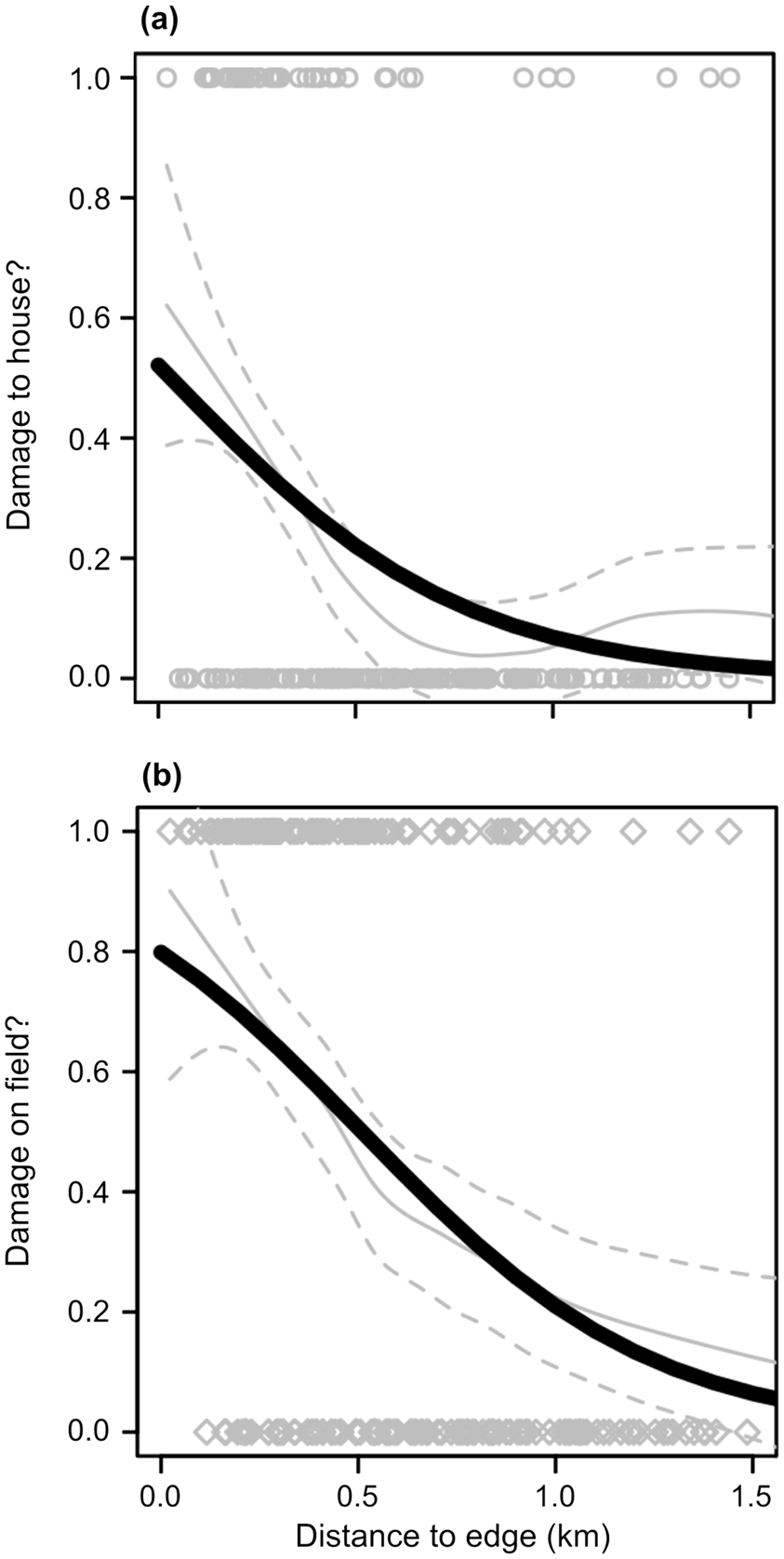
Across the study area, crop use by elephants was frequent and recurrent. Interviews with settlement leaders showed a negative relationship between the risk of damage to a field or yard and its distance from the edge of the wilderness area (Supplementary Fig. 2; logistic regression: constant = −0.006, Wald = −2.628, P = 0.009). None of the leaders of the settlements that were > 1,500 m from the matrix–wilderness boundary reported elephant damage, but leaders of all but one of the settlements < 1,000 m to the boundary reported damage. Similarly, interviews with farmers (Supplementary Fig. 1) indicated a negative relationship between damage risk and the distance of both houses and fields from the boundary (Fig. 3; logistic regression; houses: constant = −0.00268, Wald = −4.167, P < 0.001; fields: constant = −0.00270, Wald = −4.933, P < 0.001). The logistic regression model estimated that risk of damage to fields was > 0.6 at distances < 250 m of the boundary between cultivation and wilderness, 0.5 at 500 m from that edge, and only 0.2 at 1,000 m. For houses, the estimated risk was 0.3 at distances < 250 m from the edge, 0.2 at 500 m and only 0.1 at 1,000 m. According to interviews with farmers there was a significant relationship between the number of incidents in a field and its distance from the edge of the cultivation (Fig. 4; Poisson log-linear regression, regression coefficient for distance = −0.0004, d.f. = 116, P = 0.004). However, there was no such relationship between number of incidents in houses/yards and their distance from the wilderness–cultivation boundary (Poisson loglinear regression, d.f. = 61, P = 0.394).
The occurrence of elephant-caused damage in relation to distance from the edge of cultivation. Response variable is the occurrence of damage within the year prior to the interview, either (a) to the house or (b) on the field. Thin grey lines are predicted values of a locally weighted regression, with 95% confidence intervals. Thick black lines are the outcome of a binomial regression, and represent the average risk of experiencing one or more damage events per year, given a certain distance from the cultivation–wilderness boundary.
Occurrence of elephant-caused damage as a function of distance from the cultivated edge, on fields (light grey diamonds) and yards (dark grey circles). The light grey line shows the model prediction of the number of incidents based on the distance from the edge (Poisson log-linear regression, regression coefficient for distance = −0.0004, d.f. = 116, P = 0.004). There was no such significant relationship for yards (Poisson log-linear regression, d.f. = 61, P = 0.394).

Most of the damage occurred during October–December (Supplementary Fig. 3), which coincides with rice harvest and rice wine production, which according to many farmers attracts elephants. Rice wine is produced widely (84% of the farmers reported producing it), mostly in December (112 of 188 = 60%), but production starts as early as October or November.
Farmers estimated the damage to fields to be EUR 22 per incident for typical and EUR 130 for severe cases (Supplementary Tables 1 & 2). The damage per incident to houses was estimated to be EUR 43 and EUR 196 for typical and severe cases, respectively. Accounting for risk of elephant damage, the overall costs per farmer per year were EUR 23, 7, 2 and 1 for the distance classes < 500, 500–1,000, 1,000–1,500, and > 1,500 m, respectively. The self-declared median willingness to pay for an insurance scheme was EUR 22 per year (first and third quartile EUR 11 and 22, respectively).
We did not detect any significant relationship between the size of a farmer's landholdings and the number of incidents, nor the amount of reported damage (both tests: Spearman rank correlation, P > 0.05). However, compared to the value of the rice harvest, the relative damage for farmers with small landholdings was much higher. Typically, farmers with small landholdings lost c. 17% of their rice harvest (Fig. 5). Nevertheless, farmers with small landholdings were willing to pay less for insurance than those with larger landholdings (Kruskal–Wallis rank sum test, χ 2 = 33.838, d.f. = 5, P < 0.001). Farmers with small landholdings < 10 katha indicated they would be willing to contribute EUR 12 per year (median), compared to EUR 21 for farmers with holdings up to 40 katha, and EUR 44 for those with larger landholdings (Fig. 5).
Relationships between (a) landholdings and relative damage, and (b) landholdings and willingness to pay annually for insurance covering damage caused by elephants. Relative damage is defined as the proportion of rice damaged of a farmer's total rice production.

Discussion
Interviews with rice and wheat farmers living in the western buffer zone of Bardiya National Park, Nepal, showed that both poverty and damage caused by Asian elephants were concentrated in the area within a few hundred metres from the border of the Park's core zone. Elephants from the Park frequently leave the protected core area and enter the anthropogenic matrix, yet refrain from wandering deep into that matrix. By damaging buildings, farm structures and cropland, elephants heavily affect poor farmers with small landholdings, who live close to the Park's border. As a consequence, the burden of the human–elephant conflict is unequally shared among the community, which aggravates inequality in the area and pushes marginal farmers further into poverty.
In line with earlier work (e.g. in Nepal: Pant et al., Reference Pant, Dhakal, Pradhan, Leverington and Hockings2016; Neupane et al., Reference Neupane, Johnson and Risch2017; elsewhere: Sarker & Røskaft, Reference Sarker and Røskaft2014; Wilson et al., Reference Wilson, Davies, Hazarika and Zimmermann2015), our research shows that elephants cause damage frequently and recurrently around the protected area. Given the rebound of the Asian elephant population in Bardiya National Park since 1994 (Pradhan et al., Reference Pradhan, Williams and Dhakal2011), this damage could be a direct negative side effect of nature conservation efforts. These negative effects disproportionally affect farmers living adjacent to the Park (see also Thapa, Reference Thapa2010; Sarker & Røskaft, Reference Sarker and Røskaft2014; Wilson et al., Reference Wilson, Davies, Hazarika and Zimmermann2015), in particular within the first few hundred metres from its boundary (Fig. 3). The risk of damage caused by elephants decreases sharply with increasing distance from the Park, which raises the question of why some people are cultivating lands so close to the boundary with the wilderness. Land tenure does not follow an ideal free distribution (Fretwell & Lucas, Reference Fretwell and Lucas1970), because competitive abilities of land owners are different (Parker & Sutherland, Reference Parker and Sutherland1986; Houston & McNamara, Reference Houston and McNamara1988). In addition, land is inherited; inheritance laws are upheld by society at large and do not necessarily reflect the resource holding capacity of the present land owner (Udry, Reference Udry1996). There are also other factors that explain why so-called marginal people literally live at the margin of communities, where profitability is lower and risk is higher (e.g. Binswanger & Rosenzweig, Reference Binswanger and Rosenzweig1986; Binswanger et al., Reference Binswanger, Deininger and Feder1993). In the buffer zone of Bardiya National Park the net effect is that people living at the edge of the cultivated lands and near the wilderness are generally poorer than those living further within the cultivated lands.
Marginal farmers can be made destitute by a single visit by an elephant, with far-reaching consequences for their economic situation and physical and emotional well-being. Firstly, the risk of damage causes indirect costs such as sleep deprivation as a result of night shifts to protect crops, and the stress of being exposed to potentially dangerous encounters with elephants (Barua et al., Reference Barua, Bhagwat and Jadhav2013; Gogoi, Reference Gogoi2018). Secondly, to these farmers, many of whom practice subsistence farming, the direct costs can be substantial. Taking into account financial aspects (landholdings and harvest), we found that > 50% of the interviewed farmers owned less land than the minimum required for food security (Maharjan & Khatri-Chhetri, Reference Maharjan and Khatri-Chhetri2006). With costs typically amounting to 10% of the rice harvest (Fig. 5), crop damage caused by elephants can turn provisioning of food from sufficient to insufficient. The marginalized farmers, who are most in need of protection, were willing to pay less for insurance than the median cost of elephant-related damage per farmer, and also less than other farmers who were less affected by elephant crop use (Fig. 5). We explained that pay-outs from the proposed insurance scheme would be organized by the community itself, and compensation would be swift and cover the complete cost of the damage. The fact that they were still hesitant about the scheme suggests that marginalized farmers either did not trust the other members of the community or did not have the financial capacity to provide for themselves (as suggested by Wilson et al., Reference Wilson, Davies, Hazarika and Zimmermann2015).
At the time of this study, the community had not yet set up a system to share the burden of damage caused by elephants, even though nearly all members of the community were farmers, and members further away from the wilderness profited from neighbours absorbing the majority of elephant-related damage. The community as a whole occupies the fertile, riverine area that is officially part of the National Park's buffer zone but is now almost completely converted to farmland. In doing so, the community has effectively relegated the elephants to the core of the Park, where the food quality is low. At the same time, the community has increased the attractiveness of the buffer zone by planting palatable crops. The temporal patterns of elephant damage suggest that food availability is a main driver for elephants leaving the Park and entering the anthropogenic matrix. We found that most damage to the standing crop occurs in October, after the monsoon period, when rice is harvested (Supplementary Fig. 3). Most damage to houses and grain storage containers is reported when the rice is stored in and near the house a few weeks later. This is potentially aggravated by the storage of toddy, which is made mainly at that time of the year. Studies conducted in the area > 20 years ago reported higher elephant damage to rice than wheat (Studsrød & Wegge, Reference Studsrød and Wegge1995). Similarly, Bhattarai & Basnet (Reference Bhattarai and Basnet2004) and Yadav et al. (Reference Yadav, Dutta, Chalise and Williams2015) reported more severe damage to paddy than to wheat around Chitwan National Park, located further to the east in the Terai of Nepal. It is not surprising that the lowest damage to the standing crop was in early winter, when mustard is grown. Mustard is not as valuable per ha as rice or wheat, and very little if any is consumed by elephants (Thapa, Reference Thapa2010). Thus, it appears that elephants are attracted to specific crops (Neupane et al., Reference Neupane, Johnson and Risch2017). Although we did not examine the forage availability within the National Park, we assume that during parts of the year the quality and quantity of elephant food inside the Park is much lower than outside, causing elephants to leave the Park and enter the anthropogenic matrix.
Marginalized farmers appear to shield the rest of the community from damage caused by elephants. The anthropogenic matrix of the agricultural landscape mainly comprises two components, agricultural fields and houses with yards. When elephants forage (mainly at night) in the fields, where resources are abundant, they typically move little, as long as they remain undetected. They only move on once they are detected and harassed by farmers (S. Thapa, pers. comm., 2018). Although farmers keep guard at night in watch towers (called machan locally) during the times of the year when crops are ripening, these are placed relatively far apart (at distances of c. 200 m). Elephants are usually silent when using crops (H.H.T. Prins, pers. obs., 2014) and thus likely to remain undetected (Pittiglio et al., Reference Pittiglio, Skidmore, van Gils and Prins2012, Reference Pittiglio, Skidmore, van Gils, McCall and Prins2014). However, when elephants come close to settlements or feed from rice and wheat containers in the homesteads they are detected and people try to chase them away. Agricultural fields therefore pose a weaker barrier to elephant movements than house yards. Although distance of the settlement to the matrix edge is a powerful explanatory variable of the spatial distribution of human–elephant incidents (Fig. 3), perhaps a better predictor is resistance distance (rather than Euclidean distance). Settlements that are relatively close to the matrix edge, but shielded behind another settlement, probably experience less damage because elephants are either stopped in the settlement closer to the matrix edge or chased back to outside the agricultural matrix.
We sought to understand why at the time of our study the villagers had not organized a system to mitigate damage caused by elephants, for example through an insurance scheme. There are three potential explanations. Firstly, local communities may not have thought of organizing themselves along the lines of a mutual insurance scheme. We think this is a possibility because local people reacted very positively when the idea of such a system was explained to them. The second is the occurrence of so-called charity hazard: people assuming that governments or NGOs will provide assistance in the absence of an insurance policy (Raschky & Weck-Hannemann, Reference Raschky and Weck-Hannemann2007). The third, perhaps most likely, factor hampering the creation of an insurance system could be inequality amongst local people, with poorer farmers living in the high-risk zone. The poorest farmers have insufficient financial means to participate in an insurance programme, and depend on the wealthier farmers for such a system to be installed. The fundamental basis for insurance lies in concepts such as solidarity, reciprocity and social inclusion. Although ignored in many studies on wildlife-related damage (e.g. Bond, Reference Bond2014), social inequality may be a significant barrier to implementing solutions that could potentially lessen the impact of the damage, the emotional burden on the people affected (Jadhav & Barua, Reference Jadhav and Barua2012), and the negative effects on wildlife.
Thus, we argue that conservationists have a responsibility to mitigate negative side effects of wildlife protection. When an effective and communal effort to deal with wildlife-related damage is precluded because of social inequality and lack of communal solidarity, conservationists could stimulate political leadership based on social inclusivity. Stimulated by our work, the Village Development Committees considered an insurance scheme and a cost-sharing arrangement for erecting a fence to deter elephants from entering crop fields. In 2018, based on a design we provided, the Village Development Committees erected an electric fence (Liefting et al., Reference Liefting, de Jong and Prins2018), which was financed by the whole community rather than by outside sources. We did a follow-up at the end of 2019 to investigate whether fence equipment (insulated pliers, voltage meters) was still in place (c. 70% was) and whether voltages and amperages were still as they had been when the fences were installed. Over a length of c. 80% of the fence this was not the case because of poor maintenance and unauthorized draining of electricity. However, guarding of the fence line was associated with a sharp decline in crop use by elephants.
Negative attitudes towards wildlife are relatively rare in Nepal. Despite the severity of the damage caused, during the interviews farmers did not express anger towards elephants. Retaliatory killings of elephants by local people, as in India (e.g. Ogra, Reference Ogra2008), are rare in Nepal (Yadav, Reference Yadav2007) and do not occur in the Bardiya area. Other species of crop-using mammals also benefit from prevalent cultural values, as their killing is prohibited on religious grounds in much of Nepal (Wang et al., Reference Wang, Curtis and Lassoie2006).
In conclusion, we found that the poorest members of society bore the brunt of the damage caused by wild elephants, demonstrating that conservation success can come at the expense of local people, and particularly of vulnerable minorities. Although it has been acknowledged that the burden of wildlife conservation is disproportionally carried by developing societies (Baldi, Reference Baldi2019), we also need to consider that there may be finer-scale heterogeneity within societies that potentially worsens inequality. Even when this does not lead to negative impacts such as retaliatory killing of wildlife, conservationists should be aware of the human dimension of negative human–wildlife interactions, and support local communities to establish proactive mitigation measures.
Acknowledgements
We thank the Himalayan Tiger Foundation and WWF Netherlands for financial support; Kumar Khadka of the National Trust for Nature Conservation for assistance with data collection and translation; and the local community members of the Village Development Committees Gola and Patabhar for participating in the interviews.
Author contributions
Study design: all authors; instruction of interviewers on site: YL, JJ; statistical analyses: JJ; writing: all authors.
Conflicts of interests
None.
Ethical standards
This study adhered to the Code of Conduct of the Association of Universities in the Netherlands (Vereniging van Universiteiten) and the Oryx guidelines on ethical standards. In executing this research, we worked together closely with local partners (in particular, National Trust for Nature Conservation, Nepal), shared the results and discussed implications with community leaders and, together with the Warden, with a large proportion of the community, including women and men.


 Open access

