



Vegetables are a major focus of current nutritional guidelines in developed countries because higher intakes can help protect from a wide range of non-communicable diseases( 1 ). Recent findings suggest that only 12 % of the Americans meet the official dietary guidelines for vegetable intake( Reference Krebs-Smith, Guenther and Subar 2 ) and that the British consumed on average 135 g/d of vegetables, 100 g/d below the UK guidelines( Reference Maguire and Monsivais 3 ). In France, vegetable intakes appear to be higher, close to the levels reported in Southern European countries( Reference Orfanos, Naska and Trichopoulos 4 ), with 55 % of the population eating more than two servings (160 g) daily( Reference Escalon, Bossard and Beck 5 ). Barriers to vegetable consumption include cost, poor nutritional knowledge and limited cooking time and skills( Reference Welch, McNaughton and Hunter 6 – Reference Baker and Wardle 8 ). Although people spend more time in food preparation in France than in many other European countries( Reference Warde, Cheng and Olsen 9 ), these factors are also associated with lower vegetable consumption( Reference Escalon, Bossard and Beck 5 , Reference Plessz and Gojard 10 , Reference Bertail and Caillavet 11 ).
Cross-sectional surveys suggest a strong association between age and vegetable consumption in France and elsewhere( Reference Escalon, Bossard and Beck 5 , Reference Lindström, Hanson and Wirfält 12 – Reference Dubuisson, Lioret and Touvier 15 ). However, it remains unclear whether age reflects the process of ageing, differences across birth cohorts or the impact of specific life-course transitions( Reference Devine, Connors and Bisogni 16 – Reference Plessz, Dubuisson-Quellier and Gojard 19 ) such as retirement. Studies on the transition to retirement have shown its positive impact on health outcomes such as self-rated health( Reference Westerlund, Kivimäki and Singh-Manoux 20 ) and sleep( Reference Vahtera, Westerlund and Hall 21 ), but results are unclear regarding physical activity( Reference Sjösten, Kivimäki and Singh-Manoux 22 , Reference Slingerland, van Lenthe and Jukema 23 ) or alcohol consumption( Reference Zins, Guéguen and Kivimaki 24 ). In a cohort of 1200 Finnish civil servants, Helldán et al.( Reference Helldán, Lallukka and Rahkonen 25 ) found an increase in healthy food habits in retired women but not in retired men. Food budget tends to decline after retirement( Reference Hurd and Rohwedder 26 ), along with a decline in eating out( Reference Chung, Popkin and Domino 27 ) and an increase in time devoted to cooking( Reference Stancanelli and Soest 28 ). However, adverse effects of retirement were also reported – for example, people who retired from strenuous jobs were found to gain weight and waist circumference while diminishing their fruit and vegetable intakes( Reference Nooyens, Visscher and Schuit 29 ). All these findings suggest that retirement might affect food consumption and especially vegetable consumption, but research on this aspect has been very limited thus far( Reference Zantinge, van den Berg and Smit 30 ).
The aim of this study was to assess the relative effects of both the ageing process and transition to retirement on the odds of daily vegetable consumption in a cohort with 19 years of follow-up.
Methods
Study design
The GAZEL cohort study (Gaz and Électricité de France) is an occupational cohort composed of 20 625 employees of the French national Gas and Electricity Company, born in 1939–1948 (men) and 1939–1953 (women). The subjects were enrolled in 1989 and have been followed-up since then. Follow-up includes a mailed self-administered questionnaire every year; medical data from the medical department of the company; and linkage to the company’s human resources database and to the national deaths registry, as described in detail elsewhere( Reference Goldberg, Leclerc and Bonenfant 31 ). The company pays pensions to the retirees and provides mailing addresses to the investigators. For this reason, loss to follow-up was very low (see Fig. 1). A qualitative FFQ was included in the questionnaire in 1990, 1998, 2004 and 2009( Reference Le Port, Gueguen and Kesse-Guyot 32 ). The GAZEL study was approved by the National Commission overseeing ethics in data collection in France (‘Commission Nationale Informatique et Liberté’, CNIL, no. 105728).
Flowchart describing the selection of the study population from the GAZEL cohort, France 1989–2009. * Lost to follow-up: subjects asked not to be contacted again or stopped being employed by EDF-GDF before they retired.

Population
We selected individuals satisfying the following criteria: (a) aged 40–49 years in 1989 (birth years 1939–1948); (b) still alive at the end of 2009 (exclusion of 1352 deaths and 349 lost to follow-up); (c) retired after the first FFQ in 1990 and before the last FFQ in 2009; (d) aged between 50 and 61 years during retirement; (e) never had long-standing illness or disabilities, according to company records. This last restriction aimed at excluding individuals whose retirement was due to health issues.
FFQ and outcome variable
The qualitative FFQ was designed so as to capture eating habits (rather than nutritional intake). Subjects had to report how often they ate foods from various food groups over a typical week, from ‘never’ to ‘daily or almost daily’( Reference Goldberg and Zins 33 ). In 1990, the FFQ included ten food groups – for example, potatoes (fried, mashed) and green vegetables (fresh, canned or frozen). In 1998, the ‘green vegetables’ item was replaced by ‘cooked vegetables as starter, soup or main dish (leeks, cabbage, green beans)’ and ‘crudités or raw vegetables (green salad, carrots, tomatoes, radish, beet)’. The FFQ did not change after 1998.
The outcome variable was defined as eating vegetables daily (v. less than daily). In accordance with the French dietary guidelines, we did not include potatoes in the ‘vegetables’ group. We used the ‘green vegetables’ item in the 1990 FFQ and the ‘cooked vegetables’ item from the 1998 to the 2009 FFQ, because they appeared to be closest in content and distribution.
Exposure variables
The variables of interest were age in years and retirement status. For age, we used a piece-wise linear function with two knots at ages 50 and 61 years in order to capture non-linearities. Retirement status was coded using date of retirement as provided by company records.
Mediator
The impact of retirement on vegetable consumption could be mediated by a change in the usual place of lunch after retirement. The most frequent place for lunch (home v. away from home) was collected in the FFQ. We retained the most frequent place for lunch in the last FFQ before the subject’s retirement.
Control variables
All the analyses were stratified by sex.
The prevalence of diets followed for health reasons increased with age( Reference Escalon, Bossard and Beck 5 ). We controlled for whether the subject declared a diet prescribed by a doctor in each FFQ. Men living with a partner ate more vegetables( Reference Plessz and Gojard 14 , Reference Kamphuis, Giskes and de Bruijn 34 , Reference Bove, Sobal and Rauschenbach 35 ). Changes in spousal status or in the spouse’s activity status may act as a confounder of the subject’s retirement, and were therefore estimated at each FFQ year (no spouse, economically active spouse or inactive spouse).
In addition, we controlled for the birth cohort, coded in two categories (born between 1939 and 1943 or between 1944 and 1948). Educational level was coded in three categories: low (primary school or less, leaving school before age 12 years), medium (vocational or technical secondary education) or high (secondary school degree or higher education)( Reference Dugravot, Sabia and Stringhini 36 ).
Models
In the first step, we modelled the outcome as a function of age, retirement status and the following potential confounders: date of FFQ (1990 v. 1998–2009), current status regarding doctor-prescribed diet, birth cohort, education level and status of the spouse (model 1). In the second step, we studied whether a change in the usual place of lunch can mediate the association between retirement status and vegetable consumption. For this purpose, an interaction term between the place of lunch before retirement and retirement status was introduced (model 2).
We ran logistic regressions using generalised estimating equations (GEE) with an unstructured correlation matrix in order to account for the repetitive nature of the data.
In order to test whether the change in FFQ items affected the results, we estimated model 2, excluding the data from the year 1990.
Treatment of missing data
We imputed the non-responses using multiple imputation by chained equations( Reference White, Royston and Wood 37 , Reference Sterne, White and Carlin 38 ). This technique allows imputing missing information for several variables at a time, through an iterative process (the chained equations). Moreover, running multiple imputations produces between-imputation variance, which accounts for the precision or imprecision of the imputation process.
In the GAZEL study, non-response to the annual questionnaire was linked with sex, age, occupational status and retirement status, as well as with poor health and unhealthy lifestyle( Reference Goldberg, Chastang and Zins 39 ). These variables had very high response rates because they were collected at inception in 1989 or from the company records (occupational status, retirement and age). They are also known predictors of vegetable consumption( Reference Escalon, Bossard and Beck 5 , Reference Lindström, Hanson and Wirfält 12 – Reference Plessz and Gojard 14 ). In order to account for the (assumed) non-response mechanism, the imputation model included the covariates from the model of interest as well as the following auxiliary variables: self-reported health at inclusion, smoking status at inclusion and occupational status at age 35 years (see online Supplementary materials for more details). Other auxiliary variables (BMI and alcohol consumption at baseline) were tested and discarded because they did not improve the quality of the imputations while creating collinearity issues.
We imputed the missing data separately for men and women. This allowed the imputation model to be fully compatible with the specifications of the model of interest. It also warranted that if the non-response mechanism or the sample size made the imputation less precise for women it would not affect the results for men. We generated fifty completed data sets, ran the GEE on these files and combined the results using Rubin’s rules( Reference Rubin 40 ), which take into account the variability in estimates and se between the imputed data sets( Reference Sterne, White and Carlin 38 ). We also ran model 2 on the complete cases only (model 3). We carried out all the statistical analyses with Stata version 12 (commands ‘mi impute chained’ and ‘mi estimate: gee’). Results are reported as odds ratios with 95 % confidence intervals.
Results
Study population
Fig. 1 provides a flowchart for the selection of participants in the study. The population included 12 942 men and 2739 women. Descriptive statistics and the number of missing values for men and women are presented in Table 1 (baseline characteristics) and Table 2 (time-varying variables). As the company has specific rules on retirement, retirement occurred on average at age 55 years. The average year of retirement was 1999 for men and 2000 for women. In the cohort, a higher proportion of women ate vegetables every day over the entire follow-up period, had a low educational level and were single (P<0·001). Among the available cases (respondents who completed the questionnaires in a given year), between 1990 and 2009, the daily consumption of vegetable increased from 17·7 to 33·4 % for men and from 31 to 55·3 % for women. The proportion of individuals without a spouse increased for both sexes. Crude associations between the repeated measurements of vegetable consumption are presented in the online Supplementary material.
Baseline characteristics: descriptive statistics and the number of missing values in men (n 12 942) and women (n 2739) in the GAZEL cohort, France 1989–2009 (Percentages or mean values and standard deviations)
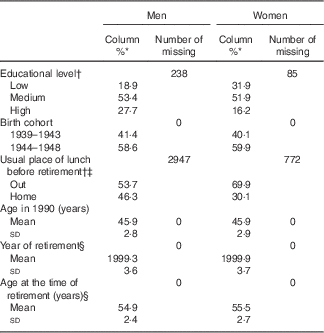
* Column percentages based on available cases for the categorical variables (pair-wise deletion). Mean and standard deviation for the continuous variables.
† Difference between men and women statistically significant (χ 2 test: P<0·001).
‡ Measured at the last FFQ before retirement.
§ Difference between men and women statistically significant (t test: P<0·001).
Sample characteristics: descriptive statistics and the number of missing values for the variables with repeated measurements for men (n 12 942) and women (n 2739) in the GAZEL cohort, France 1989–2009Footnote *
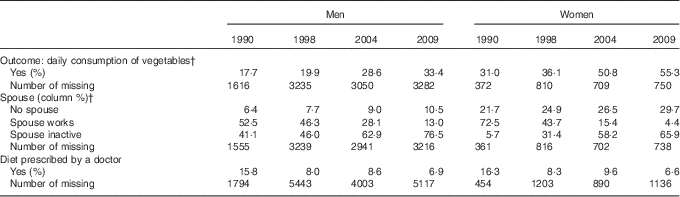
* Column percentages based on available cases (pair-wise deletion).
† Difference between men and women statistically significant each year (P<0·001; X2 test).
Missing values and imputation
Only 4332 men and 855 women had no missing values (complete cases). The number of missing outcomes increased after 1990 (Table 2). Fig. 2 displays the proportion of subjects who declared that they ate vegetables everyday according to year of measurement for both sexes, among the complete cases (list-wise deletion), the available cases (pair-wise deletion) and after imputation (fifty completed data sets). The proportion of positive outcomes was lower after imputation than among the complete cases, and the gap widened over time, although CI overlap.
Proportion of subjects eating vegetables daily according to sex and year of measurement among complete cases ( , list-wise deletion), available cases (
 , pair-wise deletion) and after imputation (
 ) in the GAZEL cohort, France 1989–2009, with 95 % confidence intervals represented by vertical bars. Imputed data: fifty imputed files, for details see the ‘Methods’ section.

Ageing and retirement
Table 3 reports the OR of daily consumption of vegetables. Model 1 showed the evolution of vegetable consumption as the subjects grew older and retired, based on the imputed data. The odds of eating vegetables daily increased steadily by 6 %/year of age for men (95 % CI 5, 7 %) and 7 % for women (95 % CI 4 , 10 %) until age 61 years. After age 61 years, the increase was smaller but remained statistically significant.
Multivariate models for daily vegetable consumption, men and women in the GAZEL cohort, France 1989–2009 (Odds ratiosFootnote * and 95 % confidence intervals)

Model 1, controls+age+retirement status, completed data (fifty imputations); model 2, controls+age+interaction between retirement status and usual place of lunch before retirement, completed data (fifty imputations); model 3, same as model 2 on complete cases (list-wise deletion: subjects with zero missing value).
* Logistic regressions using generalised estimating equations.
† Lunch: the most frequent place of lunch declared at the last FFQ before retirement. Reference category: not retired and lunches out.
Model 1 also showed that being retired had a positive and significant effect on the odds of eating vegetables every day for men, but the effect was not significant for women. For men, retiring was equivalent to being 3 years older in terms of vegetable consumption.
Place of lunch before retirement
Based on the available cases of our sample (pair-wise deletion), in the last FFQ before retirement, the most frequent place for lunch was away from home for 53·7 % of men and 69·9 % of women (Table 1). After retirement only 1·5 % of the respondents had most lunches away from home, implying that most of those who used to lunch out started to lunch at home.
Model 2 in Table 3 shows that before retirement, men who had most of their lunches at home ate vegetables significantly more often than those who had lunch away from home (OR 1·28; 95 % CI 1·18, 1·39). The difference was smaller and not significant for women (OR 1·16). After retirement, there was no significant difference between the subjects who used to have lunch away from home when working and those who did not.
Indeed, for men who had lunch mostly away from home before retirement, the effect of retirement was positive and statistically significant (OR 1·31; 95 % CI 1·17, 1·46). For these men, getting retired increased the chances of daily vegetable consumption in the same proportions as being 5 years older. In contrast, those who had lunch mostly at home when working increased only slightly and non-significantly their vegetable intake upon retirement (before retirement OR 1·28 v. after retirement: 1·38). The same was true for women: those who used to lunch out increased their vegetable consumption after retirement (OR 1·21), whereas for the others the OR before and after retirement were very close (1·16 v. 1·22).
Fig. 3 displays the results of model 2 as predicted probabilities of eating vegetables daily if the subjects had retired at age 56 years. In terms of probabilities of eating vegetables daily, the gap between men and women grew larger over time. The transition to retirement implied no change for those who had lunch at home at the end of their active life. There was a positive change for those who had lunch away from home before retirement, and after retirement the two groups did not differ in their vegetable consumption.
Predicted probabilities of consuming vegetables daily for men and women according to age, retirement status and usual place of lunch before retirement in the GAZEL cohort, France 1989–2009. Predicted probabilities of eating vegetables everyday in the GAZEL cohort study are based on model 2 (imputed data), assuming that retirement occurred at age 56 years adjusted for educational level (high v. low), current doctor-prescribed dieting status (no v. yes), current marital status (no v. yes), FFQ 1998 or later. Solid line, predicted probability for people having most lunches away from home before retirement; shaded area, 95 % confidence interval for the solid line; dashed line, before retirement, alternative prediction for a person who had most lunches at home.

Robustness checks
In order to assess the impact of the imputation process on the results, we ran model 2 on the complete cases only (model 3 in Table 3). Changes in estimate values were modest and non-significant for men. Some coefficients varied more markedly for women, possibly due to the smaller number of complete cases.
In 1990, the question on vegetables was about ‘green vegetables’, whereas later on the item was ‘cooked vegetables’. We tested whether this change affected the estimates by running model 2 on the imputed data after excluding the 1990 FFQ, and found very similar results (online Supplementary material).
Discussion
We used four FFQ over 19 years of follow-up to assess the evolution of vegetable consumption between ages 42 and 70 years, as subjects aged and retired. Our results show that for both men and women the process of ageing was associated with gradually increasing odds of eating vegetables every day. The increase in vegetable consumption observed upon the transition to retirement appeared to be mediated by the place of lunch before retirement. These results hold after imputing non-responses and taking into account the main potential confounders.
Age is associated with increased vegetable consumption in cross-sectional studies( Reference Escalon, Bossard and Beck 5 , Reference Lindström, Hanson and Wirfält 12 – Reference Plessz and Gojard 14 ). Our study suggests that as a given birth cohort grows older, its members tend to eat vegetables more often. This ageing effect remains positive and significant after controlling for retirement status, but also for current spousal status, current dieting prescription status and birth cohort. The ageing effect is relatively stable over time, at least from 42 to 61 years of age, and may decline slightly afterwards.
Retirement is a major life-course transition between midlife and old age. Although the association between transition to retirement and changes in health-related behaviour such as alcohol drinking and physical activity have been studied before, there are only few studies on changes in food intake( Reference Helldán, Lallukka and Rahkonen 25 , Reference Zantinge, van den Berg and Smit 30 , Reference Akbaraly and Brunner 41 ). In this cohort study, retiring was associated with increased vegetable consumption in those respondents whose meal environment changed upon retirement. This is consistent with the life-course perspective on food consumption( Reference Devine, Connors and Bisogni 16 – Reference Plessz, Dubuisson-Quellier and Gojard 19 ).
Food eaten away from home seems to be less healthy than food eaten at home( Reference Mancino, Todd and Lin 42 , Reference Guthrie, Lin and Frazao 43 ). Evidence is less clear on the nutritional quality of meals consumed at work – for example, in staff or university canteens( Reference Kjollesdal, Holmboe-Ottesen and Wandel 44 – Reference Roos, Sarlio-Lähteenkorva and Lallukka 46 ). In France, a nationally representative survey including a 7-d food diary found that 26 % of the lunches eaten by adults were consumed away from home( Reference Lafay 47 ). In the USA, a similar figure (25 %) was found in the NHANES survey 2003–2004( Reference Mancino, Todd and Lin 42 ). In our study, those who had lunch away from home while working ate vegetables less often, but vegetable consumption after retirement did not differ according to the place of lunch before retirement.
This result may be related to the impact of the spouse on male respondents’ food habits. In the GAZEL study, men’s BMI depended more on the spouse’s social status than on the respondent’s occupational category( Reference Ribet, Lang and Zins 48 ). In the present study, the presence of a spouse was associated with higher odds of eating vegetables every day for males. Women’s vegetable consumption was higher than men’s and less affected by the presence of a spouse. This may be linked to the fact that women have better nutritional knowledge( Reference Baker and Wardle 8 ) and do most of the cooking in European countries( Reference Tai and Treas 49 ).
Our hypothesis was that getting retired may have a causal effect on vegetable consumption, through changes in the place of lunch. In order to move from the measurement of an association to the identification of a causal pathway, we have taken several precautions. A reverse causality path from vegetable consumption to retirement was unlikely. We controlled for several sources of confusion, besides ageing. A poor health condition during active life could lead both to retiring earlier than expected and to adopting healthier eating habits, including higher vegetable consumption. We therefore excluded from the study population all individuals who had a long-standing illness or disability, according to the company records, and we controlled for current dieting prescription status. It is also necessary to separate the subject’s retirement from his or her spouse’s retirement: we controlled for the presence and the activity status of the spouse at each FFQ date. In addition, we controlled for birth cohort, education level and changes in the questionnaire.
Another potential source of confusion is the period of observation. Over 60 % of the subjects retired between 1998 and 2004. In 2001, France launched nutrition information campaigns including the message to eat ‘five fruits and vegetables a day’. According to cross-sectional surveys, the share of the adult population aware of this nutritional guideline (2·5 % in 2002) increased 11-fold between 2002 and 2008( Reference Escalon, Bossard and Beck 5 ). However, based on the 24-h recalls included in the same surveys, the level of vegetable consumption had not changed much: the share of the French population who ate five fruit and vegetable servings a day was estimated to be 10·2 % in 2002 and 13 % in 2008( Reference Escalon, Bossard and Beck 5 , Reference Guilbert and Perrin-Escalon 50 ). Confusion between the measured effect of ageing and the impact of nutrition information campaigns during the observation period might play a role, but it is very unlikely that it would explain all the ageing and retirement effects.
An important limitation regarding the interpretation of the results is the population included in the survey. Respondents were all employees of a large, state-owned French company. Although their social background was diverse (over 80 % entered the firm as blue-collar or clerical workers( Reference Goldberg, Leclerc and Bonenfant 31 )), the subjects’ risk of being laid-off was virtually null and their income did not drop substantially after retirement. It is therefore likely that the impact of retirement would be lower in a population exposed to unemployment or having less protective retirement status. Similarly, it would be unwise to extend our conclusion to other age groups or birth cohorts than those included in this survey. Indeed, it appears that, in the GAZEL cohort, the subjects born after 1943 had a higher BMI( Reference Dugravot, Sabia and Stringhini 36 ) and lower alcohol consumption( Reference Zins, Guéguen and Kivimaki 24 ). Other studies in France suggest differences in lifestyle and food consumption across birth cohorts born after the Second World War( Reference Chauvel and Schröder 51 , Reference Hébel and Recours 52 ). In addition, in the GAZEL cohort, men are far more numerous than women. Although the results seemed robust for men, for women it was sometimes unclear whether the estimates were non-significant because the associations were weaker or because the sample size reduced the power of the tests.
Measures of vegetable (or fruit) intake are sensitive to survey designs and definitions. For example, the French official dietary guideline of five fruits and vegetables a day is met by only 13 % of the French population( Reference Escalon, Bossard and Beck 5 ), but around 45 % of the French have intakes ≥400 g/d( Reference Escalon, Bossard and Beck 5 , Reference Castetbon, Vernay and Malon 53 , 54 ). In 2008, 86 % of the French respondents (aged 12–75 years) to a nutritional survey had eaten vegetables at least once during the 24-h recall( Reference Escalon, Bossard and Beck 5 ). In contrast, in our occupational cohort, in 2009, one out of three men and 55 % of the women reported that they usually ate (cooked) vegetables every day. Rather than food intake, our short, qualitative and self-administered FFQ captured food habits – namely, whether a food group is usually consumed on a daily basis. Misreporting is possible, but measurement error induces bias in a longitudinal analysis only if it is time-dependent. In our case, the FFQ did not change from 1998 to 2009. The FFQ changed between 1990 and 1998, but our robustness check showed that this did not affect our results. Measurement error should, therefore, not be a concern in this study. Finally, as we do not control for total food intake or BMI, it is possible that the subjects increased their consumption of unhealthy foods along with their vegetable consumption. Although our results indicate that vegetable consumption complied more and more with nutritional guidelines as subjects grew older, it remains to be shown whether their whole diet became healthier.
Major strengths of our study were a large sample size and a long follow-up period, with very low attrition: more than 16 000 subjects were followed-up over 19 years, with four repeated questionnaires on their food habits. To our knowledge, there is no comparable study on vegetable consumption and ageing. Moreover, due to the initial recruitment of people aged over 40 years in a large, state-owned company, virtually every subject had a continuous work history in the company and had retired during the survey period. Multiple imputation of missing values prevented loss of power and reduced bias due to non-response. We were also able to address several potential sources of confusion.
In developed countries, people aged 60 years and above represent nearly 23 % of the population. They face a life expectancy of 23 years at 60 years of age( 55 ), with an increasing risk of nutrition-related chronic diseases. Although population ageing is a major public health concern for industrialised societies, our results also suggest that ageing and retiring may have a positive effect on vegetable intake among older adults. This supports the idea that dietary interventions at the time of retirement may make an effective and sustainable( Reference Lara, Hobbs and Moynihan 56 ) contribution to healthy ageing.
Acknowledgements
The authors thank EDF-GDF and the Population-based Epidemiologic Cohorts Unit (UMS 011 INSERM/UVSQ) for their contribution to building and providing the GAZEL database. The authors are grateful to Dr Séverine Gojard (INRA ALISS), Dr Éléonore Herquelot (INSERM UMS 011) and Diane Cyr (INSERM UMS 011) for their support and comments.
This research received no specific grant from any funding agency, commercial or not-for-profit sectors.
M. P., M. G., M. Z. and S. C. designed the research. M. P. and A. G. analysed the data. M. P. wrote the paper. M. Z. and M. G. provided detailed information on the data. All the authors revised the text and approved the final draft.
The authors declare no conflicts of interest.
Supplementary material
For supplementary material/s referred to in this article, please visit http://dx.doi.org/doi:10.1017/S0007114515002615



