

Introduction
Direct Payments, or cash payments provided to individuals to pay for their long-term care needs, are increasingly the Government's preferred method of providing support to those eligible for council-funded adult social care in England (DH, 2014). The idea is that service users can exercise greater choice and have more control over the services they receive by managing their own budgets. The expectation is that services will then be more personalised and better meet their needs. Such ‘cash for care’ schemes have been introduced in a number of countries, with many of them also providing cash payments to residents in care homes (Angeles Tortosa and Granell, Reference Angeles Tortosa and Granell2002: Da Roit and Le Bihan, Reference Da Roit and Le Bihan2010). However in England, until recently, direct payments have only been available to those requiring care and support services in their own homes.
In 2011, the Law Commission recommended that the Government considered making direct payments available to people in residential care:
‘extending direct payments to cover residential accommodation [. . .] would give some service users greater choice and control over the provision of accommodation and would mean they no longer have to rely on their preferences being acknowledged and implemented by local authority staff. Although direct payments would not be suitable for all people moving into residential care, in many cases the option of direct payments will be appropriate and we see no reason in principle for excluding people merely on the basis of the type of service being provided.’ (Law Commission, 2011: 102–103)
In response to this recommendation, the Government initiated a pilot programme to test the introduction of direct payments in residential care in 20 councils in England (HM Government, 2012). Its 2012 White Paper states:
‘As part of our ambition to help more people experience the benefits of a direct payment, we will develop, in a small number of areas, the use of direct payments for people who have chosen to live in residential care, in order to test this approach. [. . .] It will help us to understand better how direct payments in residential care might work in practice, and what the costs and benefits of this approach might be for people using residential care, local authorities, care providers, and families.’ (HM Government, 2012: 55)
An evaluation of the processes and impacts of introducing direct payments in residential care was conducted between January 2014 and June 2016. This was preceded by a nine-month ‘preparatory phase’ to allow pilot sites to think through the implications of offering direct payments to care home residents. It was during this time that the Government committed itself to introduce direct payments in residential care in all areas in England in April 2016, therefore turning the ‘pilots’ into ‘trailblazers’. This announcement greatly increased the expectations of councils that participated as ‘trailblazer sites’ which now saw themselves at the forefront of implementing direct payments rather than just ‘testing’ them.
In a scoping and feasibility study in 2013, project leads indicated that they anticipated a total of over 400 people receiving a direct payment to pay for their residential care by the end of the programme (Ettelt et al., Reference Ettelt, Perkins, Wittenberg and Mays2013). However, when the programme formally ended in September 2015, only 71 service users had accepted a direct payment and, of these, only 40 were in receipt of a payment. Six sites officially withdrew from the programme at different stages, whilst a further four had not reported issuing any direct payments by the end of the programme (Ettelt et al., Reference Ettelt, Wittenberg, Williams, Damant, Lombard, Perkins and Mays2017). The low uptake of direct payments had significant implications for the evaluation of the trailblazer programme, as it limited the possibility of robustly assessing the impact of direct payments on service users and their families, care homes and councils. Given the difficulties in implementing direct payments in residential care in trailblazing sites, the Government decided to postpone the national implementation of the programme from 2016 to at least 2020.
This paper presents findings from the evaluation of the trailblazers, particularly using data from interviews with project leads, council staff, and owners and managers of care homes. It aims to understand why implementing direct payments in residential care was less successful than initially expected. These findings capture the first experience of direct payments in residential care in England. To date, there are few studies of direct payments or similar schemes being introduced in care homes internationally. Although there are a few studies of ‘cash for care’ schemes that also extend to care-home residents, these do not examine the barriers to their implementation (Da Roit and Le Bihan, Reference Da Roit and Le Bihan2010). An exception is the study by Angeles Tortosa and Granell (Reference Angeles Tortosa and Granell2002) who evaluated the introduction of nursing home vouchers in the Valencia region in Spain. They found that the scheme had expanded the supply of publicly funded places in care homes and therefore improved choice of care homes for service users, yet this expansion also involved higher costs (Angeles Tortosa and Granell, Reference Angeles Tortosa and Granell2002).
Barriers to implementing direct payments in domiciliary care
There is now substantial experience of implementing direct payments and other ‘cash for care’ schemes in England and elsewhere (Ottmann et al., Reference Ottmann, Allen and Feldmann2009; Gadsby et al., Reference Gadsby, Segar, Allen, Checkland, Coleman, McDermott and Peckham2013). In England, direct payments in adult social care have been available for selected groups and services since 1996 with some councils offering direct payments even before they became national policy. More recently, direct payments have become the Government's preferred mechanism for meeting individuals’ domiciliary care needs. However, the uptake of direct payments in the community has remained relatively low (DH, 2005; Ellis, Reference Ellis2007; Fernandez et al., Reference Fernandez, Kendall, Davey and Knapp2007; May et al., Reference May, Mair, Dowrick and Finch2007; Priestley et al., Reference Priestley, Jolly, Pearson, Ridell, Barnes and Mercer2007; Taylor, Reference Taylor2008; Carr and Robbins, Reference Carr and Robbins2009). In 2013–14, only about 15 per cent of adults who received council-funded domiciliary care opted for a direct payment, with the remainder having their social care services managed by their council (NAO, 2016).
From early on, direct payments have attracted controversy. They have appealed to advocates of the disability movement as providing a mechanism to increase the autonomy of people with disabilities vis-a-vis councils and providers. They have also been advertised as an approach to increase choice and control and a solution to the perceived problem of welfare dependency (Leadbeater et al., Reference Leadbeater, Bartlett and Gallagher2008). However, others have argued that concerns about welfare dependency were a distraction to promote neoliberal ideas rather than a concern voiced by professionals or users (Ferguson, Reference Ferguson2007). By casting service users as ‘consumers’, direct payments would shift responsibility from professionals to individuals, support the privatisation of service provision and deskill the care workforce in the process (Ferguson, Reference Ferguson2007; Ferguson, Reference Ferguson2011; Daly, Reference Daly2012). The focus on choice would also underplay the public nature of decisions about care provision, especially where such care is publicly funded (Stevens et al., Reference Stevens, Glendinning, Jacobs, Moran, Challis, Manthorpe, Fernandez, Jones, Knapp, Netten and Wilberforce2011). Ferguson (Reference Ferguson2007) puts forward the criticism that direct payments build on a flawed conception of the people who use adult social care, by casting dependency as not only undesirable but as illegitimate. There is evidence that direct payments have unequal effects on different user groups, with studies showing that older people are less likely to benefit than younger people (Rabiee, Reference Rabiee2013; Callaghan and Towers, Reference Callaghan and Towers2014; Lewis and West, Reference Lewis and West2014; Woolham et al., Reference Woolham, Daly, Steils and Ritters2015).
Establishing direct payments in community care has turned out to require complex changes to professional practice (Carmichael and Brown, Reference Carmichael and Brown2002; Glasby and Littlechild, Reference Glasby and Littlechild2002; Ellis, Reference Ellis2007). Fernandez and colleagues (Reference Fernandez, Kendall, Davey and Knapp2007) identified two narratives that have emerged from the analyses of the barriers to implementing direct payments in domiciliary care. One narrative focuses on attributing barriers to ‘resistance’ from professionals arising from the attitudes and behaviours of council staff such as social workers, or care managers, but also from local leadership and senior management. This narrative sees direct payments as a challenge to enduring (but seemingly outdated) professional norms and a general aversion to change among public sector workers that has led frontline staff to act as gatekeepers to direct payments (Glasby and Littlechild, Reference Glasby and Littlechild2002; Taylor, Reference Taylor2008; Priestley et al., Reference Priestley, Riddell, Jolly, Pearson, Williams, Barnes and Mercer2010).
The second narrative emphasises structural and contextual factors as the main barriers to implementation, especially constraints in social care funding, the structure of the adult social care market and the mutual dependencies between providers, commissioners and recipients of council-funded care (Glendinning et al., Reference Glendinning, Challis, Fernandez, Jacobs, Jones, Knapp, Manthorpe, Moran, Netten, Stevens and Wilberforce2008). From this perspective, it is argued that direct payments can only be useful to service users if the care market provides sufficient services to choose from, and if there is sufficient funding available for users to access these choices. This is especially relevant for older people since funding is lower for them than for younger adults (Humphries et al., Reference Humphries, Thorlby, Holder, Hall and Charles2016).
Methods
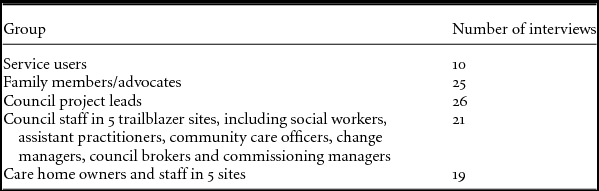
This paper draws on all the data collected for the evaluation from January 2014 to February 2016, but especially on semi-structured interviews conducted with those leading the project in each trailblazer site (n=26), council and care home staff (n=41) as well as service users (n=10) and their family members or advocates (n=25) (Table 1). Project leads in all sites were interviewed twice during the evaluation, in autumn 2014 and summer/autumn 2015. Project leads in four sites selected for in-depth study identified council and care home staff involved in the project who were then invited by the research team to participate in an interview. ‘In-depth’ sites were selected to cover a spread of sites offering direct payments to different service user groups (e.g. older people; younger adults with physical or cognitive disability; adults with mental health problems); sites offering different types of direct payments (e.g. ‘full’, ‘part’ and ‘additional’ payments); sites working with a few care homes or intending to make direct payments available in all care homes; and sites in different regions of the country. A few additional interviews were conducted in a fifth site, which was part of a case study conducted to inform an interim report.
Number of interviews per stakeholder group
Service users and their family members who were offered a direct payment in residential care were invited to participate in a survey to seek their views about the process of being offered a direct payment and their satisfaction with their direct payment if they had accepted one (or their reasons for declining the offer if they had declined it). They were asked to indicate on the final page of the survey questionnaire whether they would be available to be interviewed. In response to low participation rates in the survey, a few additional service users with a direct payment were identified by project leads and approached by the research team with a request for an interview. Informed consent was obtained from all interviewees.
Interviews with project leads explored their experience of setting up the programme locally, the progress made and any barriers and challenges experienced. Council and care home staff were asked about their understanding of the purpose of the programme and about their experience during its implementation. Interviews with service users and family members accepting a direct payment explored their understanding of a direct payment, their experience of the setting-up process and how they were using, or planning to use, the payment, including whether they had experienced any benefit. For those declining, questions focused on whether they had any prior knowledge or experience of direct payments in the community, their experience of being offered a direct payment in residential care and their reasons for declining. Interviews were conducted face-to-face with the exception of interviews of project leads and family members, which were conducted over the telephone. Interviews were tape recorded and transcribed verbatim.
The analysis presented in this paper builds on the themes identified for the evaluation. These included descriptive categories that aimed to understand how direct payments were implemented in each site (e.g. the number and type of direct payments available; processes of facilitating direct payments; the organisation of the financial transaction; how direct payments were used) and themes that explored the challenges experienced during the process of setting up and having direct payments (e.g. information available about direct payments; approaches to communication and engagement; difficulties setting up direct payments; concerns about impacts of direct payments). For this paper, these themes were reanalysed with the aim of identifying perceptions and experiences that could help explain the lower than expected number of direct payments taken up by care home residents. Themes that stood out centred on the demand for direct payments from service users and their families; the availability of the supply of services for which direct payments could be used; and the implications (perceived or real) of direct payments on service provision in care homes.
A full account of the methods and the logic model used in the evaluation has been published elsewhere (Ettelt et al., Reference Ettelt, Wittenberg, Williams, Damant, Lombard, Perkins and Mays2017). The methods were approved by the Research Ethics Committee of the London School of Hygiene and Tropical Medicine and the Social Care Research Ethics Committee (14/IEC08/0011). The evaluation team was not involved in the selection of sites or in designing local implementation strategies, and aimed not to influence decisions by sites about the selection of service users or care homes.
Setting up direct payments in residential care in trailblazing sites
Council staff developed different strategies for implementing the direct payment trailblazer in care homes in their area and they implemented different types of direct payments. An initial challenge was that councils had to decide how to determine the monetary value of direct payments. Normally, placements were made by matching a person's eligible assessed care needs with the supply of care home places in an area, underpinned by block or spot contracts through which the care-home fee was determined. These fees typically covered the entire costs of care and accommodation provided to residents (except nursing costs met by the NHS). These fees were often derived historically and, in some councils, were highly variable for the same level of need. A resource allocation mechanism that would match individual care needs with a sum of money, as it existed in domiciliary care, was absent in many council areas. Personal budgets provided, if not a mechanism to calculate a budget, then at least a statement of the allocated sum. However, these were introduced in residential care only halfway through the trailblazer in April 2015 and progress in implementing them varied widely among sites.
Interviews with project leads suggested that councils employed a range of approaches to calculating direct payments. Most councils initially aimed to develop a resource allocation system similar to the one used to determine direct payments in the community. This approach meant that the value of the direct payment would be determined through the needs assessment process, and result in a budget that could then be spent by the service user.
The second, and eventually more popular option, was to base the value of the direct payment on the existing fees charged by care homes. This option was preferred by most care homes participating in the scheme, as it minimised their risk of facing financial losses as the needs-based resource allocation approach might result in a lower budget available to a user than the fees currently paid. A third option, chosen by two councils, was to pay a small sum as a direct payment in addition to the existing care home fee (e.g. £20 per month). Project leads from these councils noted that this approach was chosen in response to concerns from providers about the possibility of losing income from direct payments if service users chose to use their direct payment to fund additional services or activities.
Councils also varied in whether they offered direct payments that covered the whole or only part of the care home fee, with some offering both options. Decisions about the size of the direct payment in relation to the care home fee were often determined in response to concerns from care home owners and managers. For example, in some sites only ‘part’ direct payments were offered due to concerns from providers that a ‘full’ direct payment would increase the risk of service users or their families not paying their fees. However, councils opting for ‘part’ direct payments typically required care homes to help determine that part of the fee that could be made available to service users to be used more flexibly. In consequence, such part direct payments tended to be modest for older people because the fees paid to care homes by councils often did not allow for much flexibility. They could be more substantial for younger adults with social care needs for whom additional funding was available to pay for daytime and social activities.
Councils differed in their approaches to offering direct payments to service users, with some working through several approaches sequentially when trying to increase uptake. Most councils initially collaborated with selected providers, for example by establishing or using an existing provider forum to promote the idea of direct payments. They had earlier been requested to identify providers that were willing to participate when applying to be included in the trailblazer scheme. In a number of areas, councils also asked care homes, typically those with whom they had good working relationships, to identify service users to whom a direct payment could be offered and, in some cases, to offer direct payments to them directly.
An alternative strategy was for social workers or care managers to identify service users to whom direct payments would be offered. This approach was chosen initially only by a small number of councils although it became more popular as it became clear that relying on providers to promote the scheme resulted in few users taking up direct payments, if any. Three councils decided to make a universal offer of direct payments to all service users as part of the needs assessment or care review, reasoning that extending direct payments to all service users was the ultimate aim of the policy.
In consequence, direct payments differed between sites in how they were calculated, how they related to care home fees currently charged by providers, and how, and by whom, they were offered to service users and families.
Barriers to implementing direct payments in residential care
Three main barriers emerged from the analysis: (1) a lack of clarity about the benefits of direct payments to residents in care homes and their families; (2) a lack of clarity about how demand for personalisation, where it existed, could be met within the current supply of residential care; and (3) concerns about the potential financial impact of direct payments on care homes, especially if these were expected to provide more choice within the current context of constrained council funding for adult social care.
(1) Lack of clarity about the benefits of direct payments
While all council and care home staff interviewed welcomed the opportunity to promote personalisation in residential care, many (but not all) felt unsure about the benefits of direct payments for care home residents. This included council staff and care home managers as well as family members who had declined a direct payment. They noted that many people in residential care had high levels of care needs that affected their ability to exercise, and thus benefit from, the types of choice and control associated with direct payments.
‘Yes, she couldn't honestly make an informed choice. She couldn't. We spoke about it, but it's just so difficult really. With [my daughter], one could almost get her to do or say whatever you wanted to, depending on how you presented something, which is . . . well, she has a limited understanding.’ (Family member, Site 7)
While it was uncontested that a more person-centred approach to delivering care would improve the quality of care in homes, it was less clear how direct payments would translate into a more person-centred approach in residential settings. This was especially a concern for people with severe cognitive impairment (such as older people with advanced dementia and adults with severe learning disabilities) for whom personalisation was seen as desirable but who were less able to exercise choice and control without support from a third party.
Family members who had declined a direct payment and completed a questionnaire mostly noted that they were happy with the care received by their relatives and would not wish to take up a direct payment for that reason (with a few noting that they also did not wish to disrupt their relationship with providers). In some instances, in contrast, the direct payment (as a ‘full’ payment) was accepted because family members felt it would allow them to have more control over current or future care arrangements on behalf of their relative. However, no cases were reported in which relatives had made use of this lever to negotiate better care.
Council staff noted that in domiciliary care, most direct payments were used to employ a personal assistant of the service user's choice. In care homes, however, this option was seen to be less feasible given the additional cost associated with employing a separate carer. Such additional cost needed to be covered from the budget available for the care home fee. There were also concerns from care home managers and council staff about safeguarding other residents if, for example, an untrained person were to be brought into the home as a carer. However, no case was reported in which this problem materialised in practice during the evaluation.
In many cases in which a direct payment was taken up, this was seen to provide a solution to an existing problem, often related to the choice of care home. For example, the direct payment was used to pay for a place in a desired care home that would not have been available otherwise (e.g. because the council did not contract with the home).
‘[the direct payment] means that she is in a care home of her choice, and the family's choice actually, because I guess that if we didn't have the direct payment, if she needed care, she may have been told to go into a specific home nominated maybe by social services or the local authority or whatever.’ (Family member, Site 17)
In this instance, the user chose to remain in a home that she was already familiar with from previous respite stays. Without the direct payment, this possibility would not have been available to her because the council had already exceeded the number of allocated places for which it had contracted with the home. A few other examples were reported in which the direct payment was used to pay for a care home of the user's choice that might otherwise have been unavailable – for example, when residents reached the funding threshold below which they qualified for council funding and wished to stay in the same home. However, in these cases, either the council or the service users’ families incurred an additional cost (i.e. a higher rate or an increased ‘top up’).
Given the novelty and untested nature of direct payments in care homes, many frontline staff in councils noted that they did not feel confident in promoting direct payments to service users and families.
‘When somebody is actually asking me really in-depth questions, I don't know the answers to them, and I think. . . if we had an example in [council name], just one person, and then you could say ‘look, this is an example’, I think [it would] take a lot of the fear away, and it would certainly give me more confidence, yes. I can tell people about [direct payments], the actual bare bones of it, but the nitty-gritty of how it will run, I don't know. So, it's really difficult to promote something.’ (Social worker, Site 17)
Likewise, some service users and their families reported that they felt they did not have sufficient information about the implications of having a direct payment to enable them to judge whether having one would be a good idea.
This problem of adequately communicating the implications of having a direct payment was also compounded by councils still having to come to grips with the facilitation of direct payments in residential care, including determining their monetary value. For ‘part’ direct payments, this would involve negotiating with care homes about how the funding allocated to the care of a person could be split to be able to make part of the money available to the person directly.
While this lack of experience can be expected in any new scheme, it was striking that there was no established positive narrative about direct payments in residential care to which frontline staff and others could relate. This contrasts with the introduction of direct payments in the community, which was enthusiastically supported by a broad range of advocates including service users, their families and social care staff.
A number of providers and council staff also pointed out that family members were not always prepared to become more involved in managing their relative's care and instead welcomed others taking on this responsibility. This was seen as a particular problem for older people as they were often admitted to a care home at an advanced stage of frailty or dementia:
‘But certainly the vast majority of people that go into residential care are older people. And most of the older people go into residential care and their carers or family or friends just wanted the most simple [sic] process possible. So in those cases, if they were offered a direct payment, that was refused and they preferred for it to be directly commissioned by the council.’ (Project lead, Site 11)
In some cases, it was not clear how service users would be able to benefit from their direct payment. This was clearest in cases in which a ‘full’ direct payment covered the entire care home fee, as this meant that the service user or family member simply transferred the monies to the care home that previously had been paid by the council, without creating additional choices for the user.
For ‘part’ direct payments, the expected benefit was dependent on the size of the payment and on the existence, and knowledge, of alternatives to existing services. This was most clear-cut for younger adults whose care attracted additional funding for day activities which could be converted into a direct payment and spent on other activities in or outside the home. For older people, this was more difficult as they typically did not receive such a payment and funding was more narrowly confined to covering personal care needs. Even in those two councils in which the direct payment was offered to older people as an additional small payment (£20 per month in one site and £25 per week in the other), only a small number of direct payments were taken up (seven in the first site, and two in the other) and care homes reported having had difficulties in facilitating activities for this group, most of whom were frail elderly with or without dementia. These experiences discouraged staff who, in one site, stopped promoting direct payments to service users.
(2) Uncertain supply of options to choose from
There was also uncertainty about what the direct payment would be able to achieve for service users within the care home market and whether having a direct payment would lead to more options to choose from in and outside of care homes. As previously stated, people taking up a full direct payment typically were required to use the payment to cover the care home fee in full. However, those with a part direct payment were expected to be able to spend this on services or items other than those included in the usual ‘care package’. In a number of cases, service users chose to use their direct payments to participate in day services or other activities outside the care home. This was feasible where the direct payment equated to an existing day service supplement to be used for activities funded by the council and where additional service options were available. Fee levels for this supplement varied widely, but could be as high as £181 per week.
Alternatively, some care homes provided services or organised activities that service users wished to participate in and which could be paid for with the part direct payment (e.g. a visit to the garden centre, theatre or local pub). However, some care home managers and owners indicated that they had difficulties organising the additional carer support required to enable residents to participate in their chosen activities outside the home. Such participation was possible, as demonstrated in a number of examples, but required dedicated organisational support, sometimes in excess of the support funded by the direct payment. In one site, in which the council provided additional funding for direct payments, council staff spoke of the burden on relatives to organise carer support despite the fact that the scheme could draw on a dedicated carer agency that the council used in domiciliary care. There were also additional costs involved in organising transport and entrance fees (e.g. for visits to the theatre or exhibitions) for carers which were not covered by the direct payment.
Some council staff and care home managers also discussed the idea that care homes could use the opportunity of the direct payment scheme to distinguish themselves from competitors by developing strategies to attract service users with a direct payment, but how this was to be achieved was not obvious. There was also the question of how offering individualised services to residents with a direct payment would fit into the current approach of pooling resources across residents (typically including those funding their own care). Some smaller care homes and those providing care for older people noted in particular that they felt unable to move to a different approach to costing and providing services due to current funding constraints. One project lead commented that ‘the [care home] market was not ready’ to support direct payments both in relation to having the costing approach in place and with regard to offering more diverse services that would allow for more flexibility and choice.
In acknowledgement of these constraints in service supply, several frontline staff and project leads mentioned attempts to improve relations with the local voluntary sector, for example, to provide more community-based support for daytime activities for residents in care homes. However, the involvement of the voluntary sector in residential care observed during the programme was highly variable, with some homes having established relationships with volunteer groups and charities, often for younger adults with physical disabilities, while others had few or no support networks.
(3) Potential financial impact of direct payments
With the few exceptions mentioned above, trailblazer councils expected to implement direct payments ‘cost neutrally’, i.e. without incurring additional costs (other than the costs of running a trailblazer scheme for which the Department of Health provided a grant). This meant that money made available as a direct payment had to be taken from the funding assigned by the council to a person based on his/her eligible assessed care needs (under the new regulations this equates to people's ‘personal budget’). This is in line with the approach in the community of individuals having a personal budget that can be taken as a direct payment.
Managers and owners of care homes noted that both ‘part’ and ‘full’ direct payments presented financial risks to providers. The full payment raised questions about the course of action to be taken if a service user or their family member failed to pay for his or her care. Questions were raised about whether the care home would be expected to absorb this risk, whether the councils would be able to provide financial support to care homes in such cases, and whether care homes would be expected and able to give residents notice to leave the home in case of default on payment. Care home managers and owners argued that part of the reason why they accepted lower rates from council-supported users than from self-funders was that council-funded clients posed less risk to providers than self-funding service users; councils would be less likely to default on payment of care home fees than individual service users or their family members. Providers felt that they were now being asked to accept greater financial risk whilst providing the same, or even better services.
‘If someone's on a full payment . . . how do we know we're going to get paid? What happens if the local authority has given this individual the money, they've spent the money and they've not paid my fees; where do I get my money from?’ (Care home manager, Site 8)
Providing a ‘part’ direct payment could mean that care homes would have to reduce their fees, unless they were able to provide the service to the resident themselves and reclaim that part of the funding. Some larger care home organisations with a mixed private and council-supported clientele felt they might be able to absorb some of this risk, and others saw this as an opportunity to diversify and expand their services in the community. However, care home managers and owners who provided care to older people, those running smaller care homes and those who accommodated a high number of residents on council funding felt particularly threatened by the prospect of losing income through direct payments.
‘So the issue is, and the anxiety is, well look, the local authority rates are insufficient as it is now. If you're giving the option for a new resident to have all that money and then come and live with us but not give all of us that money because they want to spend some money elsewhere, then we're still providing services to the resident; we've still got to have the right number of carers in the building to make it safe for our duty of care.’ (Care home owner, Site 4)
The financial concerns of providers were seconded by some family members. A family member of a person in a charitable care home noted that they would not want to take money away from the care home as this might disadvantage other service users, which they saw as contravening the charitable status of the home:
‘There's no way that I would [take a direct payment] because I'm really quite angry about it because my mum's left with £23 a week [personal allowance], which is not enough anyway. If they were to say ‘we're going to give your mother another £10 a week to go in her pocket, but not rob it from anybody else’, that would be great, but they're not saying that. . .it's robbing Peter to pay Paul.’ (Family member, Site 8)
Some family members felt that this potential reduction in provider funding could affect the general quality of care if direct payment users were allowed to shift monies away from care homes. A family member who declined a direct payment feared that the direct payment could be a disadvantage to her family member in future if the cost of care were to increase.
‘We felt that if in the future, for instance, the care costs rose and that money [the part direct payment] had already been committed to other things, that would cause [my brother] considerable problems, if you follow that slightly weird line of logic.’ (Family member, Site 7)
Discussion
This analysis has explored the barriers to implementing direct payments in residential care in England and the reasons behind the lower than expected uptake of direct payments during the trailblazer scheme. Our analysis suggests that the two narratives identified by Fernandez and colleagues in respect of domiciliary care are both relevant for understanding the difficulties of implementing direct payments in residential care.
Our findings confirm the key role of frontline staff in promoting direct payments, echoing concerns about gatekeeping behaviour identified in the literature (Carmichael and Brown, Reference Carmichael and Brown2002; Spandler and Vick, Reference Spandler and Vick2006; Ellis, Reference Ellis2007; Glendinning et al., Reference Glendinning, Challis, Fernandez, Jacobs, Jones, Knapp, Manthorpe, Moran, Netten, Stevens and Wilberforce2008; Taylor, Reference Taylor2008). However the approach (to identifying service users to whom direct payments were then offered) was also a result of how the trailblazers had been initiated. Participants in the scheme were typically selected by council staff or care homes on the basis that they were ‘suitable’ candidates (‘willing and able’) to accept a direct payment. This was in line with the purpose of the trailblazing scheme, which set out to test how direct payments could be implemented in residential care. In addition, as many sites worked through providers to recruit service users, at least initially, care homes also emerged as gatekeepers with some being more willing to promote direct payments than others, and many expressing concern about the potential impact of direct payments on care home finances if the scheme were to be rolled out. This is unsurprising given the financial pressure on care home providers (Humphries et al., Reference Humphries, Thorlby, Holder, Hall and Charles2016). Yet it contrasts with experience of direct payment in community care, suggesting that care homes, at least in some areas and in a largely private market, have more levers to resist implementation compared to home care workers, who constitute a more individualised workforce.
Council frontline staff, as well as project leads, also faced difficulties in convincing service users and their families of the potential benefits of direct payments. Council staff explained the difficulty of ‘promoting’ direct payments because of the lack of evidence of benefit to users and the absence of a consistent narrative in support of direct payments in residential care. Questions were also raised about the benefit derived from direct payment for residents whose ability to exercise choice and control was limited, especially those with advanced dementia or severe learning disability. While it was universally felt that all residents in care homes should receive personalised care, it was often not clear how the direct payment would enable this. These findings resonate with earlier concerns about the appropriateness of direct payments for some individuals who may not want or are not able to exercise choice (Law Commission, 2011; Glendinning et al., Reference Glendinning, Challis, Fernandez, Jacobs, Jones, Knapp, Manthorpe, Moran, Netten, Stevens and Wilberforce2008). They challenge the idea that direct payments can improve personalisation for everyone; instead the findings highlight the risk that direct payments can increase the marginalisation of those with the highest levels of care need and dependency (Ferguson, Reference Ferguson2007; Lewis and West, Reference Lewis and West2014; Woolham et al., Reference Woolham, Daly, Steils and Ritters2015).
Earlier research on the relevance of choice for people with disabilities has shown that the existence of choice is only seen as meaningful if it is underpinned by services to choose from (Rabiee and Glendinning, Reference Rabiee and Glendinning2010). This was most straightforward where a ‘full’ direct payment allowed for extended choice of care home, although this typically involved additional cost to the council or the service user's family. For ‘part’ direct payments, younger adults with disabilities who were in receipt of funding for day activities were among those who were able to use their direct payment to participate in a wider range of activities. However, for older people, the choice of services which could be funded through a direct payment was less obvious, both in relation to the size of the direct payment and the alternative services on offer to them. This finding underlines the relevance of the second narrative that emphasises contextual factors such as differences in funding available to council-funded care home residents with a direct payment. As other examples of introducing ‘cash for care’ schemes for residents in care homes have illustrated, an extension of user choice is unlikely to be ‘cost neutral’ (Angeles Tortosa and Granell, Reference Angeles Tortosa and Granell2002).
Concerns about the impact of direct payments on care home finances proved a major barrier to attracting providers to the scheme. These included concerns about the risk of service users and families not paying their bills, service users using the direct payment to purchase services outside the home, and the costs associated with providing more personalised care within a funding context that rewards economies of scale. While many care home managers stated that they would like to provide care in a more person-centred, individualised way, they also argued that the funding available from councils was often not sufficient to achieve this, particularly for older people. Indeed, it is hard to see how direct payments would not have an impact on care home funding unless users were in receipt of a ‘full’ direct payment. A ‘full’ direct payment, however, just means that the payment to the care home is made by the budget holder rather than the council. This is unlikely to result in more choice for users although it could give users and their families some sense of benefit if they attach intrinsic value to receiving cash rather than care purchased for them.
Conclusions
This analysis has identified a number of reasons for the low uptake of direct payments in residential care during a trailblazer scheme in England. These include a lack of clarity about the benefits of direct payments to residents in care homes with high care needs and limited capacity to exercise choice and control (i.e. become ‘customers’ to maximise their utility), and the supply of services available to residents that would allow meaningful choices, relative to the size of the direct payment. It also raises questions about the potential financial impact of direct payments on care homes if the scheme were to be rolled out to enable access to services beyond the care package provided by the care home.
This research suggests that, if direct payments are made available more widely in England from 2020, then structural issues related to the care home market and the funding for council-supported care need to be addressed before embarking on a scheme that sets out ostensibly to improve users’ choice and control. However, even if this were the case, there are still questions to be answered as to whether people with high care needs and substantial dependency are able to benefit from direct payments, given the reliance of direct payments on people's capacity to exercise choice and control. Because of the low uptake of direct payments during the trailblazer scheme, it was not possible to measure user outcomes with sufficient robustness. Yet the difficulty encountered during the trailblazers suggests that the ambition that ‘more people [should be able to] experience the benefits from direct payments’ set out in the 2012 White Paper may be harder to achieve in residential care than expected.
Acknowledgements
The authors would like to thank the project leads for helping to organise the interviews and are grateful to all interviewees for their participation. This paper is based on independent research commissioned and funded by the NIHR Policy Research Programme (Policy Innovation Research Unit). The views expressed in this paper are those of the authors and not necessarily those of the NHS, the NIHR, the Department of Health, its arm's length bodies or other government departments.


 Open access

